
Back to School Boom: Proven Growth Strategies for Martial Arts Schools

Can back-to-school growth boost your revenue?
The back-to-school season is a missed opportunity for many martial arts studios. Parents are looking for activities they can enroll their kids in, and that one window can financially set your studio up for the majority of the year—if you prepare for it in advance.
Are you ready for that?
Your competitors are. They're looking to recruit as many of these students as they can, and if you let them, they'll take every one of those families for their gym.
So how do you make sure you're the one they choose?
This guide to back-to-school martial arts marketing walks through the growth strategies you can use to fill your martial arts academy like clockwork.
Back to School Surge: Why It Matters for Martial Arts Schools
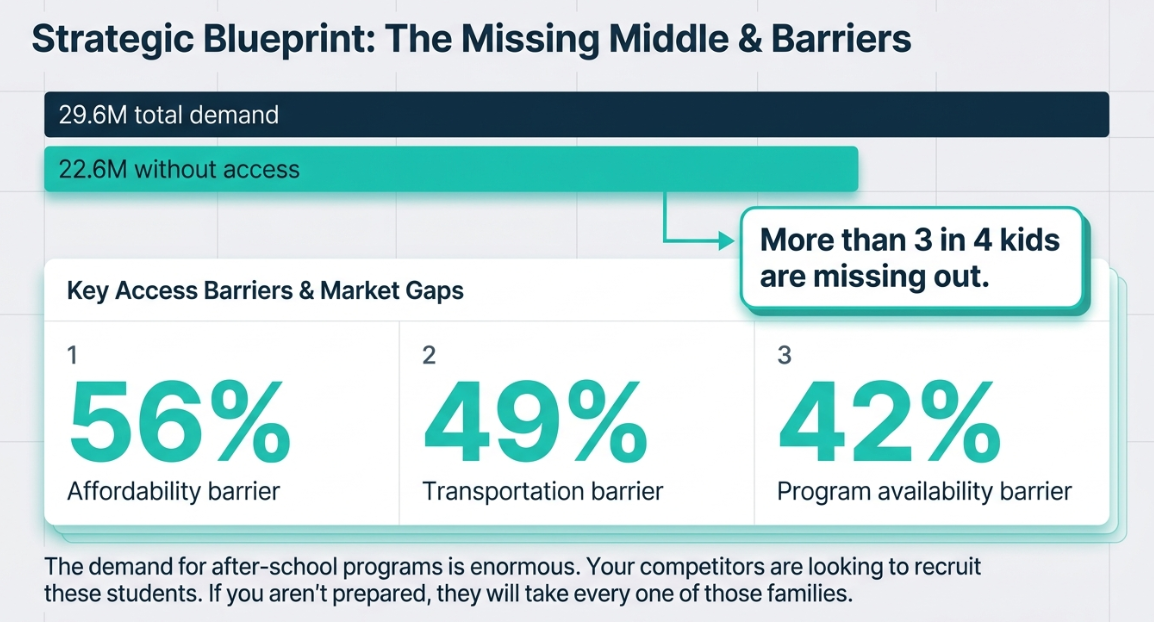
The demand for after-school programs is enormous.
According to the After School Alliance's America After 3 PM report, there's an overwhelming demand for after-school programs that remains largely unmet:
And the gap isn't limited to one type of household:
- 84% of kids from low-income families are missing out
- 73% of kids from middle-income families are missing out
- 59% of kids from high-income families are missing out
So what's driving the shortage? Why are so many families struggling to find a good after-school program for their kids?
- 56% cite affordability as a key issue
- 49% cite transportation as a barrier
- 42% cite program availability as the main problem
Now, what kind of programs are parents actually looking for? The America After 3 PM report outlines parents' top-of-mind concerns:
- Keep kids safe
- Help kids build skills
- Improve school attendance
- Engage kids in learning
- Reduce screen time
So it's all about the kids, then?
Not exactly. Parents also say after-school programs help them:
- Keep their jobs
- Boost their productivity
- Reduce stress
Did you catch that? After-school programs keep families afloat. Parents know their kids are safe, learning, and growing—so they can focus on their work and take care of their families.
And martial arts studios get the steady revenue they need to grow their business. A structured after-school martial arts program sits right at the center of that exchange.
5 Recruiting Channels for Fall Enrollment

You're selling to two groups at once:
- Parents: Remember the top-of-mind concerns above? Your messaging has to address those problems in a way that's compelling for parents.
- Children: As child psychologist Jean Piaget put it, "Play is the work of children." Treat that as creative direction: kid-facing ads should show play and fun, not technique drills, because play is how children decide they want to come back.
"Play is the work of children."
— Jean Piaget, developmental psychologist
Your recruiting messages should speak to both parents and their kids. (If you're building a kids program from the ground up, our guide to martial arts for kids covers the curriculum side.)
Got your messaging down? Next come the channels—the places you'll go to find and convert those families. These five do the heaviest lifting in any back-to-school martial arts marketing plan.
1. Social media content that recruits
Trust in advertising is down.
Research shows that only 8% of respondents automatically assume the information in advertising is true. People still view ads, but they're not interested in getting bombarded by them.
This is exactly why organic social works so well. As a channel, it has captured our attention—according to the Pew Research Center, 95% of teens use social media.
For your school, that splits cleanly by platform. Facebook and Instagram remain the top platforms for reaching parents, while YouTube and TikTok excel at reaching teens interested in martial arts classes or self-defense training.
Some gyms share memes, others share dancing videos. A better idea is to share the content that actually generates revenue. There are three types:
- Value-driven content: Content that produces value for your target audience—notice I didn't say value for your followers. This is content tailor-made for prospective students.
- Story-driven content: Content that tells a story—about your students, their successes, your gym, and the growth happening inside it. A compelling story about the people you serve.
- Offer content: Sales offers that are ultra-relevant and precisely timed for your audience. If you're going to make an offer, make sure it's something your audience specifically wants. (For seasonal ideas, see our guide to martial arts promotions that work.)
Stick to this framework and your social posts will feed the paid campaigns below instead of just collecting likes.
2. Paid ads on Google and Facebook
Paid advertising remains a top growth driver—if you have a plan for the budget.
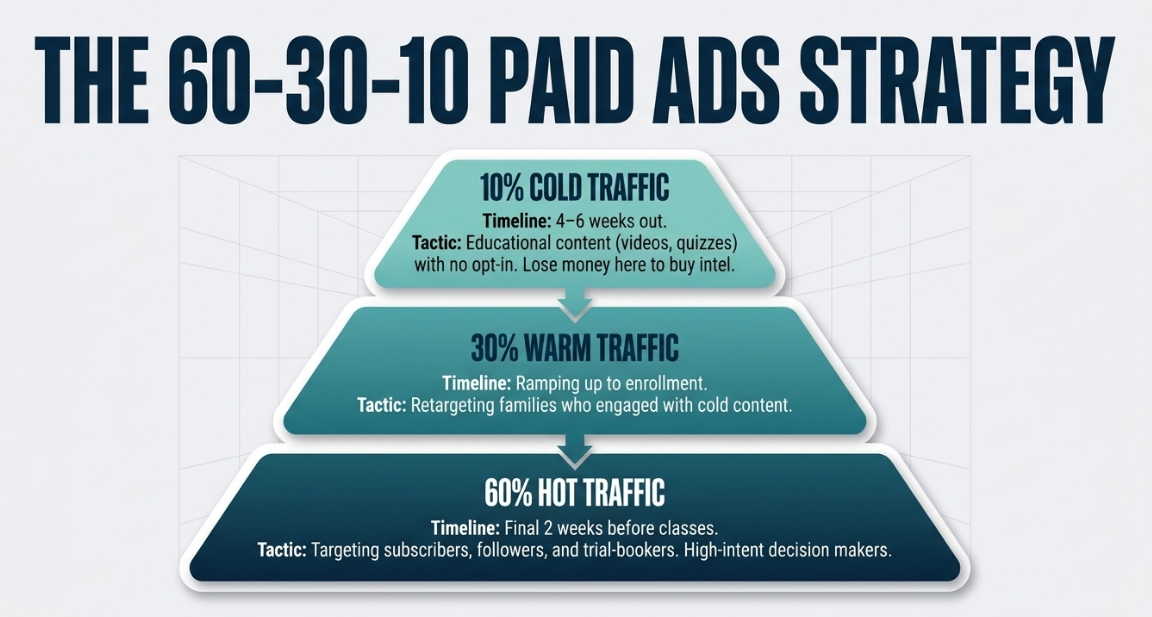
A lot of academies throw money at ad platforms, spend as much as they can, and hope for the best. It's a great way to lose money. The alternative is a simple split popularized by Perry Marshall and others:
60-30-10.
KEY TAKEAWAY:
Split your ad budget 60-30-10 across hot, warm, and cold traffic—then shift the weighting toward hot traffic as enrollment week approaches. In the final two weeks before classes start, most of your spend should land on families who've already engaged and are about to decide.
You divide your budget into three buckets. During the back-to-school sprint, you shift the weighting as the window opens and closes:
- 10% on cold traffic: People who've never heard of you. Start here 4–6 weeks before school begins, promoting educational content—videos, quizzes, downloads—with no opt-in required. If you have to lose money, lose it here, in exchange for intel you'll use everywhere else.
- 30% on warm traffic: The families who now know your academy and are interested enough to engage. As enrollment week approaches, this is where the budget grows.
- 60% on hot traffic: People who've already engaged—list subscribers, social followers, anyone who's booked a trial. In the final two weeks before classes start, this is where most of your spend should land, because these are the families about to decide.
As a rule of thumb, you can make this work on as little as $5 a day; $10–20 per day per platform is a reasonable starting point to test once the season ramps—adjust from there based on what your own results tell you. A few best practices:
- Campaign setup: Run separate campaigns for kids, teens, and after-school programs, with tightly themed ad groups built around a single idea.
- Google Ads: Focus on keywords with purchase or navigation intent, like "martial arts enrollment" or "jiu jitsu school near me."
- Facebook Ads: Set up Meta's conversion tracking, then give Facebook broad enough targeting to optimize and find what works.
For a deeper walkthrough of creative and campaign prep, see our guide to martial arts advertising.
These are typical ballpark ranges, not guarantees—your numbers will vary by location and competition:
Feature | Google Ads | Facebook Ads |
Average cost per click | $1.50–$3.00 | $0.50–$1.50 |
Targeting | Search intent, location | Demographics, interests |
Conversion rate | 5–10% | 3–8% |
Best use case | High-intent searches | Awareness + retargeting |
3. Local SEO and website optimization
Want more search traffic that converts on its own?
Local SEO earns visibility from the families already searching "back to school martial arts," "after school programs," or "children's martial arts classes near me." The full ranking-factor breakdown lives in that guide. For the back-to-school push, focus your energy on the moves that actually shift the needle:
- Update and optimize your free Google Business Profile
- Create location-based landing pages for your programs
- Make sure your site loads fast and is fully mobile-optimized
- Request reviews from every customer (and keep your name, address, and phone consistent everywhere)
- Add schema markup for classes, events, and programs
- Repurpose the social content above into pages that earn links
4. Email campaigns and automated reminders
Your emails have a problem.
Right now, parents are flooded with emails, content, and advertising. If you build an autoresponder and blast it out, you have no idea whether it'll land or fall flat.
The fix is to test with broadcast (one-time) emails before you automate anything. Broadcasts let you experiment with headlines and angles and see what resonates—timing and frequency, subject lines, visuals, landing pages, offers, and segmentation—at low risk.
Once you know what works, here are several email sequences worth building:
- Welcome series for new leads
- Student wins and successes
- Promotions, belt tests, and awards
- Upcoming events and support
- Re-engagement campaigns for disengaged or former students
- Review-request campaigns
- Incentives (discounts, coupons, and deals)
Whenever possible, combine SMS and email so reminders actually reach parents—and go out of your way to earn and verify your opt-ins.
5. Referral incentives for current students
Quality referrals are almost always sales-qualified leads.
Give your students referral incentives and you'll attract high-quality leads consistently over time. A few options that work:
- Tiered rewards: $25 for the first referral, $50 for the second
- Family bonuses: Free merch (rashguards, leggings, shorts) when other family members join
- In-house competitions: Throw a party for the class when students hit referral benchmarks
If you're using gym management software like Gymdesk, you can customize when and how you reward referrers for bringing in new students—rewards apply automatically to the referrer's next payment, so you never forget to honor a referral. Our guide to building a referral program goes deeper on the mechanics.
Building Long-Term Retention and Student Engagement
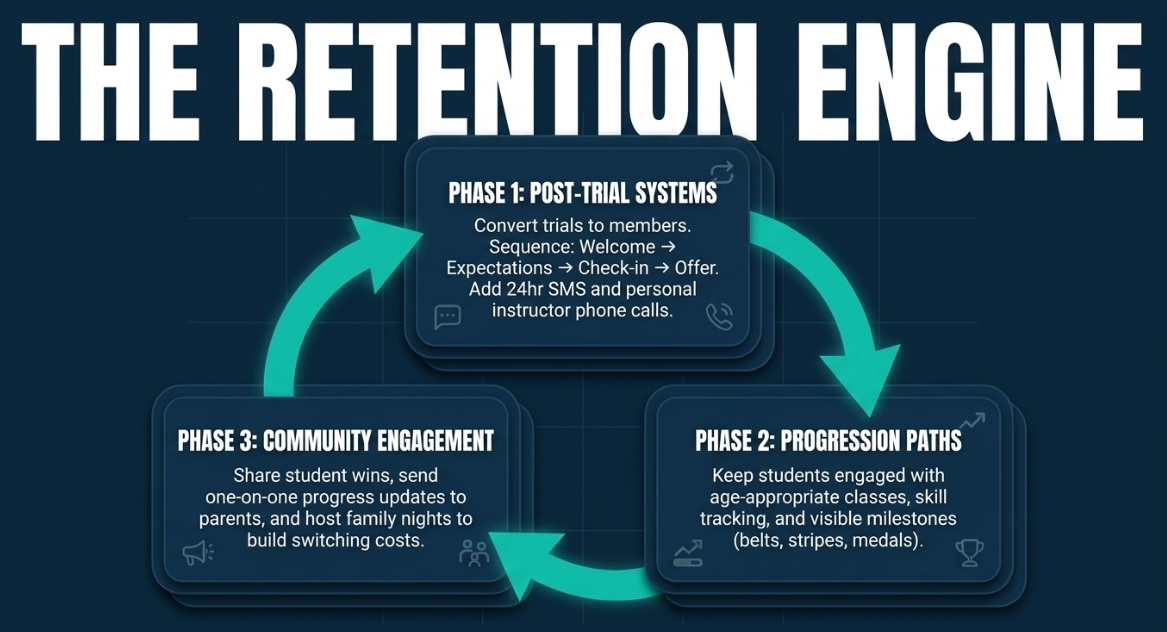
Recruiting fills the mats in September. Retention is what keeps them full through the winter—and it's where the real return on your back-to-school spend shows up.
It comes down to engagement: personalized interactions, real outcomes, and consistent two-way communication. Here are a few ways to build it.
1. Post-trial follow-up systems
If you're offering a free trial, build an autoresponder sequence that does the follow-up for you. The goal is to convert free trials into paying members.
Here's a simple sequence you can use:
- Send a short autoresponder sequence (welcome → expectations → check-in → offer)
- Send an SMS reminder 24 hours after the free trial ends
- Have instructors personally call parents to discuss progress
Customize the sequence as needed for your school.
2. Class variety and progression paths
Engaged students do more than keep showing up. They renew, and they bring their friends. Many become the parents and kids who talk up your studio to everyone they know.
So how do you keep them engaged? With your classes.
Class variety and well-designed progression paths keep students coming back:
- Offer age-appropriate classes (ages 4–6, 7–12, and teens)
- Track performance by skill level (beginner, intermediate, advanced)
- Give students visible milestones—belts, stripes, certificates, medals, and awards
- Add specialty classes (competition teams, advanced classes) for status and recognition
3. Ongoing communication and community engagement
Engaged parents, like engaged students, lead to higher retention.
Here are some steps to increase parent communication and community engagement:
- Share stories about their child's wins
- Give students (and their parents by proxy) status, recognition, and awards
- Send weekly or monthly progress updates about the group
- Send one-on-one messages to parents with updates about their child
- Host family nights, charity events, and tournaments
- Feature student stories on social media (remember the three types of posts)
A 7-part email course covering everything from lease negotiation to your first 100 members. Written for martial arts instructors ready to open their own school.
Turn Results Into Your Back-to-School Message
Recruiting and retention both run on the same fuel: proof. Parents want to see the results you've achieved for other families before they hand you theirs. So collect that proof, then point it at the benefits parents care about most.
Collect testimonials that sell
To do this well, gather a mix of feedback—reviews, testimonials, video, surveys, and interviews. The hallmarks parents care about most:
- Character development
- Behavioral growth
- Academic improvement
- Inspiring stories ("I can do it too")
- Self-confidence
- Kids standing up for themselves
- Safety
Not sure how to ask? Worried parents won't know what to say? Lower the odds of a useless review by guiding them with questions:
- What would have prevented you from joining our gym?
- What did you find as a result of signing up?
- What do you and your kids like most about training with us?
- What are two other benefits of training with us?
- Would you recommend our gym to someone else? Why?
These questions give parents a clear mental track to follow. You're not coaching or manipulating them—when parents answer honestly, they can't help but write a believable, credible review that defuses objections for the next family. The honest answer and the persuasive review turn out to be the same thing.
Lead with the benefits parents are buying
When you build your back-to-school creative, point that proof at the three benefits parents are actually shopping for:
- Confidence and discipline: Show how kids in your programs build confidence and discipline, with a visible change in their behavior.
- Improved focus in school: Physical activity improves memory, attention, and problem-solving—all of which feed directly into academic success.
- Physical fitness and resilience: Martial arts training builds strength, durability, and coordination, and consistent training improves sleep and emotional resilience.
Tie each testimonial you collect to one of these benefits, and your message writes itself.
Back to School Surge: The Payoff for Martial Arts Schools
So, can back-to-school growth boost your revenue?
The short answer is yes.
The back-to-school season is a huge missed opportunity for many martial arts studios. The parents of 29.6 million kids are looking for activities to enroll them in, and 22.6 million kids still miss out every year.
Most of your competitors aren't preparing for this season. Many aren't even looking to recruit these students. That's your opening.
To capture it, pick the recruiting channels that fit your school and put a retention plan behind them. Then revisit what's working every quarter and refine from there. A few of these channels pair naturally with the tactics in our martial arts marketing ideas guide.
Use Gymdesk to automate the parts of this that fall through the cracks—post-trial follow-up that converts free trials into members, and referral tracking that rewards parents the moment they send you a new family. Get ahead of your enrollment periods, and you'll be able to run back-to-school campaigns on demand.
Gym management software that frees up your time and helps you grow.
Simplified billing, enrollment, student management, and marketing features that help you grow your gym or martial arts school.


FAQ
Back-to-School Martial Arts FAQs
A few questions come up every fall as schools plan their enrollment push. Here are quick answers to the ones we hear most.
.webp)
Andrew McDermott is a gym owner, Brazilian Jiu Jitsu brown belt, and digital marketer. He’s on a mission to build premier, high-stakes grappling tournaments, world-class academies, and a championship team of high-level athletes.