
AI for Gym Management: What's Real, What's Hype, and What You Actually Need

Open the homepage of almost any gym software company in 2026 and you'll find the same two letters plastered everywhere: AI.
The emails promise a "self-driving gym." And somewhere between teaching a class and chasing a failed payment, you're left wondering whether you're falling behind for not having it.
This is a plain read on AI for gym management: what the wave actually means for a gym your size, and how to judge any claim a salesperson throws at you.
The short version, before you read another word: Most of what gets called "AI" in gym software falls into three buckets: automation that's existed for years and got a new label, genuinely useful prediction that's worth a look, and marketing vapor you can safely ignore.
Knowing which is which is the whole game. It saves you from paying a premium for a buzzword, and from missing the one feature that would actually give you your evenings back.
This isn't a "computers are scary" piece. It's a clear-eyed look at the AI wave, written for owners who'd rather spend the afternoon coaching than decoding a pricing page.
The AI Arms Race in Gym Software
In the last 18 months, nearly every major platform in this space shipped something it calls AI, and the announcements have not slowed down since. It looks like this:
- PushPress markets an AI assistant and talks about the "self-driving gym."
- Zen Planner brands a suite of intelligent features.
- Mindbody surfaces "at-risk" member flags.
- Glofox markets a churn predictor.
- WellnessLiving promotes an AI front-desk agent.
- Newer entrants pitch themselves as "AI-native" from the ground up.
Then there's the other end of the spectrum. At least one long-standing article in this space still talks about applying AI in the future tense, years after it was published.
Laid side by side, the same word is doing very different jobs:
Vendor | What they market it as | Substance or positioning | Who it's built for |
PushPress | An AI assistant and a "self-driving gym" | Mixed: real prediction bundled with old automation and content tools under one label | Multi-location and franchise operators |
Mindbody | "At-risk" and "big spender" flags | Real machine learning, trained on a deep multi-business data network | Large wellness brands |
Glofox | An AI churn predictor | Machine learning, though the training claims are self-reported | Boutique chains |
Zen Planner | An "AI" engagement suite | Largely a generative content generator | Studios scaling their marketing |
WellnessLiving | An AI front-desk agent | Generative AI, a language model answering inquiries | Front-desk-heavy studios |
"AI-native" newcomers | Built on AI from the ground up | Mostly positioning, and the hardest to verify | Early adopters |
(Each vendor's own framing, summarized fairly. Capability claims are drawn from their marketing; treat self-reported numbers as exactly that.)
That spread is the problem.
The features behind the label range from substantive automation that genuinely saves hours to a press release with no product attached.
"Has AI" tells you almost nothing about whether it will change your week. So before you compare a single platform, you need a way to decode what the word is actually pointing at.
What "AI" Actually Means in Gym Management
Strip the marketing away and nearly everything sold as gym "AI" sorts into three layers, each with a plain-English test. Most owners already use the first one every day under a plainer name.
The three layers, in plain English
Layer | What it actually is | The plain-English test | Is it AI? |
Rule-based automation | If-then logic a human sets up once and the system runs forever — missed check-ins, failed-payment retries, staff tasks. This kind of gym marketing automation has been in software for decades | No learning: the output never changes unless you change the rule | No — valuable, but not AI |
Machine learning | A system trained on historical data to spot patterns nobody programmed — churn prediction, lead scoring — sharpening as data piles up | Predictions improve over time as more member data accumulates | Yes — real, and worth evaluating |
Generative AI | Large language models that write text, make images, or hold a conversation — usually an API call to ChatGPT, Gemini, or Claude with your gym's data as context | It produces new text or images on demand | Yes — useful, and something every platform will have soon |
The reason this matters is that most competitors blur the three together on purpose.
One "AI" umbrella gets stretched over a churn model, a batch of old automations, and a content generator, so you can't tell which part is doing the work.
That blur is exactly what the layers above let you cut through.
Regulators have leaned the same way: the FTC has pursued companies for overstating their AI capabilities (its "Operation AI Comply" effort), a sign the gap between AI marketing and AI reality got wide enough to act on.
One question cuts through all of it:
THE ONE QUESTION:
"If I change nothing about how my members behave, will this feature's outputs change over time?"
If no, it's rule-based automation. Valuable, but not AI. If yes, gradually, it's real machine learning—worth a closer look. If yes, but it's spitting out new text or images, it's generative AI—useful, and something every platform will have soon.
Ask a vendor that question and watch how cleanly they can answer. The fumbling tells you as much as the answer does.
The Features That Actually Save You Time (vs AI-Washing)
The automation worth paying for is the boring kind. It removes a decision you'd otherwise make by hand, and it does it whether or not anyone remembers to log in.
Picture an ordinary week:
- Monday morning: The weekend's failed payments retry on their own, with overdue notices already sent and door access handled by membership status.
- Wednesday: A member who hasn't shown up in 10 days gets flagged into a staff task, so someone actually reaches out before that quiet drift turns into a cancellation.
- Thursday: A new lead fills out a form while you're on the mats, and the confirmation and trial reminder go out without you touching anything.
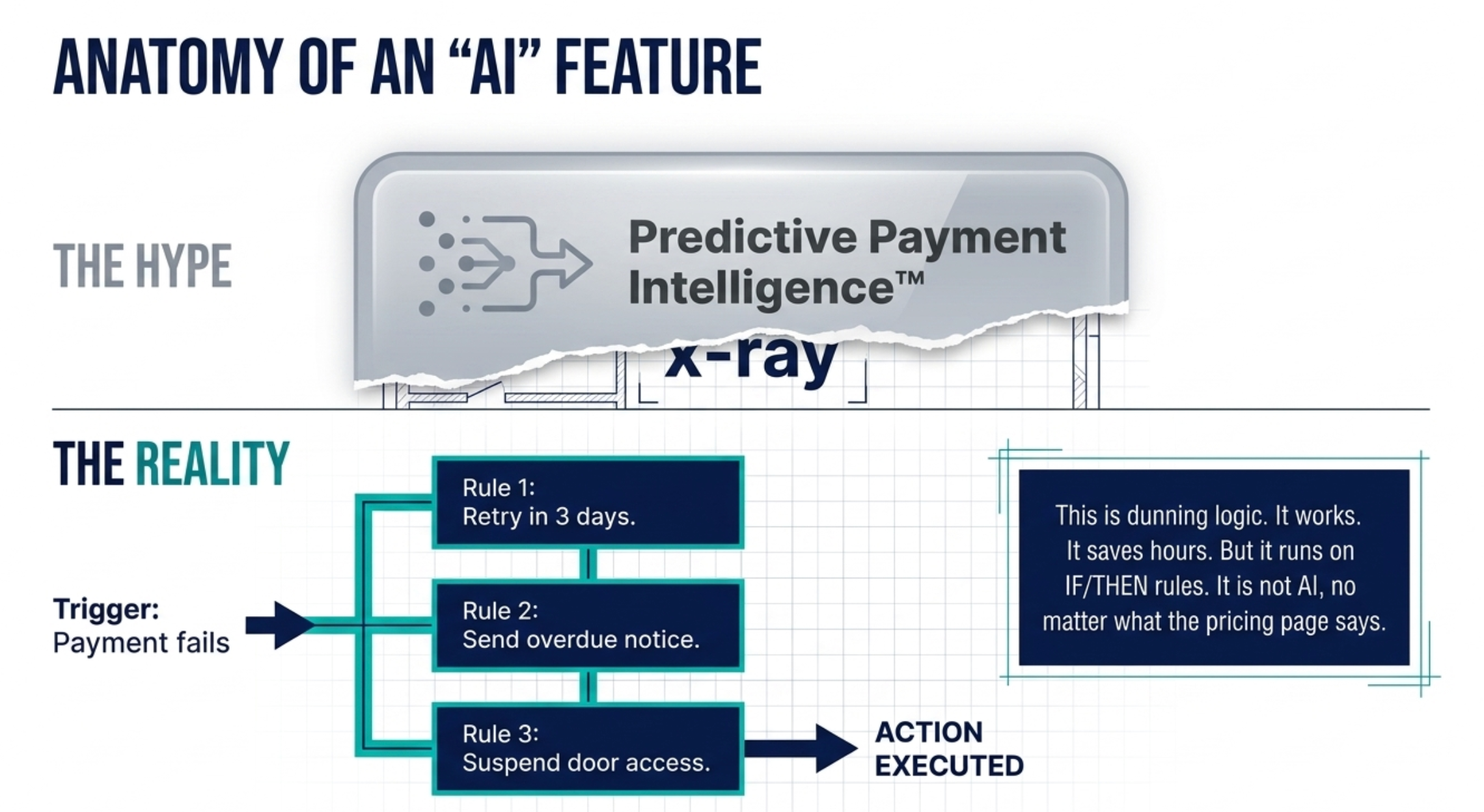
None of that requires AI. All of it is the kind of thing a competitor would happily label "AI-powered member engagement" on a pricing page.
Look at the pieces one at a time:
- Failed-payment recovery. Automated billing retries on a schedule, escalates notices, and can suspend access on repeated failure. A vendor could call this "predictive payment intelligence." It's dunning logic, and it works.
- At-risk member flags. An absence trigger watches check-in recency and routes a quiet member into a task or a "we miss you" sequence. This is the manual version of what churn models promise, and for most gyms it catches the bulk of the risk on its own. It's also why we've argued that the real way to reduce gym churn is a system that notices, not a dashboard you have to remember to check.
- Lead follow-up. A new inquiry gets an instant reply, a trial reminder, and a post-trial nudge, with staff looped in. Speed is the whole point here, and it maps directly to more trial sign-ups.
- Attendance and progression. Check-ins validate membership in real time and can surface a "ready for promotion" list. Belt tracking without a spreadsheet looks a lot like "AI-powered progression tracking" in a demo. It's a rules engine.
The outcome you actually want, hours back in your week, is mostly delivered by features nobody bothers to brand. The research backs this up bluntly.
That's the gap between the marketing and the buying decision, in one line.
The work that wins members and keeps them is well-run, included automation, and a platform that makes software and retention work together. The AI label rarely enters the room.
How to Evaluate Any Vendor's AI Claims
You don't need to become a data scientist to judge an AI pitch.
You need a short rubric you can run in a sales call on any AI gym management software, starting with the one question from above.
The full rubric:
The question to ask | What the answer tells you |
1. "If I change nothing about how my members behave, will the output change?" | The single best filter. No means automation, yes-gradually means machine learning, yes-but-it-generates means a language model. |
2. "Is this machine learning or a language model?" | Machine learning trained on gym data is a real advantage. A language model is an API call anyone can make. Both can help; only one is hard to copy. |
3. "What data does it need, and when will it be accurate for a gym my size?" | Churn prediction needs months of attendance history. A 200-member school generates far less training data than a national chain. Ask for the minimum member count before predictions mean anything. |
4. "Can I see it on real data, or is this a roadmap slide?" | Ask for a demo on live outputs, not a concept video. If the honest answer is "coming soon," evaluate the platform on what it does today. |
5. "Is it included, or another tier?" | A feature that saves an hour a week but costs $100 a month more has to clear that bar. Check the price of the result, not the feature — your gym software cost math should hold up without the upsell. |
6. "Is the core platform solid underneath?" | AI bolted onto shaky billing and scheduling is lipstick on a pig. The unglamorous 95% of your operations is where the day is won or lost, so make sure the gym reporting, billing, and attendance are right first. |
Run a pitch through those six questions and the brand preference takes care of itself.
What AI Can't (and Shouldn't) Do for Your Gym
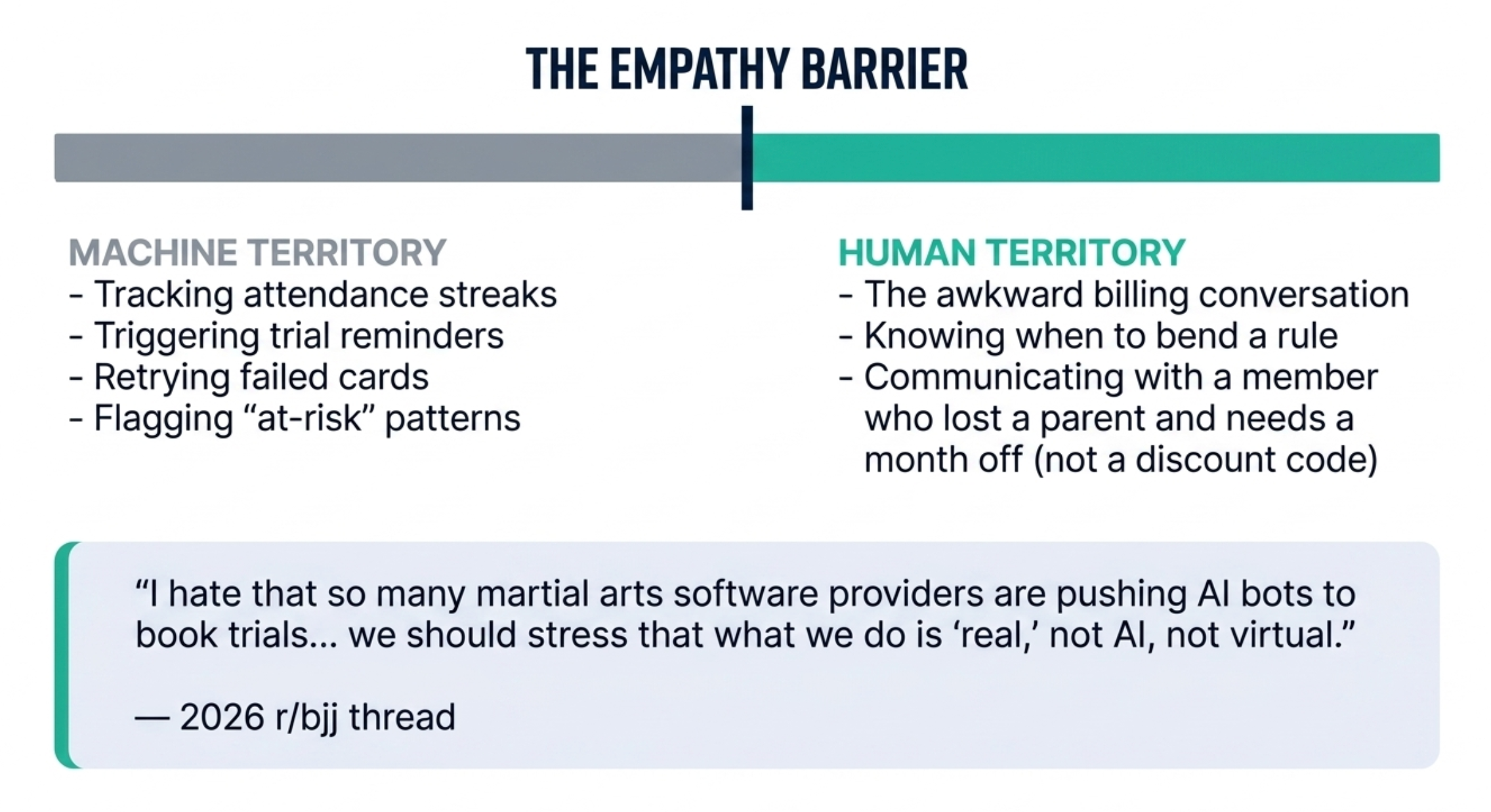
The honest part almost nobody in this space writes down: there are places AI shouldn't go in a gym, and naming them is what makes the rest of this trustworthy.
Member communication has a ceiling.
For a smaller gym, your edge is that the messages still feel like they came from a person who knows the member's name.
Automate the timing and the reminders, sure, but the moment a renewal nudge reads like a bot wrote it, you've traded the one thing a small gym has that a chain doesn't.
That instinct isn't just yours. A vocal part of the martial arts community actively resents AI creeping into the mats.
As one poster put it in a 2026 r/bjj thread:
"I hate that so many martial arts software providers are pushing AI bots to book trials and sell memberships. I think we should go the other way and stress that what we do is 'real,' not AI, not virtual, not screens."
— r/bjj poster
For a chunk of your prospective members, "we use AI to talk to you" is a reason to leave, not a selling point.
There's a data tradeoff worth being awake to as well.
Predictive features run on member behavior, and the more they ingest, the sharper they get.
That pulls vendors toward collecting more than they strictly need, and the privacy weight of it lands on you, the name on the door members trust, not on the software company.
Before you switch on anything that profiles members, it's fair to ask what's being stored, where, and whether you'd be comfortable explaining it to the member in question.
And some calls simply shouldn't be automated at all.
The awkward billing conversation, the member quietly going through something hard, the judgment about when to bend a rule, those stay human.
A model can tell you someone is at risk. It can't tell you they just lost a parent and need a month, not a discount code.
The biggest limit on AI in a gym isn't the AI—it's that the basics underneath usually aren't running yet.
WARNING:
The trap nobody warns you about: owners routinely praise automations they never actually turned on. Buying more "AI" on top of features sitting untouched doesn't get you anywhere. The basics have to be running first.
Where Gymdesk Fits
We'll keep this short, because the honest version is short.
Gymdesk's answer to the AI question is unglamorous on purpose. A handful of time-saving tools come built in and included:
- Failed-payment recovery
- Lead follow-up
- Attendance and progression
- The member app in your members' pockets
A coach running the gym around a day job gets the outcome, time back, without buying an "AI" tier to unlock it.
Marty Herrick, who runs Adayama Jiu-Jitsu, described what included automation did for him this way:
"It makes it look like you are much more omnipresent than you actually are."
— Marty Herrick, Adayama Jiu-Jitsu
That's the whole goal: fewer things you have to personally remember.
And to be plain about the roadmap question, since it comes up: we're not interested in stapling "AI" onto a feature list to keep pace with everyone else's homepage. The bar for us is simple.
Does it get a gym owner out of the computer and onto the floor?
We'd rather make the busywork disappear with automation that already works today, and invest in the bigger improvements that move that needle, than ship a badge that doesn't earn itself.
The Bottom Line
Your goal was never "adopt AI." It was to get time back, and to stop the small leaks that cost you members.
You now have the filter for every AI for gym management pitch that hits your inbox: name the layer, ask what decision it removes, and check whether the basics underneath it actually run.
Start by auditing which two or three automations would buy back the most hours in your week, then get those running and judge any "AI" against that bar.
When you're ready to compare, the best gym management software for you is the one that runs your gym today, not the one with the loudest label.
Gym management software that frees up your time and helps you grow.
Simplified billing, enrollment, student management, and marketing features that help you grow your gym or martial arts school.


FAQ
AI for Gym Management FAQs

Sean has spent the last decade creating content that helps businesses—small and not so small—grow smarter to allow operators to do more of what they love. You know, the fun stuff.
From shipping and international logistics to web development and marketing, he's done the work (not just the words) to scale retail and service businesses efficiently.
You can find his work at Sendle, Shogun, The Retail Exec, Gymdesk, and more.