Sport Clubs
Content for sports and recreation club owners—basketball, soccer, swimming and more: registration, scheduling, team management, and growing enrollment.
Most people don't quit because they picked a bad gym. They quit because they picked the wrong kind.
KEY TAKEAWAY:
A powerlifting gym and a Pilates studio are both "gyms" in the same way a food truck and a Michelin-starred restaurant are both places to eat. Same category, completely different experience, wildly different price.
The price tells you the truth, which is why understanding the different types of gyms matters before you sign anything.
The Health & Fitness Association pegs the average US gym membership at $69 a month in 2024, up from $65 the year before. That's still its most recent published figure.
And more people are paying it. A record 81 million Americans belonged to a gym, studio, or fitness facility in 2025.
$69/month average US gym membership in 2024 (up from $65 in 2023)
$38/month median US gym membership — the typical price most members actually pay
But that average hides everything important—budget chains start near $10, premium clubs cross $300, and the right number for you depends entirely on what kind of gym you walk into.
This guide covers the 15 main gym types—what they offer, what they cost, who they're built for, and where they fall short. Here's what each one's actually like.
Gym Types at a Glance

Gym Type | Best For | Typical Monthly Cost |
Big Box Gym | Self-guided exercisers | $20–$50 |
Luxury/Premium Club | Amenities + atmosphere | $200–$500+ |
24-Hour Access Gym | Shift workers, night owls | $10–$70 |
CrossFit Gym | Variety + community | $150–$250 |
HYROX/Hybrid Gym | Race-focused conditioning | ~$100–$250 |
HIIT Studio | Time-efficient group cardio | $150–$300 |
Boot Camp Gym | Short-term, results-focused | $100–$250 |
Powerlifting Gym | Strength athletes | $50–$200 |
Yoga & Pilates Studio | Mobility, mind-body, low-impact | $100–$300 |
Cycling, Barre & Specialty Cardio | Choreographed group cardio | $100–$300 |
Martial Arts Academy | BJJ, Muay Thai, MMA, traditional | $100–$250 |
Rock Climbing Gym | Adventure fitness | $50–$150 |
Personal Training Studio | One-on-one coaching | $50–$150/session |
Small Group Training | Coached classes, smaller setting | $100–$300 |
Women's Gym | Women-only environment | $30–$80 |
The most common type is still the big box gym, but every option on this list has a real use case. Here's what to expect from each.

Big Box Gyms
Big box gyms are the ones you already know—Planet Fitness, LA Fitness, Gold's Gym, 24 Hour Fitness, Crunch.
They're large commercial facilities in strip malls with rows of treadmills, free weights, machines, and a smoothie bar nobody actually uses.
They're built for self-guided exercisers. If you already know what you're doing in the weight room and just need equipment, a big box gym makes sense.
Mid-tier big box pricing typically runs $40 to $70 a month, with budget operators like Planet Fitness still anchoring the $10 to $30 range.
You get a lot for the money—and a fairly bland room to do it in, which is why some operators are leaning harder into gym decoration ideas just to feel less like a warehouse.
Peak hours can feel like a crowded airport. The community is thin—most people have headphones in. And if you're new to training, you're mostly on your own.
What you get:
- Wide equipment selection.
- Group classes (usually included).
- Multiple locations for traveling.
- Low monthly cost.
What you don't get:
- Coaching or accountability.
- Any sense of community.
- Help figuring out what to do.
Big box gyms work best when you already have a plan. Without one, you'll wander the floor for a while and quit by March.
Luxury and Premium Clubs
Luxury clubs sit two tiers above the big box experience.
Equinox, Life Time, and the local independents charging Equinox-adjacent prices are the obvious examples. The equipment is the least of what you're paying for—these are full-service facilities with pools, racquet courts, classes, recovery suites, and locker-room amenities.
Some flagships add hotels and restaurants.
Pricing reflects it. NerdWallet puts Equinox memberships in the low $200s to more than $400 a month depending on location and access tier, and Life Time's signature clubs land in a similar band.
The atmosphere is calmer than a big box gym. Equipment is rarely crowded. The amenities turn the gym into a third place—somewhere you actually want to spend time. You can build the same body for a fraction of the price almost anywhere else.
Good fit if: Convenience, atmosphere, and amenities matter as much as the workout itself.
Not a good fit if: You only use the squat rack and a treadmill. You're paying for everything else.
24-Hour Access Gyms
There are clear 24-hour gym pros and cons, but the flexibility is hard to argue with.
These facilities use key-fob or app-based access to let members in at any hour. No staff needed after hours.
They're popular with shift workers, early risers, night owls, and anyone whose schedule doesn't conform to a 9-to-5. Pricing varies widely—Anytime Fitness and Snap Fitness usually land around $40 to $70 a month, set by each franchise location, while smaller independent operators can run lower.
The tradeoff is safety and support.
After-hours access means limited supervision. There's usually no staff around if something goes wrong. Amenities like pools and saunas may only be available during staffed hours.
Good fit if: You work unconventional hours and need flexibility above everything else.
Not a good fit if: You're new to training and benefit from having staff around.
HIIT Studios
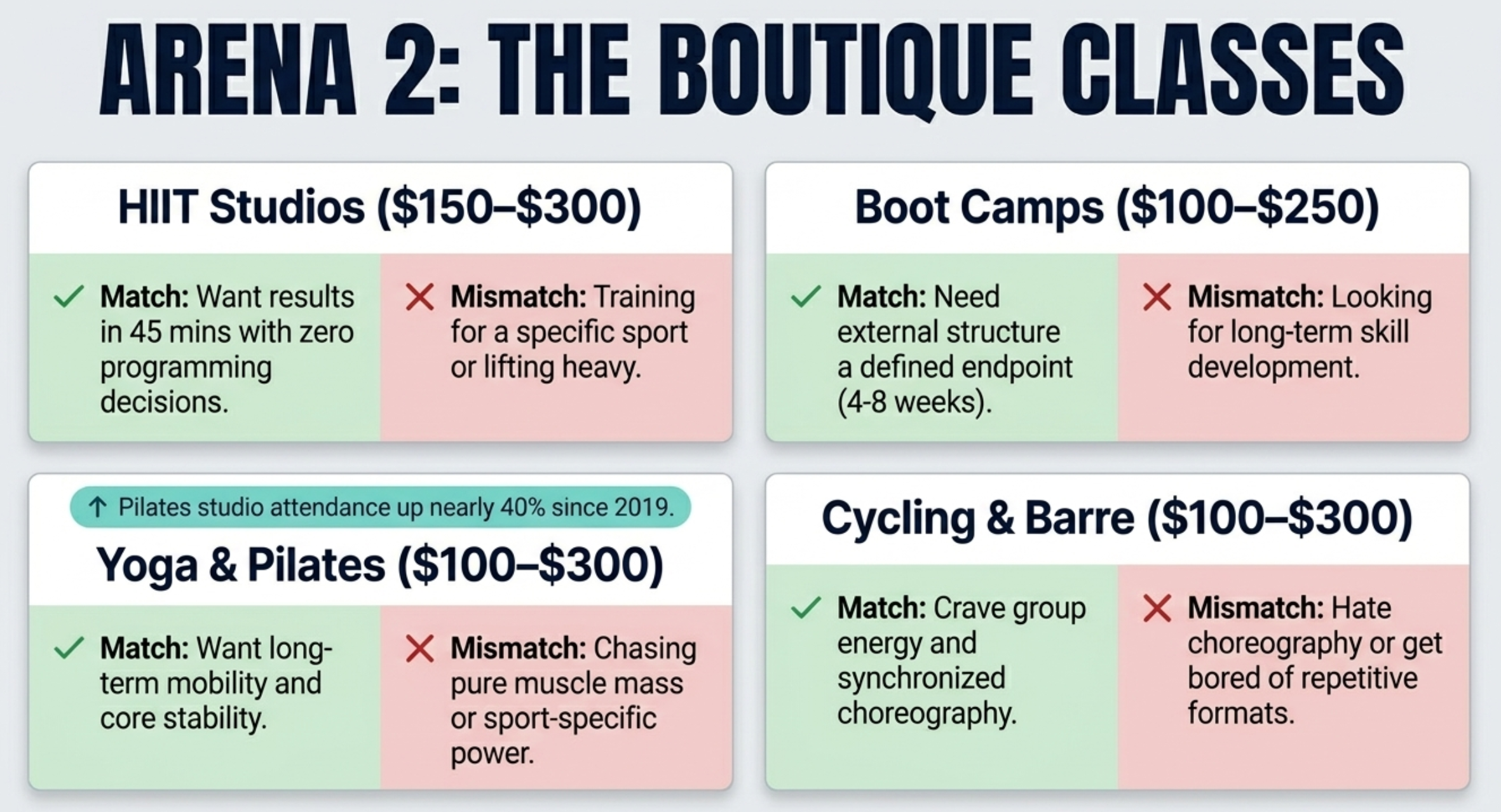
High-intensity interval training studios—F45, Orangetheory, Barry's, solidcore, Burn Boot Camp's HIIT-leaning sessions—built one of the most recognizable formats in fitness.
F45 alone runs roughly 1,600 studios across 60+ countries.
The format is a 45- to 60-minute coached class that mixes cardio intervals with strength circuits, usually with heart-rate tracking on a screen above you.
The workouts are programmed centrally and rotate on a schedule, so the experience is consistent whether you walk into a studio in Dallas or Dublin.
Pricing typically runs $150 to $300 a month for unlimited classes.
Orangetheory's casual-visit retail is around $35 a class; F45's unlimited month typically runs $200 to $280 depending on metro.
The workout is great and the equipment is fine. But you're locked into one format, the music is loud, and if you want to actually program your own training around a goal, you're in the wrong place.
Good fit if: You want results in 45 minutes, three or four days a week, with zero programming decisions.
Not a good fit if: You're training for a specific sport or you want to lift heavy.
Boot Camp Gyms
Boot camp gyms run structured, high-intensity programs—usually four to eight weeks—that blend strength, cardio, and conditioning into short, efficient sessions.
The atmosphere is intentionally motivating.
You're moving fast, you're with a group, and the format doesn't leave a lot of room for coasting. Monthly fees range from $100 to $250 depending on the facility and format.
Boot camps are results-focused. That works for eight weeks. It doesn't teach you how to lift in year three.
If you want a short-term push to build a habit or drop weight before an event, boot camp gyms are effective. But the format isn't built for skill development.
You're not learning how to lift correctly over time—you're doing the work until the program ends.
Good fit if: You want external structure, high accountability, and a defined endpoint.
Not a good fit if: You're looking for long-term skill development or prefer working at a controlled pace.
Yoga and Pilates Studios
Yoga and Pilates have moved from "boutique fitness" to a category of their own.
US Pilates participation grew about 39% from 2020 to 2025, to 13.8 million people (per the Sports & Fitness Industry Association), and Franchise Times put Club Pilates' 2023 system sales at $735 million.
Modern Pilates and yoga studios run small reformer or mat classes, with instructors trained in 200-, 300-, or 500-hour programs.
The work targets mobility, core stability, breathwork, and low-impact strength—a long list of yoga benefits you only collect by sticking with it. It's the rare workout that gets harder the better you get at it.
Memberships typically run $100 to $300 a month for unlimited classes, with single drop-ins around $25 to $40. Reformer Pilates trends higher than yoga because the equipment limits class sizes.
If your only goal is to bench more or run faster, this isn't your category.
But yoga and Pilates pair well with almost every other type of training on this list, and the people who stick with them tend to keep moving well into their 60s and 70s.
Good fit if: You want long-term mobility, low-impact strength, or recovery alongside heavier training.
Not a good fit if: You're chasing pure muscle mass or sport-specific power.
Cycling, Barre, and Specialty Cardio Studios
Indoor cycling studios (SoulCycle, CycleBar), barre studios (Pure Barre, The Bar Method), dance fitness (Zumba, Y7's hip-hop yoga) and the rest of the choreographed-cardio category make up the third boutique slice.
The format is energetic and the music is loud. The class itself is the product.
Pricing typically runs $100 to $300 a month for unlimited classes, with drop-ins around $25 to $40. Premium operators like SoulCycle have crossed $40 a class in major metros.
What you're paying for is the experience: synchronized choreography, instructor charisma, sound systems that actually move you, and a room full of people doing the same thing at the same time.
People who love these studios love them—and they're often the most consistent gym-goers in any city.
Good fit if: You want cardio that doesn't feel like cardio and group energy that pulls you in.
Not a good fit if: You hate choreography or the format gets stale fast.

CrossFit Gyms
CrossFit gyms—called "boxes"—run daily Workouts of the Day (WODs) that combine strength, cardio, and functional movements. The workout changes every day.
That's by design.
You show up, someone tells you what to do, and you do it next to other people who are also suffering. There's a reason CrossFit has built one of the most loyal communities in fitness.
Expect to pay between $100 and $250 a month for CrossFit gym pricing, with most independent boxes anchored around $150 to $200.
That's more than a big box gym, but you're getting coached classes, not just floor access.
CrossFit is competitive by nature.
If that motivates you, great. If you find competition stressful or you're working around injuries, it may not be the right environment. The workouts are hard, and beginners can find them overwhelming before they understand how to scale.
Good fit if: You want variety, coaching, and a community that actually knows your name.
Not a good fit if: You have specific injuries, prefer working at your own pace, or hate being yelled at (even encouragingly).
HYROX and Hybrid Training Gyms
HYROX calls itself fitness racing. Every race runs the same format: eight 1 km runs, each one followed by a functional workout station—SkiErg, sled push, sled pull, rowing, wall balls, and the rest.
Because the format never changes, you can train for it anywhere. That's what hybrid gyms sell: running, strength, and conditioning built around a race on your calendar.
It's growing fast. HYROX reports participation jumping from 570,000 athletes in the 2024/25 season to 1.5 million in 2025/26, with a network of about 15,000 partner gyms worldwide (per SportsPro). Those are the company's own numbers. Even discounted, that's a lot of people pushing sleds.
Most HYROX training doesn't happen in a dedicated building. It happens at CrossFit boxes and functional gyms that added a HYROX class, so pricing usually tracks theirs—plus a race entry fee if you sign up for one.
Good fit if: You like having a date on the calendar, and you want fitness you can actually test.
Not a good fit if: You hate running. Every race has 8 km of it.
Martial Arts Academies
Martial arts academies—BJJ, Muay Thai, MMA, boxing, traditional karate, taekwondo, and the rest—operate on a different logic from the gyms above. You're not buying equipment access.
You're buying instruction in a skill that takes years to develop, with a coach who actually watches what you're doing.
The format is class-based, often six to twelve people on the mats with a head coach and one or two assistants.
Belt or stripe progressions create natural milestones, and the community tends to be the stickiest of any gym type—people stay at the same academy for a decade or longer.
Industry pricing data shows independent BJJ and MMA academies typically run $120 to $200 a month for unlimited training (see BJJ pricing models for a deeper breakdown), with traditional karate and taekwondo schools often cheaper.
Premium gyms in major metros can cross $250.
Martial arts is humbling at first. You will get tapped, hit, or corrected constantly for the first six months. The people who stay long enough swear it changed their lives. Most people don't stay long enough to find out.
Good fit if: You want to learn a skill, not just train. Bonus if you're drawn to a community that shows up for each other. Community is also why a lot of academies build on software like Gymdesk for martial arts—the schools that win on identity tend to run on tools built for that kind of operation. (If you're weighing options, here's how the best gym member apps stack up by gym type.)
Not a good fit if: You can't take being a beginner for a year, or you can't make it to two or three classes a week.
Powerlifting Gyms
Powerlifting gyms are built around three lifts: the squat, the bench press, and the deadlift.
The equipment reflects that—power racks, calibrated plates, chalk-allowed floors, and platforms that can handle serious weight. (For a broader breakdown of what serious training spaces actually stock, top gym equipment is a useful reference.)
These aren't the gyms you see in movies. They're usually loud, a little rough around the edges, and smell like effort.
The community tends to be tight-knit. People help each other hit PRs.
Monthly fees run $50 to $200, depending on the facility. The lower end gets you a solid warehouse-style space; the higher end gets you specialty bars, calibrated kilo plates, and a coach on the floor.
No cardio equipment. No group classes. Nobody training for a 5K. If your goals go beyond strength, you're in the wrong place.
Good fit if: You're serious about getting strong and want a community of people who are too.
Not a good fit if: You're a beginner who doesn't know the difference between a squat and a deadlift yet.
Rock Climbing Gyms
Rock climbing gyms are exactly what they sound like—large facilities with climbing walls of varying difficulty, gear rentals, and instruction for beginners.
The workout is legitimate. Climbing works the arms, shoulders, back, core, and legs simultaneously, and the problem-solving element keeps it mentally engaging in a way that treadmill intervals don't.
Monthly memberships typically run $50 to $150, with day passes around $20 to $30.
The community in climbing gyms is unusually welcoming. Experienced climbers almost always help beginners. You'll find people across a wide age range and fitness background, all working on different problems on the same wall.
You're not going to build a cardio base on a climbing wall, and it's tough on the fingers until your skin adapts. If you're already training for something specific, rock climbing works better as a supplement than a primary program.
Good fit if: You want a challenging workout that doesn't feel like working out.
Not a good fit if: You have upper-body injuries or need cardiovascular conditioning as your primary goal.
Personal Training Studios
Personal training studios are spaces built around one-on-one work with a certified personal trainer.
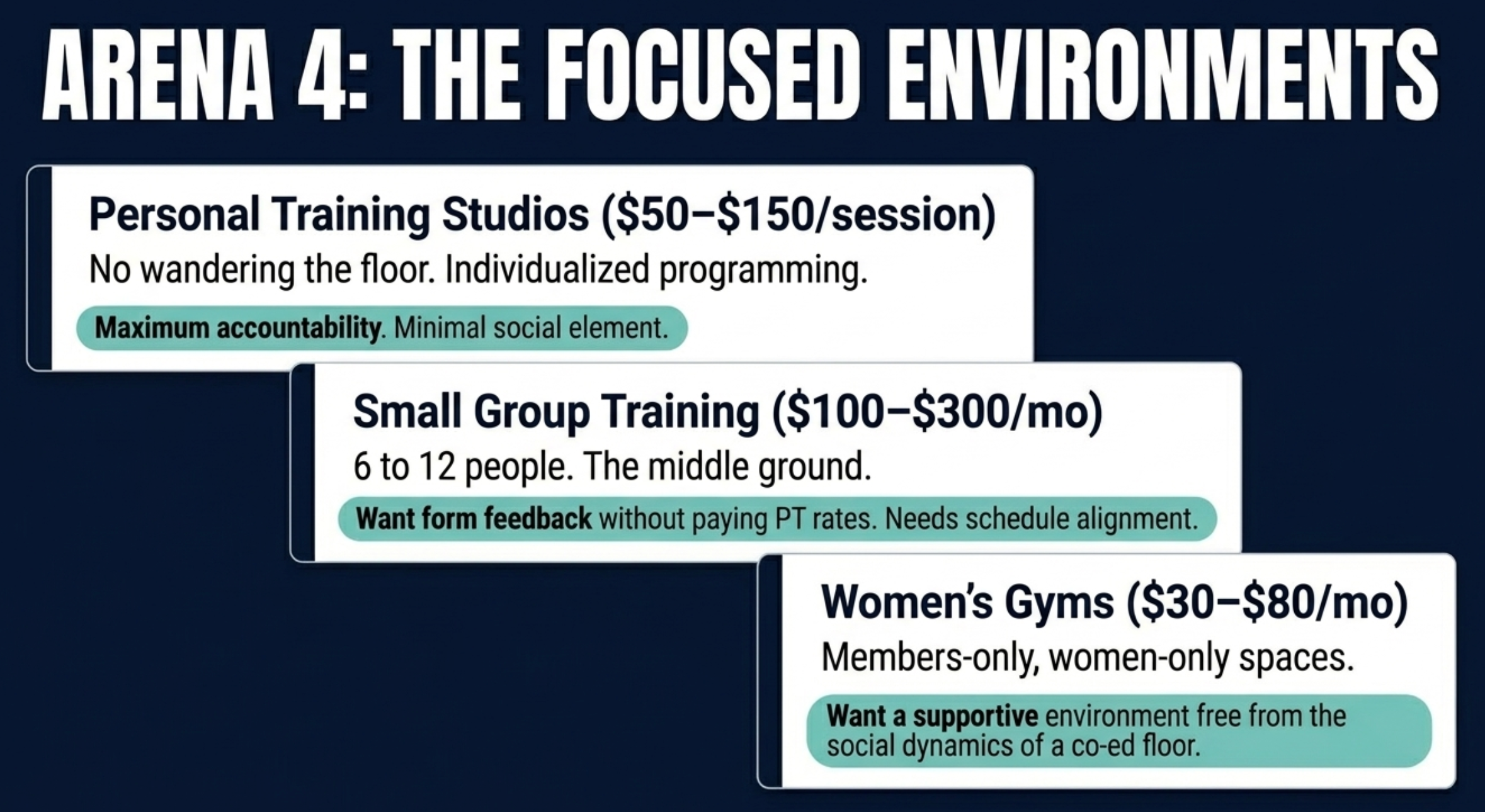
No wandering the floor, no waiting for equipment. Someone designs your program, watches your form, and adjusts when something isn't working.
Sessions typically run $50 to $150 per hour, with high-end coaches in major metros reaching $200-plus. That's expensive.
But there are real reasons to hire a personal trainer—especially if you're starting from scratch, working around an injury, or have tried big box gyms and never actually made progress.
The social element is minimal. This is a professional relationship, not a community. That suits some people fine.
Good fit if: You want maximum accountability and individualized programming.
Not a good fit if: Budget is a concern or you draw motivation from group energy.
Small Group Training Facilities
Small group training hits a useful middle ground. You get the coaching and form feedback that big box gyms don't offer, at a lower cost than personal training.
Classes are intentionally small—usually six to twelve people.
The instructor knows everyone's name, adjusts programming to individual ability, and can catch technique issues that would go unnoticed in a class of thirty. Monthly fees typically land between $100 and $300.
The downside is scheduling. Small group sessions require advance booking, and if the class times don't work with your week, you're stuck.
The dynamic also depends heavily on who else is in your group—which you can't fully control.
Good fit if: You want accountability and coaching without paying personal training rates.
Not a good fit if: Your schedule is unpredictable or you prefer working alone.
Women's Gyms
Women's gyms are members-only fitness spaces for women.
The format varies—some are full-service gyms with cardio equipment and free weights, others are class-based boutique studios—but the common thread is a women-only environment.
The appeal is straightforward. Some women feel more comfortable training without a male audience.
New exercisers, especially, may find it easier to focus on form and progress without the social dynamics of a co-ed floor. Monthly pricing usually lands between $30 and $80.
The tradeoff is smaller facilities and, in some cases, limited equipment selection. Hours may also be more restricted than a large commercial gym.
That said, many women-specific gyms punch above their weight on community and programming, and Curves, FIT4MOM, and Fierce 45 have all built durable franchises in the category.
Good fit if: You want a supportive, focused environment without the noise of a co-ed facility.
Not a good fit if: You need extensive equipment variety or maximum schedule flexibility.
How to Choose the Right Gym Type
Which type of gym fits you?
Five questions, about 90 seconds. Honest match with what to look for when you visit.
Knowing what's out there is the easy part. Picking the one that actually works for you is where most people stall.
A few questions that cut through the confusion:
What's your actual goal?
Not the goal you think you should have—the one you'll stay interested in six months from now.
Building strength, improving cardio, learning a skill, and finding community are all legitimate goals that point to different gym types.
Do you need coaching or equipment?
If you already know how to train, a big box gym at $30 a month may be all you need. If you're starting from scratch or plateauing, paying more for coaching usually pays off.
How important is community?
Pick the gym whose people you actually want to be around in year two.
CrossFit boxes, martial arts academies, and rock climbing gyms build real community—and a lot of those academies operate on platforms like Gymdesk for martial arts precisely because community-first gyms need different tools than big-box ones. Big box gyms and 24-hour facilities are more anonymous. Neither is wrong.
What fits your schedule?
Pick the one closest to your house.
Proximity wins. A worse gym five minutes away beats a great gym 25 minutes away every time.
If you're not sure where you fit, the Gym Type Match tool below walks you through it in about 90 seconds.
The Perfect Gym is Whatever Works For You
FOR GYM OWNERS:
If you run a gym yourself, the same principle applies in reverse. Know what your gym is, who it's built for, and stop trying to be everything to everyone. The gyms that struggle are usually the ones that can't answer "what makes you different?" without a long pause.
That's especially true if you operate in one of the categories with the most competition—big box adjacents, generalist boot camps, or CrossFit boxes in saturated metros. The boutique categories (martial arts, Pilates, climbing, women's) tend to win on identity rather than price, and software like Gymdesk is built with that kind of community-first operation in mind.
No gym type is universally better.
The right one is the one that matches what you actually want, fits your schedule, and sits close enough to use without a second thought.
KEY TAKEAWAY:
Most people who fall off in their first six months don't fail because they picked a bad gym. They fail because they picked the wrong gym for who they actually are.
If you haven't picked yet, take the quiz above. Then go visit two of whichever type comes out on top before you sign anything—the one you walk back into is the one to join.