
Martial Arts
Straight talk and proven systems for managing and growing martial arts schools.
Families, hobbyists, kids—they're the ones who build the business.
Less than 1% of people ever get into an MMA cage. So that's a pretty poor market to go after.

That's Mario, co-owner of Cornerstone Mixed Martial Arts in Deerfield, Illinois, looking at the numbers and telling you where the money actually comes from.
Here's the thing most martial arts school owners already know but don't act on:
"The other thing is not focusing on competitors, because less than 1% of people ever get into an MMA cage. So that's a pretty poor market to go after."—Mario Gomez, Cornerstone MMA
The adults-only competition gym sounds exciting on paper. But the families walking through your door every Tuesday and Thursday? They're the foundation.
Yet too many gym owners still treat their kids martial arts program like a side hustle—something that pays a few bills while the "real" training happens on the adult mats.
The gym owners in this piece did the opposite. They built their entire business around kids and families. And the results speak for themselves: packed classes, multi-year retention, parent-to-member conversions, and the kind of community that markets itself.
With an estimated 27.3 million youth ages 6–17 participating on a sports team or in sports lessons in 2023, and girls' participation rising every year since 2019, the youth activity market isn't shrinking. It's shifting.
The question is whether you're set up to capture it.
The Business Case for Kids-First Programming
You don't need a business degree to see the math. Kids classes fill faster, families stay longer, and the revenue compounds in ways that adult-only programs can't match.
Before we go too far, try your hand at this interactive calculator to get a sense of what a kids' program could do for you:
Take Fit and Fight, where owner Arat Gasanov started with just 10 kids—all children of friends. Today, that program has grown to over 40 students.
The kids program built the gym's foundation—not supplemented it, not funded it, but actually built it from the ground up.
It didn't supplement the business. It was the business.
Or look at Nova Jiu-Jitsu, where the kids program hit 50–60 students within five years of launch. That's not a side offering. That's a growth engine.

The mechanism is intuitive, and gym owners see it every week: families don't cancel memberships the way individuals do. When one parent has second thoughts, another has to overrule them, the kid has to agree, and the whole family calendar has to get reshuffled.
That friction alone—the sheer logistical inertia of a family membership—is why household accounts are stickier than single-person accounts at almost any membership business, from gyms to streaming services.
That's not a niche market. That's most parents actively looking for exactly what you offer.
At Neo Martial Arts in Brampton, the kids program drives the gym's busiest days.
Tuesdays and Thursdays are the busiest days—it's a mad house in here.

That's what happens when you treat your kids martial arts classes as the core of your business—not the afterthought. Your schedule fills differently. Your retention numbers shift. Your word-of-mouth multiplies.
Because parents talk. And when their kid loves something, they tell every other parent at school pickup.
How Families Become Your Best Retention Engine
Here's where the real magic happens. A kid signs up for class. The parent sits on the bench. The parent watches for a few weeks. Then months. Then one day, the parent asks about the adult program.
You've seen this happen. The best gym owners have turned it into a system.
At Nova Jiu-Jitsu, the conversion from spectator to participant happens naturally. Parents volunteer as instructors. The gym organizes family camping trips that extend the community beyond the mats.
The line between "my kid trains here" and "this is our community" disappears entirely.

That's the family retention flywheel. One kid enrolling creates a chain reaction: siblings join, parents watch, parents start training, and suddenly you're retaining an entire household. For years.
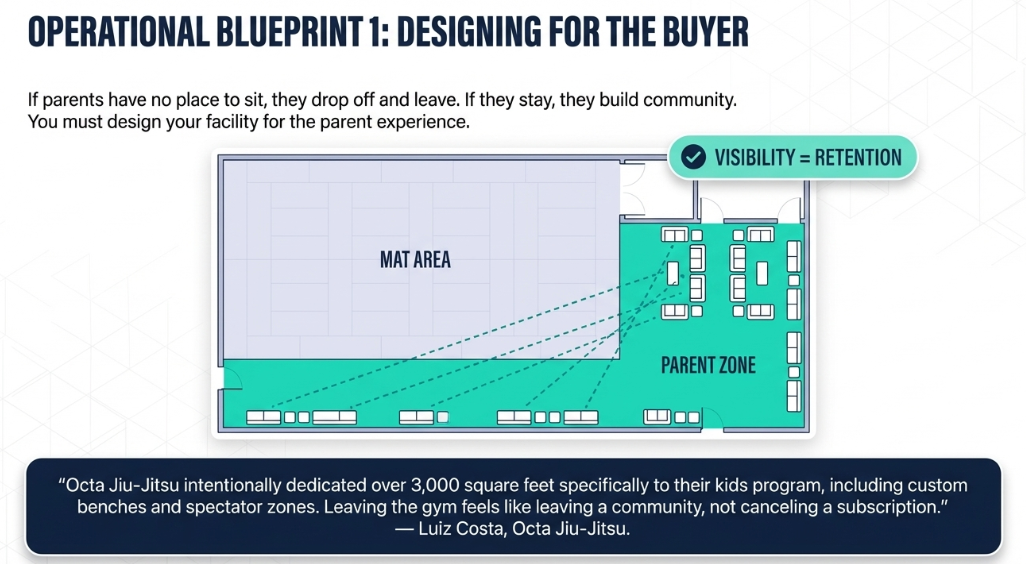
The physical space matters too. At Octa Jiu-Jitsu in Oakville, Canada, they dedicated over 3,000 square feet to their kids program and thought carefully about where parents fit.
Here's our parent area. So that's when they connect and wait for their kids. We also have a watching area over here. So most of the parents may like watching. So we have a few benches for them to watch their kids.

That's not an afterthought. That's intentional design.
When parents have a comfortable place to watch, they connect with other parents. Those relationships make leaving your gym feel like leaving a community—not canceling a subscription.
Grapple Zone London takes the same approach with dedicated parent watching areas and junior classes split into beginner and advanced tracks. Parents can see their kids progressing. That visibility matters more than any progress report you could email.
If you're managing family accounts with siblings in different age groups, tools like Gymdesk's family account linking with automatic sibling discounts take the billing complexity off your plate—so you can focus on building the community instead of untangling invoices.
Age-Specific Programming That Actually Works
"Kids class" is too broad. A four-year-old and a 12-year-old don't learn the same way, move the same way, or need the same things. The gyms that win with kids programming break it into developmentally appropriate tracks—and the difference is massive.
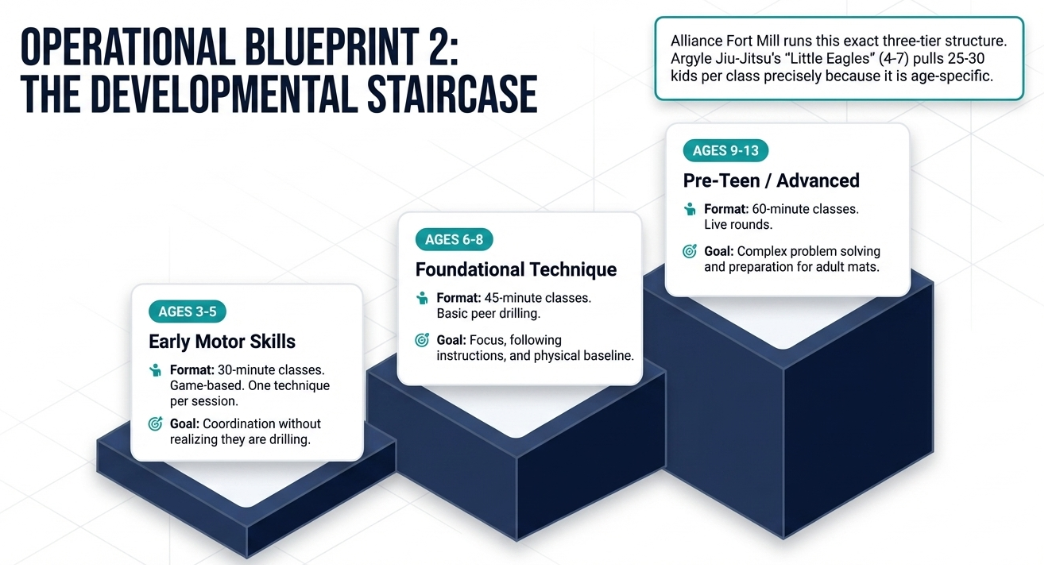
At Unlimited Jiu-Jitsu in Las Vegas, they start kids at age three with a program called "Tiny T-Rexes." The name is fun. The approach is dead serious: 30-minute classes, one technique per session, and games that teach motor skills without the kids even realizing they're learning jiu-jitsu.
Thirty minutes. One technique. Games that build coordination. That's age-appropriate programming—not a watered-down adult class.
Alliance Fort Mill, carrying on the Lucas Lepri legacy, runs a three-tier kids structure: ages 3–5, 6–8, and 9–13. Each bracket has its own curriculum, its own expectations, and its own progression milestones.
A five-year-old isn't measured against a 12-year-old. They're measured against where a five-year-old should be.
At Argyle Jiu-Jitsu, their Little Eagles program (ages 4–7) regularly pulls 25–30 kids per class. That kind of enrollment doesn't happen by accident. It happens because parents see that the programming was built for their child's specific age—not a one-size-fits-all class where their kindergartner gets lost behind the bigger kids.
If you're running a single "kids class" for ages 5–13, you're almost certainly losing students at both ends. The little ones feel overwhelmed. The older ones feel bored. Neither group stays.
Structuring your kids BJJ belt system around age-appropriate tracks gives every student a clear path forward.
The after-school and summer camp multiplier
If you're only offering evening kids classes, you're leaving serious revenue on the table. Demand for after-school programs in the US continues to outstrip supply—the Afterschool Alliance's America After 3PM research has consistently shown that millions of families are actively looking for programs they can't find or can't afford. Some of the most successful gyms in our Gymdesk Originals series have built their entire businesses on that gap.
NC Budo built what might be the most comprehensive after-school model we've seen. Kids rotate through 30-minute segments—homework help, martial arts training, animal care, nature areas. It's not just "martial arts after school." It's a full after-school experience that happens to be run by a martial arts school.
Biggest key to success in our market.

That's not a throwaway line. That's the strategy that built their gym.
Argyle Jiu-Jitsu found another angle entirely: homeschool PE enrichment. They enrolled 50 kids in a program that serves as physical education credit for homeschool families.
That's a dual revenue stream—new students who might not have found martial arts through traditional channels, plus steady daytime enrollment that fills hours when your mats would otherwise sit empty.
And then there's the summer camp opportunity. The Building Gym Changes Lives program runs a summer camp serving 60–70 kids daily—kindergarten through sixth grade, six weeks, full-day programming. That's summer camp revenue that can carry your gym through the slower months.
When you're juggling multiple age groups, rotating activities, and after-school scheduling, class scheduling with capacity limits and waitlist management keeps the chaos organized. Without a system, programs this complex break down fast.
Building a Competition Pipeline from Your Kids Program

Kids programs don't just drive revenue. They build your gym's competitive reputation from the ground up.
At Sasaki Judo in Orlando, Sensei Shinjiro Sasaki deliberately caps enrollment at 150 students—and currently runs around 120—to preserve the personal relationship between coach and every student.
In that deliberately small program, they've produced national champion youth competitors and veteran world medalists through systematic progression, kids who started in beginner classes and moved through the ranks into serious competitive athletes.
That pipeline doesn't happen overnight. It takes years of age-appropriate programming, intentional progression, and coaches who know when a kid is ready to compete and when they need more time on the mat.
Grapple Zone London is building the same thing across the Atlantic.
"We've just competed this year and we're looking to compete a lot more in the following year, the 2026 years, adults and children." — Courtney Anderson, Grapple Zone
Kids competing at local, national, and international levels. That's reputation that attracts serious families—parents who want their child in a program with a track record, not just a kids class with a fun name.
Competition gives kids purpose beyond belt ranks. It gives them goals and a reason to keep training when the novelty wears off. And every medal, every podium photo, becomes marketing that no ad budget can buy.
Parents share those photos. Other parents see them. The cycle continues.
The Stories That Sell Themselves: Transformation Beyond the Mat
Revenue matters. Retention matters. But the stories that actually sell your kids martial arts program aren't about numbers. They're about the kid who changed.
Fred Silva at Alliance Fort Mill is a kids teaching specialist. His perspective on children's martial arts is personal—his autistic daughter uses jiu-jitsu for aggression management, with outcomes that overlap with what you'd see in occupational therapy.
He's watched two brothers transform through training, going from unfocused and disconnected to disciplined and confident. It's the kind of transformation-over-profit mindset that defines the best kids programs.
These aren't marketing stories. They're real outcomes that happen on your mats every week.
Gabriel Goulart runs an anti-bullying program, and the story of Ayana captures exactly why these programs matter beyond revenue. She was 12, being bullied at school, and arrived with shoulders hunched and confidence gone. A year of training later, she was a different kid—standing taller, making eye contact, and carrying herself like someone who knew what she was capable of.
That's not a marketing talking point. That's a kid's life changing on your mats.
And at King Tiger Taekwondo in Harrisburg, a non-verbal autistic child began developing communication skills through structured classes. Not because the program was designed as therapy. Because the consistency, the routine, and the community created an environment where growth happened naturally.
Parents who love your gym tell other parents. Stories like these are why. They're what parents share at birthday parties, at school pickup, in text threads. They're your most powerful word-of-mouth marketing—and they cost nothing.
Common Mistakes That Kill Kids Program Growth
You can build a great kids program and still watch it stall. Here's what holds most gyms back:
- Running one generic "kids class" for all ages. A seven-year-old and a 13-year-old need completely different instruction. If you're lumping them together, you're losing both groups. The seven-year-old feels overwhelmed; the 13-year-old feels bored.
- Treating kids classes like babysitting. If your best instructors only teach adults and your least experienced staff handles kids, parents notice. They might not say anything. They'll just leave. Invest in dedicated kids instructors who actually want to teach children.
- Ignoring the parent experience. No watching area. No communication about progress. No sense of what their kid is learning. Parents who feel shut out don't stay. Give them visibility—a place to watch, regular updates, and milestones they can celebrate with their child. Tracking attendance and skills progress helps you know exactly where each young student stands, so you can share that progress with parents instead of guessing.
- No clear progression system. Kids drift without milestones. If there's no visible path from white belt to the next rank—and the next one after that—motivation drops. Why kids quit is almost always about feeling stuck, not about losing interest in martial arts itself.
- Missing the after-school and camp opportunity. If you're only running evening classes, you're competing with every other evening activity. After-school and summer programs give you daytime revenue, fill empty mat hours, and serve families who need care, not just classes.
The Bottom Line
The gyms that thrive aren't built on fighters. They're built on families.
Every gym owner in this piece—from Fit and Fight's 40-student kids program to Nova JJ's 50–60 kids to NC Budo's after-school model—arrived at the same conclusion. Kids programs aren't the side hustle. They're the foundation.
The family that enrolls one child and stays for five years, adding siblings, converting parents, and telling every family they know? That's worth more than any adult competitor who trains hard for 18 months and moves on.
Build the kids program first. Build it with age-specific tracks, dedicated instructors, and a parent experience that makes families feel like they belong.
The rest—the revenue, the retention, the reputation—follows.
And when the complexity of managing family accounts, multi-age scheduling, and progression tracking across dozens of young students starts piling up, the right gym management tools help you stay organized without adding admin hours to your week.
Watch these gym owners tell their stories in our Gymdesk Originals video series.




.png)