
How to Build a Kids' BJJ Belt System That Actually Works
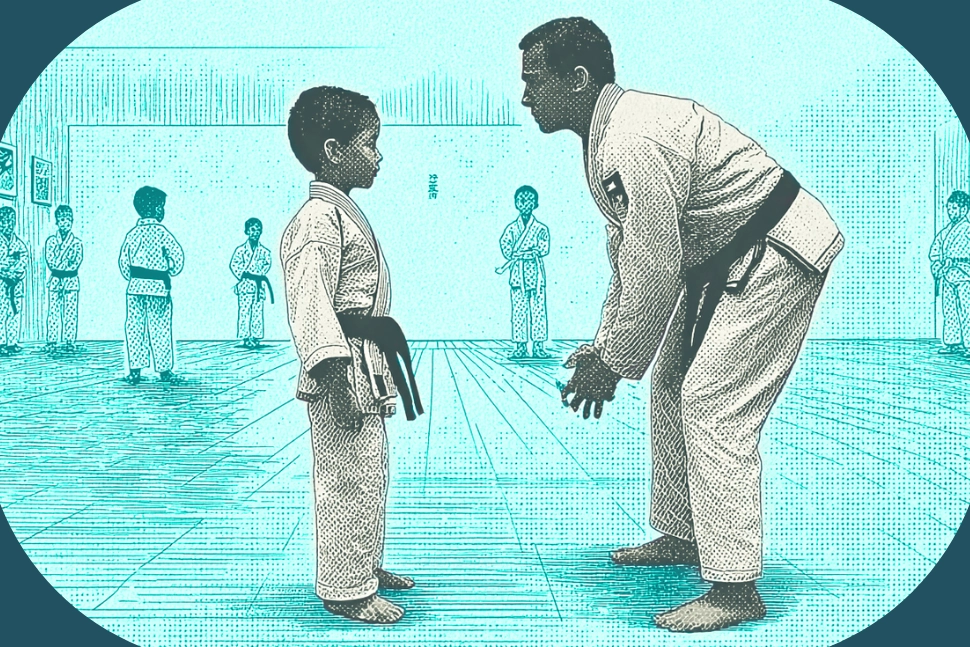
You're spraying the mats down after class when Matt, one of your students’ parents, walks over to you.
“My son has been training with you for six months. Why hasn’t he gotten his orange belt yet? Some of the other kids have been promoted ahead of my son, even though they started after he did.”
There's instant tension.
The conversation is immediately awkward. Matt's question isn't unreasonable—but you still can't give him a clear answer.
Why can't you, though? There’s no written criteria for promotion. Traditionally, instructors “know it when they see it.”
Promotions feel subjective because they are subjective.
Parents feel confused. Kids feel stuck. This feels unfair. As if some students are treated more favorably than others.
This perception of favoritism is damaging because it hurts retention. If you're running a kids program, you know, retention is the business.
Today we're going to fix that.
In this guide, you'll learn how to build a kids' BJJ belt system that keeps students motivated, parents informed, and instructors on the same page.
You can do this without the perception of favoritism, administrative headaches, or watering down your curriculum.
Why Your Kids' BJJ Belt System Matters More Than You Think
Your kids' programs are the backbone of your cash flow. Kids come with parents, siblings, and friends. This leads to long-term memberships and a steady increase in your cash flow.
Vague promotions are the number one complaint parents have about kids' programs. Here’s what I know:
- Kids' programs see higher retention when there are clear progression milestones that are visible to students and parents.
- Gyms with structured skill assessments show better long-term retention than those that arbitrarily promote their students.
- Objective criteria, along with clear parent communication (about promotion), reduce the “why aren't my kids advancing?” questions.
But why? Why are belt ranks so important to your students and their parents?
Well, they're competitive.
I realize you’re probably already aware that parents are competitive. What you may not know is why they're so competitive.
The major drivers of parental competitiveness
So, we’ve established that parents are often a driving force behind this drive for progression. Here's a short list of the biggest and most common motivations behind parental competitiveness:
- Social/peer pressure. A belief that their kids need to be successful and skilled at jiu-jitsu to be accepted by other kids in their peer group.
- Status and identity. Parenting is a significant identity; parents showcase their kids’ accomplishments to seek validation and status, which reflects positively on them.
- Living vicariously. Parents often push their kids into training to fulfill their own unrealized dreams. As a result, kids may lose their desire to continue their training.
- Insecurity and self-doubt. Parents often compare their kids to other kids in the gym; they often feel inadequate or less than, leading them to overcompensate or tear down other parents.
- Fear of failure. Parents experience stress and anxiety about their child's potential and success. This fear can lead parents to display controlling behavior, with the underlying message: "Your success will prove that I'm a good parent."
- Jealousy. A toxic parent might feel threatened or jealous of another kid's talent. They may feel threatened by the opportunities or attention other kids receive from you and other coaches.
What does this mean for your gym?
For parents, belts and promotions are status validators. It's a way for them to show that they're doing better than other kids.
This is why a clear kids martial arts belt structure directly protects your revenue.
For a deeper look at how progression impacts churn, see Gymdesk’s guide on martial arts student retention.
The Core Problem With Most Kids' Belt Systems
Most schools fall into one of three traps:
- Vague requirements. Coaches are unclear about what's expected. Stripes and belt promotions are a black box—students and parents aren't sure about the requirements, so they're never really sure about their current progress.
- Time-based promotions. These student promotions are based primarily on attendance rather than on objective criteria (e.g., pin escapes success rate). For example, students attend 10 classes and receive a stripe.
- No tracking. There's no attendance tracking system in place, so no one can actually remember how any of the 75 kids in class are doing. Can they escape Mount? Can they take someone down? There are too many kids and not enough tracking.
This comes with steep consequences.
For example: Your 8-year-old white belt can’t do a technical stand-up, but they're promoted to gray belt anyway because “it’s been six months.” They decide to compete, and they're beaten badly.
Kids and parents come away feeling discouraged—they begin to lose trust in the promotion system.
Retention begins to slip.
What's the point of working hard in class if the results are never there? This is why choosing your promotion and belt rank structure is so important.
Choosing Your Belt Rank Structure
The majority of kids' martial arts belt structure follows the rankings system outlined by the International Brazilian Jiu-Jitsu Federation (IBJJF).
There are five ranks before adult belts.
The youth BJJ belt order follows a four-color system. Each belt has three sub-levels: a solid color, a white stripe, or a black stripe through each belt.
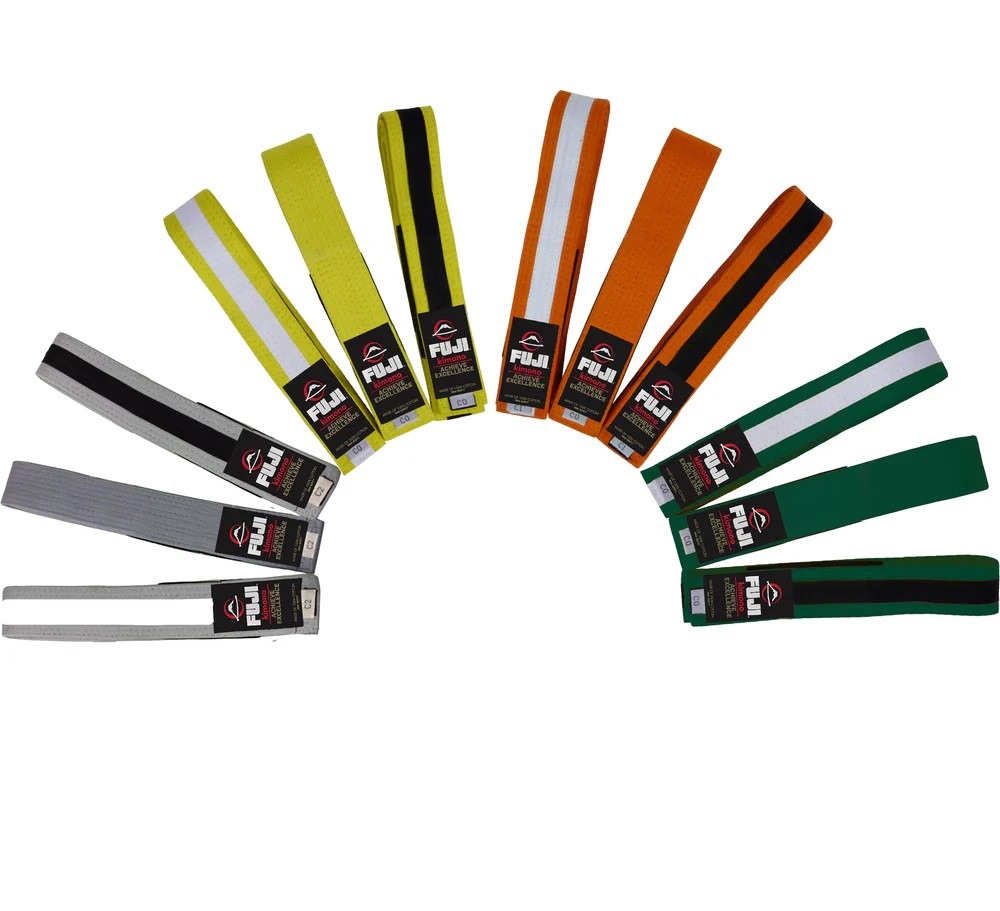
Each belt color and its variations (degrees) receive four stripes before students progress to the next belt color.
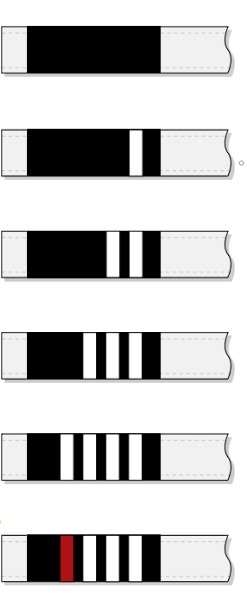
Students get a stripe wrapped around a 5 to 7-inch black sash at the end of their belt. Generally, this is a white stripe of either athletic tape or electrical tape.
There are four stripes to a belt.
Too many stripes and promotions dilute value. Too few and your students run into long dead zones where training becomes a grind and motivation drops.
Stripes should be earned, but you'll want to pace your promotions carefully.
This “graduation system,” as the IBJJF calls it, paces motivation for younger attention spans. Students receive consistent promotions, moving smoothly into the adult ranks at 16+.
Here's the great part about this ranking system.
You have a huge amount of flexibility. You can set your own promotion schedules, choosing how often you want your kids to experience wins.
This should be determined by a few factors. Some schools add sub-levels or colors, but the decision should be based on:
- Your gym goals. Are you running a competition gym? A bullyproof program? What's the focus of your gym?
- Your IBJJF alignment. How closely do you want to align with IBJJF? If you're a competition gym, aligning with the IBJJF gives your students a clear path to professional competition.
- Your ability to manage promotions. How many promotions can your admin team realistically manage? Lots of promotions are great for students, but logistically, this can become a nightmare to manage—especially as your gym grows.
When you define your kids' belt ranking structure, you're prepared to use tools like Gymdesk’s custom rank tracking system—set it once and apply it across every student.
But you have to know what you're looking for.
Building Observable Skill Criteria
Stripes and promotions should be tied to observable criteria, not good vibes or time served.
White belt (foundations): 0-6 months
Your white belt students should be able to:
- Tap safely, before injury
- Perform all the required movements (e.g., shrimps, bridges, rolls, technical stand-up, etc.)
- Identify mount, guard, side control, knee-on-belly, north/south, and back control
- Retain a guard (open, closed) for 30 seconds
- Execute at least one sweep (with guidance)
- Execute at least one guard pass
- Execute at least one submission
- Execute at least one pin escape from each position
Gray belt (basic control): 6 months - 1 year
Your gray belt students should be able to:
- Retain their guard for two minutes against resistance
- Execute at least two escapes from each major position
- Execute at least one guard pass from each of the four categories (loose, stack, tight, and float passing)
- Demonstrate basic handfighting
- Execute two to four sweeps from guard (e.g., butterfly, scissors, flower, hook sweep
- Execute five to ten submissions
- Execute two pin escapes from each position
Yellow, orange, green belts: 1+ year
Your yellow, orange, and green belts should progress by position categories:
- Pin escapes: Mount, side control, north/south, back control, knee-on-belly
- Guard play: Closed, open seated, supine, half guard
- Top control: Passing, camping, pinning, controlling
- Submissions: Front head, rear naked choke, armbars, shoulder locks, and triangles
- Takedowns: Breakfalls, handfighting to two upper and lower body takedowns
- Self-defense: Striking defense, bullyproofing, stranger danger, etc.
You'll want to see that your students are building competence against their peers—students with the same color/rank.
Are your white belts able to consistently escape pins from other white belts? Can your gray belts pass the guard using loose, stack, tight, or float passing?
When instructors can check off students' skills in real time, everyone sees what's required to reach their next rank.
Creating a Graduation Schedule That Works
Successful kids' programs follow a schedule. This is important because it keeps student momentum without success feeling automatic.
IBJJF recommends three graduation systems for kids, based on degrees and stripes. Here's how it works:
| Monthly System | Triannual System | Quarterly System | |
|---|---|---|---|
| Stripes (per belt) | 12 | 2 | 4 |
| Stripe colors | White, Red, Next belt color | White | White |
| Promotion cadence | 1 stripe per month | 1 stripe every 4 months | 1 stripe every 3 months |
| Time-in-rank | 1 year | 1 year | 1 year |
Here’s what these graduation schedules mean:
- The monthly system: For academies that award degrees monthly, the IBJJF recommends 11 degrees per belt. The 12th degree will graduate the student to the next belt color. The first four degrees are white, the following four red, and the last three the color of the next belt.
- Triannual system: For those that hold degree graduations every four months, the IBJJF recommends two degrees per belt. The third degree will be graduating the athlete to the next belt color.
- Quarterly system: For those that confer degrees every three months, the IBJJF recommends three white degrees for each belt. The fourth degree will promote the athlete to the next belt color.
Choose the one that best fits your school’s values.
If you’re a competition-focused gym or your kids are driven and eager to train, the triannual or quarterly system may be best.
Kids in this environment will want their competition victories to speak louder than their rank anyway.
For kids in a hobbyist or bullyproof program, start with the monthly system and then shift from there if needed.
Communicating with parents
Communication about promotion is an important part of the promotion process.
Communicating gives parents the time they need to invite family and friends and prepare for their kid's big day. It also teaches parents what to expect.
Here's a message you can send to parents:
“Here are the skills your child needs to demonstrate to be promoted. We track their progress weekly. When they’re ready, you’ll be the first to know.”
This can be tough to manage as your kid's program grows.
Parent communication tools that automate students' milestone updates and testing eligibility can save an estimated 3–5 hours per week of manual follow-up.
Tracking Progress Without Drowning
Memory-based or old-school methods (e.g., 4x6 notecards or stamps) may work at first, but they create headaches as your gym grows.
Here are a few of the options you can use:
| What it is | Best for | Limitations | |
|---|---|---|---|
| Digital tracking | Online tools like Gymdesk are used to track attendance and performance. | Martial arts academies that are looking to grow quickly. | Training and ongoing maintenance are required to keep this system working well. |
| Belt cards | Physical cards are used to track individual student attendance and performance. | Small gyms that are focused on a small core group of students. | Entirely dependent on manual entry. If cards aren’t filled in, the data isn’t recorded. |
| Instructor memory | The head instructor (you) relies on memory to determine who is eligible for promotion and who is not. | Micro gyms—gyms with 20 members or fewer. It’s an ideal option for bootstrapped gyms. | Students are frequently forgotten or passed over for promotion, leading to retention issues. |
Here's a workflow you can use to stay on track:
- Instructor notes student progress after each class
- Your gym management platform (i.e., Gymdesk) monitors student progress
- A monthly review shows you which students are on deck for a promotion
- Parents log in and view the coaches' updates about their kids' status anytime
If you're using digital belt tracking and reports, you can instantly answer promotion-related questions:
- Who is stripe-ready in the 6–8 group?
- What skills do our four-stripe yellow belts need to work on?
- Which gray belts can retain guard for 5 minutes against strong resistance?
We're obviously biased, but experience tells us that a shift towards digital belt tracking is the right move.
Common Mistakes to Avoid
When it comes to promotion, there are several mistakes you'll want to avoid:
- Promoting kids to keep their parents happy
- Using adult criteria for young and pre-teen kids
- Allowing each instructor to define “mastery”
- Failing to explain the promotion system to kids and parents upfront
- Promoting based on intangibles (e.g., vibes, feelings, or time served)
These mistakes provide short-term relief, but they break trust over the long term.
Final Thoughts
When there’s no written criteria for promotion, retention suffers.
The traditional approach, “I’ll know it when I see it,” breaks trust. When this happens, promotions feel subjective because they are.
Parents feel confused. Kids feel stuck.
A clear kids' BJJ belt system transforms your gym because:
- Students stay focused and motivated
- Parents know what's expected and how to track progress
- Instructors, parents, and kids are all on the same page
- Admin time drops as software does more heavy lifting
- Student retention grows
It’s not just teaching—it’s operations.
Define your criteria, set expectations, and track performance intelligently. Do the upfront work, and you'll find you spend your time coaching, not explaining promotions to parents.
Gym management software that frees up your time and helps you grow.
Simplified billing, enrollment, student management, and marketing features that help you grow your gym or martial arts school.


FAQ
Kids' BJJ Belt System FAQs
Let's finish up by answering a few lingering questions you may have.
.webp)
Andrew McDermott is a gym owner, Brazilian Jiu Jitsu brown belt, and digital marketer. He’s on a mission to build premier, high-stakes grappling tournaments, world-class academies, and a championship team of high-level athletes.