Jiu Jitsu Origins: How BJJ Went from Samurai Art to Global Sport
Brazilian Jiu-Jitsu has become one of the most practiced martial arts on the planet—millions of people training in a system built on one idea: technique and leverage can beat size and strength.
It's in MMA gyms, police academies, and neighborhood dojos on every continent.
But where did this remarkable fighting system actually come from?
The origins of Brazilian Jiu-Jitsu (BJJ) are a messy blend of myths, cultural exchanges, and martial evolution—and the story is more dramatic and more contested than the official version suggests.
Quick Reference: Key Moments in BJJ History

Year | Event | Why It Matters |
1500s–1700s | Jiu jitsu develops among Japanese samurai | Grappling emerges as core battlefield skill |
1868 | Meiji Restoration ends the samurai era | Traditional ryu begin to disappear |
1882 | Jigoro Kano founds Kodokan judo | Modernizes and preserves Japanese grappling |
1914 | Mitsuyo Maeda arrives in Brazil | Brings hybrid ground fighting system to South America |
1916 | Carlos Gracie begins training with Maeda | The lineage that becomes BJJ begins |
1925 | Carlos Gracie opens first Gracie academy | BJJ formally established as its own art |
1951 | Helio Gracie vs. Masahiko Kimura | Defining moment in Gracie mythology |
1967 | Fadda’s students beat Gracie students | Non-Gracie lineages proven at the highest level |
1993 | Royce Gracie wins UFC 1 | BJJ goes global overnight |
2000s | IBJJF and ADCC establish global standards | BJJ becomes a serious competitive sport |
Feudal Japan: The Samurai's Battlefield Art (1500s–1700s)

During Japan's feudal period, jiu jitsu evolved from spiritual practice into deadly battlefield necessity. Samurai warriors found that striking proved useless against an armored opponent—their fists and feet couldn't penetrate the heavy armor worn by enemy soldiers.
This practical reality drove the development of sophisticated grappling. When samurai lost their swords in battle or faced opponents in heavy armor, they needed joint locks, throws, and submission holds rather than strikes.
What emerged was an art built on controlling opponents through leverage and technique rather than raw power.
By the height of the feudal period, over 2,000 different jiu jitsu schools (ryu) had emerged across Japan—though that number varies significantly depending on the source—each developing unique techniques and fighting strategies.
This golden age couldn't last.
The Meiji Restoration of 1868 ended the samurai class and their martial traditions. As Japan modernized and adopted Western military methods, traditional battlefield arts appeared obsolete. Many schools closed permanently, and masters struggled to find students interested in what seemed like outdated techniques.
The decline was so severe that some experts feared the complete extinction of Japanese grappling arts.
The Kodokan Revolution: Jigoro Kano's Modern Vision (1882)
Into this crisis stepped Jigoro Kano, a visionary educator who would reshape Japanese grappling forever. Recognizing the value in traditional jiu jitsu, Kano founded Kodokan judo in 1882 with the goal of preserving and modernizing these ancient techniques for contemporary society.
Kano's genius was his systematic approach. He studied multiple traditional ryu, extracting the most effective techniques while eliminating those too dangerous for regular training.
He introduced randori—free sparring against a resisting opponent—as the primary method for developing practical skill. This replaced the compliant drilling that had dominated most traditional schools.
Kano focused on throwing techniques and standing combat rather than ground fighting. While traditional jiu jitsu included extensive ground work, Kodokan judo prioritized dramatic throws and takedowns—an emphasis that would later define judo as an Olympic sport.
It also created space for a different art to own the ground.
He also removed dangerous techniques from the curriculum: strikes, small joint manipulation, methods designed to permanently injure or kill. He created an art suitable for educational and sporting purposes.
The Japanese government adopted judo for police training and school curricula. Kano's students—including the legendary Mitsuyo Maeda—began spreading this modernized system throughout the world.
One of them would carry something beyond sport judo to Brazil.
Maeda's Journey: Bringing Japanese Arts to Brazil (1914)
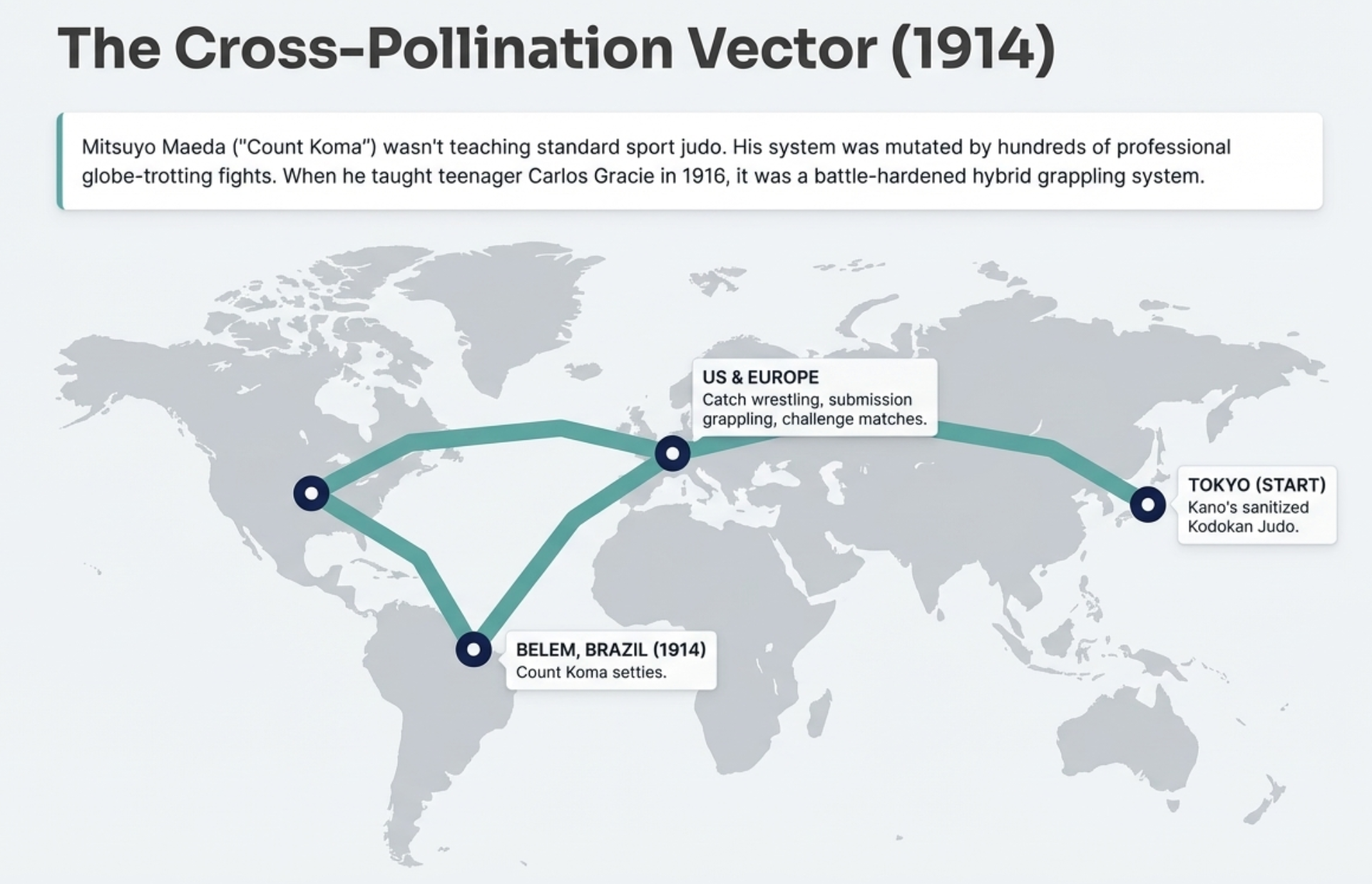
Mitsuyo Maeda was known in fighting circles as "Count Koma"—a nickname earned not in Japan, but across the world's fight venues.
Maeda wasn't a pure judoka. Before arriving in Brazil in 1914, he'd spent years as a professional fighter competing in catch wrestling, submission grappling, and challenge matches across the United States, Europe, and Latin America.
His fighting style was a hybrid, shaped by real combat experience rather than the sanitized sport judo Kano had codified. This matters because it explains why what he taught was so different from the judo being practiced in Tokyo.
Maeda arrived as part of a Japanese government initiative to establish overseas colonies. Among his early students in Belem was Carlos Gracie, a teenager who began training with Maeda around 1916. What Carlos received wasn't textbook Kodokan judo—it was Maeda's complete grappling system, ground work included, shaped by years of actual fights against all comers.
Carlos understood he'd learned something special: a fighting system that could allow smaller grapplers to defeat larger opponents through superior technique and strategy.
HISTORICAL NOTE:
Maeda’s “Count Koma” nickname reflected his globe-trotting fighting career. He competed in hundreds of matches across multiple countries before settling in Brazil—which is why the system he passed on was richer and more complete than what you’d have learned at a standard judo club.
The Gracie Innovation: Birth of Brazilian Jiu-Jitsu (1925–1950s)
Carlos Gracie opened the first Gracie academy in 1925 in Rio de Janeiro, marking the official beginning of what would become BJJ. The Gracie brothers training together created an environment of constant experimentation and refinement.
Helio Gracie and the leverage principle (with a caveat)
The official Gracie family narrative holds that Helio Gracie—smaller and physically weaker than his brothers—modified the techniques to rely even more heavily on leverage and timing over strength.
This adaptation, the story goes, produced the ground-focused, submission-based system that defines BJJ today.
That narrative may be broadly true, but it's worth knowing: historians like Roberto Pedreira have questioned how much of it is accurate versus mythology carefully cultivated by the family. Helio's physical limitations may be somewhat exaggerated in the retelling.
What's not contested is that the Gracies, collectively, pushed the art toward ground fighting to a degree no one had before.

The famous guard position became emblematic of their approach—a fighter on their back using legs to control an opponent, neutralizing size and strength advantages. From the guard, a skilled grappler could sweep, lock joints, or apply chokes while appearing to be in a disadvantageous position.
The Gracie Challenges: Vale tudo and the proving ground
The Gracie family didn't just develop their art behind closed doors. They tested it publicly—and the results are some of the most dramatic moments in BJJ history.
The "Gracie Challenge" was an open invitation to any martial artist who believed their style could beat theirs. These vale tudo (anything goes) matches, fought without weight classes or time limits, spanned decades.
Beach fights in Rio. Challenges issued through newspaper ads. The famous Gracie in Action VHS tapes that circulated through gyms in the 1980s. All of it served as proof of concept for ground fighting supremacy.
The most famous challenge produced the most famous loss. In 1951, Helio Gracie faced Masahiko Kimura, one of the greatest judoka who ever lived. Kimura outweighed Helio significantly and was widely considered unbeatable.
DEFINING MOMENT:
In 1951, Kimura applied a reverse ude-garami—a shoulder lock still called “the kimura” in every BJJ academy today—and broke Helio’s arm. Helio refused to tap. His corner threw in the towel.
The Gracies reframed the loss as evidence of the system’s validity—a smaller man lasting over 13 minutes against the world’s best. Even in defeat, BJJ claimed the lesson.
Non-Gracie lineages: The fuller picture
BJJ history is often told as entirely Gracie history. It isn't.
Luiz Franca learned directly from Maeda independently of the Gracies and founded his own lineage. Oswaldo Fadda trained under Franca and brought BJJ to working-class communities in Rio that the Gracie academy, which charged substantial fees, didn't serve.
In 1967, Fadda's students challenged Gracie students to a series of matches—and won. The Gracies acknowledged the result and the legitimacy of the Fadda lineage.
This matters for understanding what BJJ became: multiple lineages contributed to the art, even if the Gracie name dominated the global story.
Global Recognition: The UFC Era and Modern Expansion (1993–Present)
The ultimate validation came in 1993 when Royce Gracie entered the first Ultimate Fighting Championship.
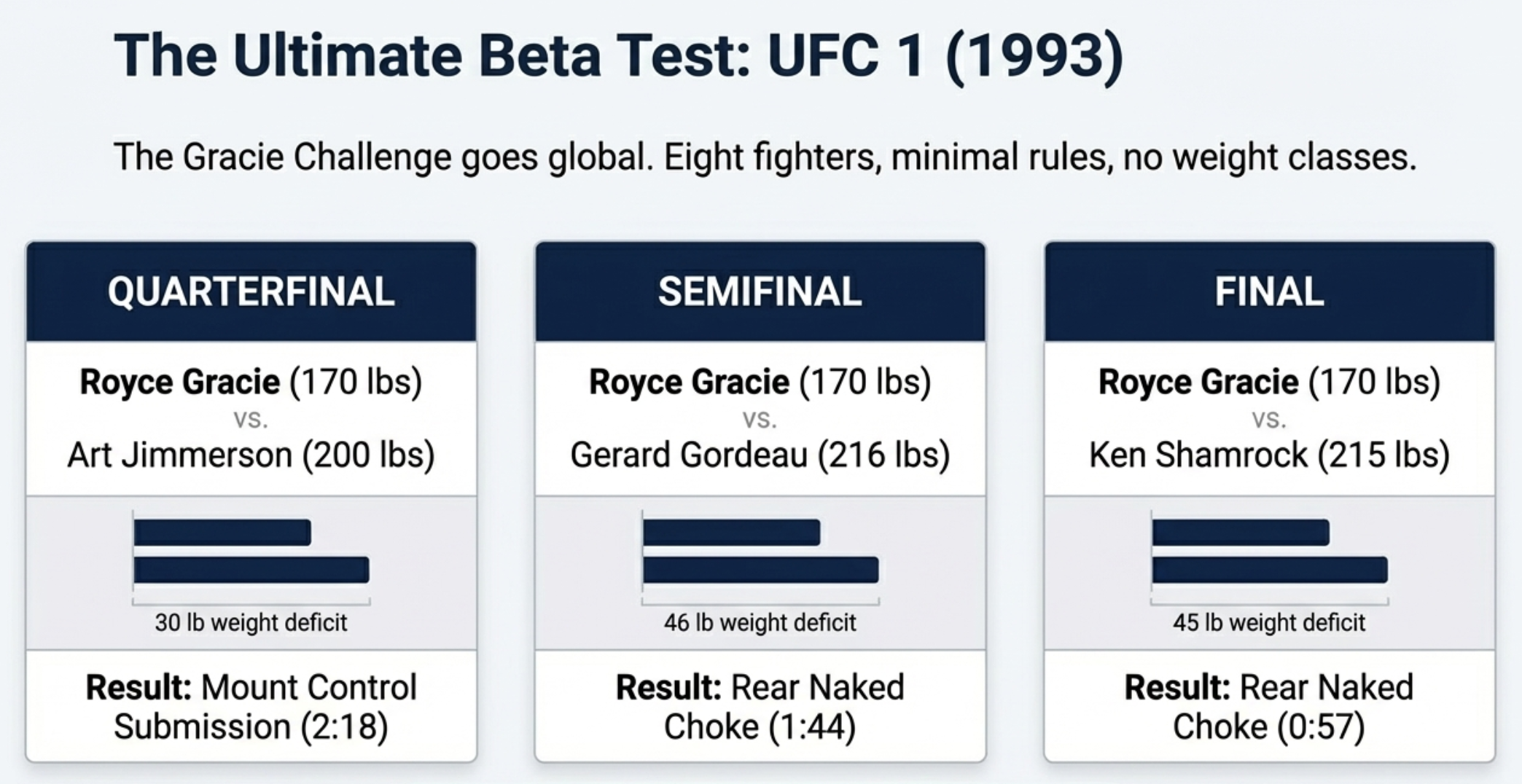
The UFC was designed as a tournament to answer one question: which martial art actually works? Eight fighters, no weight classes, minimal rules. Royce—at 170 pounds—was among the smallest competitors.
His path to the championship reads like a highlight reel for BJJ:
Round | Matchup | Result | Time |
Quarterfinal | Royce Gracie (170 lbs) vs. Art Jimmerson (200 lbs) | Submission (mount control) | 2:18 |
Semifinal | Royce Gracie (170 lbs) vs. Gerard Gordeau (216 lbs) | Submission (rear naked choke) | 1:44 |
Final | Royce Gracie (170 lbs) vs. Ken Shamrock (215 lbs) | Submission (rear naked choke) | 0:57 |
Jimmerson entered the cage with one boxing glove on his lead hand—and tapped before a submission was even locked in. Three fights. Three finishes. The martial arts world had never seen anything like it.
FOR ACADEMY OWNERS:
The UFC era is why most of your students are in your gym. Understanding that history—and being able to tell it—is one of the best recruiting tools you have. The story of Royce at UFC 1 still lands in introductory classes 30 years later.
Fighters who'd dedicated their lives to striking systems suddenly realized they had no answer for what happened when the fight went to the ground.
Jiu jitsu schools began opening across the United States and internationally as the demand for BJJ exploded.
Mark Cerrone, who now runs Renzo Gracie Milford, discovered BJJ through that first UFC broadcast in 1994. At the time, there was virtually no instruction available on the East Coast—his only resources were monthly columns by Rorion Gracie in Inside Kung Fu magazine.
A year and a half later, he was commuting by train to Renzo's gym in Manhattan, four days a week, for 12 years straight.
Major competitions like ADCC and the IBJJF established global standards for technique and competition. Belt requirements and promotion standards became formalized across academies worldwide. BJJ had become a sport with infrastructure.
Today, virtually all professional MMA fighters train BJJ extensively. The art has expanded into law enforcement, military applications, and fitness training far beyond its competitive origins.
Where it's going
Modern BJJ has evolved significantly from its Gracie roots. No-gi competition has introduced wrestling-influenced techniques and faster-paced grappling that appeals to MMA athletes.
Online instruction has made high-level coaching accessible worldwide, accelerating technical development in ways that weren't possible when knowledge passed only through lineage. The sport now has parallel competitive tracks—gi and no-gi—each with distinct strategies and athlete profiles.
The Bottom Line
BJJ's 500-year journey—from armored Japanese battlefield to global sport—produced an art constantly reshaped by real combat, cultural exchange, and hard-nosed testing against all comers. A few things are worth holding onto from that history:
THE BOTTOM LINE:
- The ground game didn’t come from sport. It came from Maeda’s real fighting experience, the Gracie family’s vale tudo challenges, and decades of proving that leverage beats strength.
- The Gracie narrative is powerful but contested. The history is richer—and more honest—when it includes Fadda, Franca, and the other lineages that helped develop the art.
- UFC 1 was the tipping point, not the origin. The art was already decades deep before Royce ever stepped into the cage in Denver.
- The gi has a history. The traditional training uniform connects directly to the Japanese judo lineage—if you want to go deeper on that thread, check out the complete guide to BJJ for more context on how training evolved.
If you're running a BJJ academy today, you're carrying that history forward—which also means running it like a serious operation.
Gymdesk was built by practitioners who understand what that looks like: software that handles billing, attendance, and member management so you can spend your time on the mat, not on a spreadsheet. If you're still managing your academy the hard way, it's worth a look.
Gym management software that frees up your time and helps you grow.
Simplified billing, enrollment, student management, and marketing features that help you grow your gym or martial arts school.


FAQ
BJJ Origins FAQs

Josh is a martial arts educator and coach who bridges live training on the mats with evidence-based teaching. A 4th degree Taekwondo black belt and dedicated Brazilian Jiu-Jitsu practitioner, he’s spent years running classes, mentoring students, and helping instructors move beyond rote drills to training that actually works under pressure.
He holds a Master of Education in Teaching & Learning from Liberty University and runs Combat Learning, where he breaks down ecological dynamics, constraints-led coaching, and games-based training for combat sports. Through his writing and podcast work with Gymdesk, Josh turns coaching science and gym-owner stories into practical ideas you can use to run better classes and build a stronger martial arts school.