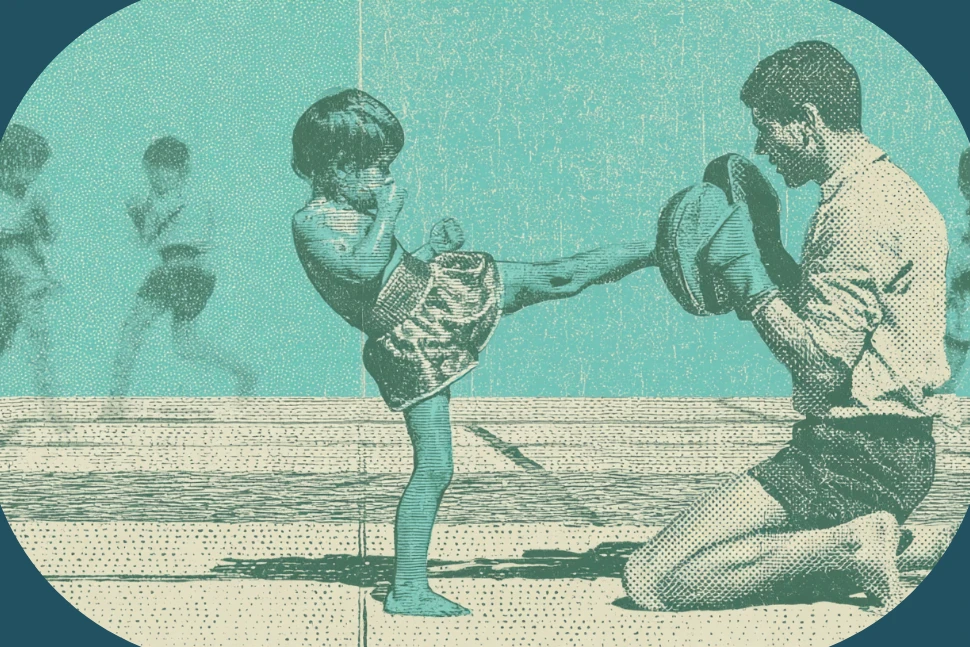

So what is Muay Thai, exactly? In 2020, when every gym in New York City was shut down, two Muay Thai fighters started training outdoors in lower Manhattan. Justin and Dillan Joucoo had known of each other from the New York fight scene for years.
Both were accomplished amateurs—Dillan with 41 amateur fights, Justin with around 30 before retiring from competition. A mutual friend introduced them, and with nowhere else to go, they started meeting up near the Brooklyn and Manhattan Bridges to keep sharp.
It was a selfish arrangement at first. Just two fighters holding pads for each other.
Then their personal training clients spotted them. "I thought you said you couldn't train me," they said. "What about me?" Within a few months, too many people were showing up to call it a training session anymore.
Justin, Dillan, and Justin's longtime coaching colleague James Villa made it official. Five years later, Two Bridges Muay Thai classes are full, the owners are all full-time coaches, and they're looking at a new space three to four times bigger.
"It was like a fun idea turned into a dream turned into reality," Justin says.
Two Bridges is one of thousands of Muay Thai gyms around the world, and every one of them started the same way: with somebody who couldn't not do it.
If you've been thinking about starting any kind of training, Muay Thai is worth a serious look. It's one of the many types of martial arts that rewards both fitness seekers and would-be fighters equally.
Which raises the question most people never actually get a clean answer to: what is Muay Thai, exactly?
What Is Muay Thai? The Short Answer
Muay Thai is Thailand's national sport and martial art. It's a full-contact striking discipline known as "The Art of Eight Limbs" because fighters use eight points of contact as weapons: two fists, two elbows, two knees, and two shins.
That's double the arsenal of Western boxing history, a sport that uses only fists, and more than most kickboxing rulesets, which typically allow punches and kicks but restrict elbows and knees.
Muay Thai is practiced at every level imaginable.
Thai kids start training at five or six years old. American adults take their first class for fitness at 40. Professional fighters compete at Lumpinee Stadium in Bangkok, and UFC champions use it as the striking foundation for mixed martial arts.
It's welcoming to beginners and one of the most honest martial arts you can train.
Here's everything you need to know before you step into a gym for your first class.
The Art of Eight Limbs: What Actually Makes Muay Thai Different
| Weapon | Muay Thai | Boxing | Kickboxing (K-1) | Taekwondo |
|---|---|---|---|---|
| Striking Weapons | ||||
| Fists (punches) | ||||
| Shins / Kicks | ||||
| Elbows | ||||
| Knees | ||||
| Close Range | ||||
| Clinch (knee & sweep range) | ||||
| Scoring Philosophy | ||||
| Effective striking (power required to score) | ||||
Most striking arts work with a limited toolkit.
Boxing uses two weapons: your fists. Taekwondo emphasizes kicks, and Karate mixes punches and kicks depending on the style. Muay Thai uses all of it, plus two weapons nobody else features as prominently: elbows and knees.
Here are the eight weapons and how they're used:
Fists (2). Similar to boxing punches, but with a subtly different stance. Muay Thai fighters square up more than boxers because they need to defend kicks and knees coming from any angle.
Elbows (2). Short-range, devastating, and legal in Muay Thai ring rules. Banned in most kickboxing rulesets. A clean elbow can end a fight outright, or open cuts that force a referee stoppage.
Knees (2). Thrown from distance, from the clinch, and from grabs. In traditional Thai scoring, knees often score higher than any other weapon because they demonstrate control and deliver maximum damage.
Shins (2). Used for kicks, for checking incoming kicks, and for sweeping. You'll spend years conditioning your shins because the shin bone, not the foot, is the striking surface.
Then there's the clinch, a grappling range unique to Muay Thai. When you lock up close with another fighter, you compete for dominant head and neck control, trying to create angles for knee strikes, off-balances, and sweeps.
No other striking art emphasizes the clinch the way Muay Thai does.
If you've ever watched a Muay Thai fight and wondered why both fighters are suddenly holding each other's heads and throwing knees, that's the clinch.
Dillan, who has 41 amateur fights, describes the difference between a Muay Thai roundhouse and the kicks he used to throw in Taekwondo:
"Taekwondo is more of a snap, a quick snap. A Muay Thai roundhouse is your full body into the kick. Your whole shin, everything is going, like you're trying to penetrate somebody—deliver a really devastating blow."
— Dillan Joucoo, Co-founder, Two Bridges Muay Thai (41 amateur fights)
That philosophy shows up in Thai scoring, too.
Unlike point-karate or Olympic Taekwondo, where touches to target areas score regardless of power, Muay Thai judges look for what the Thais call effective striking. If your shot doesn't visibly move the opponent or cause damage, it doesn't count.
"If you don't move the person with your shot, it doesn't score even if it lands."
— Dillan Joucoo, Co-founder, Two Bridges Muay Thai
That's what makes Muay Thai feel different when you train it. Every strike is supposed to mean something.
A Brief History: From Battlefield to Ring
Muay Thai's roots go back centuries in what was then the Kingdom of Siam.
According to Muay Thai tradition, its ancestor Muay Boran ("ancient boxing") developed as a battlefield combat system used by Siamese soldiers when they lost their weapons. Techniques were raw and practical, taught hand-to-hand in the army.
As warfare modernized, Muay Boran evolved into a sport.
By the early 20th century, fighters were competing in rings with rope-wrapped hands (and later gloves), formal rules, and designated rounds. The sport was officially named Muay Thai ("Thai boxing") in the 1920s and '30s.
By the mid-20th century, the first major stadiums became the spiritual home of the sport: Rajadamnern (1945) and Lumpinee (1956), both in Bangkok.
Outside Thailand, Muay Thai stayed relatively underground until Dutch kickboxers started traveling to Thailand in the 1970s and '80s to train and fight. They brought techniques back to Europe and blended them with Western boxing, spawning a generation of hybrid fighters.
When the UFC launched in 1993, and the first generation of MMA fighters started looking for the most effective striking base, Muay Thai was the obvious answer.
From there, you saw it spread worldwide.
Today, a traditional Thai gym in Bangkok and a modern American gym like Two Bridges teach essentially the same art, with the same traditions (the pre-fight wai khru ram muay dance, the mongkol headband, the ringside Thai music) layered over modern coaching methods.
What a Typical Muay Thai Class Actually Looks Like
This is the section that matters if you're thinking about trying your first class. A beginner Muay Thai class is a structured workout. If you've ever taken a solid spin class or a boot camp, you'll recognize the shape of it.
Here's what a typical 60-minute beginner class looks like at a gym like Two Bridges:
Warm-up (10–15 minutes). Jump rope, shadowboxing, dynamic stretches, maybe some footwork drills. You'll sweat before you throw a single strike. A good warm-up is one of the best predictors of whether you'll avoid injury long-term. Our guide on how to warm up and cool down properly covers the basics.
Technique drilling (20–30 minutes). A coach demonstrates a strike or combination (say, a jab-cross-low kick) and breaks down the mechanics. Students pair up and drill it slowly on Thai pads. The coach walks around correcting form. Nobody's trying to hurt you, and the pace stays deliberate the whole way through.
Pad work (15–20 minutes). Partner A holds the pads while partner B throws the combinations for a round (usually 3 minutes). Then you switch. This is where the workout intensity spikes.
Clinch work (10 minutes, usually intermediate/advanced). If the class includes clinch, you'll practice grip, balance, and knee strikes with a partner at light intensity.
Conditioning finisher (10 minutes). Bodyweight circuits, medicine ball work, or pad-based drills designed to crush you on the way out.
Cool-down and stretching. You'll leave soaked, tired, and probably grinning.
At a well-run gym, you'll follow the same structured curriculum as every other student, from first-timer to professional fighter. That structure is deliberate. Justin puts it this way:
"Every fighter was once a beginner. You need that foundation to grow to even be a fighter. So it's the same rules from beginner, intermediate, fighter, whatever it is. We build that foundation first."
— Justin, Co-founder, Two Bridges Muay Thai
A good gym will go out of its way to defuse the anxiety of that first visit. Two Bridges has a specific onboarding system you can look for—they call it the Three Friend Rule:
"We have a three friend rule. They come in, the front desk is their first friend. The front desk introduces them to a coach—that's their second friend. The coach introduces them to another student, and that's their third friend."
— Justin, Co-founder, Two Bridges Muay Thai
You don't walk in alone. By the end of your first class, you've met at least three people who know your name.
But Do You Actually Get Hit?
Let's address the fear directly, because it's the one thing that stops most curious people from ever walking through the door. Justin has thought about it a lot:
"It's already intimidating to step foot into a martial arts gym. So the way we marketed ourselves in the beginning was fitness. It's more broad, easier to get in. Martial arts makes people think, 'Oh, I don't want to get hit.'"
Here's the honest answer: no, you do not get hit in your first class. Or your tenth. Or your thirtieth, unless you decide you want to.
Contact in Muay Thai follows a deliberate progression:
- Pad work. You throw strikes at heavy Thai pads held by a partner or coach. No contact to the body.
- Partner drills. You practice techniques on a partner at zero power. They're not trying to hit you; you're not trying to hit them.
- Light technical sparring. Intermediate students only, with strict rules about power, usually in full protective gear.
- Hard sparring. Fighter track only. You opt in. Most students never do.
KEY TAKEAWAY:
Most Muay Thai students train for years without ever taking a real shot. Contact follows a deliberate ladder—pad work, partner drills, light technical sparring, and finally hard sparring—and you only move up when you choose to. Any legitimate gym makes that clear on day one.
If a gym pushes you to spar in your first week, walk out. That's disqualifying.
WARNING:
If a gym pushes you to spar in your first week, walk out. That is a red flag, not a feature. Sparring in your first days—before you have any technique or body awareness—means the gym prioritizes toughness theater over your development and safety.
Who Muay Thai Is Actually For
Muay Thai students generally fall into three buckets. You get to pick which one you want to be, and you can change your mind at any time.
The Fitness Seeker. You want the workout: full-body conditioning, sweat, skill progression that keeps cardio from getting boring. A 60-minute Muay Thai class is among the most calorie-intensive martial arts workouts you can do, and you'll build strength, flexibility, and endurance without ever touching a treadmill. This is the largest group at most gyms, and it's completely valid.
600–900 calories burned per 60-minute Muay Thai class, depending on size and intensity
$120–200/month for unlimited classes at a quality Muay Thai gym in a major US city
~$100–150 in gear to get started—hand wraps, mouthguard, and gloves. One of the cheapest martial arts to begin.
The Hobbyist Practitioner. You actually want to learn the art—the mechanics, the traditions, the technique. You train two to four times a week, drill seriously, and might eventually do in-house interclub matches or friendly sparring. You're not chasing a fight career, but you want to be good—and that's what most of a gym's loyal long-term members look like.
The Competitor. You want to fight. You join the fight team, train four to six times a week, follow a structured camp cycle, and accept that your body will get tested.
Competition starts in the amateur ranks and can progress to professional levels. Most people don't believe this until they see it: you can start this path at almost any age.
At Two Bridges, Justin can rattle off student transformations that make the age thing sound silly:
"One of them started with us in 2020. She's now a two-time champion. We have another who's about to fight for a title—she probably never thought about fighting. She's got almost nine fights in five years. Then we have a dude who started with us outside. He's a little older. He fought in Madison Square Garden. He's got almost 13 fights. He's a little above 40."
— Justin, Co-founder, Two Bridges Muay Thai
Read that again. A guy who started training in 2020, a little past 40, has now fought at Madison Square Garden and has 13 amateur fights on his record.
That's not a genetic freak. That's somebody who showed up consistently for five years and let the process work on him.
If you're curious about Muay Thai's growing appeal to women specifically, our guide to the best martial arts for women covers it.
Two Bridges also trains elite pros. Justin told us UFC fighter Khalil Roundtree came in and trained alongside regular members:
"We had Khalil Roundtree in here and he was following the instructions more than some of our guys. It's like, come on guys—he's a pro fighter and he's listening to the drill."
— Justin, Co-founder, Two Bridges Muay Thai
The fundamentals don't change depending on who you are. A pro drills the same techniques as a first-timer. That's one of the humbling things about Muay Thai.
What You Actually Need to Start
Starting Muay Thai is one of the cheapest martial arts to get into. You don't need a gi, you don't need a belt system, and most gyms will loan you gloves for your first class or two.
Month 1 (what you need on day one):
- Hand wraps (~$10 at any sporting goods store)
- Mouthguard (~$15; boil-and-bite works fine)
- Athletic shorts and a T-shirt or tank top
- That's it. Most gyms loan gloves to first-timers.
Month 2–3 (once you know you like it):
- Your own boxing or Muay Thai gloves, 14–16 oz for training (~$50–100)
- Shin guards (~$40–80), essential for any partner drills with contact
Later, if you keep going:
- Thai-specific shorts (traditional, and they breathe better than athletic shorts for pad work)
- Elbow pads if your gym does clinch sparring
- A jump rope for conditioning at home
One important note: "authentic" Muay Thai gyms tend to have slightly more traditional gear expectations than cardio-kickboxing classes at a commercial fitness chain. That's a good sign. It means the gym takes the art seriously, which means your coaching will be better.
Muay Thai vs Kickboxing, Boxing, and MMA: The Quick Comparison
You'll hear people use these terms interchangeably. They're not the same thing. Here's the short version:
Matchup |
What Muay Thai has that the other doesn't |
What the other has that Muay Thai doesn't |
Muay Thai vs. Kickboxing |
Elbows, knees, and the full clinch game |
Varies by ruleset; some allow more refined footwork |
Muay Thai vs. Boxing |
Six additional weapons (elbows, knees, shins) plus the clinch |
More refined footwork, head movement, and defensive boxing |
Muay Thai vs. MMA |
Deeper striking specialization and clinch work |
Wrestling, ground grappling, submissions |
Muay Thai vs. BJJ |
Full stand-up striking system |
Ground grappling and submission game |
Muay Thai vs. Judo |
Full striking system across all eight limbs |
Throws and takedowns |
Muay Thai vs Kickboxing. Kickboxing is a family of sports (K-1, Dutch, American) that allow punches and kicks but generally restrict or ban elbows, knees, and clinching. Muay Thai allows all eight weapons plus the clinch. Muay Thai stance is more square; kickboxing stance is often more bladed. If you see elbows and extensive knee-from-the-clinch work, you're watching Muay Thai. (We're publishing a deeper comparison soon—Kickboxing vs Muay Thai—link coming in the next few weeks.)
Muay Thai vs Boxing. Boxing is hands only, while Muay Thai adds six more weapons and the clinch on top of that. Boxing footwork is more refined than Muay Thai footwork, and Muay Thai has more kicking and clinching volume. Many fighters cross-train different martial arts to get the best of both.
Muay Thai vs MMA. MMA combines striking, wrestling, and ground grappling. Muay Thai is the striking foundation most MMA fighters build on, which is the reason so many modern MMA coaches have Muay Thai backgrounds. If you want to do MMA someday, Muay Thai is an excellent base. If you just want to strike, you don't need the grappling component.
Muay Thai vs BJJ. Muay Thai is stand-up striking; Brazilian Jiu-Jitsu is ground grappling. They solve different problems and most serious martial artists eventually train both.
Muay Thai vs Judo. Muay Thai is striking; teaching judo to beginners focuses on throws and takedowns. Two completely different traditions with zero overlap, both excellent in their respective ranges.
Is Muay Thai Good for Self-Defense?
Short answer: yes, probably better than most martial arts you could pick.
Here's why. Real-world self-defense situations tend to happen at close range, under stress, with adrenaline flooding your system. Muay Thai trains exactly those conditions. You develop the habit of throwing strikes with full body weight. You practice under pressure in pad work and drilling. The techniques—elbows, knees, clinch control—are specifically useful in the close quarters where self-defense situations occur.
You also build the single most important self-defense skill: the composure that comes from having hit and been hit in a controlled environment. Most people who've never taken a class freeze when they're in a physical confrontation. People who train freeze less.
If self-defense is your main goal, we've written a fuller comparison of options in our guide to the best martial art for self-defense.
How to Find a Good Muay Thai Gym
Not every gym teaching Muay Thai is teaching real Muay Thai. Cardio-kickboxing classes at big-box fitness chains often borrow the branding without the substance. Here's how to separate the two before you sign up:
1. Check the head coach's lineage. A good Muay Thai coach either trained extensively in Thailand, has a direct teaching lineage to a Thai coach, or has a serious competitive background. If the head coach can't point to either of those, be skeptical.
2. Watch a class before you pay. Any legitimate gym will let you observe. Look for a structured warm-up, real technique breakdown with corrections, pad work with coaching feedback, and students who actually look like they know what they're doing.
3. Ask about the beginner program. A good gym separates brand-new students from intermediate and advanced ones for at least the first few weeks. If everyone's in the same class regardless of experience, the newcomers get lost.
4. Expect to pay fair market rates. Based on typical pricing we've seen, a quality Muay Thai gym in a major US city runs $120–200 per month for unlimited classes. In smaller markets it might be $80–150. If it's dramatically cheaper, either it's a bargain or a warning sign.
5. Red flags. Sparring pushed on day one. Pressure to sign long contracts. A coach who brags more than teaches. No clear beginner progression. Any whiff of a belt-promotion revenue scheme (rare in Muay Thai, but watch for it in mixed-martial-arts gyms that tacked Muay Thai onto their karate curriculum). For a broader framework on picking any martial art, see our guide on how to choose a martial art.
The Only Way to Actually Know Is to Try One Class
Muay Thai is the kind of thing you can read about forever and still not understand until you stand in a gym and throw your first jab at a Thai pad. The gear is cheap, the first class is usually free, and the worst thing that happens is you spend an hour sweating in a new place and then go home.
Two Bridges got its start because three fighters couldn't stop training and their clients couldn't stop asking to join. Your local Muay Thai gym, wherever it is, has the same gravitational pull if you're the kind of person who needs to train. The only way to find out if that's you is to walk through the door once.
Pick a gym that looks promising. Watch a class. Sign up for the beginner package. Show up with hand wraps and a water bottle, and let the Three Friend Rule (or your local equivalent) do its thing.
You might fall in love with it the way Justin did at 11, or the way that 40-something guy did when he ended up fighting at Madison Square Garden. If you do, welcome to the Art of Eight Limbs. It's a big tradition with room for everyone.
If you're still weighing your options, our guide on how to choose a martial art can help you think it through—no pressure, no sign-up, just a framework for picking something you'll actually stick with.
If you run a Muay Thai gym and want to see how Two Bridges manages their classes, members, and marketing automations, check out the Two Bridges origin story or watch their full Gymdesk Originals episode. For owners thinking about adding a striking program, we've also covered adding a kickboxing program.
Gym management software that frees up your time and helps you grow.
Simplified billing, enrollment, student management, and marketing features that help you grow your gym or martial arts school.


FAQ
Muay Thai FAQs

Sean has spent the last decade creating content that helps businesses—small and not so small—grow smarter to allow operators to do more of what they love. You know, the fun stuff.
From shipping and international logistics to web development and marketing, he's done the work (not just the words) to scale retail and service businesses efficiently.
You can find his work at Sendle, Shogun, The Retail Exec, Gymdesk, and more.