

If your students ask what comes after green, the answer depends on whether your taekwondo is WT, ITF, or ATA (these acronyms will get more definition later, I swear).
These are the three governing bodies that determine taekwondo ranks and certify instructors.
As a martial art and Olympic sport, taekwondo (also written tae kwon do) is practiced by more than 80 million people worldwide and is taught in more than 209 countries.
The sheer size of the art may explain why there are multiple variations in belt colors and progression paths.
We'll take a look at all three systems, comparing them side by side and explaining what each belt means and what progression actually looks like in practice.
It's designed to be a helpful reference guide you can use whether you're explaining promotion to a new family, training a new instructor, or just want a clear reference for your own program.
How the Taekwondo Belt System Works
In the mid-20th century, Korean martial arts were formalized into national systems. Taekwondo developed its ranking system, drawing on judo and karate as references.
In taekwondo, the color progression is tied to a growth metaphor:
BELT COLOR |
SYMBOLISM |
GROWTH MEANING |
White | Seed | Beginning knowledge |
Yellow | Sunlight | Early growth |
Green | Plant | Skill development |
Blue | Sky | Expansion |
Red | Danger | Control and discipline |
Black | Maturity | Mastery and renewal |
Most taekwondo programs are divided into two major groups:
RANK TYPE |
DESCRIPTION |
DIRECTION |
Geup (Gup) | Color belts | Counts down (10th Gup to 1st Gup) |
Poom | Junior Black Belts | Counts up (1st Poom to 4th Poom) |
Dan | Black belts | Counts up (1st Dan to 10th Dan) |
Taekwondo ranks are divided into "junior" (or "student") and "senior" (or "instructor") sections.
The geup (gup) rank literally translates to "grade"; beginners start their training at 10th geup (white belt) and work toward 1st geup, then test for 1st dan black belt.
While the core philosophy remains the same, the taekwondo belt colors and meaning differ slightly across the three major organizations:
Here's a comparison of these three governing bodies:
FEATURE |
WT (WORLD TAEKWONDO) |
ITF (INTERNATIONAL) |
ATA (AMERICAN) |
Main Focus |
Olympic sport/sparring |
Traditional art |
Personal growth/system |
Contact |
Full contact |
Light continuous contact |
Semi-contact |
Head Punches |
No |
Yes |
No |
Intensity |
Hard sparring |
Light/moderate sparring |
Touch sparring |
Forms/Patterns |
Poomsae (Taegeuk) |
Tuls (Chang Hon) |
Songahm |
Key Feature |
High-speed kicking |
Sine wave movement |
Weapon training |
Let's take a closer look at these three organizations.
WT/Kukkiwon Belt Order (World Taekwondo)
The WT/Kukkiwon system is often referred to as the World Taekwondo Headquarters.
It's the official, government-sponsored governing body for Taekwondo, based in Seoul, South Korea.
Kukkiwon is supervised by the International Sports Division of the Ministry of Culture, Sports, and Tourism (MCST). It functions as a global hub for certifying dan (black belt) ranks and training instructors.
It's the Olympic format and the most widely practiced form of Taekwondo worldwide.
Here's what the WT progression looks like (including striped belts):
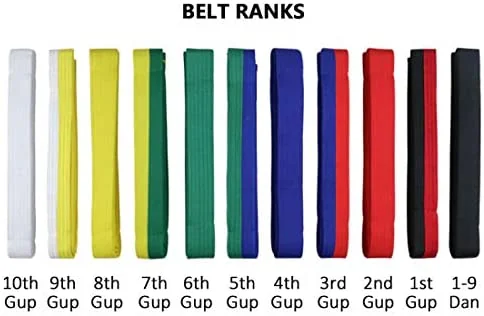
Standard WT belt order
GEUP |
BELT COLOR |
TYPICAL FOCUS |
10th |
White |
Basic stances, blocks, front kick. The "empty cup"—ready to learn. |
9th |
White w/ yellow stripe* |
Refining basics. Introduction to kicking combinations. |
8th |
Yellow |
First forms (Taegeuk Il Jang). Basic combinations and kicking fundamentals. |
7th |
Yellow w/ green stripe* |
Expanded forms. Building stance transitions. |
6th |
Green |
Technique solidifying. Roundhouse kicks, more complex poomsae. |
5th |
Green w/ blue stripe* |
Intermediate combinations. Sparring introduced. |
4th |
Blue |
Technical sparring. Jumping kicks introduced. |
3rd |
Blue w/ red stripe* |
Advanced poomsae. Controlled sparring. |
2nd |
Red |
Spin kicks, board breaking, mental discipline. Refinement before black belt. |
1st |
Red w/ black stripe* |
Final preparation. All techniques tested. |
1st Dan |
Black |
Foundational mastery. The beginning of advanced learning. |
*Stripe/tip belts vary by school. Kukkiwon defines five core color levels; most schools add intermediate ranks to create 8–10 color belts before black belt.
What makes WT different
When it comes to taekwondo sparring and competition, WT is the gold standard. Here's what makes WT different.
- Kukkiwon certification is recognized internationally. Students with full contact sparring, competition, or Olympic aspirations will need to train at a WT school.
- WT offers full-contact (the only full-contact TKD system). Full force strikes are delivered to the electronic vest, but malicious, uncontrolled, or intentional hits, particularly to the head, are penalized.
- WT Taegeuk poomsae curriculum. These are detailed defense-and-attack patterns and techniques ranging from beginner to advanced.
Timeline to black belt
Students at WT schools typically test for promotion every two to four months (with a consistent training schedule of two to three classes per week).
If these assumptions are correct, the average time to 1st Dan is typically in the 3- to 5-year range.
ITF Belt Order (International Taekwondo Federation)
The ITF belt order follows a 10-geup format with stripe progression. The ITF focuses on traditional, semi-contact "sine wave" movements and techniques.
Here's what this belt order looks like:
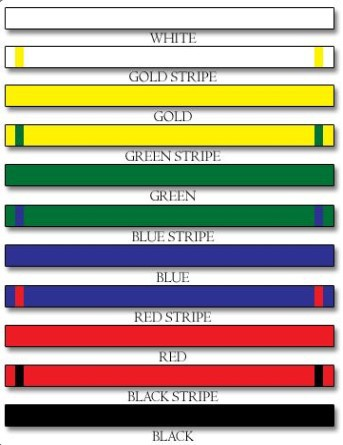
Standard ITF belt order
RANK |
BELT |
TYPICAL FOCUS |
10th Geup |
White |
Basic, foundational techniques |
9th Geup |
White/Yellow Stripe |
Refining basics |
8th Geup |
Yellow |
Learning essential kicks, blocks, and stances |
7th Geup |
Yellow/Green Stripe |
Building combinations |
6th Geup |
Green |
Developing power, improving, and refining techniques |
5th Geup |
Green/Blue Stripe |
Intermediate development |
4th Geup |
Blue |
Focusing on complex kicks, building speed, and agility |
3rd Geup |
Blue/Red Stripe |
Advanced technique |
2nd Geup |
Red |
Emphasis on controlling power and striking with precision |
1st Geup |
Red/Black Stripe |
Pre-Dan preparation |
1st Dan |
Black |
Building maturity, leadership, and expertise |
What makes ITF different
There are some significant differences between WT and ITF schools. While both are taekwondo organizations, these styles have some noteworthy distinctions.
- Uses 24 tul patterns instead of the Taegeuk poomsae (the colored belt curriculum), which have more shallow stances than forms in most other arts.
- The ITF uses a sine wave, a "down-up-down" movement, to generate power. It's using your knees as springs to drop, raise, and then drop the body's center of mass during techniques.
- Uses semi-contact sparring: The ITF allows punches to the head, and they don't use chest guards. This contrasts with the WT, which allows harder contact.
- Minimum time to black belt: The average timeline for promotion (assuming an attendance of 2–3 classes per week) is generally 3.5–4 years.
The overall taekwondo belt promotion timeline remains similar to WT systems.
ATA/Songahm Belt Order
The ATA belt order differs more visibly than WT or ITF systems.
Their rank system divides rankings into two series: the colored belt series and the black belt series. Each series has nine ranks and is designed to (1.) establish a hierarchy and (2.) measure student progress.
Here's what that looks like:
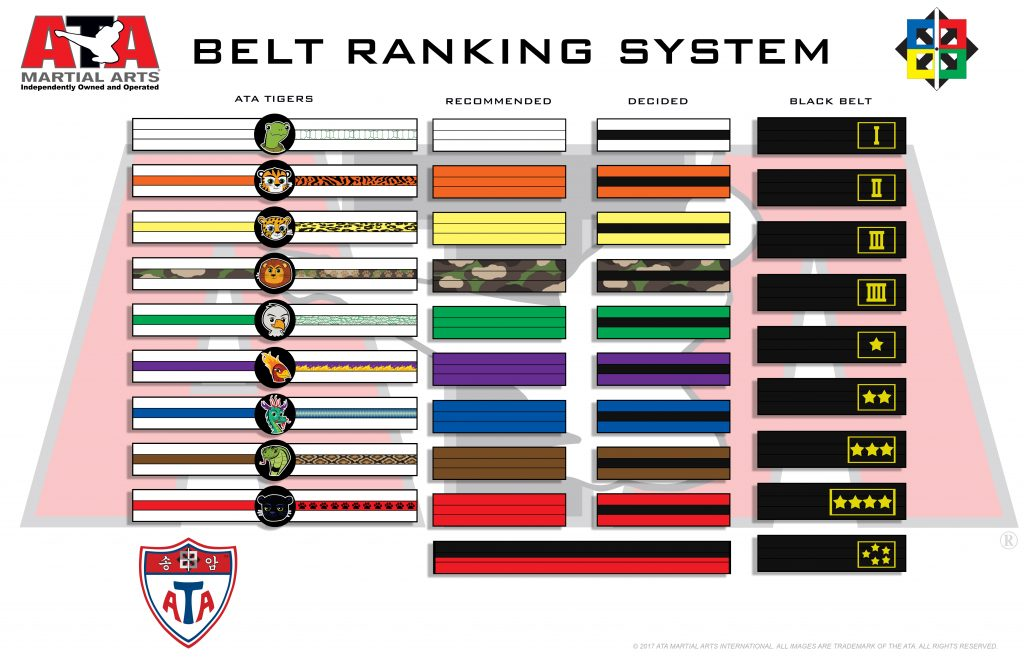
Why so many belts? Two main reasons drive this:
- Adding more belts helps maintain student motivation by giving them more short-term goals to achieve. This also means students no longer need to remain in a single color for months at a time. Students in Western markets seem to prefer frequent recognition.
- This variation was created for a Western market. ATA founder Haeng Ung Lee got his start teaching American servicemen. ATA forms and curriculum were specifically developed for the US market, focused on well-rounded personal development. ATA has 300,000+ students across 21 countries and is one of the largest taekwondo organizations in the US.
Here's a breakdown of the ATA's ranking system.
ATA Songahm taekwondo belt order
RANK |
BELT |
Beginner | White |
1 | Orange |
2 | Yellow |
3 | Camouflage |
4 | Green |
5 | Purple |
6 | Blue |
7 | Brown |
8 | Red |
9 | Red/Black |
Dan | Black |
What makes ATA distinct
- The ATA is a commercialized system emphasizing personal development, proprietary forms, weapons training, and a mix of WT/ITF techniques.
- Orange precedes yellow belts, and this system includes unique colors like camouflage. These belts are intended to shorten the promotion cycle.
- Includes recommended black belt phase. This is similar to the WT and ITF.
- Under the ATA, students reach black belt faster (typically around ~2.5–3 years).
The ATA curriculum also includes youth-specific programs—perfect for families looking for an established taekwondo belt system for their kids.
Belt Order Comparison: WT vs ITF vs ATA
Here's a side-by-side comparison of the belt orders offered by these governing bodies.
WT/KUKKIWON |
ITF |
ATA |
White |
White |
White |
Yellow |
White/Yellow |
Orange |
Green |
Yellow |
Yellow |
Blue |
Yellow/Green |
Camouflage |
Red |
Green |
Green |
Black |
Green/Blue |
Purple |
- |
Blue |
Blue |
- |
Blue/Red |
Brown |
- |
Red |
Red |
- |
Red/Black |
Red/Black |
- |
Black |
Black |
Key takeaways
- All taekwondo systems begin with white and end with black belts.
- Color counts range from six to 10 belts, depending on the organization or style.
- Promotion and recognition varies by organization, and it can vary by school as well. For example, two WT schools may also have different belt ranking systems.
- Testing fees differ widely in taekwondo. Belt testing fees typically range from $30 to $100+ per exam for colored belts. Black belt tests tend to be more expensive, with pricing ranging from $300 to $1,500+ (the higher cost is often due to registration with organizations like Kukkiwon).
Taekwondo Black Belt Levels: The Dan Rank System
Contrary to popular belief, a black belt isn't an indicator of mastery or the end of your training—it's the start of advanced learning. Colored belts lay the foundation that you use once you've achieved your black belt.
Taekwondo Dan ranks
The Kukkiwon groups Dan ranks into three tiers. Titles and expectations vary across schools—what one school calls a "master" at 4th Dan, another might not recognize until 5th or 6th.
The titles below follow the Kukkiwon standard, but your school may use different terminology.
RANK |
KUKKIWON TIER |
COMMON TITLE |
MIN. TIME AT PREVIOUS RANK |
1st Dan |
Trained student |
Black Belt |
3–5 yrs from white belt |
2nd Dan |
Trained student |
Assistant Instructor (kyo sah nim) |
1 yr |
3rd Dan |
Trained student |
Assistant Instructor |
2 yrs |
4th Dan |
Instructor/Master |
Master (sah bum nim) |
3 yrs |
5th Dan |
Instructor/Master |
Master |
4 yrs |
6th Dan |
Instructor/Master |
Master |
5 yrs |
7th Dan |
Grand Master |
Grand Master (kwan jang nim) |
6 yrs |
8th Dan |
Grand Master |
Grand Master |
7 yrs |
9th Dan |
Grand Master |
Grand Master |
8 yrs |
10th Dan |
Honorary |
Supreme Grand Master |
- |
Titles vary by school and organization. These follow Kukkiwon/WT conventions. The ITF and ATA use different title structures. 10th Dan is honorary—only a handful have been bestowed by Kukkiwon.
Kukkiwon also sets minimum age requirements at each Dan rank—you must be at least 15 for 1st Dan, 21+ for 4th Dan (Master level), and 44+ for 8th Dan.
Between the time-in-rank minimums and the age floors, reaching 9th Dan before your early 50s is essentially impossible. These are Kukkiwon standards—the ITF and ATA set their own thresholds, and individual schools sometimes vary from all three.
As of April 2026, the Kukkiwon has issued over 12.3 million certificates, which are internationally recognized as the most prestigious ranks in Taekwondo.
That's significant because only holders of Kukkiwon-issued Dan and Poom certificates are allowed to compete in international competitions organized by World Taekwondo.
Poom vs Dan: The Junior Black Belt System
This is one of the most misunderstood topics in the taekwondo belt ranking system. Outsiders and martial artists are very critical of this.
Many martial artists feel a 10-year-old black belt isn't credible—that they shouldn't hold the same rank as an adult who's been training for decades.
What is a Poom belt?
A poom belt is a junior black belt awarded to students under age 15 who pass black belt testing.
It's a transitional rank that's a visible indicator of competence that also signifies that these students are not yet ready for full Dan status.
RANK |
DESCRIPTION |
1st–4th Poom | Junior black belt levels |
Conversion | Converts to Dan at age 15 |
The Poom belt is not an inferior or lesser achievement.
Students who achieve this rank are expected to meet the same technical requirements as Dan and receive a transitional belt until they've fully matured.
In some schools, this rank converts automatically to Dan at age 15. However, most schools will need to apply for 1st Dan.
Most students earn 1st poom between ages 8–14 after completing 3–5 years of training. Many people feel that kids (under 15) and a black belt are incompatible.
What to Expect at a Taekwondo Belt Test
Parents often ask about taekwondo testing requirements by belt, and transparency matters here.
Typical test components
Testing assesses student proficiency in several core areas.
COMPONENT |
PURPOSE |
Forms | Demonstrate memory and technique |
Sparring | Decision-making and applied skills under pressure |
Self-defense | Practical, real-world application |
Board breaking | A demonstration of power and control |
Fitness | Measuring physical conditioning and stamina |
Written test | Knowledge and history |
Typical costs
The costs for belt tests vary by organization and school. Here are the typical price ranges for belt tests.
TEST TYPE |
COST RANGE |
Color belt |
$30–$100 |
Black belt |
$150–$500+ |
Kukkiwon certification |
$70–$150 |
ITF certification |
$100–$700 |
ATA certification |
$50–$1,000 |
In many schools, tracking promotion eligibility means clipboards, spreadsheets, and memorization. Schools that switch to digital tracking find that it's easier to monitor attendance, student eligibility, and performance requirements.
With digital tracking, it's also easier to notify families ahead of testing day.
Fee aside, there's the question of tracking: how do you identify which of your students are eligible to test? How do you monitor all of the students in your school who are ready to be tested?
Here's a detailed look at how digital tracking works for King Tiger Taekwondo, a martial arts school that faced these same challenges.
How Taekwondo Belts Compare to Karate
Taekwondo and karate share common roots, but their progression systems differ. There are similarities between these two martial arts, but a few differences set them apart—junior black belts, technique, and testing emphasis.
Here's a comparison of these two martial arts.
FEATURE |
TAEKWONDO |
KARATE |
Color belt ranks |
6–10 (varies by org) |
6–9 (varies by style) |
Terminology |
Geup (color) / Dan (black) |
Kyu (color) / Dan (black) |
Rank counting |
Geup counts down (10th → 1st) |
Kyu counts down (10th → 1st) |
Junior black belt |
Poom (under 15) |
Rare—most styles don’t have one |
Time to black belt |
3–5 years |
3–5 years |
Testing emphasis |
Kicks, poomsae/tul |
Hand techniques, kata |
Governing bodies |
WT, ITF, ATA (3 major) |
WKF, JKA, style-specific orgs |
Olympic format |
Yes (WT sparring) |
Yes (WKF kumite) |
Taekwondo and karate are very similar.
How do these ranking systems compare with other martial arts? If you're curious about how they do it in Brazilian Jiu-Jitsu (trust me, it's quite different), take a look at the BJJ belt system. It offers another useful perspective on how belt progression differs across various martial arts.
Make Taekwondo Belt Ranks and Progression Transparent
KEY TAKEAWAY:
The belt system your school uses matters less than how clearly you communicate it. Schools that retain students longest are the ones where families always know where they stand—what their student needs to test, what comes next, and how long it takes.
Taekwondo schools with consistently high student retention make belt ranks and progression transparent.
Take it a step further.
Choose the right gym management software to track and manage student progress. You'll find that you spend less time tracking attendance or manually tracking belt records and more time teaching, mentoring, and shaping your students into superstars.
If you're a black belt thinking about opening your own dojang, here's how to start a taekwondo school from federation choice to first-year roadmap.
Gym management software that frees up your time and helps you grow.
Simplified billing, enrollment, student management, and marketing features that help you grow your gym or martial arts school.


FAQ
TKD Belt Order FAQs
.webp)
Andrew McDermott is a gym owner, Brazilian Jiu Jitsu brown belt, and digital marketer. He’s on a mission to build premier, high-stakes grappling tournaments, world-class academies, and a championship team of high-level athletes.