

Walk into any decent-sized gym and you'll find half a dozen people who all call themselves personal trainers.
One's running a boot camp out in the parking lot. One's hunched over a laptop building meal plans for a bodybuilder. One's leading a spin class loud enough to rattle the windows.
Same job title. Completely different jobs.
That's the part that trips people up. When you go looking for a trainer—or, if you run a gym, when you go looking for trainers to hire—"personal trainer" tells you almost nothing.
The specialty is what matters.
Get it right and you're matched with someone whose whole skill set points at your goal. Get it wrong and you're paying premium rates for advice that doesn't fit.
So let's sort the field out. Here are the nine types of personal trainers, what each one is actually good for, what they cost, and—if you're thinking about the career yourself—which lane fits you.
KEY TAKEAWAY:
Not all personal trainers do the same thing. Start by identifying your goal—physique change, weight loss, sport performance, group motivation, or remote convenience—then find a certified specialist in that lane.
What Is a Personal Trainer?
A personal trainer is a fitness professional who builds your exercise program, guides your nutrition, and keeps you accountable to your goals.
They figure out where you are now and map the route to where you want to be—dropping weight, adding muscle, moving better, or performing in a sport.
Before anyone writes you a program, a good trainer assesses a few basics:
- Flexibility, posture, and balance
- Body composition (measurements, body fat percentage)
- Cardiovascular endurance
- Coordination and agility
One thing to check before you hand over your money: credentials aren't all equal. Look for a certification from an NCCA-accredited body like NASM, ACE, or ACSM.
That accreditation is your proof the trainer met a real, tested standard instead of printing a certificate off a weekend website.
The 9 Types of Personal Trainers
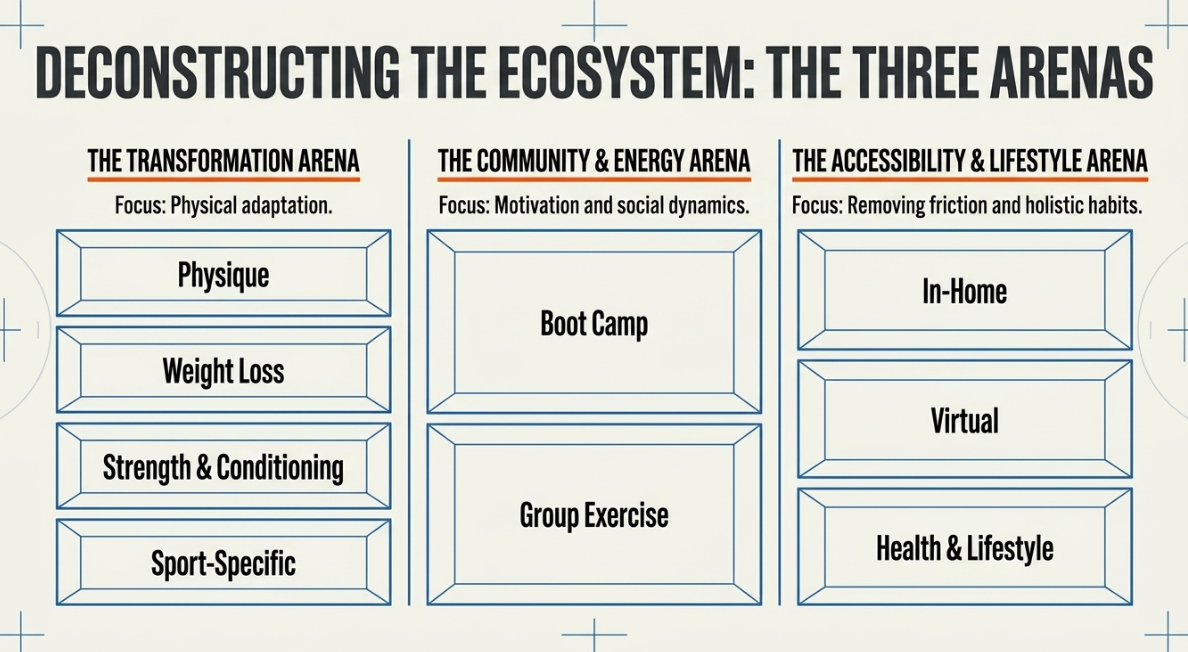
Trainers specialize, and the specialty is the whole game.
The coach prepping a bodybuilder for the stage is not the coach leading your lunchtime spin class. Here's what each type does best—and who tends to thrive in the role, if you're sizing up the career.
Physique trainers
If your goal is to look different—less fat, more muscle, a specific shape—this is your trainer.
Physique trainers work with bodybuilders, athletes prepping for a shoot, and everyday people chasing a visible transformation. They pair resistance programming with detailed nutrition plans, and they track everything: measurements, photos, the slow creep of progress week over week.
Consider this lane if you love the science of hypertrophy and contest prep, and you don't mind the long relationships a real transformation takes.
Weight loss specialists
Weight loss trainers zero in on fat loss without necessarily piling on muscle.
You'll find them working with everyone from an actor prepping for a role to someone whose doctor just told them to drop 50 pounds. They set realistic weekly targets, keep a close eye on what you're eating, and adjust as your body adapts.
The good ones build habits you'll keep after the sessions stop—not a crash diet you'll abandon by spring.
Consider this lane if you're strong on behavior change and accountability, not just programming.
Strength and conditioning coaches
Strength and conditioning coaches build raw capacity—strength, power, speed, work capacity—rather than a look.
They program barbell lifts, plyometrics, and energy-system work, often in a gym, a CrossFit box, or a team setting. Where a physique trainer trains for the mirror, an S&C coach trains for the platform or the field.
Consider this lane if you've got an exercise-science background and you want measurable performance, not just a before-and-after photo.
Boot camp instructors
Boot camp instructors run high-energy group sessions built on interval training, bodyweight circuits, and the occasional obstacle course.
If you've ever driven past a group flipping tires in a park at 6 a.m., that's a boot camp.
These classes pull in people who need outside motivation and feed off a competitive crowd. Boot camp instructors aren't one-on-one trainers—they're closer to group fitness leaders who design intense, structured workouts for a room full of people.
Consider this lane if you're high-energy and you'd rather fire up a room than program for one person at a time.
Group exercise instructors
Group exercise instructors lead classes like spin, Pilates, cardio kickboxing, and dance fitness.
They work in studios, gym group-ex rooms, and sometimes outdoors. Within group exercise you'll find sub-specialties—cardio formats, strength classes, and mind-body work like Pilates and yoga.
The line between group exercise and boot camp comes down to intensity and structure. Group classes tend to follow a fixed format—same time, same room, same playlist energy. If you want variety and a social buzz without boot-camp-level punishment, this is your move.
Consider this lane if you're a performer at heart who can run an engaging, repeatable class.
Sport-specific trainers
Sport-specific trainers work with athletes who need to get better at one thing: their sport.
That's speed and agility drills for a soccer player, rotational power for a baseball pitcher, reaction-time work for a boxer. These trainers usually come from an exercise-science or sports-performance background, and they build the program around the exact demands of your sport and position.
Consider this lane if you're a former athlete or an exercise-science grad who wants to coach performance over general fitness.
In-home and mobile trainers
In-home trainers bring the session to you—your living room, your garage, the building gym, a nearby park.
They've grown fast because they remove the two biggest reasons people quit: travel time and gym intimidation. The trade-off is equipment. A good mobile trainer programs around a kit bag of bands, dumbbells, and bodyweight progressions instead of a full rack.
Consider this lane if you want to own the relationship—and the margins—without renting floor space.
Health and lifestyle coaches
Health and lifestyle coaches pull back from a single workout to the whole picture: sleep, stress, nutrition habits, long-term behavior change.
They often work alongside your healthcare providers and lean harder on coaching and accountability than on barbell technique. If your real obstacle is consistency and lifestyle rather than programming, this is the lane.
Consider this lane if you're as interested in psychology and habits as you are in sets and reps.
Virtual personal trainers
Virtual training took off during the COVID lockdowns and stuck around because, for a lot of people, it just works. Virtual trainers deliver programming over video calls, custom apps, or pre-recorded workout libraries.
The upside is convenience—you can train from your living room, a hotel gym, or a park.
The trade-off is less real-time feedback on your form. If you're an experienced lifter who mainly needs programming and accountability, virtual training is a solid, cheaper option. If you're a beginner who needs hands-on correction, in-person still wins.
Consider this lane if you want to reach past the limits of a local schedule and coach people anywhere.
Personal Trainer Types at a Glance
Not sure which lane fits? This table maps each type to who it's best for and how the sessions usually run. (Costs are relative—see the cost section below for dollar figures.)
Type | Best for | Typical format | Relative cost |
Physique trainer | Muscle gain, body recomposition, contest prep | 1-on-1 | High |
Weight loss specialist | Sustainable fat loss, habit change | 1-on-1 | Mid–high |
Strength & conditioning coach | Strength, power, athletic capacity | 1-on-1 or small group | Mid–high |
Boot camp instructor | Motivation in a group, all-around conditioning | Large group | Low |
Group exercise instructor | Variety, social energy, cardio/mind-body | Group class | Low |
Sport-specific trainer | Performance in one sport | 1-on-1 or team | High |
In-home / mobile trainer | Convenience, privacy, busy schedules | 1-on-1 at your location | Mid–high |
Health & lifestyle coach | Sleep, stress, nutrition, long-term habits | 1-on-1 (often remote) | Mid |
Virtual trainer | Self-motivated exercisers, travel, lower cost | Video or app | Low–mid |
How Trainers Deliver Sessions
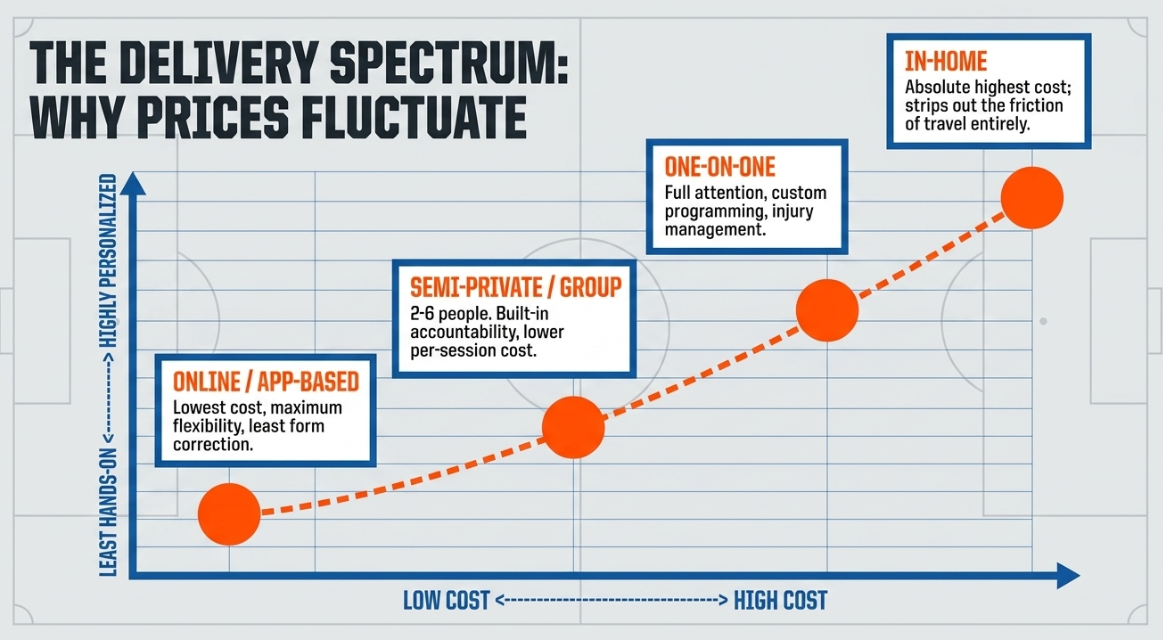
Two trainers can hold the exact same certification and feel nothing alike to work with—because the delivery model shapes the price and the experience as much as the specialty does.
- One-on-one: the trainer's full attention, fully custom programming, top of the price range. Best when you're learning form, training around an injury, or chasing a specific goal.
- Semi-private / small group: two to six people sharing a coach. You keep most of the personalization at a lower per-session cost, plus a little built-in accountability from the people training next to you.
- Online / app-based: programming and check-ins delivered remotely. Lowest cost, most flexibility, least hands-on correction.
- In-home: the trainer comes to you. You pay a premium for it, but it strips out the friction that quietly kills most routines.
If a trainer's price looks high or low for their specialty, the delivery model is usually the reason.
How to Choose the Right Personal Trainer
Choosing a trainer isn't complicated. Get clear on what you actually want—weight loss, muscle, sport performance, general fitness—then find someone who specializes in that. From there, check their credentials and ask a few questions before you commit a dime.
Qualifications to look for:
- NCCA-accredited certification: NASM, ACE, or ACSM are the most recognized
- Relevant education: a degree in kinesiology, sports science, or nutrition is a plus
- First aid and CPR certification: non-negotiable for handling emergencies
- Liability insurance: protects you both if something goes wrong
Questions to ask before you sign up:
- How long have you trained people with goals like mine?
- What does a typical session look like?
- Is your coaching style hands-off or high-energy?
- What are your rates, cancellation policy, and package options?
WARNING:
Avoid trainers who skip an initial assessment of your injuries or physical limitations. Be wary of anyone who guarantees fast results or pushes you to sign a long-term contract before you have had a single session. Trainers are not doctors—if someone tries to diagnose a medical condition, walk away.
For more on the hiring side, we've covered choosing a trainer, the reasons to hire one, and the skills every personal trainer needs.
How Much Does a Personal Trainer Cost?
Personal training isn't cheap. Most mid-level trainers charge between $40 and $80 a session, and the price swings on a handful of factors. Plenty of gyms also require a membership before you can book their trainers at all.
Factor | Impact on Cost |
Experience level | New trainers charge less; veterans with specialized certifications charge more |
Location | Trainers in major metros cost significantly more than those in smaller markets |
Session type | Group sessions run cheaper than one-on-one training |
Session length | Longer sessions (60–90 min) cost more than 30-minute check-ins |
Want a quick estimate for your own situation? Try our personal training rate calculator to ballpark a fair rate before you book.
If you're hiring a personal trainer for the first time, start with a small package—four to eight sessions—so you can test the fit before you commit real money.
How Much Do Personal Trainers Earn?
If you're reading this to pick a career instead of a coach, here's the other side of the ledger. Pay swings hard on specialty, certification, location, and whether you're an employee or out on your own. The national average for a general personal trainer sits around $49,966 a year—but the specialty you pick moves that number a lot.
Specialty | National average salary | Source |
General personal trainer | $49,966/yr | |
Bodybuilding / physique coach | $61,076/yr | |
Exercise specialist | $51,940/yr | |
Lifestyle coach | $47,955/yr | |
Health coach | $47,397/yr | |
Sports coach | $38,978/yr |
Independent trainers who own their relationships—especially in-home and online coaches—can clear well above these employee averages. They also carry their own marketing, insurance, and no-show risk. If the career still appeals to you, start with our guide on how to become a personal trainer.
How Often Should You Meet With a Trainer?
How often you train comes down to your goals and your budget. Sessions add up fast, so most people work with a trainer two to three times a week and handle the rest on their own.
A good trainer hands you a plan for the solo days—nutrition guidance and a workout to follow—so you're never guessing. Over time you learn enough to run your own routine.
Some people keep a trainer long-term purely for accountability. Others phase out after a few months and check in quarterly. The right frequency is whatever keeps you progressing without wrecking your finances.
How Your Gym Benefits From Personal Trainers
If you run a gym, offering personal training is one of the most practical ways to keep members engaged and coming back. A trainer gives members a reason to stay—when someone's seeing results with a coach, they're far less likely to cancel.
What personal trainers add to your gym:
- Stronger member retention: members working with a trainer stick around longer and show up more often
- Extra training revenue: packages, semi-private sessions, and specialty programs bring in income beyond monthly dues
- Lower injury risk: proper coaching means fewer member injuries and less liability landing on you
You can manage training sessions right inside your gym management software—bookings, payments, and attendance in one place instead of a pile of spreadsheets and paper sign-ups.
And if you're still building your team, hire trainers whose specialties match the members already walking through your door.
Match the Trainer to Your Goal
Not every personal trainer does the same job, and picking the wrong type costs you time and money. Start with your goal—physique change, weight loss, sport performance, group motivation, or remote convenience—then find a certified specialist who lives in that lane.
If you run a gym, the right mix of trainer specialties can move your retention numbers and open new revenue lines at the same time. Match your trainers to your members, give them the tools to actually deliver results, and the training program starts paying for itself.
Gym management software that frees up your time and helps you grow.
Simplified billing, enrollment, student management, and marketing features that help you grow your gym or martial arts school.


FAQ
Personal Trainer FAQs
Here are the questions that come up most about trainer types, costs, and certifications.

Sean has spent the last decade creating content that helps businesses—small and not so small—grow smarter to allow operators to do more of what they love. You know, the fun stuff.
From shipping and international logistics to web development and marketing, he's done the work (not just the words) to scale retail and service businesses efficiently.
You can find his work at Sendle, Shogun, The Retail Exec, Gymdesk, and more.