
Nobody signs up for teacher training to learn zoning law (that's a very roundabout way to do it, if so).
But somewhere between your last 200-hour module and your first lease, words like "certificate of occupancy" start showing up in your life.
That's normal. It means you're starting a yoga business.
Quick disclosure: I'm a marketing guy. You're not getting pose cues from me. The business side, though, I can help with.
Here's the short version. To open a yoga studio, settle three things first: what kind of yoga you'll teach and for whom, whether you'll run your own space or share one, and whether your area has room for you.
Then work through ten steps: write a lean business plan, set your budget and line up funding, form your business and get licensed, insure it, choose your location, design the room, build your schedule and prices, hire your teachers, set up booking and billing, and market before you open.
This guide walks the whole setup in order, from first decision to launch week.
If your first question is how much it all costs, that has its own guide on yoga studio startup costs, with a line-item budget and the break-even math.
What to Decide Before You Open a Yoga Studio
These calls shape every step that follows. Make all three on paper before you tour a single space.
Your style and who it's for
"Yoga" is too broad to market.
Heated vinyasa for people who want a workout, yin and restorative for stressed-out desk workers, prenatal, beginners over 50: each one is a different room, a different schedule, and a different person reading your website.
Pick the style you teach best and the people you most want in front of you.
Your studio name, your brand, and your pricing all follow from that choice, so it's worth getting right before you pay a designer for a logo.
Your own studio, a shared space, or hybrid
You don't need a lease to start.
Plenty of teachers rent a room by the hour, run classes inside a gym that sits empty in the mornings, or teach online and in parks while they build a following.
That route is slower to feel "real," and it's a lot less risky. If you're weighing it, read our guide to teaching yoga without a studio.
A hybrid works too. Own a small room for your core classes, then stream or rent space for the overflow.
Is there room in your market?
Pull up a map and search "yoga" within a 15-minute drive of where you'd open. Count the studios, then look at what each one teaches, when, and what it charges.
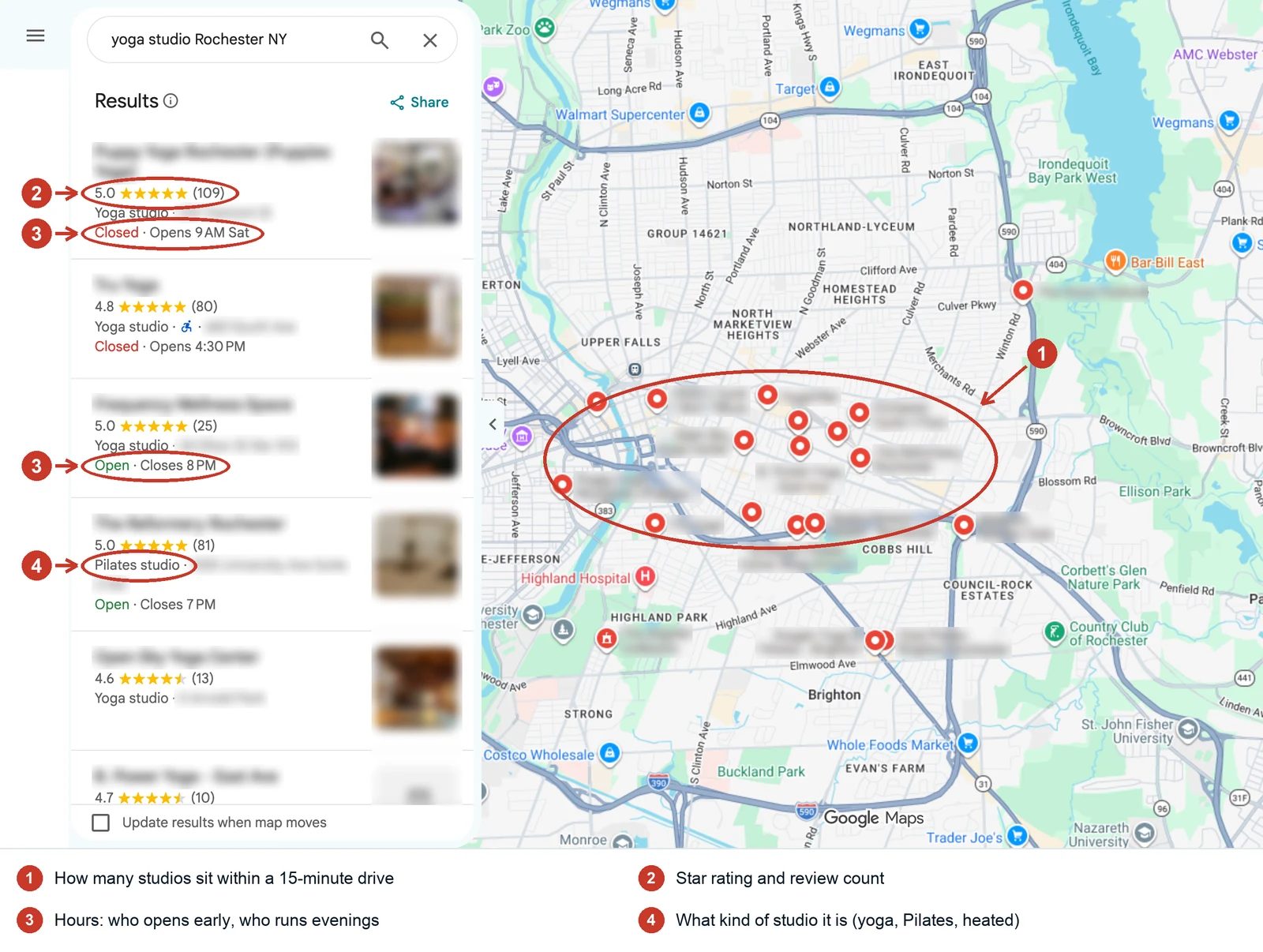
You're looking for the gap.
Maybe nobody runs a 6am class. Maybe there's no heated room on your side of town. Maybe every studio nearby is built for advanced students and nobody's serving the nervous beginner.
If you can't name the gap in one sentence, keep looking before you commit.
We'll keep you in the loop with fresh content, podcasts, how-to guides, tool reviews, and product exclusives.
How to Open a Yoga Studio in 10 Steps
Work these roughly in order. A few overlap, and that's fine, as long as nothing gets signed before the step that checks it.
1. Write a lean business plan
A business plan is how you find the holes in your idea while they're still cheap to fix.
It's also what a lender will ask for first. Nobody has ever gotten a loan on vibes alone.
Cover these sections, and keep each one short:
- Executive summary: what the studio is, who it serves, and why now.
- Classes and services: styles, schedule, workshops, retail.
- Operations: who runs the front desk, who teaches, who has keys.
- Target market: the people from your market check, described specifically.
- Location: the area you want and why.
- Marketing plan: how the first 50 students find you.
- Funding plan: what you have, what you need, and where it comes from.
- Financials: startup budget, monthly costs, and projected members, with conservative growth.
The full section-by-section walkthrough lives in our guide to writing a yoga studio business plan.
2. Set your budget and line up funding
The budget is the step that decides the size of everything else, so do it before you fall for a space.
The cost guide breaks it into line items, with a lean column and a full build-out column, so build yours from that and from local quotes.
Most new studios fund the opening from some mix of these.
- Savings. Simplest, because you answer to nobody. It's also your money on the line, so keep a personal cushion that the studio never touches.
- Friends and family. Common, and fine, if you treat it like a real loan or investment. Put the terms in writing, including what happens if the studio closes. Thanksgiving is awkward enough already.
- A small business loan. Banks and credit unions will look at your personal credit and your business plan, since the studio has no track record yet.
SBA MICROLOANS AT A GLANCE:
- Loans of up to $50,000, with an average of about $13,000 (SBA)
- Made through nonprofit community lenders that the SBA funds; those lenders make the credit decisions
- Can cover working capital, equipment, supplies, furniture, and fixtures
- Can't be used to buy real estate or pay off existing debt
- Repayment terms run up to seven years, and interest generally falls between 8% and 13%
Borrow what the plan says you need, reserve included. A loan sized to the build-out alone leaves you short in month three, when rent is due and the schedule isn't full yet.
3. Form your business and get licensed
This is the paperwork step, and the least zen part of this whole guide. Breathe through it.
It's less scary than it sounds, but some of it takes weeks, so start early.
Work through it in roughly this order:
- Pick a business structure. Many studio owners form an LLC, which keeps business debts separate from personal ones. A CPA or business attorney can tell you what suits your situation. The SBA's launch guide explains the common structures.
- Register your business name with your state, plus a DBA ("doing business as") if the studio name differs from your legal entity name.
- Get an EIN, your federal tax ID. You need it to hire, open a business bank account, and pay taxes, and you can apply for free with the IRS.
- Get your local business license from your city or county.
- Check zoning before you sign anything. Zoning rules can restrict what kind of business can operate in a building, and they're set locally. Your city planning office can confirm a space is zoned for your use.
- Get a certificate of occupancy if your city requires one for a commercial space opening to the public. The building or planning department handles it, and it's often tied to inspections after a build-out.
- Get a sales tax permit if you'll sell mats, clothing, or anything else at the front desk.
- License your music. More on this one below, because it catches a lot of new owners.
- Write your liability waiver. Every student signs one before their first class. Our guide to writing a gym liability waiver covers what goes in it.
About the music. Your personal Spotify account is licensed for personal listening. A room full of paying students needs a different license.
It doesn't stretch that far, no matter how good the warm-up is.
US copyright law requires permission from the music's copyright owners to play it in your business, according to ASCAP's yoga studio licensing page.
An ASCAP license covers songs by ASCAP members. Other songwriters are represented by separate organizations, including BMI and SESAC, so ask each one which license fits a yoga studio, or build your playlists from a service that licenses music for business use.
(Look, I'm not going to narc on you. You should still know the law before your first playlist does.)
4. Get the right insurance
Get coverage in place before the first class. The first twisted ankle is a bad time to start shopping.
The policies most studios look at:
- General liability covers injuries and accidents on your premises.
- Professional liability covers claims that your instruction caused an injury. Check whether it covers every teacher on your schedule or only you.
- Property coverage, often bundled with general liability as a Business Owner's Policy, covers your build-out, sound system, and props.
- Workers' compensation applies once you have employees, and most states require it.
Your landlord will probably ask for proof of liability coverage before handing over keys. The types of gym insurance guide explains each policy in more detail, and the cost guide covers what to budget.
5. Choose your location
Rent is a big monthly commitment, so pick the neighborhood before you pick the floor plan. Go back to your market check: the studio belongs near the people you described in your plan.
Before you sign, check the space for:
- Parking and access. Can someone get from their car to the mat in under five minutes, with a mat bag and a coffee?
- Neighbors and noise. Visit at the times you'd hold class. A spin studio or a bar upstairs will be in every savasana.
- Heating, cooling, and airflow. A heated studio needs a system that can hold the temperature and move humid air out. Get an HVAC contractor's opinion before you sign.
- Changing rooms and restrooms, or space to add them.
- Zoning and occupancy. Confirm both with the city before the lease is final.
For a deeper walkthrough, read our guide to choosing a yoga studio location. The lease money terms, like deposits and who pays for maintenance, are in the cost guide.
6. Design the room
Yoga is light on gear. That's great news for a new owner, because the room itself does most of the work.
Get these right first:
- Flooring that's easy on knees and easy to clean. Hard floors that can handle sweat suit heated classes, and cushioned floors suit gentler styles.
- Sound: a decent speaker, a mic for bigger classes, and some acoustic panels if the room echoes.
- Lighting you can dim, because nobody relaxes under office fluorescents.
- Storage for props, so the room looks calm when students walk in.
- Props: mats, blocks, straps, bolsters, and blankets for the styles you teach. Start with what your classes actually use and add specialty props when students ask.
Capacity follows from your floor space.
The cost guide has the square-footage math, and your local fire and occupancy rules set the legal ceiling.
7. Build your class schedule and pricing
Your opening schedule should be smaller than the one you dream about. (Everyone's dream schedule has a 5:30am class. Your students may have opinions.)
A few well-attended classes beat a full grid of half-empty rooms, because a full room feels like a studio worth coming back to.
Start with the times your target students can actually make, usually early mornings, lunch, and after work. Leave room to add classes once the first ones start to fill.
Then set up your pricing:
- An intro offer that lets a new student try the studio for a couple of weeks without a big commitment.
- Memberships, monthly recurring plans that keep your income steady.
- Class packs and drop-ins for people who can't commit to a regular schedule.
To figure out the actual numbers, read our guide on what to charge for yoga.
8. Hire your teachers
Your teachers are the studio, as far as most students are concerned. They're the person a student sees three times a week and the reason that student renews.
Look for solid training first.
Yoga Alliance's RYT 200 is the foundational Registered Yoga Teacher credential, built on 200 hours of training at a Registered Yoga School, and Yoga Alliance says most new teachers start there.
Specialty credentials exist for children's and prenatal yoga if you plan to teach those classes. If you'll teach too and haven't trained yet, start with our guide to becoming a yoga instructor.
Then look for fit. Can they teach your style, at your level, to your students? Ask them to teach a class you take.
Decide early whether teachers are employees or contractors. The IRS looks at the whole working relationship: how much you control what they do and how, the financial side of the job, and whether there's a lasting relationship with benefits or a written contract.
If you set the schedule, the class format, and the dress code, that points toward employee.
Your state may have its own test too, so check with a CPA before the first paycheck.
Pay usually runs per class, per head, or a mix of the two. To set fair rates, see how much yoga instructors make, and for the hiring process itself, read our guide to hiring yoga studio staff.
9. Set up booking, billing, and your website
Picture opening week. Twenty people want the 6am class, which holds fourteen.
Three of them haven't signed a waiver. Two paid in cash, one paid by Venmo, and one says she bought a class pack at the open house, which nobody wrote down.
That's what running a studio from a spreadsheet, a payment app, and a paper clipboard looks like. Each tool works on its own.
Together they create a second job, and it's the job nobody trained for. Call it the manual tax.
The fix is one system that runs the whole loop. Students should be able to find a class on your website, book a spot, sign the waiver, and pay in the same few taps.
Memberships should renew on their own, and a full class should fill from its waitlist when someone cancels.
That's what yoga studio software like Gymdesk is for. Students book online, with class capacity and a waitlist that promotes the next person automatically.
Waivers get signed during booking, so nobody's signing paper at the front desk.
Memberships, class packs, and intro offers bill on schedule with autopay, and an intro offer can roll into a full membership when it ends. Your online booking and schedule show up on a website you build inside Gymdesk, or on the site you already have.
Every plan includes the full platform, and you pick a tier by active members. Compare options in our roundup of the best yoga studio software before you commit.
The payoff is simple. You spend opening week teaching, and Venmo can wait.
FOR YOGA STUDIOS
Booking, waivers, and autopay set up before your first class, so opening week goes to teaching and the spreadsheet never gets a vote.
See Gymdesk for Yoga10. Market before you open
The worst grand opening is the one where you and your mom are the only people on the mats. (She's very supportive. She's also not a membership.)
Start marketing before the doors open.
What tends to work for a new studio:
- A founding-member presale. Sell a limited number of memberships at a founding rate before opening day. It brings cash in early and proves demand before your first class.
- Your Google Business Profile. Claim it as soon as you have an address, add photos as the build-out finishes, and ask your first students for reviews. Our guide to yoga studio SEO covers the rest of local search.
- A grand opening. Free community classes, an open house, a local partner or two. Collect emails and book people into a real class before they leave. Our gym grand opening guide has the full playbook.
A Realistic Timeline for Opening Your Studio
How long does all this take? Longer than the Instagram version.
The lease, the build-out, and the permits usually set the pace.
When | What to work on |
6+ months out | Pick your style and model, check your market, write the business plan, set the budget |
4–6 months out | Form the business, get your EIN, line up funding, tour spaces, confirm zoning, sign the lease |
3–4 months out | Build out the room, apply for permits, buy insurance, license music, start hiring teachers |
2 months out | Set the schedule and pricing, set up booking and billing, launch the website, open the founding-member presale |
1 month out | Claim your Google Business Profile, train teachers on your systems, plan the grand opening, run a soft-open class or two |
Opening week | Grand opening, intro offers, and follow-up with everyone who came |
This is an illustrative planning timeline. Build yours backward from the date your lease starts.
Your First 90 Days
Your doors are open. Now the first three months decide whether the studio sticks.
Your biggest job is turning intro students into members. Know who's on an intro offer, follow up with each one before it ends, and make the membership the easy next step.
Learn names. Ask how the class felt. Notice who hasn't been back in a couple of weeks and check in.
Then build the reasons people stay. Workshops, a regular community class, and teachers who remember a student's tight hamstrings all add up.
Our guide to building a positive studio culture goes deeper.
Why New Yoga Studios Struggle
Studios that close early tend to trip over the same few things.
- No niche. A studio that's "for everyone" gives nobody a reason to drive past three other studios to get there. Go back to your one-sentence gap.
- Building out ahead of demand. A beautiful reception desk doesn't fill classes. Spend on the room students practice in, and keep the rest of your money as a reserve. The cost guide's section on hidden costs shows where first budgets usually leak.
- Teachers without support. A teacher who leaves isn't always a bad hire. Sometimes they got no onboarding, no feedback, and a schedule that changed weekly. Train your team, pay them fairly, and tell them what good looks like.
- No marketing before launch. Even a great studio is invisible if nobody knows it's there. That's why step 10 starts months before the doors open.
Franchise, Buy an Existing Studio, or Start From Scratch?
There's more than one way through the front door.
A franchise gives you a known brand, a tested system, and support. In exchange, you pay an upfront franchise fee and ongoing royalties, and you follow their rules on everything from class formats to paint colors.
Ask for the Franchise Disclosure Document, read it with an attorney, and call current owners before you sign.
Buying an existing studio gets you a room, a schedule, teachers, and students from day one. You also inherit whatever isn't working.
Before you buy, check the real member count in the billing system, the lease terms and how long they run, and whether the teachers plan to stay.
Abe Awad did exactly this with the martial arts school he'd trained and taught at for years. Here's what buying a martial arts school looked like for him at Subforce Jiujitsu in New Jersey.
Starting from scratch gives you full control over the style, the space, and the culture, along with every decision and every risk.
It's the slowest route to a full schedule and the one this guide is built for.
FREE CHECKLIST
Yoga Studio Launch Checklist
Every step from this guide, grouped by how far out you are from opening day. Tick things off as you go. Your ticks save in this browser, so you can come back to it.
6+ months out
4–6 months out
3–4 months out
2 months out
1 month out
Get the Printable PDF
Want it on paper? Pop your email in and the PDF download shows up right here.
Same checklist, ready to print. Tape it to the wall of your future studio.
Download the printable PDFOpen the Doors
Opening a yoga studio is a long list of small, doable steps. Take the steps in order, and start marketing before the paint dries.
Let your software handle the bookings, waivers, and billing, so your evenings go to teaching.
See how Gymdesk for yoga studios handles the whole setup, then go teach your first class.
The rest is practice. (Sorry. It had to go somewhere.)