
Jiu-Jitsu (BJJ) vs Wrestling: Which Grappling Style Fits You Best?

Two grappling arts. Two completely different answers to the same question: what do you do when the other person doesn't want you to win?
Of all the grappling-based martial arts you could pick, these two pull more crossover traffic than the rest combined.
Here's the short version.
In BJJ vs wrestling, there's no universal winner. There's a better fit for you—based on your goals, your age, and what's actually available where you live.
Wrestling gives you superior takedowns, brutal conditioning, and a free path through the school system if you're young enough to use it.
BJJ gives you a complete ground game—chokes, joint locks, sweeps from positions wrestlers consider catastrophic—plus a training environment you can stay in for the next forty years.
For real-world self-defense effectiveness, BJJ usually has more tools. You can choke an attacker unconscious, hyperextend a limb, or just hold someone in place from mount until help arrives—all without throwing a single punch.
Wrestling gets you to the ground faster and pins better, but pure wrestling has no mechanism to actually finish the fight.

For school-age athletes in the US, the math flips.
High school wrestling is everywhere—per NFHS data, 291,874 boys wrestled in 2023–24 with girls participation growing fast, and the NCAA gives you a clear competitive runway. BJJ lives in private academies, which makes it more accessible for adults but harder for teenagers to fit into a school year.
A concrete picture: a 70 kg BJJ blue belt against a larger untrained attacker pulls them into closed guard, breaks their posture, and finishes with a triangle choke in seconds. A high school wrestler against a brand-new BJJ white belt blasts through with a double-leg, lands top pressure, and rides them for a minute—but doesn't know how to end it.
Choose wrestling if you want grueling practices, seasonal competition, and explosive athletic power.
Choose BJJ if you want technical learning, submissions, and a chess-like game you can play into your sixties.
Both if you can manage it. That's the real answer most serious grapplers land on.
KEY TAKEAWAY:
There's no universal winner between BJJ and wrestling—there's a better fit for you. Wrestling is free, school-based, and seasonal; it gives you takedowns, top control, and elite conditioning. BJJ is private-academy-based and year-round; it gives you submissions, comfort fighting from your back, and a practice you can sustain into your sixties. Adults usually pick BJJ. Teenagers with school programs usually pick wrestling. Serious grapplers eventually train both.
Origins: Two Different Family Trees
Wrestling and Brazilian jiu-jitsu sit on the same combat family tree, but their branches sprouted thousands of years apart.
Wrestling has archaeological evidence going back to ancient Mesopotamia and Greece (circa 3000–700 BCE). BJJ emerged in Brazil barely a century ago. That gap—roughly 5,000 years—shapes how each art thinks about a fight.
Wrestling's ancient roots
Wrestling may be humanity's oldest combat sport.
The Greeks added it to the Olympic Games in 708 BCE. By the 19th century, Greco-Roman wrestling was formalized in France, emphasizing upper-body throws and forbidding attacks below the waist.
Freestyle wrestling joined the Olympic program at the 1904 St. Louis Games—legs were now in play, and the foundation for modern American wrestling was set.
Through the 20th century, scholastic and collegiate wrestling exploded across the US.
The NCAA built formal weight classes, scoring rules, and a competitive pyramid that runs from middle school mats to Olympic podiums. That pipeline now feeds talent into MMA, professional wrestling, and just about every grappling art that benefits from a wrestling base.
BJJ's Brazilian birth
Brazilian jiu-jitsu traces its lineage through Japanese martial arts. In the early 1900s, a Japanese judoka named Mitsuyo Maeda traveled the world demonstrating judo and Japanese jiu-jitsu.
Between 1914 and 1917, he landed in Brazil and began teaching Carlos Gracie. Carlos and his brothers—especially Hélio—adapted what they'd learned into a ground-focused system built on leverage rather than brute strength.
The Gracie family refined the art through decades of challenge matches, proving a smaller practitioner could defeat larger, stronger opponents by taking the fight to the ground and applying submissions. (For a deeper dive into BJJ's evolution, see how jiu-jitsu has evolved.)
The world saw it for itself in 1993.
At UFC 1, Royce Gracie—small, skinny, in a gi—submitted opponents from striking and wrestling backgrounds who had no answer for his guard work. He went on to win UFC 1, 2, and 4 (he withdrew before the semifinal at UFC 3). One man in pajamas changed how every fighter on earth trained.
By the 2010s, every high-level MMA fighter had either a wrestling base, a BJJ base, or—if they were smart—both.
(For a deeper look at how grappling stacks up against striking systems, comparing combat effectiveness across disciplines is a useful frame.)
Core Principles: The Win Conditions Are Different
This is the single most important thing to understand: wrestling and BJJ are trying to do completely different things. Wrestling wants takedowns and pins. BJJ wants positional dominance leading to submissions.
That difference explains almost everything else.
In wrestling, being on your back is a disaster. You're seconds from being pinned and losing the match.
In BJJ, your back is a weapon. The guard position turns "the worst place to be" into an offensive platform. Sweeps, triangles, armbars, chokes—all launched from underneath.
Wrestling rewards explosiveness, forward pressure, and chain-wrestling—stringing takedown attempts together until one lands. The whole goal is to control the hips and shoulders, drive the opponent to the mat, and keep them there.
BJJ rewards leverage and timing. Practitioners use frames, angles, and positions like closed guard, half guard, and back control to set up sweeps and submissions.
A BJJ fighter might deliberately pull guard—a move that would be suicide in wrestling—because they've drilled thousands of hours attacking from there.
Picture two strategies in one sentence each. Wrestler shoots a double-leg, drives through, exposes the back for the pin. BJJ player accepts the takedown, locks closed guard, breaks posture, finishes with a triangle.
Both arts use intelligent body control. Their strategies just diverge the moment the fight hits the ground.
Key principles of wrestling
Wrestling is a top-control, takedown-driven sport with clear scoring across folkstyle, freestyle, and Greco-Roman.
The primary objectives:
- Secure takedowns from standing—shots, throws, trips
- Maintain dominant top control through riding and pressure
- Expose the opponent's back to the mat for near-fall points
- Achieve a pin—both shoulders on the mat for about one second
Essential techniques: level changes, penetration steps, sprawls, and—in collegiate wrestling—riding time. Wrestlers train from day one to get back to their feet immediately if taken down.
Never stay on bottom.
That mentality becomes invaluable when wrestlers transition to MMA, where bottom position means absorbing strikes.
Key principles of Brazilian Jiu-Jitsu
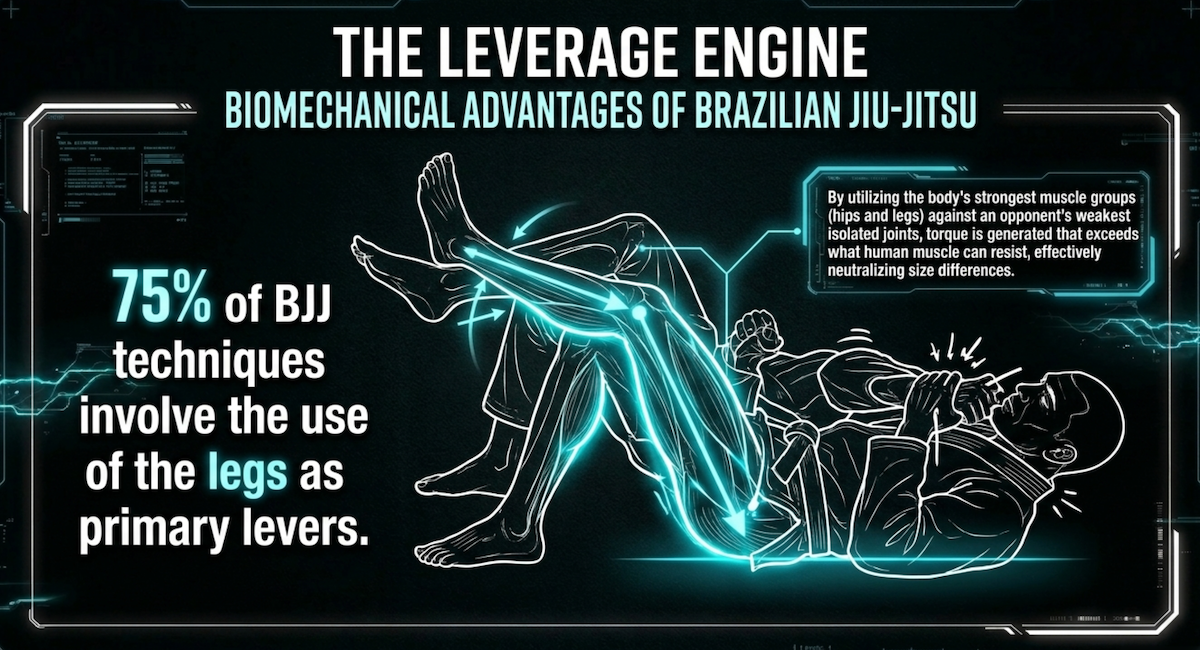
BJJ is often called the gentle art because it leans on leverage and technique rather than strikes. It lets a smaller practitioner control or submit a larger attacker without throwing a punch.
This isn't marketing. It's physics. A properly executed armbar generates torque that exceeds what any human muscle can resist, regardless of size.
The main goals:
- Achieve a dominant position—mount, back control, side control
- Finish with a submission—joint lock or choke
- Attack effectively from disadvantaged positions—the various guards
- Sweep or reverse opponents to improve position
Fundamental concepts include guard retention, frames and wedges, hip movement, off-balancing (kuzushi), and the positional hierarchy.
A typical progression: guard → sweep → side control → mount → back take → rear naked choke.
A submission ends the match regardless of score. Points reward positional advancement, but the finish is sovereign. BJJ athletes train both gi (using the kimono for grips and chokes) and no-gi (faster, with wrestling-style grips).
For the basics of what BJJ is, the foundation is here. The wrestling-first, no-gi-default training culture now reshaping the sport has its own name—the American jiu-jitsu movement.
Gear and Training Environment
The uniform shapes the art more than people realize.
Wrestling gear
- Singlet—tight one-piece allowing unrestricted movement
- Wrestling shoes—grip and ankle support on the mat
- Headgear—usually required in scholastic settings to prevent cauliflower ear
- Knee/elbow pads—optional protection during hard drilling
The mat is typically circular with boundary lines. Wrestlers go out of bounds, they're stood up and reset—which encourages constant forward attack rather than defensive stalling.
BJJ gear
Two formats, two different games.
Gi training:
- Heavy cotton jacket (similar to a judo gi)
- Matching pants
- Colored belt indicating rank (white through black and beyond)
For specifics on what to look for in your first kimono, see the BJJ gi guide.
No-gi training:
- Rash guard (compression shirt)
- Grappling shorts or spats
- No belt visible during training
The gi opens up hundreds of grip variations on lapels, sleeves, and pants. That alone creates entirely different tactical possibilities than no-gi grappling. The IBJJF standardizes gi competition. ADCC showcases elite no-gi.
Training environments
Wrestling rooms emphasize drilling, live goes (sparring), and intense conditioning circuits. Practices run uniformly hard—often multiple full-intensity rounds daily during competitive seasons.
BJJ gyms typically open with technical instruction, move into positional sparring, then full rolling rounds (5–10 minutes each). Intensity flexes more—you can choose lighter rolls for technical development or hard competitive rounds for fight prep.
That flexibility is exactly why BJJ stays accessible across ages and fitness levels.
Rules, Scoring, and Match Structure
Rules create incentives. Wrestling rules punish being on your back. BJJ rules embrace the guard. That's the whole story right there.
Wrestling match structure
Element | Folkstyle (NCAA) | Freestyle / Greco |
Periods | 3 periods (3-2-2 minutes) | 2 periods (3 minutes each) |
Takedown points | 2 points | 2-4 points (based on amplitude) |
Pin | Match ends | Match ends |
Riding time | Up to 1 point bonus | Not used |
Passivity | Not penalized directly | Penalized; can lead to shot clock |
A wrestling match ends instantly with a pin. Otherwise points decide—takedowns, escapes, reversals, near-falls. International freestyle actively penalizes passivity, forcing constant attack.
BJJ match structure
Standard IBJJF lengths:
- White and blue belts: 5 minutes
- Purple belt: 7 minutes
- Brown belt: 8 minutes
- Black belt: 10 minutes
Scoring:
- Takedowns: 2 points
- Guard passes: 3 points
- Sweeps: 2 points
- Mount: 4 points
- Back control: 4 points
A submission ends the match regardless of score. That's the entire philosophy in one rule. Points reward progress, but the finish is the prize. (For the full belt structure and what's expected at each rank, the BJJ belt system is a useful reference.)
How rules translate to MMA
In MMA under Unified Rules, wrestling-oriented fighters often win rounds through takedowns and top control.
Judges score effective grappling heavily. Khabib Nurmagomedov—who averaged 5.32 takedowns per 15 minutes across his UFC career—dominated through exactly this path.
BJJ specialists go the other way: threatening submissions from guard or taking the back. Charles Oliveira leads UFC history with 17 submission finishes.
Spectacular results, even against elite wrestlers.
The two arts compete for the same outcome from opposite directions. That's why the best fighters borrow from both.
Ranking, Progression, and Training Culture
Each art measures progress differently. That difference shapes the entire long-term experience.
BJJ belt system
Belt | Typical time | Description |
White | 0-2 years | Beginner fundamentals |
Blue | 2-4 years | Intermediate techniques |
Purple | 4-6 years | Advanced concepts |
Brown | 6-8 years | Refining personal game |
Black | 8-12+ years | Expert level |
Coral / Red | 30+ years | Grandmaster ranks |
Promotions weigh technical knowledge, live sparring performance, competition results, and mat time. Most practitioners train for a decade before earning black belt. That's not a bug—it's the whole appeal. BJJ isn't a quick-achievement system; it's a lifestyle.
The purple belt requirements post gives a sense of how granular the standards get.
Wrestling progression
Wrestling has no universal belt. Skill is validated through results:
- Grade levels (JV vs. varsity)
- Local and national rankings
- Tournament placements (district, state, nationals)
- College recruitment and NCAA rankings
Brutally objective. Either you placed at state or you didn't. That clarity is part of what makes wrestling so intense.
Cultural differences
Wrestling community: grueling team practices, weight cutting, seasonal peaks (late autumn to early spring), team-first mentality.
BJJ academies: year-round practice, mixed-age classes, varied intensity options, individual progression paths.
Both build mental toughness and discipline. The difference is in the timeline.
Wrestling typically peaks for athletes in their late teens or early twenties—the body just doesn't sustain that intensity forever. BJJ is regularly practiced by people into their 40s, 50s, and beyond. It's a true lifelong art.
(The benefits of Brazilian jiu-jitsu make this longevity case in detail.)
Self-Defense: When Sport Rules Don't Apply
A real fight has no referee. No out-of-bounds reset. And punches are very much allowed.
How does each art translate?
Wrestling in self-defense
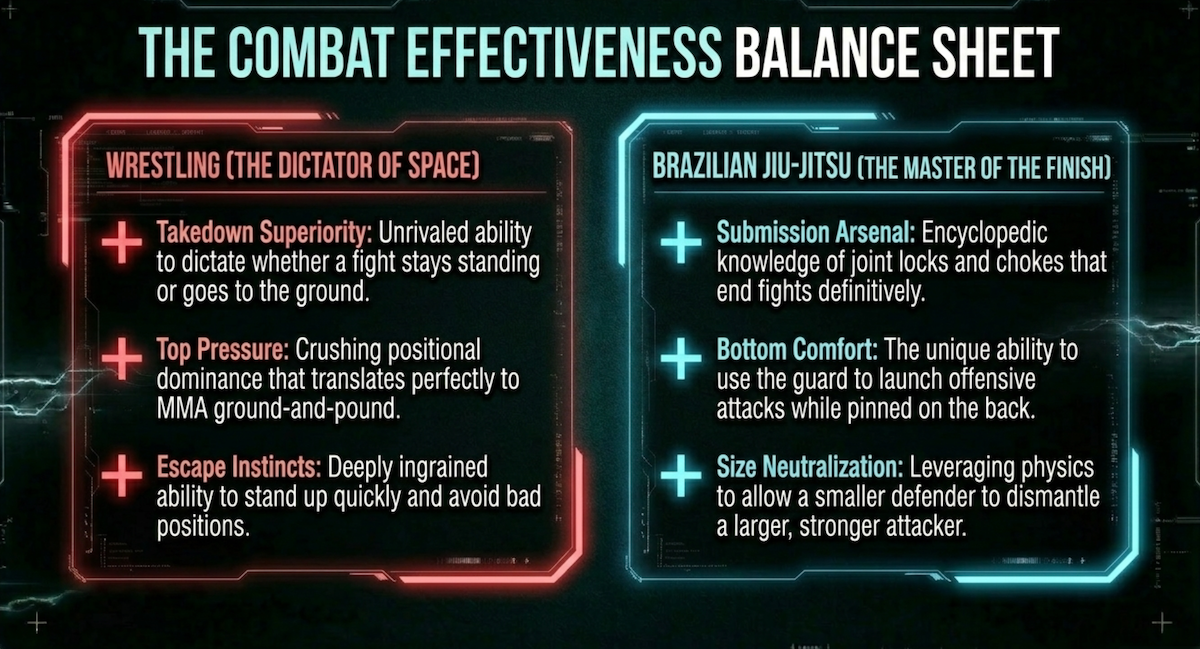
Wrestling translates powerfully to street confrontations:
- Rapid takedowns—put attackers on the ground immediately
- Strong clinch control—neutralize striking
- Dictate whether the fight goes to the ground
- Top pressure—pin and control until help arrives
Wrestlers can put someone on their back and either disengage or hold position. Reaction times are faster, entries are more decisive.
But pure wrestling has limits in a street fight. No training for chokes or joint breaks. No practice against punches and kicks. And a rule-trained habit of avoiding bottom positions can create openings against skilled strikers or submission artists.
BJJ in self-defense
Many BJJ academies explicitly address self-defense:
- Standing self-defense techniques (grip breaks, clinches)
- Takedown defense (sprawls, underhooks)
- Closing distance safely against strikers
- Controlling and submitting attackers on the ground
BJJ's positional control from mount, back control, or side control lets you restrain an attacker without heavy striking—important for legal and ethical reasons in civilian situations. Traditional Gracie jiu-jitsu curricula include specific responses to common attacks: shirt grabs, headlocks, bear hugs, haymakers.
A concrete self-defense scenario
A trained BJJ practitioner facing an aggressive attacker in a parking lot might:
- Clinch to neutralize striking range
- Execute a body lock takedown
- Establish mount or take the back
- Apply a rear naked choke until the attacker loses consciousness
Threat ends. No legal complications from striking someone repeatedly. BJJ teaches control and finishing—two options wrestling, limited to pins and holds, simply doesn't include.
Intensity, Conditioning, and Use of Force
Both arts are physically demanding. They're not demanding in the same way.
Wrestling conditioning
A typical wrestling practice:
- Hard drilling of takedowns and escapes
- Multiple live goes (sparring matches)
- Conditioning circuits—sprints, rope climbs, burpees
- Heavy emphasis on pace
Wrestlers train daily during season, pushing the limit repeatedly.
Studies of elite collegiate and national-level wrestlers show VO2 max levels around 50–58 ml/kg/min—high-end cardiovascular conditioning that transfers directly to other combat sports.
That's why so many MMA champions—Khabib Nurmagomedov, Daniel Cormier, Henry Cejudo, Kamaru Usman—come from wrestling backgrounds. The intensity builds mental toughness alongside physical capacity. They simply don't break.
BJJ conditioning
A BJJ session typically runs:
- Technical instruction (30-45 minutes)
- Positional sparring (specific scenarios)
- Full rolling rounds (5-10 minute matches)
Practitioners learn to manage energy through timing, frames, guard work, and selective explosiveness. A BJJ competitor can train hard for competition or dial back for technique—which is exactly why people stay on the mats for decades.
Use of force
Wrestling is limited to pins and holds by its rules. Excellent control, no finishing mechanism.
BJJ includes joint locks and chokes that can cause real injury if applied fully. A hyperextended elbow or unconscious opponent is a real possibility. That's why control, tapping (submitting), and safety protocols are absolutely central to BJJ training culture.
Your training partners are your training partners. Take care of them.
Injury rates reflect the differences. NCAA wrestling sees roughly 8.8 injuries per 1,000 athlete-exposures overall (with competition rates several times higher than practice rates), often to knees and shoulders from high-impact scrambles.
The most-cited BJJ competition study (Scoggin et al., 2014) found about 11% of competition injuries were to the hand and fingers—largely from gi grips—with overall match impact lower thanks to controlled training intensity.
Where BJJ Has the Edge
When rules are removed or in submission-based environments, BJJ has clear advantages wrestlers have to respect.
Submission knowledge
BJJ practitioners build encyclopedic finishing systems:
- Arm attacks—armbars, kimuras, americanas
- Chokes—rear naked choke, triangle, guillotine, bow-and-arrow
- Leg attacks—heel hooks, kneebars, toe holds (in advanced no-gi)
A wrestler without submission training is vulnerable in deep ground exchanges. The catalog of finishing options simply doesn't exist in their vocabulary.
Comfort from bottom positions
BJJ practitioners are uniquely comfortable fighting off their backs. Closed guard, half guard, butterfly guard, lapel guards—what wrestlers consider disaster, they treat as an offensive platform. Sweeps, submissions, and reversals flow continuously from these positions.
Size neutralization
BJJ's emphasis on leverage lets smaller practitioners control larger opponents. The physics of submissions—fulcrums generating torque beyond muscle resistance—don't care about weight differences.
That makes BJJ particularly valuable for self-defense, where attackers are often significantly larger.
Longevity and accessibility
You can train BJJ at moderate intensity for decades. That's the killer feature.
Many academies have mixed-age classes—teenagers training alongside retirees. The community spans body types and ages in ways competitive wrestling simply doesn't.
Historical validation
Royce Gracie's tournament wins at UFC 1, 2, and 4 in the 1990s proved submission skill could overcome top-pressure grappling. Larger wrestlers, strikers, and stylists from every major tradition were submitted by a relatively small BJJ specialist. Decades of Gracie family challenge matches, validated on the biggest stage available.
Where Wrestling Has the Edge
Wrestling's competitive and practical strengths translate powerfully to MMA and real confrontations.
Takedown superiority
Wrestlers have a massive advantage in getting fights to the ground on their terms. Double-legs, single-legs, body locks, trips—drilled thousands of times. BJJ practitioners who don't cross-train wrestling or judo often lack comparable takedown ability.
The skill of dictating whether the fight stays standing or goes to the ground is arguably the most valuable in all of fighting.
MMA scoring advantages
Under Unified Rules, judges reward takedowns and ground control heavily. Many modern champions—Kamaru Usman, Henry Cejudo, Khabib Nurmagomedov, Islam Makhachev—built their games on a wrestling foundation. A wrestling background gives you a clear path to winning rounds.
Conditioning edge
Years of grinding practices, cuts, and competitions build what wrestlers call a never quit mentality. It's the most consistent thing about wrestlers in MMA: they don't break when things get hard.
Top pressure and ground-and-pound
Wrestlers' riding skills translate directly to MMA ground-and-pound. Keeping opponents pinned, neutralizing guards, landing strikes from top position—second nature. Their positional control creates fight-ending opportunities.
Escape ability
Wrestlers learn to stand up quickly. In street fights and MMA, this ability to escape and reset—rather than fight from the bottom—prevents disaster against skilled grapplers or strikers.
Can You Train Both?
Cross-training isn't just possible. It's the modern standard among serious grapplers and MMA fighters.
The combination of BJJ and wrestling produces the most complete grappling skillset available, and the bridge between them is shorter than most people think.
How wrestlers benefit from BJJ
Wrestlers adding BJJ pick up:
- Submission awareness (avoiding getting caught)
- Guard passing with threat recognition
- Comfort if put on their backs
- Leg lock defense (increasingly critical in modern grappling)
- Finishing ability once dominant positions are achieved
Many experienced wrestlers reach a solid BJJ blue belt within 1–2 years. Their balance, pressure, and scrambling transfer almost completely.
How BJJ practitioners benefit from wrestling
BJJ players adding wrestling gain:
- Improved takedowns (less dependence on guard pulling)
- Takedown defense (sprawls, underhooks, whizzers)
- Scrambling ability
- Conditioning for pace
- Standing position control
No-gi BJJ already integrates wrestling-style takedowns, so the transition is relatively smooth.
The modern roster
Elite examples of fighters who've blended both:
- Khabib Nurmagomedov—sambo and wrestling base with strong top submissions
- Islam Makhachev—similar background, excellent ground finishing
- Gilbert Burns—high-level BJJ with solid wrestling entries
- Georges St-Pierre—karate and wrestling base who developed dangerous BJJ guard
The pattern is consistent: dominant takedowns + submission threat = champion.
Practical cross-training advice
For hobbyists, a workable schedule:
- 2 BJJ sessions per week
- 1 wrestling session per week
Many martial arts gyms now run both disciplines under one roof.
FOR SCHOOL OWNERS:
Running both programs is more workable than people think, and the calendars are complementary—wrestling is seasonal (Nov-Mar), BJJ runs year-round, so you're not competing against your own classes for mat time.
The retention math works too. Members who train two arts attend more classes per week and stick around longer than single-discipline members.
If you're scheduling combined programs and need a clean way to manage memberships across both, Gymdesk's martial arts gym software handles class booking, attendance, and billing for multi-discipline schools without forcing you into two systems.
The modern standard for MMA or serious grappling is functional competence in both—strong wrestling entries paired with at least blue-to-purple belt level BJJ submission awareness.
Which Is Better for You?
The real answer depends on your goals: competition type, age, access, and whether you're prioritizing MMA, self-defense, or athletic development.
Decision framework
Choose wrestling if:
- You're in middle school or high school with access to a wrestling program
- You enjoy intense, seasonal competition
- You want free or low-cost training through schools
- You plan to compete at collegiate levels
- You thrive on high-intensity team training
Choose BJJ if:
- You're an adult (any age) looking for a long-term martial art
- Self-defense and submissions are your priority
- You want year-round flexibility
- You prefer private academy environments
- You want a sustainable practice into your 40s, 50s, and beyond
Time and cost considerations
Factor | Wrestling | BJJ |
Cost | Often free through schools | $100-200/month typically |
Schedule | Season-based (Nov-Mar) | Year-round |
Age access | Primarily youth/college | All ages |
Competition | School / NCAA structure | Private organization events |
Body type and personality
Explosive, high-energy athletes often thrive in wrestling. Analytical, patient learners may gravitate toward BJJ's chess-game feel.
But either personality can succeed in either art. Coaching matters more than archetype.
Try before committing
Visit both. Watch a class. Feel the energy. Try a free session if it's offered.
Culture, intensity, and coaching style vary dramatically between facilities. Finding the right environment matters as much as choosing the right art—maybe more.
Either discipline will dramatically improve your grappling, fitness, and confidence. You can always add the other later.
The important thing is to begin.
How Serious Grapplers Actually Pick
Wrestling and BJJ aren't really competing—they're complementary.
Wrestling decides where the fight goes. BJJ decides how it ends.
If you have access to a school program and you're young, take the wrestling path while you've got it—it's free, it's competitive, and the conditioning compounds for life.
If you're an adult picking one art for the long haul—for self-defense, fitness, or just because the chess of it scratches a problem-solving itch—BJJ is the more sustainable bet.
The grapplers who own both rooms own the fight.
Find the closest gym this week, drop in for a free class, and let the mat tell you the rest.
Gym management software that frees up your time and helps you grow.
Simplified billing, enrollment, student management, and marketing features that help you grow your gym or martial arts school.


FAQ
BJJ vs Wrestling FAQs

Josh is a martial arts educator and coach who bridges live training on the mats with evidence-based teaching. A 4th degree Taekwondo black belt and dedicated Brazilian Jiu-Jitsu practitioner, he’s spent years running classes, mentoring students, and helping instructors move beyond rote drills to training that actually works under pressure.
He holds a Master of Education in Teaching & Learning from Liberty University and runs Combat Learning, where he breaks down ecological dynamics, constraints-led coaching, and games-based training for combat sports. Through his writing and podcast work with Gymdesk, Josh turns coaching science and gym-owner stories into practical ideas you can use to run better classes and build a stronger martial arts school.