

Nobody teaches you how to price your gym plans.
You get your black belt. You learn to teach. Maybe someone shows you how to run a warm-up that doesn't put people to sleep.
But the money part? You figure that out the same way you learned your first armbar—by getting caught, tapping, and hoping you remember the lesson next time.
This is the post about getting caught and learning the lesson.
We've spent months talking to gym owners on Gymdesk Originals, and money is the topic where every single one of them has a story that starts with "I wish someone had told me..."
The patterns are so consistent, it's almost funny. Almost.
Our gym growth roundup covered member count stories. Gym owner advice tackled retention, teaching, and culture.
This one is about the money. The pricing decisions, the revenue models, the overhead surprises, and the friends-and-family headaches that nobody warns you about.
These aren't hypotheticals. These are owners telling you what they actually charged, what they wish they'd charged, and what they changed when they finally figured it out.
"Start Cheap, Raise as You Grow"

This might be the single most common gym pricing strategy we heard across every interview.
And almost nobody planned it—they backed into it out of necessity, then realized it was the smartest move they'd made.
Chai's pricing ladder
Chai Sirisute opened 10th Planet Long Beach with six students and a rate that made his friends wince. He charged $79.99 a month.
His reasoning was straightforward: empty rooms scare people away.
"I would tell them hit your marketing really tough in the beginning, offer a real competitive price just to get numbers in," Chai said.
"And once you get your set number that you're aiming for, start raising your prices."
So that's what he did.
Started at $79.99. Got to around 50 students and bumped to $100. Hit 80 students and moved to $120. Reached 100 and raised to $140.
His second location in the Inland Empire now charges $180 for new members.
The founders who signed up at $79.99—they still pay $79.99.
"$79.99 rate, then you could keep that rate until you don't train anymore," he told us.
Chai's logic is simple: full rooms attract more people than empty rooms. A gym with 40 students training at a lower rate looks alive.
A gym with 12 students at a premium rate feels like it's struggling, even if the math is the same.
Why the regret?
Here's where Chai's story gets interesting. The low price wasn't the mistake. The mistake was everything around it.
"I didn't lock anybody in any kind of contracts or none of that stuff or direct deposits, which I feel like this business thrives off people in direct deposits."
He was collecting cash. No autopay. No contracts. Which meant every month was a guessing game—who's going to show up and actually pay? That uncertainty at a low price point nearly broke the model.
If you're building a BJJ pricing model from scratch, Chai's arc is the clearest field guide we've found: start competitive, raise as you prove value, and lock your early members into their founding rate forever.
Just make sure you're collecting payments automatically from day one.
The founding-member lock-in
OCTA Jiu-Jitsu ran a similar play with their Pioneer Program. Early members locked in at their original rate permanently.
"Unless you break the contract and you come back later, if you stick to the contract, you will never have a price raised."
Same psychology.
Founding members know they're getting a deal that new members can't get. They stick around longer, they tell their friends, and you get room to raise rates for everyone else as the gym fills up.
"Pre-Sales: The Real Opening Day"
The most financially stable gym openings we heard about didn't start on opening day. They started weeks or months before anyone set foot on the mats.
The Renzo Gracie pre-sale machine
Mike Jaramillo and Athan Siamas were opening Renzo Gracie Upper East Side, and they treated the pre-sale like a campaign.
"We had collected like over almost 350 people had signed up just from standing on the corner out there."
Three hundred and fifty people. Before the doors opened. That's not a soft launch — that's a waitlist.
Mike's previous experience was even more extreme: "me and my partner signed up over 800 people on a pre-sale. You couldn't even walk in the gym cuz the building wasn't finished yet—with a small trailer and a bunch of little signs."
His advice is blunt:
"Anybody starting off the business, the first one of the very first things I give you advice, get your ass on the street right away. Like the moment you sign that lease, that pre-sale starts."
This isn't complicated marketing.
It's a folding table, some flyers, and the willingness to talk to strangers for hours in the heat. But it means you open with revenue, not just hope.
OCTA did something similar, quieter but just as smart.
"My first student registered and paid on Gymdesk one month and a half before we opened. So Gymdesk was generating revenue before we opened."
They collected payment before they had a space to train in. That money covered the first month's rent.
The counter-argument: don't sign the lease yet
Eran, the founder of Gymdesk, has watched hundreds of gyms launch through the platform.
He's not a gym owner—he's the guy who sees the data on what happens after the excitement wears off. His take is less romantic but worth hearing.
"Renting out a space first to build up your customer base before you go out and get your own place. A lot of places that I trained at, they rent out the space three times a week to train—much smaller financial commitment."
His warning is specific:
"Once you take that plunge and you open your own place, you're on the hook for rent and a bunch of other expenses. It's really easy to like run out of money and just close the business."
If you're reading this and you haven't signed a lease yet, consider the progression: rent space part-time first, build a student base, prove the demand, then commit to your own location.
It's less exciting than the "I got the keys!" Instagram post, but it's the path that keeps you solvent. We cover the full playbook in our guide on how to start a BJJ academy.
"Contracts vs No Contracts"
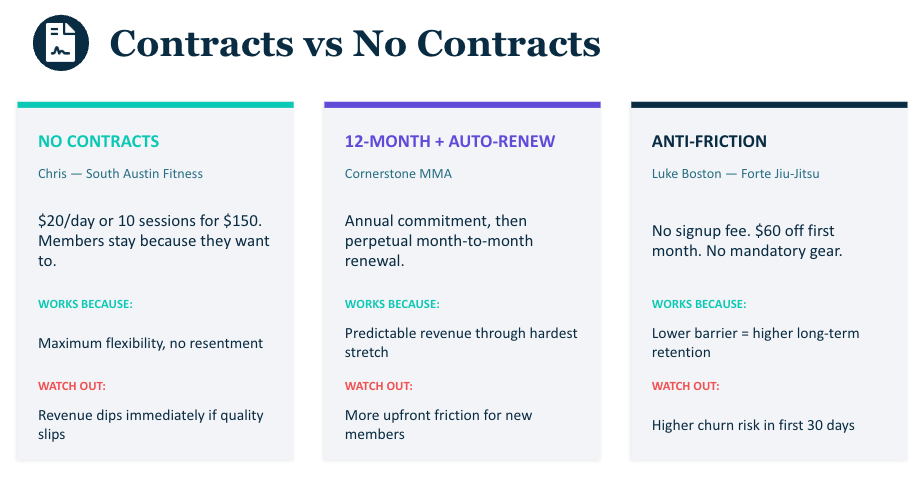
This one starts arguments. We've heard owners who swear by contracts, owners who refuse them on principle, and everything in between.
The answer is "it depends," but the reasoning behind each approach is worth hearing.
The case for no contracts
Chris at South Austin Fitness runs a straightforward model: "There's no contracts ever."
His pricing is drop-in friendly:
"20 bucks a day or you can buy 10 sessions for 150 bucks."
No annual commitments. No cancellation fees. No fine print. Members stay because they want to, not because they're trapped.
And Chris's take is that if your gym is good enough, people don't need a contract to keep showing up.
It works for his model. But if your programming or community dips, you feel it immediately in revenue. There's no six-month buffer of locked-in payments to cushion a rough stretch.
Chai's contract regret (revisited)
This is where Chai's story from Section 1 lands differently.
He started with no contracts and no autopay—not as a philosophical choice, but because he didn't think it through.
The result was collecting cash from students who sometimes forgot, sometimes disappeared, sometimes came back three weeks later with a crumpled $80.
It was chaos. He's since moved to contracts and automatic billing, and he'll tell you it's one of the changes that stabilized everything.
Same starting position as Chris—no contracts. Completely different outcome. The difference was that Chris designed his model around flexibility. Chai just didn't have a model yet.
The auto-renew middle ground
Cornerstone MMA runs a 12-month membership structure where "membership is perpetual or it stops at the end."
The structure also "allows us to modify our contracts." Members commit for a year, then auto-renew month-to-month. No one's locked in forever, but the initial commitment period gives the gym predictable revenue through the hardest stretch—the first year.
It's a pragmatic compromise.
You get the revenue stability of contracts without the resentment of members who feel trapped. And the auto-renewal means you're not re-selling every member every 12 months.
The anti-friction play
Luke Boston at Forte Jiu-Jitsu takes a different angle.
Instead of debating contracts, he removed all the friction points that make signing up feel like a commitment in the first place.
"At other gyms, you have to wear their stuff. You have to buy their gi. You start, you pay full price. Sometimes there's a signup fee... For us, we give you 60 bucks off of your first month."
No signup fee. Discount on the first month. No mandatory gear purchase.
He's betting that a lower barrier to entry leads to higher long-term retention because members chose to stay rather than being financially obligated to.
Point is: The contract structure has to fit how you actually run your gym. Copy someone else's approach without understanding why they chose it, and you'll get their problems without their results.
"Revenue Beyond the Monthly Membership"
Monthly memberships are the backbone. But the owners who build financially resilient gyms don't rely on a single revenue stream.
The question is how far you take it—and whether diversification starts feeling like nickel-and-diming your members.
The full diversification model
Grant Bogdanove at Alma Fight Gym in Tokyo runs every transaction through a single system, which lets him see exactly where revenue comes from.
"Any sort of business transaction that we have, it goes through Gymdesk. So we can see, it's very easy to look at our revenue... waters, rental gis, like DVDs, technique DVDs, private lessons."
Waters. Rental gis. DVDs. Private lessons.
None of them are big money on their own, but they add up. And because Grant operates in Tokyo, where gym culture runs differently, he had to adapt to local expectations.
"You got to bring on your first day to the gym, like two months of pay for the tuition, and pay that in advance, and it's very annoying. But here with a credit card, it's so much easier."
He made paying easier than the local competition.
Lower friction on payment means more people actually complete sign-up. Sometimes the pricing strategy that matters most has nothing to do with the price itself.
Privates as a revenue bridge
Matthew Pollino at Triple Seven Jiu-Jitsu uses private lessons as both a revenue stream and a community builder. His summer camps serve the same dual purpose.
"I grew up with very… money was tight. So this idea of summer camp is just so cool."
For Matthew, camps aren't a profit center first. They're a way to bring kids into the gym who might not otherwise have access.
The revenue helps, but the community impact is the point.
That's the tension every gym owner navigates. Where does revenue diversification stop and nickel-and-diming start? The owners who get it right can usually explain why each revenue stream exists beyond "we need more money."
The anti-diversification philosophy
Brent Burniston at Academia BJJ and Subconscious Jiu-Jitsu takes the opposite position. Aggressively.
"We're not in the business of making a quick buck on a gi. We're not in the business of making money off seminars."
His philosophy extends to everything ancillary: "we don't design that to profit... What's the value? The value is having them here."
Brent sells gis at cost. Runs seminars to build community, not revenue. His gym pricing strategy is membership-focused to the point of being philosophically rigid about it—every dollar should come from the thing you actually provide, which is training.
It's not the most financially optimized approach. But it builds a specific kind of loyalty. Members at Academia know they won't be upsold.
That trust compounds over years.
"The Friends, Family, and Scholarship Problem"

Every gym owner has someone in their life who expects to train for free.
A training partner from before the gym existed. A cousin. An old college roommate. Handling it wrong damages either the relationship or the business. Sometimes both.
The hard line
Chris at South Austin Fitness has the clearest boundary we've heard from any owner.
"If that's your friend, they should be more than willing to pay. This is your business."
He doesn't mince words about where the line is: "If I'm not a best man at your wedding you're paying."
Chris allows himself 10-12 allotted free slots. That's it. Everyone else—friends included—pays full rate.
His advice to other owners: "Pay full price. Don't let them give you a discount."
It sounds harsh. But Chris frames it as respect. If your friend opened a restaurant, you'd pay for dinner. You'd tip well. You wouldn't expect free meals every Tuesday. A gym is no different.
The structured generosity approach
Cody and Don at Shogun West BJJ in Rochester, NY, turned the friends-and-family problem into something institutional.
"The Richard J. Ryan fund is just set up to have the slush money to say, 'Hey, you can't pay the membership fees. So we'll take care, we'll do, you know, we'll pay up to 80% of your membership.'"
Instead of ad hoc favors for friends, they built a scholarship fund. Named after someone meaningful to their community. With clear parameters, up to 80% of membership costs covered.
"We never want to deter anybody away because of money."
The backstory makes it personal. Don was on the receiving end of this kind of generosity when he was younger:
"My coach never charged me a dime when I was young, when I was in middle school... we didn't have any money for extracurriculars like that."
The scholarship fund does what random discounts can't: it creates a policy instead of a series of awkward conversations. Someone can't afford to train? There's a process.
It's not about who you know or how hard you negotiate. It's about the community deciding that access matters.
If you're thinking about how to structure your own version of this, the key is having a dedicated budget and clear criteria. Ad hoc "I'll give you a discount" generosity always costs more than planned generosity.
The honest ask
Brent at Academia BJJ handles the tension with disarming honesty.
"I'm pretty good at jiu-jitsu, but I suck at business. So please pay me so I keep the lights on."
That kind of honesty works because it's true. Most members already suspect their coach isn't getting rich.
Saying it out loud reframes paying full price as supporting the community, not just a transaction.
"What Nobody Tells You About Overhead"
Here's the section that makes aspiring gym owners uncomfortable. It should.
The math that kills small gyms
Eran at Gymdesk has seen the pattern hundreds of times:
"Once you take that plunge and you open your own place, you're on the hook for rent and a bunch of other expenses. It's really easy to run out of money and just close the business. This is what happens with a lot of our smaller accounts."
Small gyms fail most often not because they can't attract members, but because they underestimate fixed costs and overestimate how quickly revenue ramps.
Rent is the big one. But it's not the only one.
Matthew Pollino at Triple Seven learned this the hard way:
"Rent, insurance, parking, contracts, all that kind of stuff. I think that when you're younger or when you're into it, you just want to start and it's like, oh, I'm going to put the mats down and we're going to start training."
Insurance. Parking. Vendor contracts. Equipment maintenance. Cleaning. Software. Payment processing fees. Each one feels small on its own.
Together, they can eat most of your gross revenue before you've paid yourself a dollar.
The mental disconnect
The best quote we heard on overhead came from a gym owner building from scratch. Roll Society put it perfectly:
"Your rent is due, but you're not thinking about that when the guy's mounted on top of you, choking you out."
That's the fundamental tension of running a gym. You're a martial artist first. You became a business owner because you wanted to teach, not because you love spreadsheets.
But rent is due on the first, whether you had a great month or a terrible one.
The owners who survive the first two years are the ones who respected the overhead from the start. They looked at their fixed costs, built a realistic revenue timeline, and had enough runway to get through the slow months.
If you want the real numbers on what gym ownership actually pays, we broke it down in our guide to how much BJJ gym owners make.
The short version: it's less than you think, it takes longer than you expect, and the owners who make it work treat the business side with the same discipline they bring to their training.
The Takeaway Nobody Wants to Hear
None of these owners started with a gym pricing strategy. They started with a passion and a lease.
The pricing came later, sometimes way too late.
Chai figured out contracts after bleeding cash for months. Chris set his friends-and-family boundary after too many awkward conversations. Cody and Don built a scholarship fund because ad hoc generosity wasn't sustainable.
Every lesson in this post was earned the hard way. The financial side of running a gym isn't something you figure out once. It changes as your gym grows and you learn what you're actually building.
A few things that held true across every story we heard:
- Set up automatic billing before you open. Every owner who started with cash collection regrets it.
- Your first price isn't your forever price, so start competitive, raise as you grow, and grandfather your early members.
- Start collecting pre-sale signups the day you sign the lease. If you’ve signed and you’re not out there selling yet, you’re leaving money on the table.
- Know your fixed costs before you commit to a space, then add 20% because you're definitely forgetting something.
- Set your free-and-discounted training policy before anyone asks. That way the first awkward conversation doesn’t decide your pricing for you.
If you want the benchmarks behind these lessons—what to charge, how to structure tiers, when to raise—our BJJ pricing models guide covers the frameworks.
This post is the field report from the people who lived through getting it wrong first.
And if you're at the stage where tracking multiple price tiers, auto-billing different rates, and managing founding-member discounts is getting unwieldy in a spreadsheet—that's the specific problem Gymdesk was built to solve.
Every gym in this post runs their billing through it. Not because we asked them to say that, but because managing 100+ members across five different rate tiers by hand is a special kind of misery nobody should volunteer for.
If it sounds like something you’d want to use, give it a try for free for 30 days to see for yourself.
Gym management software that frees up your time and helps you grow.
Simplified billing, enrollment, student management, and marketing features that help you grow your gym or martial arts school.


FAQ
Gym Pricing Strategy FAQs
Let's take a final moment to get a few last questions out of the way.

Sean has spent the last decade creating content that helps businesses—small and not so small—grow smarter to allow operators to do more of what they love. You know, the fun stuff.
From shipping and international logistics to web development and marketing, he's done the work (not just the words) to scale retail and service businesses efficiently.
You can find his work at Sendle, Shogun, The Retail Exec, Gymdesk, and more.