
How to Convince Former Members to Return to Your Gym

Every gym has a list of former members nobody likes opening.
It lives in the canceled tab of your member software. Names you remember. (Joey, your water bottle is still in the lost and found.) People who trained hard for a year, then moved shifts, hurt a knee, had a baby, or just drifted.
Some of them still wave at you in the grocery store.
You probably treat that list like a graveyard. It's closer to a waiting room, and it's the first place to look if you want to win back gym members.
Planet Fitness, which can afford to measure this kind of thing, said about 35% of its 2025 joins were former members. About a third of its "new" members had been there before.
Your gym is not Planet Fitness. (Your gym has fewer purple walls, for one.)
Fair warning: I don't run a gym. I'm the marketing guy at a company that makes gym software, so read the product section with one eyebrow raised, an exercise in skepticism.
The same logic works for a 100-member academy, though. Your former members already know what the room feels like at 6pm. You don't have to explain jiu-jitsu to them.
To keep the math honest, I'll follow a made-up academy the whole way through: Return of the Mat, a BJJ and kickboxing school with 110 active members paying $150 a month. Over the last two years, 70 people have canceled.
Yes, the name is a groaner. You are welcome.
Why It's Worth Winning Back Former Gym Members
Signing a new member costs five to 25 times more than keeping one you already have, according to Harvard Business Review. A former member sits somewhere in between.
You lost them once, but you don't have to introduce yourself.
A former member doesn't need the ad, the trial, or the tour. One good reason and a nudge will usually do.
They also come with data. You know what they paid, how long they stayed, how often they trained, and (if you asked) why they left. A cold lead from Instagram comes with a first name and a thumbs-up emoji.
The catch. Not every former member is worth the same effort. Treat the list as one big group, and you'll spend your evenings on people who were never coming back.
Sort the List Before You Send Anything
Start with four pieces of information for each person. Your gym software already has three of them, and the fourth depends on whether you asked:
- How long they stayed. Two weeks and two years are different people.
- How often they trained. Someone who came three times a week left something behind. Someone who came twice a month was already gone.
- What they paid. A family plan or an unlimited membership is worth more effort than a punch card.
- Why they left. Moved away, money, schedule, injury, a bad experience, or no reason given.
From there, most lists fall into a few groups:
- Moved away. A discount won't shorten their commute by 400 miles. If you ever open a second location near them, they're the first people you email.
- Short stays. People who canceled in their first month or two usually never found their footing, and a win-back offer rarely fixes that. Better new member onboarding does. Put them, and anyone else in between, on your regular newsletter.
- Regulars who drifted. A few months or more, training most weeks, and they left for schedule, money, injury, or life. They liked it here. Something got in the way.
- Left unhappy. A coach they clashed with, a billing mess, a class that got too crowded. These are worth a personal call, but only once the thing that bothered them has changed.
At Return of the Mat, the 70 cancellations break down like this: 15 moved, 22 left within two months, 25 were regulars who drifted, and eight left unhappy.
That leaves 33 people worth real effort.
Start with the drifted regulars. If five of those 25 come back at $150 a month, that's $750 a month, or $9,000 a year, from people who already know where the changing rooms are.
Made-up example
Return of the Mat is a made-up BJJ and kickboxing school with 110 active members paying $150 a month. Over the last two years, 70 people have canceled.
One more group isn't on the canceled tab yet. It's the member who stopped showing up three weeks ago but is still paying.
Reaching them now is far easier than winning them back later, and our guide to reducing gym churn covers how.
If someone tells you they're leaving because of an injury or a new baby, offer a freeze with a return date before you process the cancellation. A frozen member is a lot easier to welcome back than a canceled one.
If half your list has no reason on file, that's the next fix.
We'll keep you in the loop with fresh content, podcasts, how-to guides, tool reviews, and product exclusives.
Find Out Why They Left (Without Blocking the Door)
Ask everyone who cancels why.
The reason decides which message someone gets and which offer makes sense. A short cancellation form with one question ("What's the main reason you're leaving?") and a free-text box catches most of it.
Keep the options plain: moving, cost, schedule, injury or health, not enjoying it, other.
Here's a version you can paste straight into your form.
Template · Cancellation form
What's the main reason you're leaving? (optional)
- Moving away
- Cost
- My schedule changed
- Injury or health
- I wasn't enjoying it
- Other
Anything you'd like us to know? [free-text box]
Keep it optional, or ask after the cancellation goes through, so it never stands between a member and the cancel button.
One legal note before you build that form. You can ask why someone's leaving, and you can make a save offer. You can't make either one a hoop they have to jump through to cancel.
Many states, and New York City since October 1, 2026, have rules that keep cancellation simple, and some require it to be as easy as signing up. Our guide to gym cancellation law covers what each one requires.
In practice, make the reason question optional or ask it after the cancellation goes through, and put any offer next to a clear "cancel anyway" button. A member who feels trapped on the way out goes home and writes a review.
For members who already left without a reason, call them. Keep it short and curious: "We noticed you'd canceled and wanted to ask how we could have done better."
You'll get honest answers more often than you'd expect. People like being asked.
Template · Phone call
Timing: When to Reach Out After Someone Cancels
Most win-back emails go out the day after someone cancels, or never, and neither brings many people back.
The day-after email has the energy of texting an ex from the parking lot.
A rough schedule:
When | What to send | Goal |
|---|---|---|
Within a week of canceling | A short thank-you, no offer | Leave the door open |
30 to 45 days out | A personal check-in, with the offer if it fits their reason | First real ask |
60 to 90 days out | What's changed since they left, with the offer | Second ask |
Every quarter after that | Gym news and events | Stay familiar |
Put your real asks in that 30-to-90-day stretch.
By then, the reason someone left may have changed: the injury healed, the work schedule settled. And they still think of themselves as someone who trains.
Make an Offer That Fits the Reason They Left
A win-back offer works when it answers the reason someone left. If the discount is the only reason they come back, expect them to leave again when it ends.
Run a promo every month, and nobody pays full price anymore.
Waive the sign-up fee for everyone who returns. You already charged them once. Charging it again feels like billing someone for a key they still have.
It also makes your easiest message: "Your sign-up fee is on us. You're still part of this place."
From there, match the offer to the reason. The table below pairs the most common reasons with an offer that fits, and the one to skip.
Reason they left | Offer that fits | Skip this |
|---|---|---|
Cost | A cheaper plan (two classes a week, off-peak), or a locked rate for 12 months | Half off for one month |
Schedule | The new class times, or a plan built around the times they can make | A generic discount |
Injury or health | A first week back in fundamentals, with the coach told they're returning | Hard sparring on day one |
Lost motivation | A specific goal: the next belt test, a seminar, an in-house tournament | A coupon |
Bad experience | Proof that the thing changed, from you directly | Any automated offer |
At Return of the Mat, 11 of the 25 drifted regulars left over schedule. So their offer is the new 7am class, plus the waived fee.
Watch the deep discounts. If someone joined on a promo and quit the month it ended, a bigger promo usually gets you the same thing again, for less money.
Save your strongest offers for the drifted regulars.
The Three-Message Win-Back Sequence
Here's a sequence you can copy. Change the gym name, the coach, and the details in brackets.
The sequence at a glance
- Week 1Thank-youNo offer. Leave the door open.
- Day 30 to 45Reason + offerName why they left and what changed.
- Day 60 to 90Event inviteA seminar or belt test is an easier yes.
- Same weeksCall your top 10An hour a week, from their old coach.
- After thatNewsletterOnce a month. Then stop asking.
Teal marks the two real asks. Everything else keeps the door open without pushing.
Send it by email, text, or both, depending on how your members actually talk to you. (For most gyms, a text gets read, and an email gets "read.")
Message 1: about a week after canceling
Message 1 · Email or text
No offer, no hard sell. It leaves the door open and puts a real person's name on it.
Message 2: 30 to 45 days out
Message 2 · Email or text
This one names their reason and what changed. If nothing has changed for their reason, say what's new at the gym in general and keep the fee waiver.
Message 3: 60 to 90 days out
Message 3 · Email or text
"Come to the seminar" is easier to say yes to than "rejoin." Plenty of people come back for an event first.
Call your top names yourself
Run the sequence for everyone, and pick up the phone for your top 10 or so.
Automations handle the volume. A call from the coach who used to hold pads for them gets a different answer.
Block an hour a week for the drifted regulars, and for the unhappy ones whose issue you've fixed.
After that, stop asking
Move them to your regular newsletter: schedule changes, events, a photo from the last promotion night. One email a month is plenty.
Send more than that and the people you most want back start hitting unsubscribe.
The First Class Back
They booked a class. Now they have to actually walk in.
A returning member already knows where the showers are. But they're probably out of shape, and they're wondering if anyone noticed they were gone.
So notice.
Tell the coach who's teaching. Say their name at the door. Pair them with a partner who'll go easy for a round (two, if they're a favorite).
If they're coming back from an injury, start them in a fundamentals class whether they "need" it or not. Nobody wants to re-tear something in their first week back.
Hand this to whoever's on the front desk that day.
Checklist · For the front desk
- Tell the coach who's teaching that they're coming back.
- Say their name at the door.
- Pair them with a partner who'll go easy for a round (two, if they're a favorite).
- Coming back from an injury? Book them into fundamentals first.
- Check in after their first week, then fold them into your usual member routines.
Once they're through week one, the same member engagement ideas that keep your regulars around will keep them around too.
How Gymdesk Runs the Win-Back
None of this is complicated.
It's just a lot to remember, every week, for dozens of people, while also teaching classes and fixing the toilet that keeps running.
That's the part automations take off your plate. In Gymdesk, the pieces fit together like this:
- Cancellation reasons land on the member record. Members can request cancellation through the member portal with a reason, and staff can add a reason when they cancel someone.
- Your sequence starts when they cancel. A marketing automation can trigger when a member cancels, then send your emails and texts on a delay you set: one week, 30 days, 60 days. The template library includes a cancellation recovery sequence you can edit.
- Tags handle the personal part. Tag each member by their reason when they cancel (schedule, cost, injury), and a split in the automation sends each tag its own version of Message 2.
- Messages stop when they come back. An automation can end the moment someone gets a new membership or books a session, so nobody gets a "we miss you" text the morning after they rejoined.
- Filter the list in a few clicks. The member list filters by cancellation date, last attendance, membership, rank, and tags. Tag people by reason and tenure once, and every later pull is quick.
- Rejoining takes a minute. Their profile is still there, history included. You reactivate them or add a new membership. A separate returning-member plan with the sign-up fee set to zero makes the fee waiver automatic.
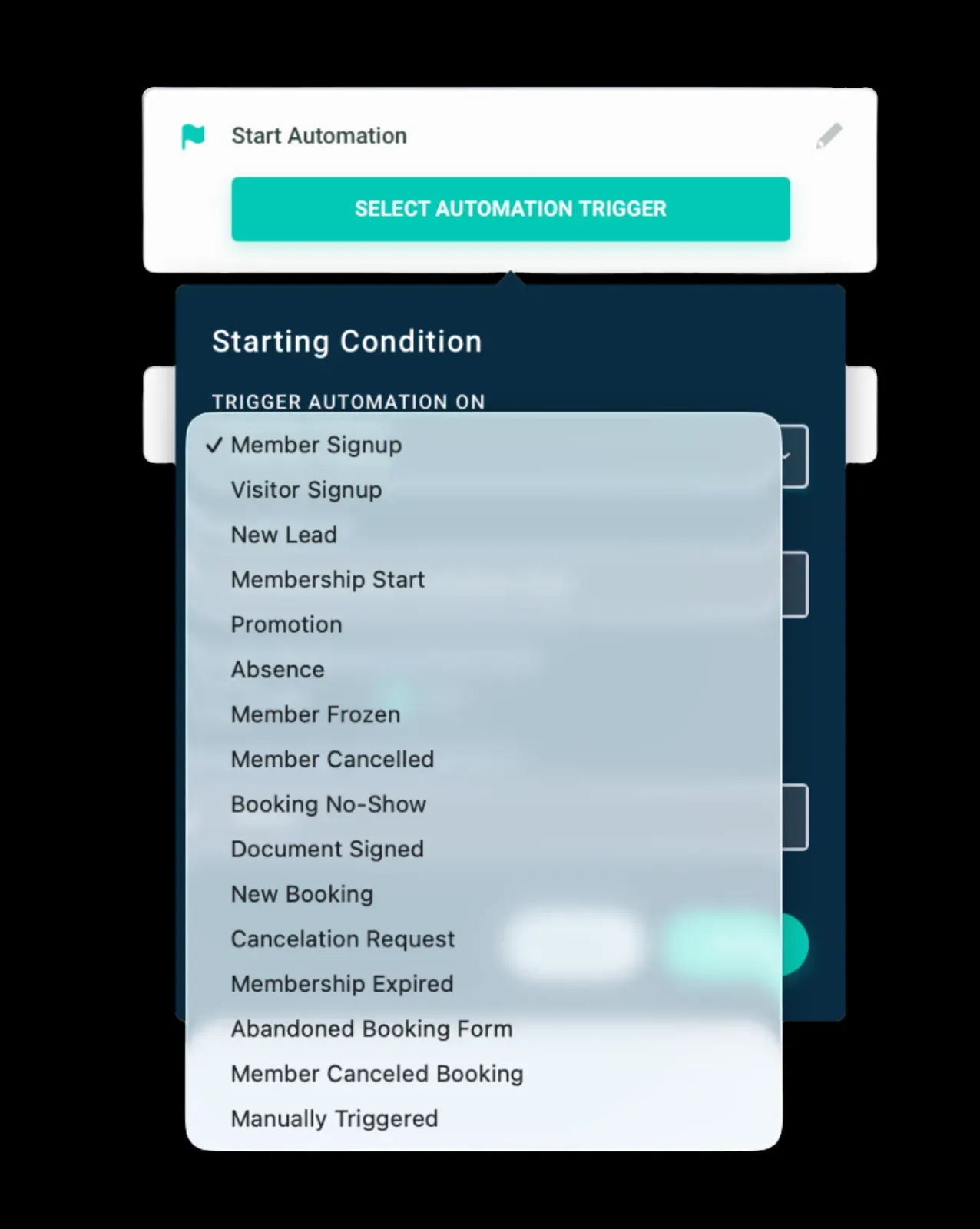
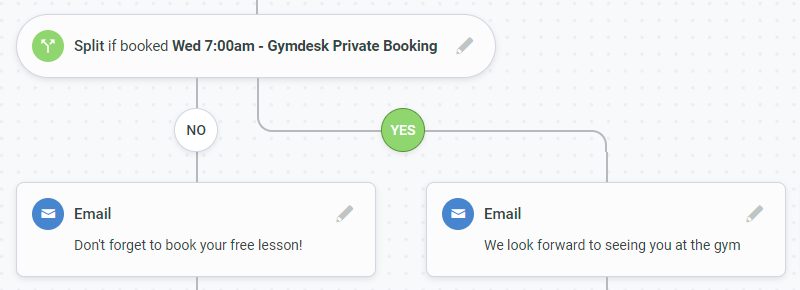
The same system watches the members who haven't canceled yet.
An absence trigger can start a check-in sequence when someone hasn't trained in a set number of days, and it stops on its own the next time they check in.
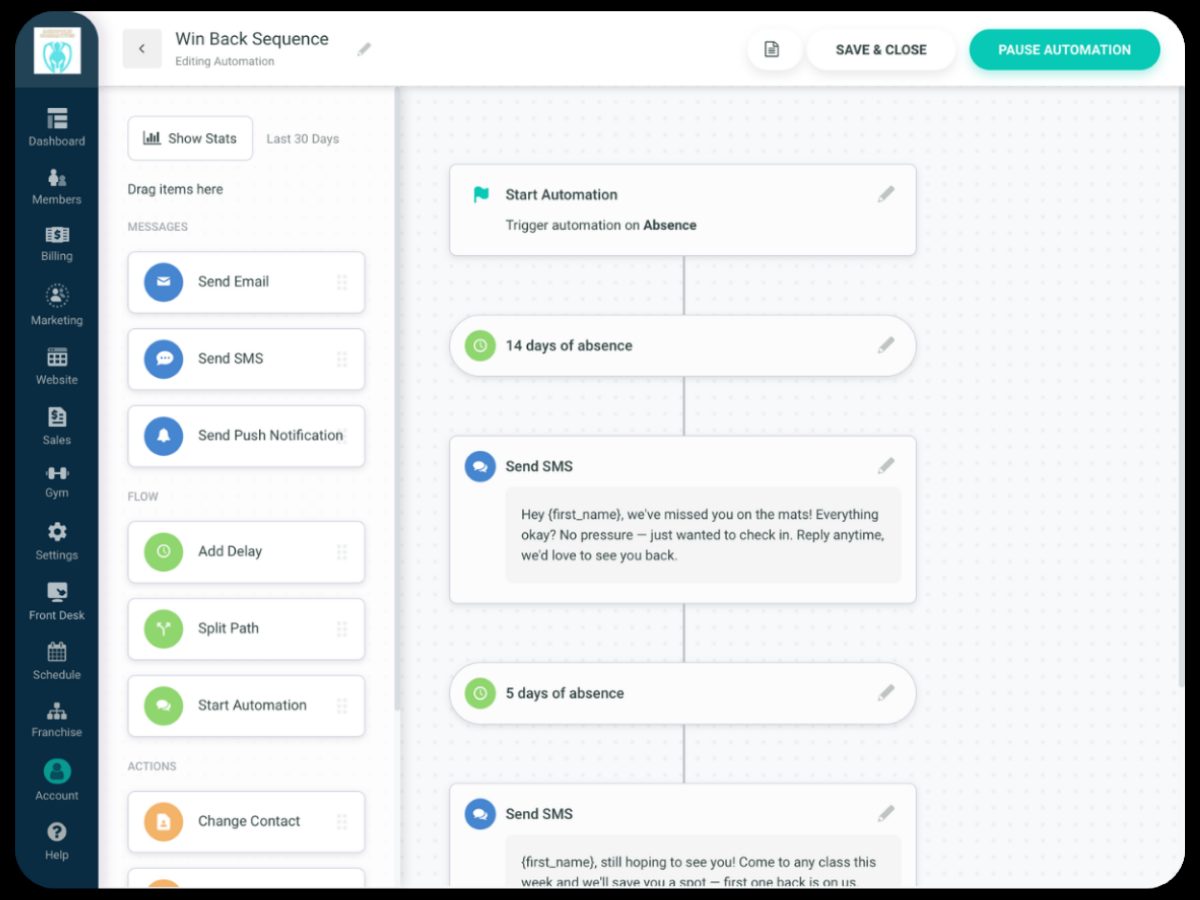
At Return of the Mat, that means the 33-person round goes out on schedule without anyone remembering to send it on a busy Thursday.
If you want to see it in action, you can try Gymdesk free for 30 days.
FOR GYM OWNERS
Cancellation reasons, tags and a delayed sequence do the remembering for you, so the next round goes out even on a busy Thursday.
Measure Whether It's Working
You'll feel good about a win-back campaign long before you can prove it worked.
Ask any marketer. I'd know.
Track one number: your reactivation rate.
Reactivation rate = former members who rejoined in a period ÷ former members you contacted in that period
Track it by group. If your drifted regulars come back at 20% and your unhappy leavers at 3%, that tells you exactly where your hour of phone calls should go.
Then check two more things after three months:
- Do returners stay? If they leave again within 60 days, the offer brought them back but the gym didn't hold them. Look at that first week.
- What did each return cost you? Waived fees plus discounts plus staff time, divided by members who came back. Compare it to what you spend to sign one brand-new member.
At Return of the Mat, the first round goes out to 33 people. If six rejoin, that's an 18% reactivation rate and $900 a month back on the books.
Made-up example
Reactivation rate = former members who rejoined in a period ÷ former members you contacted in that period
Return of the Mat is a made-up gym. Its first round goes out to 33 people, and six of them rejoin.
Not life-changing. But that money was sitting on a list nobody opened, and the list gets longer every time someone cancels, so the next round has more people in it.
To see what those returners are worth if they stay for a year, plug your numbers into our gym member retention calculator.
The Short Version
Your canceled list is full of people who already liked your gym. Sort them by why they left and how much they trained, and skip the ones who moved.
Follow the three-message schedule, with an offer that answers their actual reason. Waive the sign-up fee. Call your best ones yourself.
Then make their first class back feel like a homecoming.
Some of them will come back. A few will even bring the friend they quit with. Sore muscles love company.
Gym Management Software That Gets You Back On The Mats
Run your gym smarter with the right software. Automate your attendance tracking, lead management, belt tracking, and more.


FAQ
Gym Win-Back FAQs
The short answers, for anyone who skipped to the bottom.

Sean has spent the last decade creating content that helps businesses—small and not so small—grow smarter to allow operators to do more of what they love. You know, the fun stuff.
From shipping and international logistics to web development and marketing, he's done the work (not just the words) to scale retail and service businesses efficiently.
You can find his work at Sendle, Shogun, The Retail Exec, Gymdesk, and more.