Gym Growth
Here's a stat that gets thrown around a lot in the gym industry: most gyms lose a significant chunk of their new members within the first 90 days.
You've probably heard some version of it. Maybe you've lived it. Heck, that is a common thing software companies battle too—zero-day churn, 90-day churn. Something I've had to deal with over the last 30 years in my software career.
Over the past couple of years, I've visited dozens of martial arts gyms for Gymdesk Originals. I participated in classes, rolled with members and coaches, and spoke with owners for hours.
And I can tell you that the member stat is real, but it's not inevitable. Some of these gyms have clearly solved the problem. You can feel it the second you walk in.
What I'm going to share here isn't theory. It's what I've seen with my own eyes, across 100+ gym visits and customer conversations, my own experience running a martial arts academy in my younger years, and from owners who are actually keeping their white belts.
The Room Tells You Everything
I walked into Academia BJJ in Beamsville, Canada, and within about 10 seconds, I knew this was a gym people stayed at. I didn't need to see a spreadsheet. I could feel it.
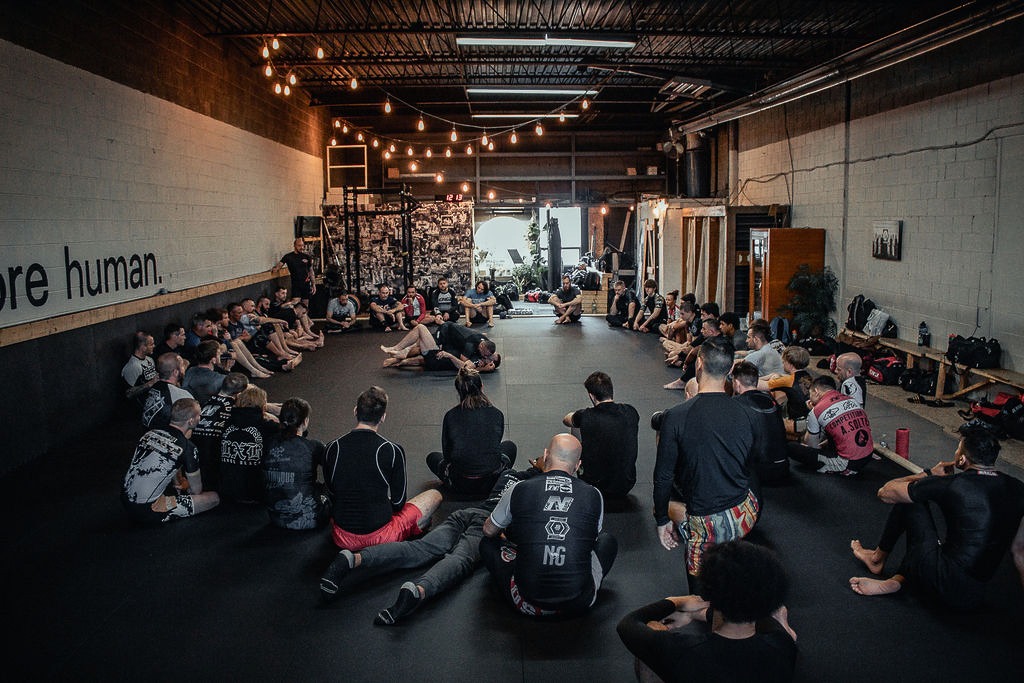
The place is designed to feel like a friend's backyard party. Wood walls, warm lighting, music going. Not the sterile gym—one with clear culture and ambiance.
Jeff, one of the owners, told me it was completely intentional:
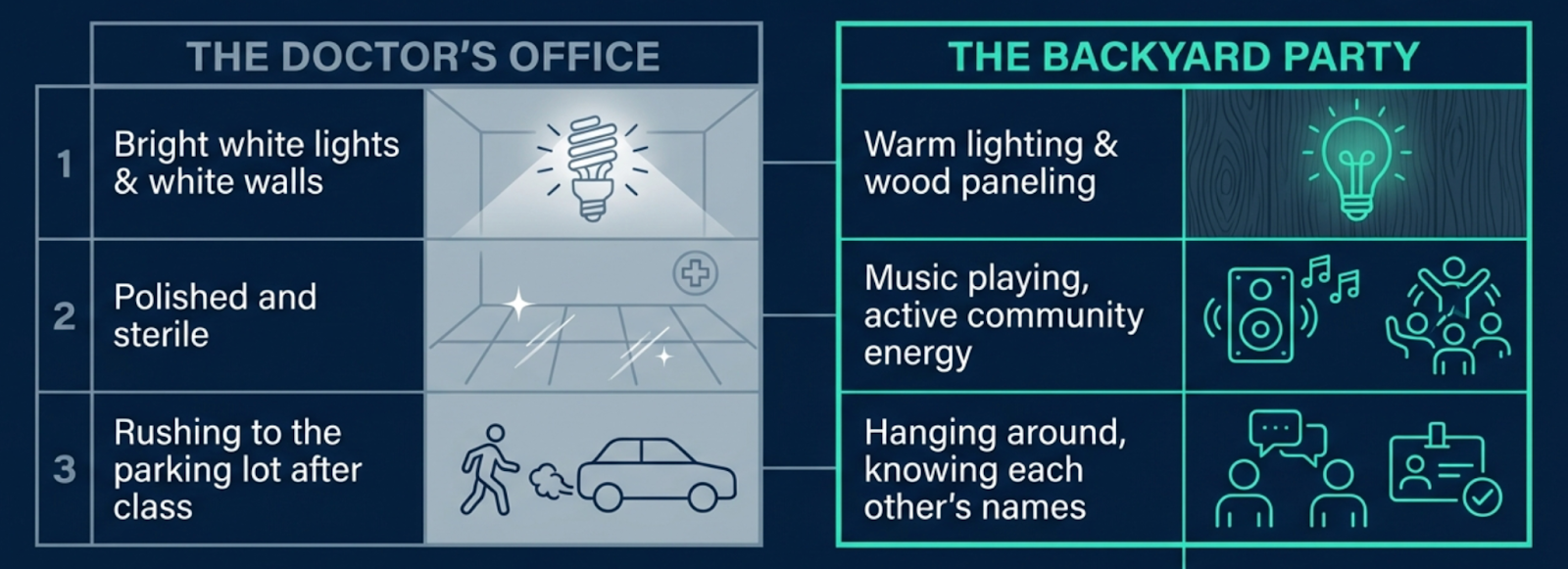
"A lot of schools now are very polished—bright white mats, white walls, very bright lights. You kind of feel like you're in a doctor's office. When you're in a doctor's office, things feel a little weird. But you're in your best friend's backyard party—you see the wood, you see the lights—and you automatically feel like, okay, I feel good here. I feel safe. I can open up and these people are welcoming me."
Steve, the other owner, put it more bluntly:
"That's intentional. That's the secret sauce. We know how hard jiu-jitsu can be, how intimidating it can be. You have to have that vibe. If you've got that vibe, the rest is easy."
I've seen this pattern everywhere.
At Shogun West, the owner told me the north star for his entire business is "100% culture." At Renzo Gracie Upper East Side, same thing: "the vibe matters so much to us." The gyms that retain people don't treat atmosphere as a nice-to-have. It's the whole strategy.
The signals are always the same: members know each other's names, they hang around after class, and they're not rushing to the parking lot. The gym feels like a place people want to be, not a place they have to go.
The First Fifteen Minutes
If I had to point to one thing that separates high-retention gyms from everyone else, it's what happens in the first fifteen minutes after a new person walks through the door.
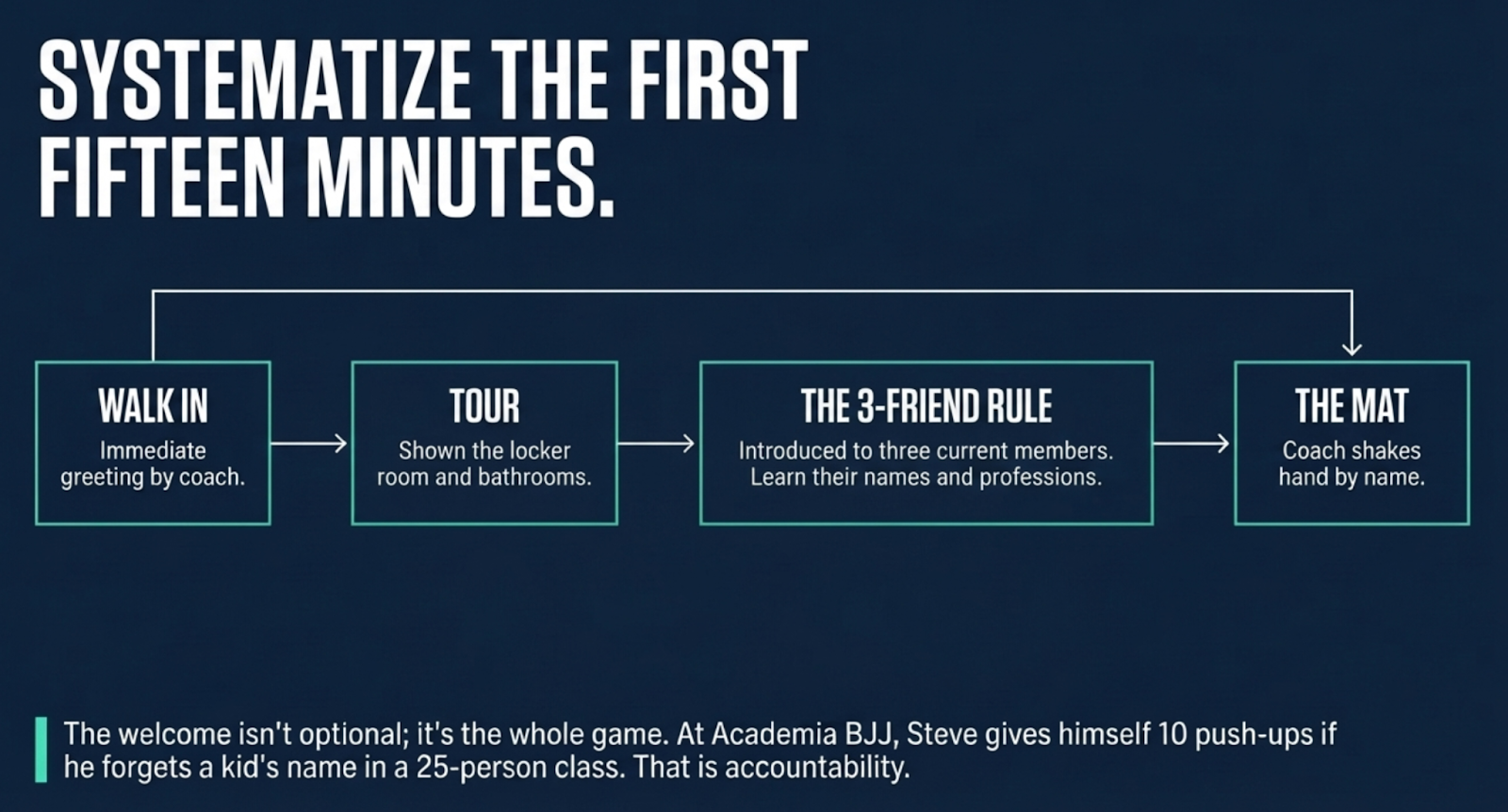
At Academia and Two Bridges Muay Thai, they have something called the Three-Friend Rule. Steve at Academia explained it to me:
You see somebody come in, introduce him to three people. Then he's going to show them the change room. He's going to introduce them to another three people. He's going to show them where the bathroom is. He's going to introduce him to another.
Within 15 minutes, this guy knows seven names. He knows this guy works over there and this guy's a doctor. And he's going to feel comfortable. He's going to have a good time. And these people are genuine.

That's not complicated. It's not expensive. But almost nobody does it systematically.
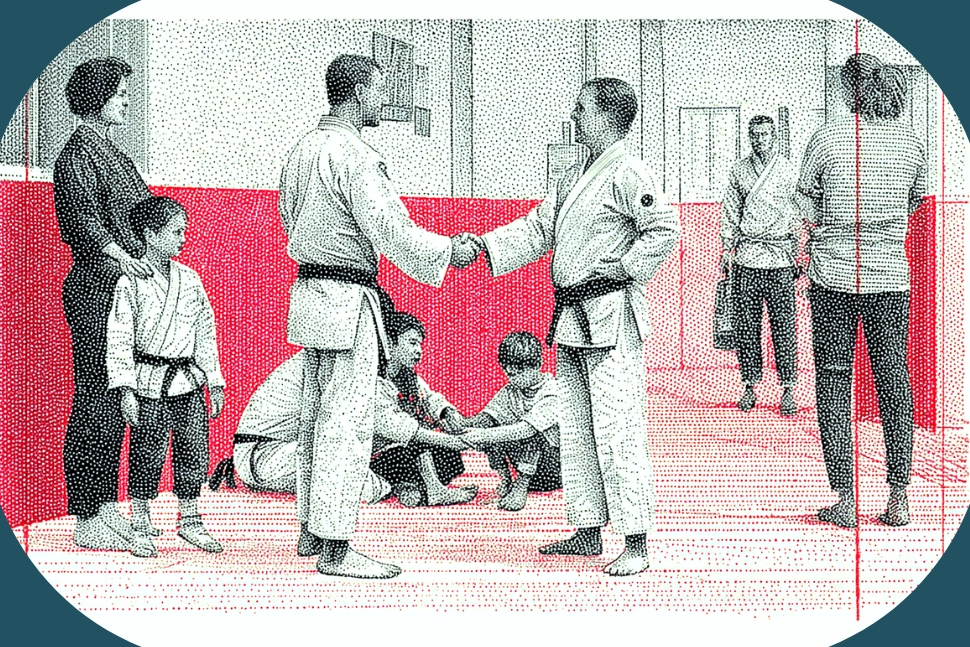
On top of that, Steve and Jeff shake every single person's hand when they step on the mat. Every class, every person, by name. Steve told me he gives himself ten push-ups if he forgets a kid's name in the children's class, even with 25-plus students. That's not just a nice touch. That's accountability. And the kids feel it.
Jeff made the point that stuck with me most:
You know who needs it the most? The guy who's there for his first time. That's actually the guy that needs it.

They have a member named Joe, a high-level police officer with a special forces background. Built, confident, in great shape. He pulled up to Academia four times, sat in his car, and turned around before he ever walked in. Four times. If that guy is nervous, imagine how the average person signing up for their first martial arts class feels.
The welcome isn't optional. It's the whole game.
Protect the Beginners
I asked Jason, the owner of Nova Jiu-Jitsu in Rochester, New York, why he thinks so many beginners drop off. He didn't hesitate:
A lot of people leave jiu-jitsu because of that. They try to spar too soon. They don't have enough fundamentals. And so it's frustrating and they quit.

Jason has been running Nova for over fifteen years. He's watched this cycle play out hundreds of times. His fix was structural: dedicated fundamentals classes where you learn the basics first, and sparring comes at the end, not the beginning.
"We have dedicated fundamentals classes that are just teaching the basics. You can definitely go to the more advanced classes—we're not saying you can't—but we create a lot of space in the schedule for those fundamentals classes."
He did the same thing with his women's program. For years, he noticed women dropping off because the environment was uncomfortable for them as beginners.
So he created a women-only fundamentals class—same idea, just a safer entry point. Three of the women who started in that program recently earned their purple belts. That's years of commitment that started because someone made the first step less intimidating.
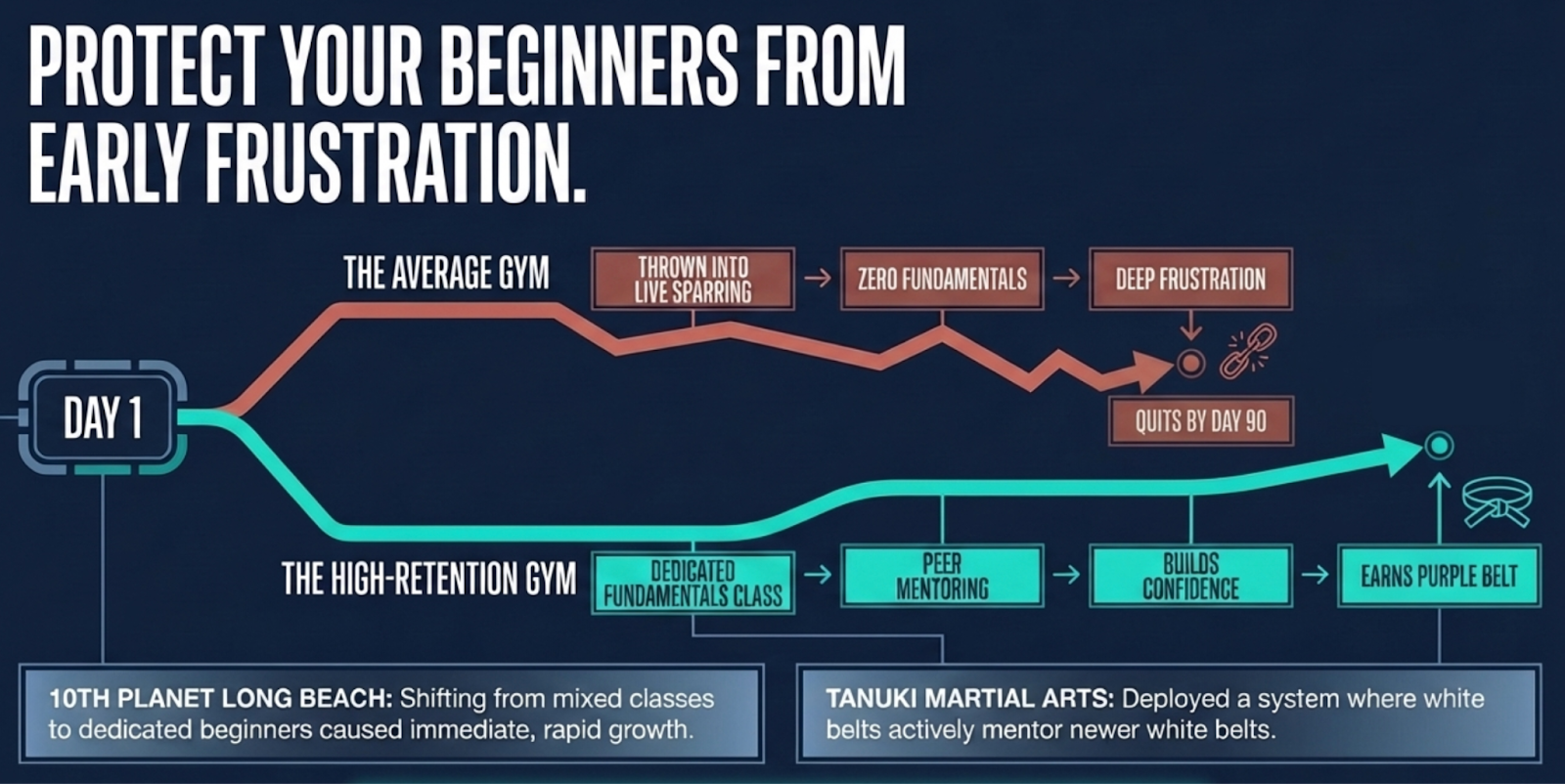
I saw the exact same pattern at 10th Planet Long Beach.
They were down to six to twenty students at one point. Retention was terrible. Then they started a dedicated beginner's class, and numbers grew fast. It wasn't a marketing fix. It was a programming fix.
At Tanuki Martial Arts in Toronto, they take it even further: white belts mentor other white belts. The support isn't just coming from the top. It's coming from peers who remember exactly what it felt like to be brand new.
The pattern is clear: if your new members are getting thrown into live sparring with experienced people before they know what's happening, you're engineering frustration. And frustrated people quit.
Why They Stay
Here's the thing nobody tells you when you open a gym: people sign up for fitness or self-defense or because they saw something on YouTube. But that's not why they stay. They stay because they found people they actually want to be around.
Jason at Nova told me something I haven't been able to shake:
We've had a lot of people that have left here that try to find this somewhere else and haven't been able to.
Think about that. People leave, maybe they move, maybe life gets in the way, and they go looking for the same thing at another gym and can't find it.
They call back. They tell Jason how much they miss it. That's not a gym. That's a community that people cannot replace.
Nova has moved locations four times over fifteen years. One of those spaces had dirt floors and was barely built out. Members didn't care. Jason put it simply:
"They don't really care about what the space looks like much because they just want good training and that's what we gave them."
They've since grown a kids' program to 50 or 60 students, and what keeps happening is that parents come to help with the kids' classes, get interested, and sign up for the adult program themselves.
They do camping trips to Hamlin Beach, skiing trips in the winter, and summer picnics. The bonds aren't just forming on the mat. They're forming around campfires.
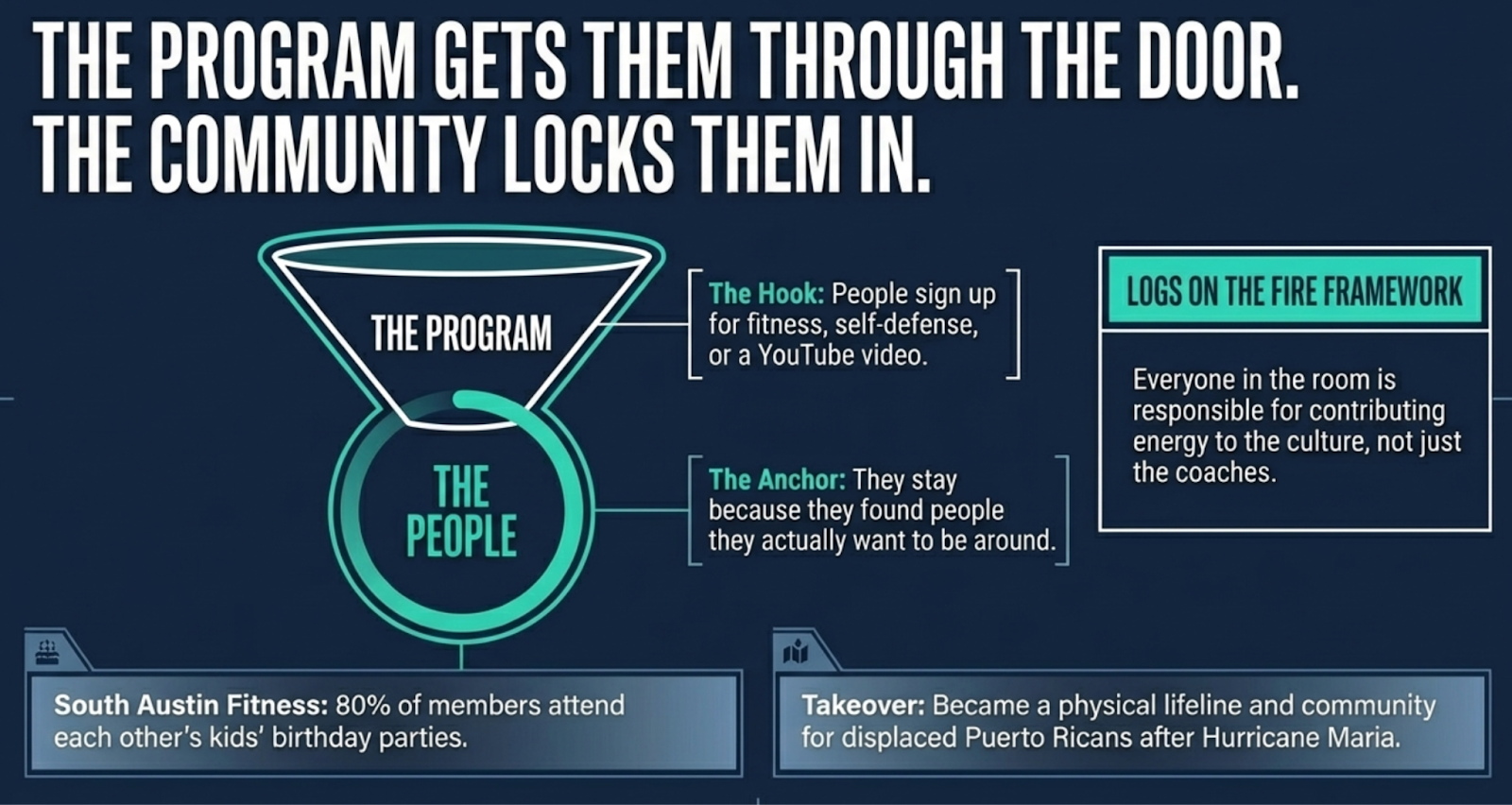
At Academia, Jeff and Steve have this phrase: "logs on the fire." The idea is that everyone in the room is responsible for contributing energy to the community.
It's not just the coaches' job. After they started using it, members picked it up on their own. Guys started saying it to each other after practice, unprompted: "logs on the fire, let's go."
That's when you know a culture is real—when it takes on a life of its own and the gym runs that way even when the owners aren't driving it. Jeff told me the gym has reached a point where he and Steve don't even need to personally welcome every new person anymore because the community does it for them.
They also hold each other accountable. If someone misses three days, they're getting a message: "Where are you? You good?" That's not surveillance. That's people noticing when you're not there.
At South Austin Fitness, the owner told me 80% of their members attend each other's kids' birthday parties.
At Square One in Kansas City, the owner described jiu-jitsu as the first time he ever felt like he belonged anywhere.
At Takeover in Buffalo, the gym became a lifeline for a community of Puerto Ricans displaced by Hurricane Maria who needed belonging more than they needed training.
Every one of these gyms figured out the same thing: the program gets people through the door. The people keep them there.
What I'd Look At
So if you're a gym owner and you're watching a third of your new members walk out within three months, here's what I'd look at.
First, do you have a dedicated beginner class? Not a regular class that beginners are welcome to attend—a class built for them, where they're not getting smashed by someone with three years of experience. If you don't have this, you're losing people to frustration, and it's the single easiest thing to fix.
Second, what actually happens when someone walks in for the first time? Is there a system—like Academia and Two Bridges Muay Thai's Three-Friend Rule—or are they standing by the wall hoping somebody talks to them? If you don't know the answer, go sit in your lobby during a class and watch.
Third, does the head coach know every member's name? If you can't name the people in your gym, they know. And they're not going to feel like they belong somewhere they're not even recognized.
Fourth, do your members have any connection to each other outside of class? If the only time they interact is during training, you're one busy week away from losing them. Group chats, social events, a camping trip once a year—it doesn't have to be elaborate. It just has to exist.
And fifth, is someone reaching out when a member disappears? Not just an automated email. A real message from someone who noticed they haven't been around. At Academia, three days off the mat and you're hearing from somebody. That's the difference between a gym and a community.
None of this is revolutionary. That's kind of the point.
The gyms I've visited that keep their members aren't running complicated retention programs or spending money on fancy technology. They're doing a handful of simple things on purpose. They're welcoming people by name. They're protecting beginners from frustration. They're building a room that's hard to leave.
Jeff at Academia said it best when I asked him what advice he'd give to owners trying to build culture:
Just break down those barriers. Tell your guys to introduce themselves and say hi. What's the negative in that?
The first 90 days aren't a mystery. They're a design problem. And the best gyms have already solved it.