
The BJJ Gym Local Marketing Checklist: Google Reviews, Local Pages, Backlinks, and Events

As a gym owner, you wear many hats.
You teach most of the classes at your gym. You’re doing personals, you clean the mats at the end of class, and you handle all the day-to-day maintenance required to keep the gym running smoothly.
What about marketing? When people enter “Brazilian jiu jitsu near me,” your competitors show up first in Google.
So you try a few new things.
You post content on social media, you hand out flyers, or sponsor a local event—you’re still struggling to gain traction, why?
If you're like many gym owners, marketing is a random activity; it's not systematic. Today, we show you how to change that.
We're about to show you a 30-day plan to boost local traffic.
Why Local Marketing Matters for BJJ Academies
At first glance, it seems like search doesn't matter as much. More people are using AI tools like ChatGPT and Claude to find the things they need, am I right?
Surprisingly, it's actually the opposite.
According to Rand Fishkin at Sparktoro, “Google Search Grew 20%+ in 2024; receives ~373X more searches than ChatGPT.”
That's right.
Google search grew by a whopping 21.64%. In a single year. That's absolutely wild, but it tells us something important. People are spending more time searching on Google, not less.
This includes your students. So what?
Well, local marketing isn't an optional nice-to-have for your BJJ academy; it's a foundational part of your marketing. If your academy is going to grow consistently over the long term, this has to be included.
Here's the good news. Local marketing focuses on a few predictable areas. Spend a consistent amount of your time on these areas to massively boost your online visibility and traffic:
- Google Business Profile optimization
- Google review growth
- BJJ-specific local SEO pages
- Local partnerships, events, and backlinks
Do these in the right order, and you'll find they lead to consistent sign-ups, trials, and new members.
What “Local Marketing” Actually Means for a BJJ Gym
If you ask gym owners what local marketing means, you get generic answers—“it’s getting your name out there. It’s advertising in the community.”
These answers aren't wrong.
They're just not very useful. They don't tell you about the next steps required to produce results. When it comes to effective local digital marketing, you need goals.
Goal #1: Ranking in Google search and the local map pack
When people search for jiu jitsu academies, they use keywords like:
- BJJ near me
- Kids jiu jitsu near me
- Beginner jiu jitsu classes
- Martial arts classes near me
If your academy ranks well for keywords with local intent, you'll show up in Google's search results.
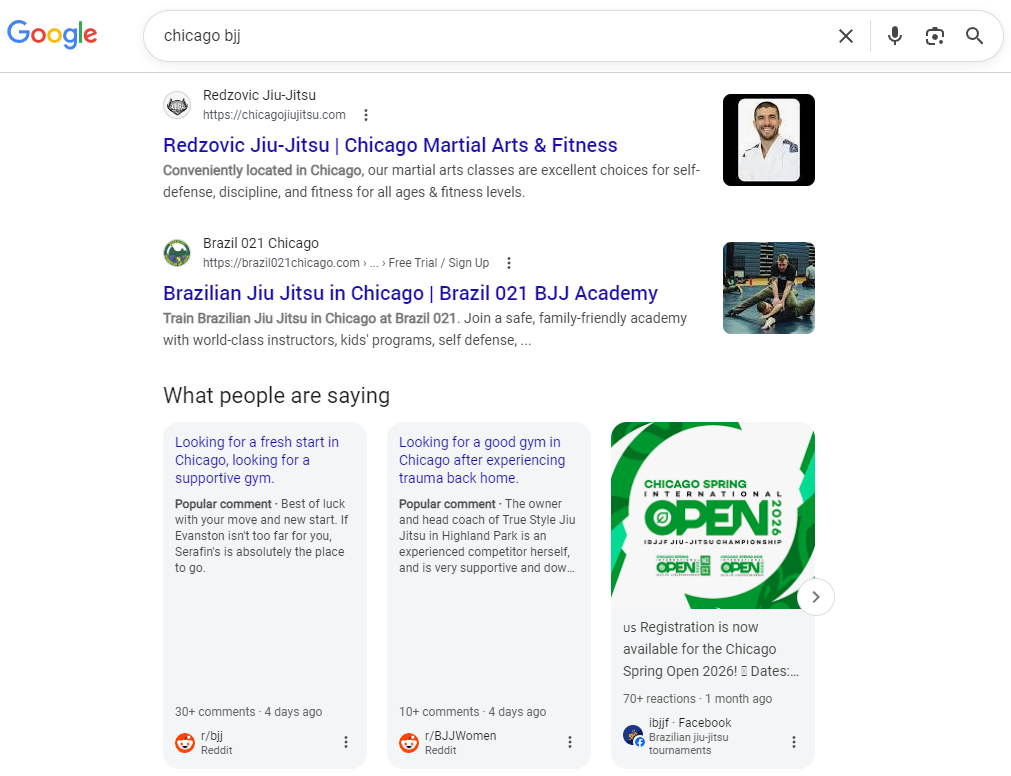
You'll also show up in the local pack.
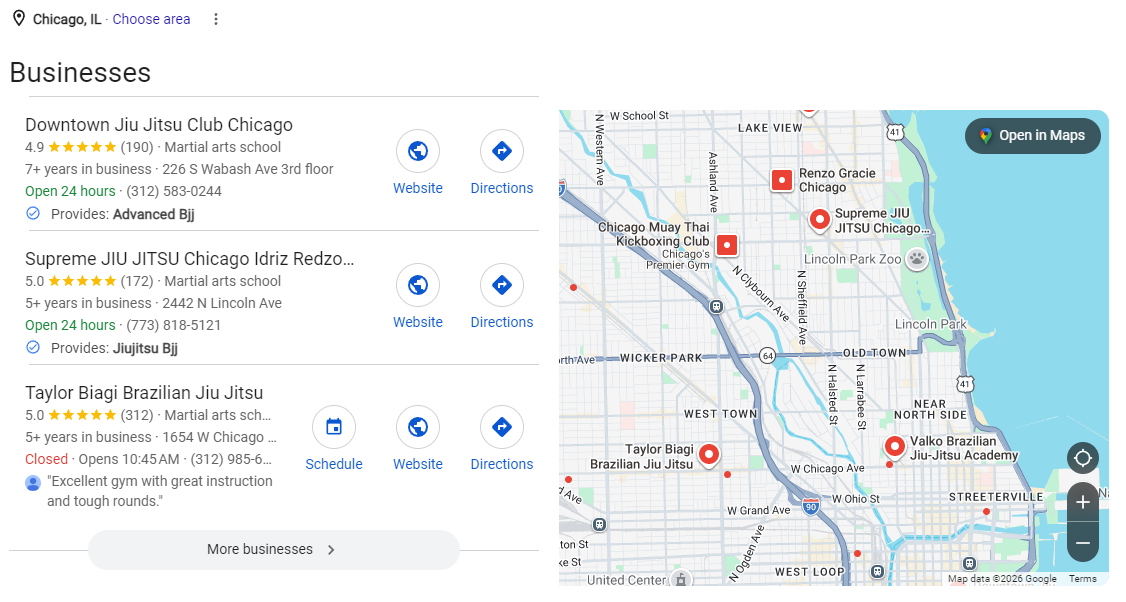
Google states that its local rankings are based on three specific factors. “Local results are mainly based on relevance, distance, and popularity. Together, these factors help Google find the best match for customers’ searches.”
What does this mean? Google breaks this down for us:
Factor | What Google Says | What You Control |
Relevance | How well your Business Profile matches what someone is searching for. Complete and detailed business info helps Google match your profile to relevant searches. | Fill out every field in your Google Business Profile—categories, services, description, hours. The more detail, the better your match. |
Distance | How far your gym is from the searcher's location. If the searcher doesn't share their location, Google uses what it knows about their location. | You can't move your gym. But you can mention nearby neighborhoods, landmarks, and cross-streets on your website to strengthen your local relevance. |
Prominence | How well-known your business is online. Based on factors like how many websites link to yours and how many reviews you have. | Earn Google reviews consistently. Get listed on directories (Yelp, Apple Maps, Bing Places). Build backlinks from local organizations, partners, and community sites. |
This is all pretty straightforward. This leads to our second goal with our local marketing.
Goal #2: Converting curiosity into trial sign-ups
Ranking isn't enough.
When your listing appears in Google, you'll need to get people to click your listing. When they do, they're going to evaluate your:
- Reviews
- Photos
- Website quality
- Reputation signals
If you're looking to convert more trial sign-ups to active members, you'll want to focus on:
Step | What It Means | Example for Your Gym |
1. Know your ideal student | Define who you actually want to attract—students who pay on time, show up consistently, request privates, stay engaged. | "Working professionals aged 25–40 looking for a physical challenge and stress relief" |
2. Use emotional triggers | Content that creates strong emotion gets attention. Triggers like awe, pride, fear, and prestige stop the scroll and start conversations. | A student's first competition win story. A parent describing their shy kid's transformation. |
3. Speak to their specific problem | Every student walks in with a reason—self-defense, fitness, a professional career, or just a hobby. Your marketing should name that reason directly. | "Looking for a way to stay in shape that doesn't feel like a gym?" |
4. Match your offer to the problem | Your solution should mirror what they're looking for. Someone searching for self-defense should land on self-defense content—not your competition team page. | Self-defense searcher → self-defense landing page → trial CTA |
5. Defuse objections up front | Prospective students hesitate around the same things: price, time commitment, fitness level, fear of injury, whether they'll fit in. | FAQ section on your site. "No experience needed" on your trial page. Pricing transparency. |
6. Reduce the risk of trying | Most beginners don't stick—gym owners commonly report that ~80% quit within their first year. Lower the barrier. | "Try a free class. No contracts. No pressure." |
7. Answer "Why train with you?" | Prospective students will compare you to every other gym in town. Your answer isn't about your past—it's a promise about the experience. | "We're the gym where white belts feel welcome on day one." |
Why are these factors necessary?
Students go through the same steps when they make purchasing decisions—regardless of the cost or size of the transaction.
Set Up Tracking Before You Do Anything Else
It's easier to improve marketing that's measured and tracked. Before you launch into a marketing or advertising campaign, you'll want to set up tracking for your local search campaigns.
Here's a list of the ingredients you'll need:
- Google Analytics: This free tool from Google enables you to track, measure, and report on website and app traffic, user behavior, and marketing performance.
- Google URL builder: Tag URLs with custom campaign variables and then use an automated reporting tool (i.e., Google Analytics) to track the variables in each of your links.
- Google Search Console: This free tool monitors site performance in Google search results. It enables site owners to track keywords and other metrics in Google search.
- QR code builder: An online tool that's used to generate a customizable, scannable, two-dimensional barcode that connects physical materials to digital content. Think apps, websites, PDFs, or contact info.
- Gym management software: A gym management platform that handles the day-to-day requirements for member management, billing, class scheduling, attendance tracking, and more.
Here's why tracking matters: At the start of any marketing campaign, you want to establish benchmarks—an assessment of where you are right now.
Comparison is how we identify patterns.
By setting benchmarks at the start of your marketing campaigns, you can gauge progress as you make improvements over time.
You'll want to focus your attention on the metrics that matter. With that in mind, here's a short list of the details every BJJ gym should track.
Lead source
When a potential student contacts your gym, you'll want to identify where they came from.
Common sources include:
- Google search
- Google local map pack
- Paid advertising
- Referrals
- Flyers, signs, and posters
- In-house event
- Social media
If you're using Google URL builder, you can create parameters to track each channel separately. When combined with QR codes, you can accurately determine who came from where.
Intake question
When a potential student drops in, you'll want to ask them how they found you. “How did you hear about us?”
This is a simple question that reveals:
- Which marketing channels are working.
- Which channels attract the highest-quality students.
- Which channels bring in the most revenue.
Unique QR codes or offers
If you're using direct-response or offline marketing, it's a good idea to use the Google URL builder and QR codes.
This works well with trackable advertising:
- Flyers with QR codes
- Posters with unique trial links
- Event-specific landing pages
Google URL builder allows you to track specific campaign parameters. For example:
- utm_id: Campaign ID. Used to identify a specific campaign or promotion. Use the same IDs that you use when uploading campaign data.
- utm_source: Referrer, for example: google, newsletter, billboard
- utm_medium: Marketing medium, for example: cpc, banner, email
- utm_campaign: Product, slogan, promo code, for example: spring_sale
- utm_term: Paid keyword
Let's say you used the URL builder to create trackable links for your 7-day trial campaign. Here's what that looks like:
- utm_source = 7-day-trial: This helps to identify traffic that comes in from your 7-day Trial ad campaign.
- utm_medium = social: This helps you to identify traffic from your ad campaign vs. your email, PPC, or direct campaigns.
- utm_campaign = trial-promo: This identifies the overall campaign.
If you used these parameters, your custom campaign URL would be: https://www.example.com/?utm_source=7-day-trial&utm_medium=email&utm_campaign=summer-sale
You don't have to use every parameter in the list. However, when you add parameters to a URL, you should always use utm_source, utm_medium, and utm_campaign.
Next, head over to QR Code Monkey to create your QR code. It's free, customizable, and permanent.
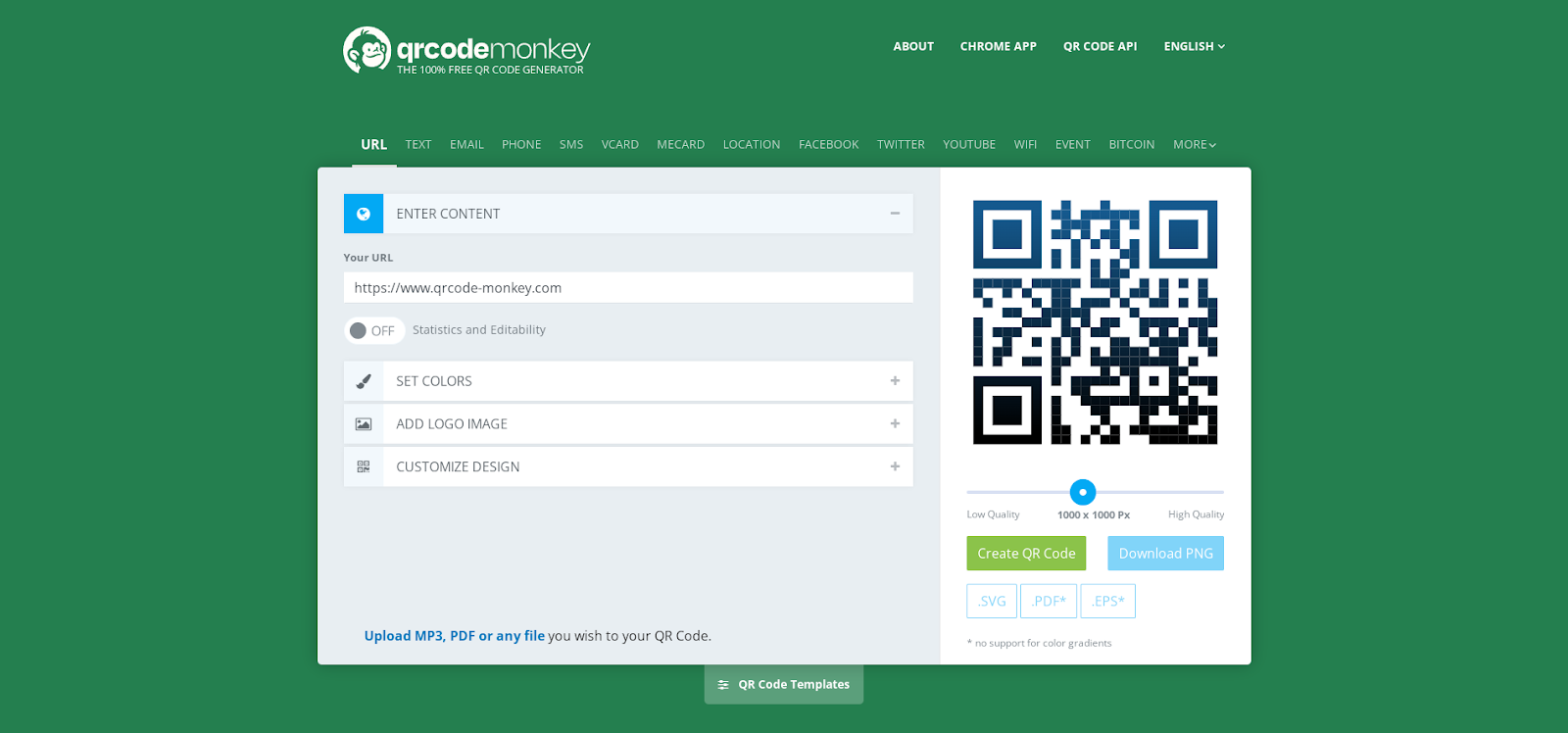
Paste in the link you made with Google's URL builder. And your colors, logo, and design, then hit okay.
You have a QR code and a link you can track in Google Analytics and others.
Follow-up reminders
Poor follow-up is a revenue killer.
It's common for academies to lose students to poor follow-up. When potential students reach out, there's a time limit.
The longer you wait to respond, the less likely they are to attend a class, request a free trial, or bring a friend.
This isn't a question of motivation or desire. Most gym owners want to follow up with potential students who reach out.
But they're wearing lots of hats, remember? It's incredibly easy to forget, for interest to run cold.
Good gym management tools help you to stay on top of student interest. Great tools enable you to track marketing sources, manage trials, send follow-ups, and measure conversion rates so you can see whether your local marketing channels are producing results.
The Local Visibility System: The Only Four Levers That Matter
When it comes to ranking in Google, some factors are more important than others. These are known as ranking factors. While many small factors determine your rank, some play a more dominant role than others.
Let's take a look at four of these ranking factors.
1. Google Business Profile
Google's official documentation says: “With a Business Profile on Google, you can manage how your business shows up on Maps and Search at no charge.”
Your Google Business Profile determines whether your academy appears in Google Maps (or not).
Here are some important steps you'll want to follow:
1. Create or claim your profile
If your business is already listed in Google search, you can claim it from the search results directly or from business.google.com. If it's a new business, you’ll need to create a new profile.
There are two ways to do that.
First, head over to business.google.com and search for your business profile there. If it’s not found, you’ll be prompted to create one.
Second, you can add your business directly from Google Maps.
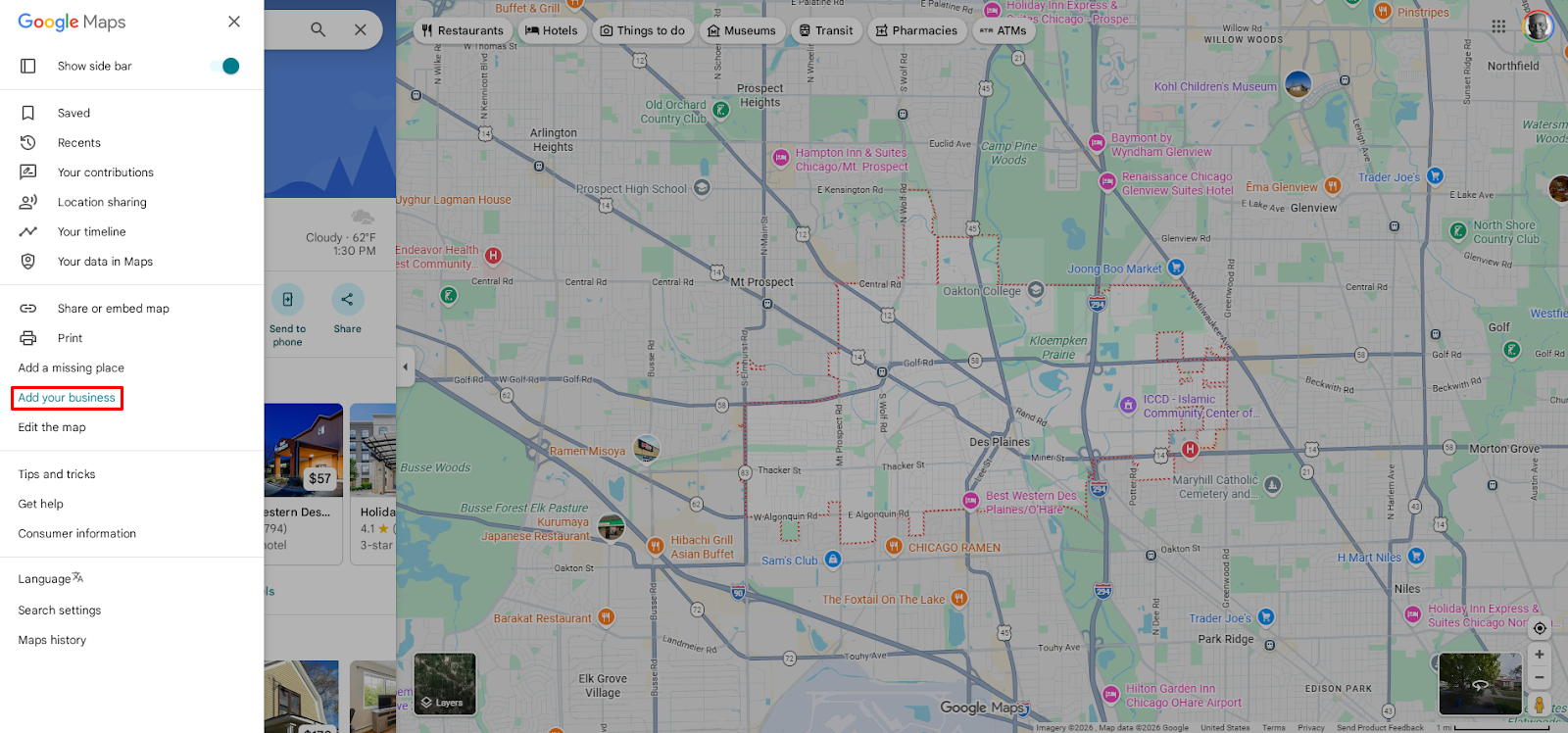
2. Complete your profile
Fill out your business name and category, add your business location, and choose your service area.
Next, add your business's contact information. Finally, you’ll want to verify your business. You can verify your business via text or phone.
2. Google reviews
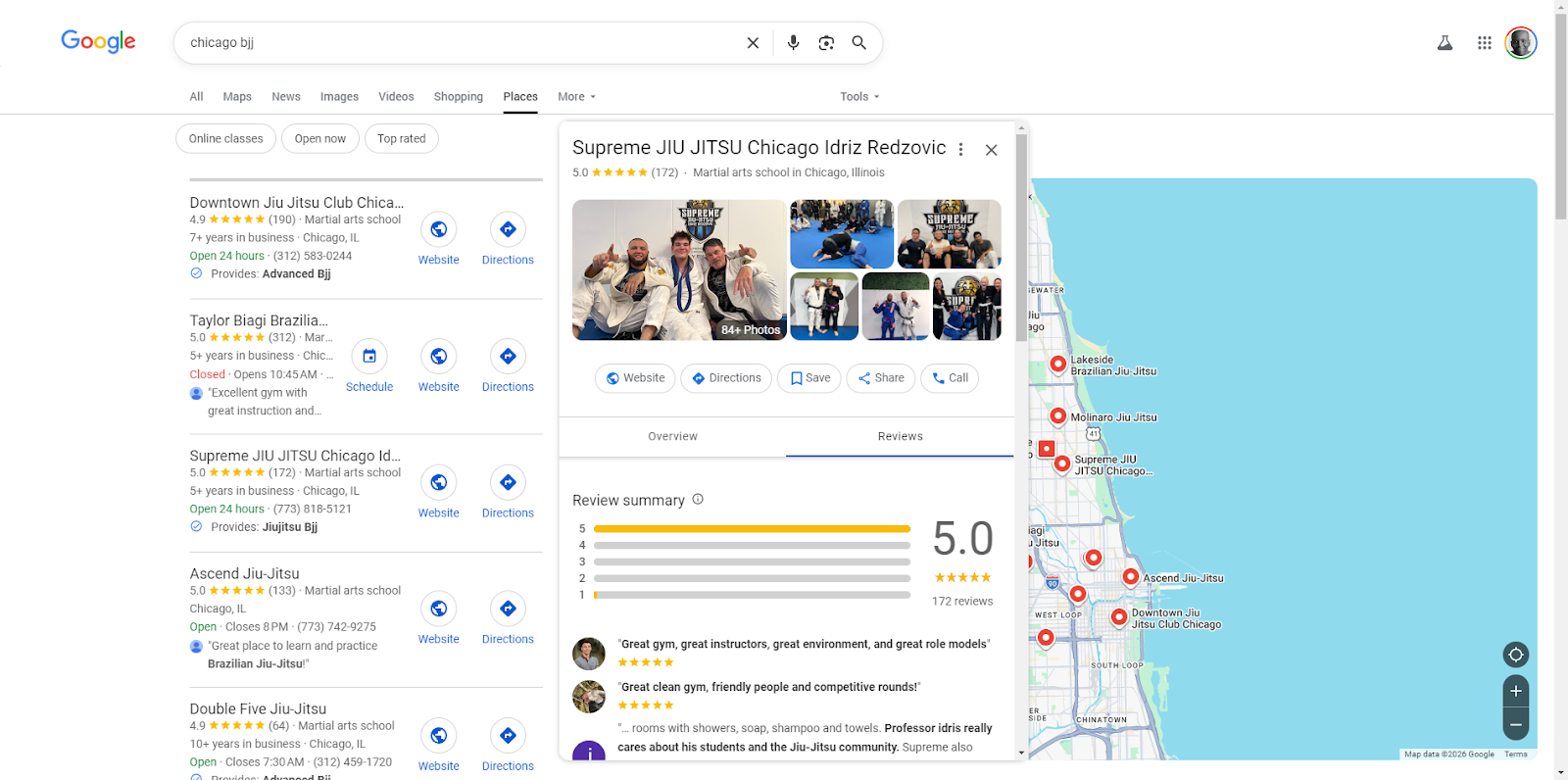
Review volume (how many reviews), velocity (how often reviews are posted), and rating (number of stars) strongly influence local ranking and trust.
The more quality reviews you have, the better. While Yelp states that you can’t ask students to write a review, Google encourages it.
They don’t like review-gating, though.
What is review gating? Imagine that I actively solicit and promote five-star reviews from my happy students. To avoid any blowback from negative reviews, I filter unhappy students to a private, hidden feedback channel.
It’s pretty unethical.
Filtering out negative feedback creates a false or inflated online reputation. That’s a direct violation of Google’s content policies, which can lead to penalties.
You’ll want to request quality reviews at a natural cadence.
Huge spikes in review volume (e.g., 150 reviews in a single day for a service business) are likely to set off alarm bells.
Here are a few ways to make review requests easy:
- Add a QR code (with tracking link) to shareable business cards
- Post a sign on the doors with a trackable QR code, requesting a review
- Use trigger-based email templates to send out review requests whenever a negative review comes in
- Make face-to-face requests after important student milestones (e.g., promotions, competition wins, etc.)
Build review requests into your business at key touchpoints without being intrusive.
3. Local SEO signals
Local marketing is part of search engine optimization (SEO). When we focus on SEO signals, we prioritize building local pages, citations, and backlinks from trusted third-party sites.
These include:
- Local pages: Pages on your website with local intent. They include your business name, address, and phone number (NAP). The content is designed for local audiences, and it includes essential Information—maps, directions, specific services, operating hours, and localized reviews.
- Citations: Online mentions of your academy, e.g., name, address, and phone number (NAP) on third-party websites, directories, and social platforms.
- Backlinks from local organizations. Think of these like votes; the more links you have pointing to your web pages, the easier it is for that web page to rank in Google Search. The more trustworthy the source of the link, the more valuable the link.
When Google looks at web pages with local intent, they look for:
- Relevance: How well your webpage matches what people are searching for
- Quality: Is your content helpful? Does your content convey experience and expertise? Is it authoritative and trustworthy?
- Usability: Are your web pages easy to use? This is based on factors like speed and mobile-friendliness
These local signals determine your visibility in Google Search and Google Maps. It’s also important to note that these are ongoing tasks; your job is never done here.
4. Community demand
Creating events, partnerships, and sponsorships helps build brand recognition and generate many local mentions. These mentions are exactly what Google is looking for.
They want to see that your academy is well-known, consistently referenced online, and well-received by other businesses in your community.
How do you create this kind of community demand, though? With Peter Thiel’s value formula.
The formula goes like this:
- Create X dollars of value for local businesses.
- Capture Y percent of X.
This formula is the basis for generating community demand. It’s how you’ll get local businesses to work with you in the community.
Here’s what you’re looking to do:
- Create value for the local businesses around you. These local businesses could be complementary or competitors.
- The value you’re creating is defined by these local businesses, not by you. It’s tangible, or it produces tangible results (e.g., more traffic, sales, leads, connections for them)
- You’re tapping into a portion of the value you have created. By serving others first, you serve yourself.
Here are a few ideas you can use as a springboard for your community efforts:
- Women’s self-defense classes
- Bullyproofing classes for kids and teens
- After school programs for specialty clubs (boys and girls clubs, scouts, etc.)
- Special classes at your local library
Looking for more? Take a look at this guide for an in-depth understanding of local SEO fundamentals.
The 30-Day Sprint (Do This in Order)

Here’s a step-by-step playbook you can use to set up and launch your local marketing in 30 days.
Week 1: Fix your Google business profile foundation
Your Google Business Profile is the most important asset in your local marketing arsenal. Start by optimizing these elements:
A. Choose the right categories
Primary category:
- Martial arts school
Secondary categories:
- Jiu-jitsu school
- Self-defense school
- Fitness center
- Martial arts club
B. Complete services
You’ll want to select all of the services you offer in your gym. If you’re running an MMA gym that offers kickboxing, say so. If you offer No-Gi classes, note it here.
Add services such as:
- Kids Brazilian Jiu Jitsu
- Adult beginner BJJ
- No-gi classes
- Competition training
- Wrestling
- Kickboxing
- Muay Thai
- MMA
C. Verify your name, address, and phone (NAP) details
- Name
- Address
- Phone number
Google wants to see that these are identical across the web—no incorrect addresses, phone numbers, or inconsistent names.
D. Add photos
Good photos to add include:
- Class photos
- Facility and mat space photos
- Competition photos
- Instructor photos
Students want to know what they’re getting into in advance. It makes sense then that profiles with more photos get more engagement.
E. Description
Your description should weave the following phrases in naturally:
- Brazilian Jiu-Jitsu
- Kids BJJ classes
- Beginner jiu-jitsu training
Resist the temptation to stuff your description with keywords. Focus on value and creating content that’s appealing to students.
If you’d like a technical breakdown that offers step-by-step instructions, check out our Local SEO Playbook.
Week 2: Build the review flywheel
Reviews are a strong ranking signal.
A recent survey from BrightLocal found that 97% of people read online reviews. Stop and think about that for a second. Almost 100% of people searching for a local business (your academy) read reviews.
Therefore, reviews are mandatory.
KEY TAKEAWAY:
97% of people read online reviews before choosing a local business. Review volume, velocity, and rating strongly influence local ranking and trust. Reviews aren't optional—they're mandatory.
Here's a simple system you can use to earn reviews on autopilot.
When to ask for reviews
If you're making a face-to-face request, the best times to ask are:
- After your student’s first 30 days
- After your students' first 90 days
- After stripes and belt promotions
- After competition wins
- After seminars and events
Who should ask
The gym owner or head instructor usually makes requests. Students are much more likely to respond when the request is personal.
How to ask
Here are simple review request templates you can customize for your gym.
REVIEW TEMPLATE #1:
[Name]!
Are you happy with your training? Would you be willing to share your feedback on how your training has been so far?
Takes 2 min.
You can do that here: [link]
REVIEW TEMPLATE #2:
Hi [Name]!
Would you be willing to share your feedback with other students? Your review gives other students a realistic view of what it's like to train with us.
It just takes 2 min.
Share your feedback here: [link]
REVIEW TEMPLATE #3:
[Name], we need your help.
You've been training with us for [timeframe] now. What has your experience been like so far? Would you be willing to share your feedback with other students?
Takes 2 min.
You can do that here: [link]
Take the time to customize your requests so they match your style and voice.
Respond to every review
Just over a third (37%) of survey respondents stated that owners responding to reviews is among the most important things to them.
Responding to student reviews shows:
- Respect
- Gratitude
- Professionalism
- Attentiveness
Prospective students want to see that gym owners and instructors take the time to respond to reviews. It's a case of how they sell me is how they'll serve me.
Week 3: Build local SEO assets that match search intent
Here's the good news.
The content students are looking for is pretty straightforward. They're looking for content that matches searcher intent.
Here's what they're looking for:
- Kids Brazilian Jiu-Jitsu classes
- Adult beginner BJJ
- No-gi classes
- Open mat schedule
- Trial class information
You can use keyword research tools like the Wordstream Keyword Tool and other AI tools to jump-start your keyword research.
Whenever possible, mention your address, city, state, and nearby areas. Doing this helps Google connect your academy to searches with local intent (e.g., "jiu jitsu near me").
Use review platforms and local search sites to add citations (NAP) for your business. You can use:
- Yelp
- Apple Maps
- Bing Places
- Your local Chamber of Commerce directories
You're looking to create helpful and educational content for people first, search engines second.
Week 4: Launch partnerships and events for more trials
Once you've laid the groundwork for a strong digital foundation, you can look for ways to increase community demand via partnerships and events.
BJJ gym community partnerships
If you have the right offer and the deal makes sense, you can build strong partnerships with other companies and organizations in the community.
Partners that are a natural fit include:
- Youth sports programs
- Physical therapists
- Chiropractors
- Medium to large fitness gyms
- Boutique fitness studios
Create offers that are mutually beneficial and focused on serving your partners.
BJJ gym open house
A BJJ open house is a great way to bring in candidates who are on the fence about training.
You can promote it via your:
- Email list
- Social media profiles
- Local partners
If you host a free beginner seminar, you'll find that you can attract people who are interested but still on the fence about training.
BJJ gym seminar marketing
You can reach out to up-and-coming competitors and ask them to do a seminar at your gym. Again, you can promote these seminars via:
- Social media ads, posts, and partnerships
- Links from well-known sources in the community
- Media coverage from local outlets
Make sure that you have a stable foundation and consistent cash flow before you decide to jump into seminars and events.
If you have the budget and the reach to promote a major event, reach out to bigger names.
If you can, pre-sell the event to the community, give them priority (e.g., member's discount, VIP tickets, exclusive bonuses), then sell to the greater metropolitan area.
The Weekly Maintenance Routine (60–90 Minutes Total)

Maintaining your local marketing system shouldn't be complex or difficult. The easier your system is to maintain, the more likely you are to stick to it.
The routine below is a great starting point; it only requires about an hour per week.
Here’s a weekly checklist for you:
- Google Business Profile: Post one update or photo to your profile
- Review requests: Make two or three face-to-face review requests each week
- Partnership outreach: Pitch one local organization per week with a collaborative offer
- Link building opportunities: Add five citations or backlinks pointing to your site
- Student follow-up: Message students who have reached out but haven't scheduled a trial
If you're using a gym management platform like Gymdesk, you should have a full suite of communication tools (e.g., email messaging, SMS reminders, and automated follow-ups) at your disposal.
Sure, you can do this manually, but it's much harder to build a consistent process when you're juggling everything and trying to focus on teaching multiple classes each day.
PRO TIP:
Local marketing maintenance only takes 60–90 minutes per week. Post one GBP update, make 2–3 review requests, pitch one local partner, add 5 citations or backlinks, and follow up with leads who haven't scheduled a trial.
Common Mistakes That Keep BJJ Gyms Invisible Locally
Local marketing isn't rocket science, but it does need a process in place. This is where many gym owners get it wrong.
Here are a few of the mistakes most academies make.
Mistake | Fix |
Doing tactics in the wrong order | Prioritize Google reviews and Google Business Profile optimization before social posts or events. |
Ignoring reviews | Set a goal (e.g., 3–5 new Google reviews per month) and establish a simple review-request routine. |
Inconsistent NAP details that confuse Google | Standardize your gym name, address, and phone number, and update every directory to match exactly. |
Weak follow-up with potential students | Follow up via SMS or email within 1 business day and add automated reminders so none slip through. |
Simple, right?
These are easy-to-fix mistakes. Local marketing requires upfront work, but the maintenance afterwards is straightforward.
Local Visibility Compounds When You Run the System
This isn't about motivations, it's about systems.
Local marketing doesn't require complexity. It needs structure and consistency. With a little bit of consistent effort and the right workflows, you'll find you're able to boost rankings, visibility, and traffic.
You're already wearing multiple hats.
As we've seen, this 30-day plan provides the clarity and know-how you need to promote your business successfully in the community.
The result is inevitable: more “BJJ near me” visibility, more trials, and fuller classes.
As we mentioned, the right gym management software can help you automate follow-up for all new requests that result from this local marketing playbook. Try Gymdesk free for 30 days to see how it helps.
Gym management software that frees up your time and helps you grow.
Simplified billing, enrollment, student management, and marketing features that help you grow your gym or martial arts school.


FAQ
BJJ Local Marketing FAQs
.webp)
Andrew McDermott is a gym owner, Brazilian Jiu Jitsu brown belt, and digital marketer. He’s on a mission to build premier, high-stakes grappling tournaments, world-class academies, and a championship team of high-level athletes.