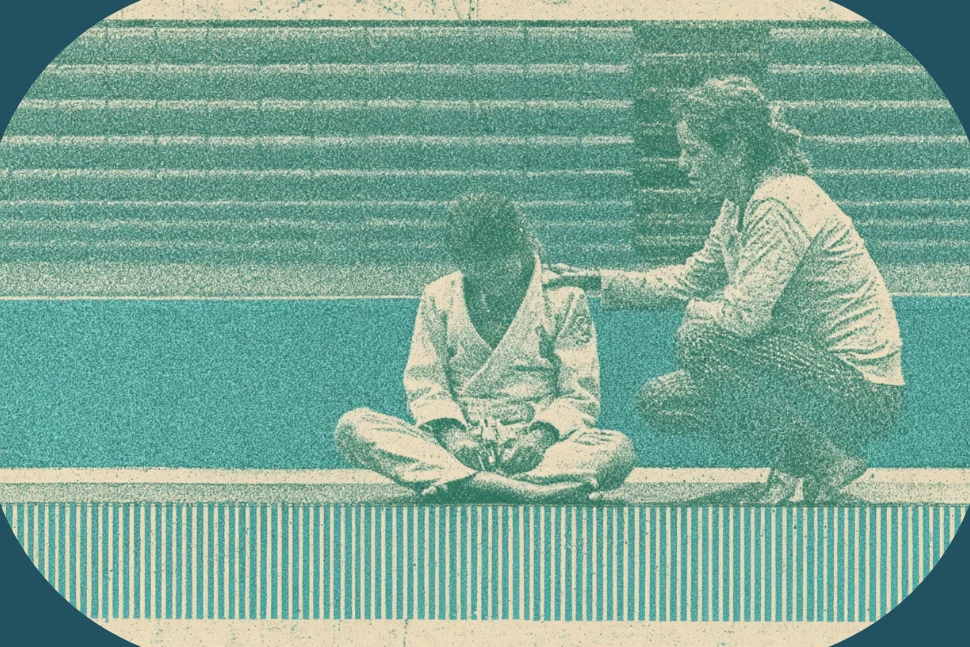
How to Build a Kids' Self-Defense Program That Goes Beyond Technique
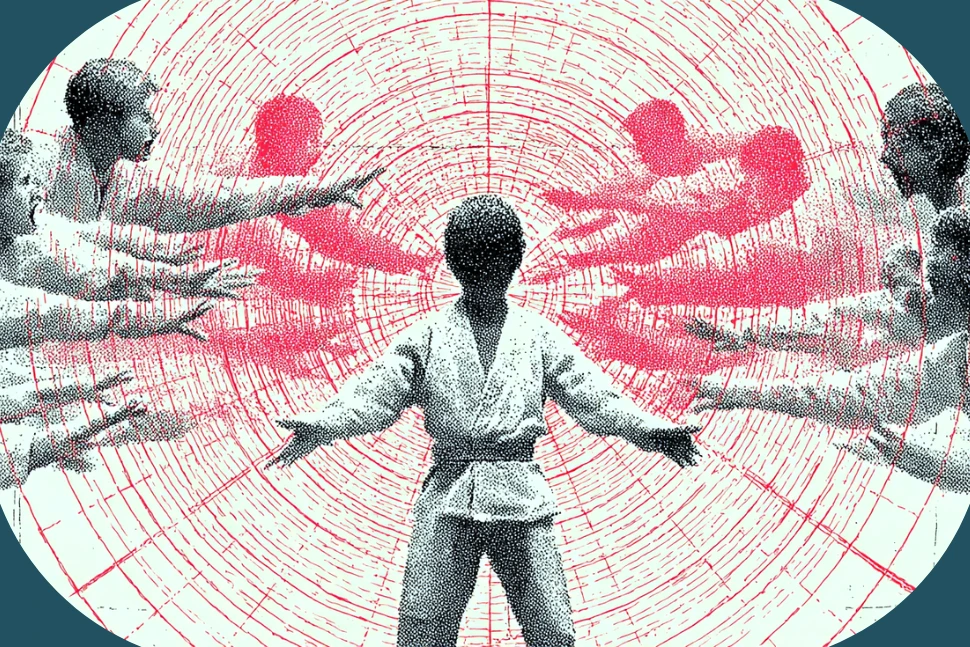
During a kids self-defense drill at Straight Blast Gym Niagara, Coach Rich Beaupit grabs a young student by the hair. Not hard. It's a hair-pull escape. The kid starts crying.
Rich asks if he pulled too hard. The child shakes his head.
"No coach. It's when you raised your voice."
That moment—the one where a kid breaks down not from pain but from the sound of an angry adult—is the moment most kids self-defense programs miss entirely. They teach the escape.
They skip the part where your hands are shaking, and your brain goes blank because someone is screaming at you.
Coach Rich has been running SBG Niagara for 32 years. He spent 34 years teaching his bully-proofing system in schools across Ontario's Niagara Region before pulling it back to his own gym.
And the thing he'll tell you, before he teaches a single technique, is that almost every martial arts school in the country has the same line on their website.
We teach life skills.
His follow-up is blunt: "Great. What's your system?"
If you're more into watching, you can find the whole episode here:
The Life Skills Gap: Why "We Teach Respect" Isn't a System
You've seen this before.
A gym's website says they teach discipline, respect, and confidence. Parents love it. Then you look at the actual class and it's: bow in, recite the student creed, drill some kicks, spar a little, bow out.
Where's the system? Coach Rich puts it plainly:
"People say, 'well, we teach life skills.' Great. What's your system? Well, what do you mean my system? That's what I mean. You don't have a system. If you know, you're a businessman, if you don't have a system, it's not going to be working for you and it's not teachable."
That last word is the one that matters. Teachable.
If your life-skills curriculum lives inside your head and depends on your personality to deliver it, it's not a curriculum. It's a vibe.
Could another instructor at your gym deliver the exact same character-development experience without you in the room? If the answer is no, what you have is charisma. What you need is a system.
This isn't unique to SBG.
Across the gyms we've profiled in Gymdesk Originals, the ones with the strongest kids programs all formalized their approach. Lion's Heart, Argyle Jiu-Jitsu, NC Budo, Takeover. Different methods, same principle. Play-based, constraints-led, needs-based, circle practice. The format varies. The discipline of having a format doesn't.
THE SYSTEM TEST:
Can another instructor at your gym deliver the exact same life-skills curriculum without you in the room?
If the answer is no, what you have is charisma. What you need is a system. If it lives inside your head and depends on your personality to deliver it, it's not a curriculum. It's a vibe.
Mental, Emotional, Physical—In That Order
Most self-defense programs start with the physical.
Wrist escapes, bear-hug defenses, takedown entries. Technique-first makes sense from a coaching standpoint. It's visible. It's measurable. You can test it at belt promotions.
But Rich flips the order.
"If you're going to teach somebody self-defense, it's mental, emotional, and physical, and the physical is easy. But if you don't have the mentally emotional self-control, there's no way they're going to physically be able to defend themselves."
Think about what actually happens when a kid gets confronted at school. Another kid shoves them. A circle forms, and people start yelling. The adrenaline hits before anyone throws a punch.
As Rich describes it, a child who's been drilled on arm bars but has never practiced staying calm while people scream in their face will freeze. The technique is in there somewhere. It's buried under panic.
That's the gap Rich identified decades ago. And it's the reason he built his entire program around filling it before he teaches a single escape.
"I don't want it to be the first time outside for real that they feel that stress. Let's feel it in here. Cause at least in here, they can say, stop. I've had enough today coach."
The concept parallels what psychologists call stress inoculation.
Expose kids to controlled, escalating doses of the emotional experience they'd face in a real confrontation. Not to traumatize them. To build tolerance. So when it happens for real, their brain doesn't short-circuit.
Across our GDO interviews, kids who quit martial arts often do so because they hit a wall they weren't prepared for, usually emotional. A program that addresses that wall directly keeps more kids on the mat.
Stress Inoculation: Drills That Build Emotional Resilience
Rich has two rules for every drill he designs for kids. Two. Not ten. Not a laminated poster of values.
"There has to be two elements to the drill, fun and safe. Otherwise kids are going to shut down."
THE TWO DRILL RULES:
Every stress inoculation drill must pass two tests: fun (kids want to do it again) and safe (kids can opt out when they need to). That combination—engagement plus agency—is what separates stress inoculation from stress creation.
At SBG Niagara, the drills have names. Kids request them.
Crowd ambush
One kid in the middle. The rest circle up, yelling, creating chaos. As described in the episode, the child in the center has to stay composed, identify the threat, and execute a basic escape.
The noise is the point. It mimics the adrenaline dump of being surrounded.
Designated hitter
A controlled scenario with a specific attacker role. One student plays the aggressor, trash-talking and advancing. The other practices de-escalation first, physical response second.
The emotional layer comes from the unpredictability. You don't know exactly when the "attacker" will commit.
The gauntlet
Progressive challenge. Each station adds a new stressor, and kids move through at their own pace. The stop signal applies at every station.
By the end, they've handled more pressure in five minutes than most drills deliver in a month.
Hair-pull with raised voice
The one from the opening of this article. Physical technique meets emotional stress simultaneously. The escape is simple. The hard part is executing it while someone is screaming at you.
In all of these, there's a built-in exit: the stop signal. Any kid can say "I've had enough today, coach" and step out. No shame, no penalty. Rich will work through it with them when they're ready.
That's important.
You're building resilience, not breaking kids down. The goal is struggle, not shutdown. Calibrate intensity by watching faces, not following a script.
If a kid goes quiet and still, you've pushed too far. If they're loud and laughing, you can push a little more.
If you're looking for age-appropriate drill structures, the same principles apply to kids BJJ games, layering skill acquisition inside play.
Build It Into Every Class, Not a Special Workshop
A lot of well-intentioned programs get this wrong.
They create a separate "life skills class" that runs once a month. Maybe it's a Saturday workshop. Maybe it's an anti-bullying seminar during a school break.
The problem is obvious: only some kids attend. And the ones who don't still have "we teach life skills" on their enrollment paperwork.
Rich doesn't bolt life skills onto his classes. He weaves them into the framework.
His SAFE system (Street Smarts Are For Everyone) and the Going Gorillas martial arts life-skills system run in every class, every week. Not a separate track. Not an elective.
Every class starts with a word of the day, something like self-control, courage, discipline, or awareness, tied directly to that session's physical training. A crowd-ambush day might pair with "self-control." A gauntlet day might pair with "courage."
The character concept and the technique aren't parallel lessons. They're the same lesson.
At SBG Niagara, kids classes are split into Chimpanzees (ages 6-9) and Junior Gorillas (ages 10-12).
The animal-themed naming creates identity and belonging. When a six-year-old says "I'm a Chimpanzee," that's pride in their group, not just a class they attend.
The real test of whether your system is a system: can someone else run it? At SBG, Coach Jermaine can teach any class and the framework holds. Same drills, same emotional progression. Nothing falls apart because Coach Rich had a dentist appointment.
If you're building a curriculum from scratch, this is the single most important design decision you'll make: bake the life-skills component into every session, or watch it become the optional thing nobody prioritizes.
DAY |
WORD OF THE DAY |
STRESS INOCULATION DRILL |
PHYSICAL SKILL |
Monday |
Self-control |
Crowd ambush (5 min) |
Wrist escapes |
Tuesday |
Awareness |
Designated hitter (5 min) |
De-escalation + clinch |
Wednesday |
Courage |
The gauntlet (10 min) |
Bear-hug defense |
Thursday |
Discipline |
Hair-pull with raised voice (5 min) |
Hair-pull escape |
Friday |
Respect |
Free choice (kids pick the drill) |
Review + sparring |
The Parent Factor: Communication, Boundaries, and Trust
Parents decide whether kids train. Full stop.
And parents who don't understand what you're doing in class will pull their child the first time they hear about a drill that involves raised voices.
Rich handles this with a two-phase viewing policy. New parents get full access for the first two weeks. Sit through every class, watch everything. See the drills, hear the coaching, understand the philosophy.
After two weeks, parents come in for the last ten minutes only.
The policy didn't come from Rich. It came from the kids.
When COVID restrictions lifted and parents were allowed back in, Rich asked his students what they wanted. They said no.
Class was their time.
They performed differently, more honestly, more willing to struggle and fail without mom and dad watching from the bench.
Rich honored that. The ten-minute window at the end is the compromise: parents still see the work, kids still own the space.
If you're running a kids' self-defense program, remember: you're asking parents to trust you with their child's emotional development.
That trust gets built in the first two weeks of full access. And it gets reinforced every time their kid comes home calmer, more confident, and better at handling conflict without losing their composure.
Rich earns that trust the old-fashioned way:
"Everyone knows here in Niagara region, if you're going to call me, you're going to talk to Coach Rich. You're not talking to my assistant or a secretary. I answer everything."
The result? His Chimpanzee class is full. Parents talk to each other. The gym's culture does the marketing.
Tracking Progress When the Outcomes Aren't Belts
PROGRESS MARKER |
WHAT TO WATCH FOR |
WHAT IT MEANS |
Composure during stress drills |
Can the child execute technique while the room is chaotic? |
Emotional regulation under pressure is improving |
Stop signal usage |
Using it means self-awareness. Needing it less often means growth. |
Self-regulation is developing |
Peer support |
Helping younger students through drills they used to struggle with |
Transfer of learned resilience to leadership |
Parent reports |
How does the child handle conflict at school, home, with siblings? |
Off-the-mat behavior changes precede on-mat progress |
Attendance consistency |
Kids who feel safe keep showing up. Drops signal a conversation needed. |
Leading indicator of program trust |
Emotional regulation doesn't have a stripe system.
You can't test a child's composure under pressure the way you test their ability to execute a hip throw. But you can track it. You just need different markers.
Observable progress looks like this:
- Composure during stress drills. Can the child execute technique while the room is chaotic? Six months ago, they froze. Now they move.
- Appropriate use of the stop signal. Using it means they're self-aware. Not needing it as often means they're growing.
- Watch for the kid who starts helping younger students through the drill they used to struggle with. That's transfer, and it's one of the clearest signs the program is working.
- Parent reports. Ask parents monthly: how does your child handle conflict at school? At home? With siblings? The changes show up off the mat before they show up on it.
One of Rich's adult students sent him an email that captures the principle perfectly: "Coach, I used to get angry. Now I just get better."
That's an adult. But the arc is the same for an eight-year-old who stops hitting their brother when they're frustrated and starts walking away instead.
Consistent attendance is the simplest leading indicator.
Kids who feel safe keep showing up. If your attendance tracking shows a student falling off, that's a conversation worth having before they disappear.
If you want to go further and map emotional milestones alongside technique, word-of-the-day themes mastered, stress drills completed, peer-mentoring moments, Gymdesk's member profiles give you a place to log it all.
A few instructors we've talked to track these in student notes, so nothing gets lost between classes.
Build Your Own System: A Starting Framework
You don't need to copy SBG Niagara's system. Build one that fits your discipline, your culture, and your students. Every effective system has the same bones.
Eight components. If you can check all eight, you have a system. If you can't, you have good intentions.
THE 8-POINT SYSTEM BUILDER:
1. Name it. A named system is teachable and marketable. Rich has SAFE and Going Gorillas. Gracie has BullyProof.
2. Define the progression. Mental readiness before emotional control before physical technique.
3. Create 3-5 repeatable drills with escalating intensity. Give them names your kids will remember.
4. Set the safety rules. Two rules minimum: fun and safe. Add a stop signal.
5. Integrate into existing classes. Every class, every week. No separate workshops.
6. Build a word-of-the-day system. Connect each session's character theme to the physical training.
7. Design a parent communication cadence. Welcome email. Monthly check-ins. A one-page FAQ.
8. Train your other instructors. If only you can deliver it, it's not a system.
That last one is the real gut check. (You knew it was coming.)
If another coach can pick up your lesson plan, run the word of the day, execute the stress inoculation drill, and deliver the same emotional development experience, you've built something that survives you having the flu.
The Bottom Line
The gap between "we teach life skills" and having a system is the gap between marketing copy and actual results for the families who trust you with their kids.
The physical self-defense is the easy part. Rich has been saying that for 34 years. The hard part, the part that actually protects children outside the gym, is emotional readiness.
Staying calm when someone is screaming. Thinking when adrenaline is telling your body to freeze. That's what your kids' self-defense program needs to teach.
You can build this. You don't need 34 years.
Start with one drill next class. Have a student raise their voice during a partner exercise. Watch what happens to the other kid's technique.
That reaction, the freeze, the tears, the blank stare, is the gap your program needs to fill.
Name the system. Build the drills. Integrate it into every class starting next week. And the next time a parent asks what makes your kids' program different, you'll have an answer that isn't a poster on the wall.
Gym management software that frees up your time and helps you grow.
Simplified billing, enrollment, student management, and marketing features that help you grow your gym or martial arts school.


FAQ
Kids' Self-Defense FAQs

Sean has spent the last decade creating content that helps businesses—small and not so small—grow smarter to allow operators to do more of what they love. You know, the fun stuff.
From shipping and international logistics to web development and marketing, he's done the work (not just the words) to scale retail and service businesses efficiently.
You can find his work at Sendle, Shogun, The Retail Exec, Gymdesk, and more.