
50+ Martial Arts Industry Statistics for 2026

Compared to other gym owners, martial arts school owners have historically reported one of the highest median salaries in the fitness industry.
Whether that's down to stronger retention or higher-value memberships is hard to pin down. But the takeaway holds: if you're planning to open a school, a dojo is a serious option.
The fastest way to give yourself an edge is to understand the numbers behind the business—how big the market is, where it's growing, and what schools actually earn.
This guide pulls together 50+ of the most useful martial arts industry statistics for 2026, from US market size down to revenue by discipline. Use it to set the right prices, pick the right programs, and plan a school that lasts.
Key Takeaways
Understand the industry norms first—then build a school that fits the market, not against it.
What 4,594 Martial Arts Gyms Actually Do
Most industry statistics are estimates—survey panels, vendor aggregates, or numbers back-derived from a growth rate.
The figures in this section are none of those.
They come from observed activity across 4,594 active martial arts and combat sports gyms on the Gymdesk platform, where an active gym is one that's open and had a payment or a check-in in the last 90 days.
How this was measured: Billing and retention figures look back 12 to 24 months, all currency is normalized to US dollars, and each metric reports only the gyms with complete data for that cut—so sample sizes vary and are published under every table in the full report. The data was re-run in June 2026 after an internal audit found and fixed eleven errors.
Where the money leaks
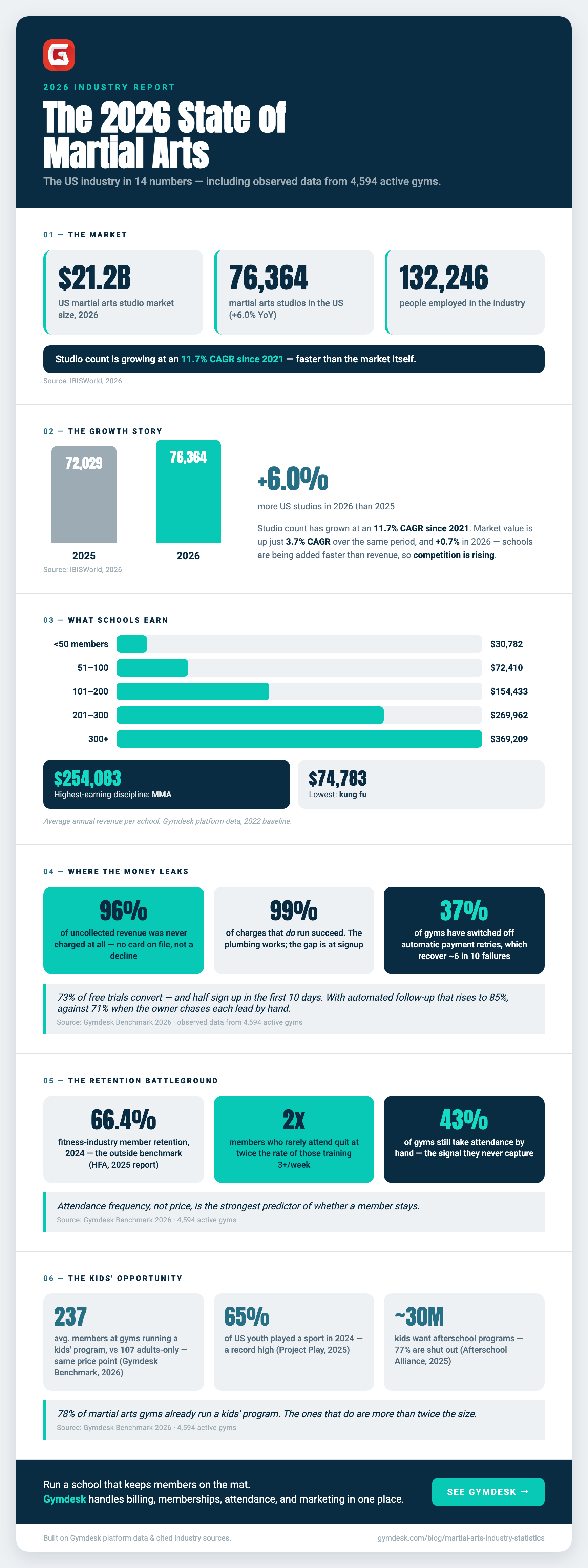
- About 8% of the money a gym is owed never arrives—and 96% of that was never charged at all, because no payment method was ever on file. Almost none of it is a declined card (Gymdesk Benchmark, 2026).
- When a gym does run a charge, it succeeds about 99% of the time. The payment plumbing works; the gap is at the front desk on signup day (Gymdesk Benchmark, 2026).
- 37% of gyms have switched off automatic payment retries. With retries on, gyms recover roughly 6 in 10 failed payments (Gymdesk Benchmark, 2026).
What converts trials into members
- 73% of real free trials become paying members, and half of those sign up within the first 10 days (Gymdesk Benchmark, 2026).
- Trials convert at 85% when software handles the follow-up, versus 71% when the owner chases each lead by hand—a 14-point gap on the same leads (Gymdesk Benchmark, 2026).
What keeps them
- Members who rarely show up quit at about twice the rate of those training three or more times a week. Attendance frequency is the strongest retention predictor in the data (Gymdesk Benchmark, 2026).
- 43% of gyms still mark attendance by hand, which means the earliest warning sign of a member drifting away is the one most schools aren't capturing (Gymdesk Benchmark, 2026).
What scale is worth
- A 200-member gym generates roughly 10x the revenue of a sub-50-member one. Growth compounds faster than headcount alone suggests (Gymdesk Benchmark, 2026).
- The average member pays about $100 per month, with family discounts a significant driver of growth (Gymdesk Benchmark, 2026).
Read together, these aren't six separate problems. They're one: a gym doing by hand what the software was built to do on its own.
US Martial Arts Industry at a Glance
The big picture is encouraging if you're thinking about opening your own school. The US martial arts industry is large, growing, and resilient—it kept expanding through the pandemic years and into the current decade.
Here are the headline numbers for 2026:
- The US martial arts studio market is worth $21.2 billion in 2026, up 0.7% on the year and growing at a 3.7% CAGR since 2021 (IBISWorld, 2026).
- There are 76,364 martial arts studios operating in the US in 2026, a 6.0% increase over 2025 (IBISWorld, 2026).
- The number of US martial arts businesses has grown at an 11.7% CAGR between 2021 and 2026—one of the faster expansion rates in the fitness sector (IBISWorld, 2026).
- The industry employs roughly 132,246 people across the US in 2026, up at a 12.0% CAGR since 2021 (IBISWorld, 2026).
- Studio count has grown from 72,029 in 2025 to 76,364 in 2026, and has risen 11.7% per year on average since 2021 (IBISWorld, 2026).
For context on the wider tailwind: a record 247.1 million Americans were physically active in 2024, an 80% participation rate and an all-time high (Sports & Fitness Industry Association, 2025).
What counts as a "martial arts studio": IBISWorld's industry category includes karate, taekwondo, judo, jiu-jitsu, krav maga, muay Thai, and MMA studios—but excludes standalone boxing gyms and self-defense instruction, which are tracked separately (IBISWorld, 2026). Keep that in mind when you compare these figures to broader "combat sports" numbers.
That growth in studio count is the standout shift since this guide was first published—and it cuts both ways. More schools means more students discovering the sport, but also more competition for the same local market.
Participation: How Many People Train
Participation data for martial arts specifically is messier than market-size data, because the big national surveys bundle disciplines together in different ways.
Here's the most defensible current picture:
- 6.61 million Americans practiced martial arts in 2023, up 4.0% year over year—of whom 3.13 million trained 13+ times a year, SFIA's "core participant" threshold (Sports & Fitness Industry Association, 2024).
- A further 1.16 million trained MMA for competition (Sports & Fitness Industry Association, 2024).
- About 8.4 million Americans participated in boxing or MMA for fitness in 2023—down 14.4% from 9.8 million the year before, as post-pandemic fitness patterns normalized (Sports & Fitness Industry Association, 2024).
- An estimated 6 million people practice Brazilian jiu-jitsu worldwide, with roughly 750,000 in the US (Gold BJJ industry estimate, 2025).
- Combat-sports fandom skews young and is getting younger: 32% of Gen Z sports fans call themselves avid boxing fans, versus just 6% of Boomer fans (Two Circles, 2024).
These categories overlap and cannot be added together. A participant who trains BJJ twice a week and also takes a boxing-fitness class is counted in both. Headline figures in the 15–20 million range that circulate online come from summing overlapping categories, and no primary source supports one. The defensible US martial arts participation figure is SFIA's 6.61 million.
The takeaway for owners: raw participation isn't booming the way studio count is, so growth is coming from new schools competing harder—not from a flood of brand-new students. Retention and local marketing matter more than ever.
Business, Revenue, and Salary Data
If you want a profitable business, the data still points in martial arts' favor. The industry is growing in total revenue, and school owners tend to earn well relative to other gym types. Growing your school is rarely the hard part—running it efficiently is.
- The US martial arts studio market grew to $21.2 billion in 2026 (IBISWorld, 2026).
- The median annual wage for US fitness trainers and instructors—the broader category martial arts coaches fall under—was $46,180 in May 2024 (US Bureau of Labor Statistics, 2024).
- Martial arts instructors earn an average of about $45,309 per year in the US (ZipRecruiter, 2026).
- Gym owners (a category that includes martial arts school owners) average about $86,197 per year, with top earners (90th percentile) clearing $242,000 (ZipRecruiter, 2026).
- The global martial arts equipment market reached $5.10 billion in 2025 and is projected to hit $5.48 billion in 2026, growing at a 5.75% CAGR (Fortune Business Insights, 2026).
- The narrower MMA-specific equipment market—gloves, protective gear, training gear—was worth about $1.32 billion in 2025 and is forecast to reach $1.72 billion by 2030 (The Business Research Company, 2025).
- Historically, martial arts gym owners reported the highest median salary among gym types in the US, though the most recent survey on that specific ranking dates to 2020 (Statista, 2020).
The takeaway hasn't changed: martial arts is a growing market, but profitability comes down to operations—retention, pricing, and keeping overhead in check.
Membership Pricing and Retention
Retention is where most of the money is won or lost. A martial arts school living on month-to-month tuition can't afford the churn a big-box gym shrugs off—so these benchmarks are worth knowing.
- The average martial arts member pays about $100 per month, measured across 4,594 active gyms—with family discounts a significant growth driver (Gymdesk Benchmark, 2026).
- Members training three or more times a week quit at about half the rate of those who rarely show up. Attendance frequency, not price, is the strongest retention predictor in the data (Gymdesk Benchmark, 2026).
- 43% of schools still take attendance by hand, so the earliest signal that a member is drifting is the one most schools never capture (Gymdesk Benchmark, 2026).
- The broad fitness industry retained 66.4% of members year over year in 2024—useful as an outside benchmark to compare against (Health & Fitness Association, 2025 report).
For observed figures rather than an industry aggregate, our 2026 benchmark reports billing, retention and trial data measured across 4,594 active gyms.
If your retention is below that 60% floor, it's almost always the highest-ROI thing to fix before you spend another dollar on ads.
US Martial Arts Schools: Annual Revenue by Gym Size
It's useful to know the industry is growing, but what does that mean at the level of a single school? The figures below break down average annual revenue by membership size, drawn from Gymdesk's own platform data.
Data note: The per-school figures in this section reflect Gymdesk's platform data (2022 baseline). They're directional snapshots of how revenue scales with size, not live 2026 averages.
- Schools with under 50 members average $30,782 in annual revenue (Gymdesk, 2022).
- Schools with 51–100 members average $72,410 (Gymdesk, 2022).
- Schools with 101–200 members average $154,433 (Gymdesk, 2022).
- Schools with 201–300 members average $269,962 (Gymdesk, 2022).
- Schools with over 300 members average $369,209 (Gymdesk, 2022).
The pattern is the single biggest lesson in this whole guide: revenue scales with membership, but not linearly. The jump from 100 to 200 members roughly doubles revenue, while crossing 300 members is where schools reach full-time, owner-can-step-back territory—the point where taking your studio full-time becomes realistic.
US Martial Arts Annual Revenue by Discipline
Gym size isn't the only factor that moves your bottom line. Some disciplines simply command higher prices and larger rooms than others. Here's how average annual revenue breaks down by style.
Data note: As above, these are Gymdesk's platform figures (2022 baseline)—a directional ranking, not live 2026 averages.
- MMA is the highest-earning discipline, averaging $254,083 in annual revenue (Gymdesk, 2022).
- Boxing is second at $152,544 (Gymdesk, 2022).
- Brazilian jiu-jitsu is third at $139,193 (Gymdesk, 2022).
- Karate is fourth at $105,472 (Gymdesk, 2022).
- Taekwondo is fifth at $103,455 (Gymdesk, 2022).
- Kung fu is sixth at $74,783 (Gymdesk, 2022).
If you're deciding which programs to offer, this ranking is worth weighing against your market and your own expertise—the highest-revenue disciplines also tend to demand more space, equipment, and coaching depth.
The Brazilian Jiu-Jitsu Boom
No discipline has grown its cultural footprint faster than BJJ over the past decade. The data backs up what gym owners feel on the mat.
- An estimated 6 million people practice BJJ worldwide, including roughly 750,000 in the US (Gold BJJ, 2025).
- In a survey of nearly 2,000 US practitioners, 43.6% had competed in the past two years—an unusually high competition rate for a recreational sport (Gold BJJ "State of Jiu Jitsu" Survey, 2025).
- Competition culture skews experienced: 66% of white belts had never competed, while only 8 of 160 surveyed black belts had zero competition experience (Gold BJJ, 2025).
For owners, BJJ's pull is real—but it's also the discipline where competition between nearby gyms is fiercest, which loops right back to retention and culture as your edge.
Martial Arts by Country
The US isn't the only country with a thriving martial arts scene. Here's how schools perform across several major markets, based on Gymdesk platform data.
Data note: This table reflects Gymdesk's platform data (2022 baseline).
Martial Arts Studio Demographics
The typical martial arts student is either a boy aged 7–12 or a man aged 25–34. Together those groups make up a large share of total membership. Women who train are more likely to choose karate or taekwondo.
Data note: These demographic splits come from Gymdesk's platform data (2022 baseline).
- Men make up about 73% of overall martial arts studio membership (Gymdesk, 2022).
- The two disciplines with the highest female participation are karate (~31% female) and taekwondo (~35% female) (Gymdesk, 2022).
- Men outnumber women about 4:1 in both Brazilian jiu-jitsu and judo (Gymdesk, 2022).
- Men outnumber women about 3:1 in kung fu (Gymdesk, 2022).
- The largest age group is 7–12 year olds, at about 26% of membership (Gymdesk, 2022).
- The second-largest is 25–34 year olds, at about 21% (Gymdesk, 2022).
- The smallest is those 55 and up, at about 2% (Gymdesk, 2022).
For owners, this is a reminder that kids' programs and young-adult classes are the core of most schools—and that there's a real, underserved opportunity in older-adult and women's programming if you can build for it.
The Kids' Program Opportunity
Children and young adults are central to most schools' rosters, and the broader youth-sports data in 2025 points to a rising tide—plus a large pool of unmet demand that a well-run kids' program can capture.
- 65% of US youth ages 6–17 played a sport at least once in 2024—the highest rate on record since 2012 (Aspen Institute Project Play, State of Play 2025).
- Youth team-sport participation rose 6% year over year in 2024 (Aspen Institute Project Play, 2025).
- 37% of girls ages 6–17 played sports regularly in 2024, the highest share since 2012 and a third straight year of growth (Aspen Institute Project Play, 2025).
- US families spent an average of $1,016 per child on their primary sport in 2024—up 46% in five years (Aspen Institute Project Play, 2025).
- Nearly 30 million children want to participate in an afterschool program, but for every child enrolled, more than three are shut out—a 77% unmet demand rate (Afterschool Alliance, America After 3PM, 2025).
- Among parents whose kids aren't enrolled, 56% cite cost as the top barrier (Afterschool Alliance, 2025).
The signal is clear: demand for structured, supervised kids' activities far outstrips supply, and martial arts is purpose-built to meet it. A well-priced, well-run kids' martial arts program is one of the most reliable growth engines a school has.
Combat Sports Fandom and the MMA Effect
A large, engaged fan base is exactly the audience your local marketing can convert into trial classes. Combat sports fandom is broad and—increasingly—mainstream.
- UFC's move to Paramount+ delivered some of its strongest numbers ever: UFC 324 in early 2026 averaged 4.96 million viewers and reached 7.18 million global households—the most-watched UFC event on streaming (Paramount+ / Nielsen, 2026).
- Combat-sports fandom holds up well across age: about 49% of US adults 18–34 and 51% of those 35–44 called themselves fans (Statista, 2021).
- Karate made its Olympic debut at Tokyo 2020—and was then excluded from both Paris 2024 and LA 2028, while taekwondo and judo remain permanent fixtures (NBC Olympics / WKF, 2024).
Fandom isn't the same as participation, but UFC's mainstreaming keeps a steady stream of curious adults walking into gyms ready to try a class.
Most Popular Martial Arts
There's no single global dataset that ranks martial arts by popularity, but national surveys give us strong clues. Surveys in Vietnam and Poland both point to karate and taekwondo as among the most widely practiced styles.
Vietnam
A 2021 nationally representative survey (ages 13–65) found these to be the most popular forms (Statista, 2021):
- Taekwondo and karate: about 33% of respondents reported participating in each.
- Boxing: about 25%.
- Vovinam: about 24%.
- Muay Thai: about 21%.
Poland
Based on a 2019–2020 survey by Poland's Central Statistical Office, the most popular martial arts by registered participants were (Central Statistical Office of Poland, 2020):
- Karate: 46,166 participants.
- Judo: 26,362 participants.
- Taekwondo (ITF): 10,407 participants.
- Kickboxing: 9,540 participants.
- Ju-jitsu: 7,011 participants.
The practical signal for US owners: karate and taekwondo's global reach is one reason they remain among the most searched-for and most enrolled disciplines—worth keeping in mind when you decide what classes to offer.
What the Numbers Mean for Your School
Step back from the individual stats and three trends define the 2026 martial arts market.
Growth is in supply, not demand. Studio count is up sharply—growing about 12% a year since 2021—while participation is flat to slightly down.
That makes this a more competitive market than the headline market-size growth suggests.
Retention is the real battleground. With more schools chasing the same students, the winners hold members longer. A 60–70% retention rate is average; closing the gap to 75–85% is where durable profit lives.
Kids' programs are the clearest opportunity. Youth-sports participation is at a record high and afterschool demand vastly outstrips supply—exactly the gap a well-run kids' program fills.
That's where the right tools pay off. Gymdesk's martial arts school software handles billing, memberships, booking, attendance, and marketing in one place—so you can spend less time on admin and more time on the mat, where retention is actually won.
Gym management software that frees up your time and helps you grow.
Simplified billing, enrollment, student management, and marketing features that help you grow your gym or martial arts school.


FAQ
Martial Arts Statistics FAQs
Quick answers to the questions owners and prospective owners ask most about the martial arts market.

Sean has spent the last decade creating content that helps businesses—small and not so small—grow smarter to allow operators to do more of what they love. You know, the fun stuff.
From shipping and international logistics to web development and marketing, he's done the work (not just the words) to scale retail and service businesses efficiently.
You can find his work at Sendle, Shogun, The Retail Exec, Gymdesk, and more.