
The Best Judo Software for Clubs in 2026, Compared

Imagine it's the week before a grading, it's late, the mats are still out, and the kyu ladder lives in a spreadsheet only one person knows how to sort.
A third of the club's federation memberships expire on different dates. Two households still owe for last month.
The treasurer collects dues in cash at the door, and this year's new waivers are in a folder somewhere.
It's all paperwork, and it can still sink a grading night.
That's the job judo software has to do.
Most of what you'll find was built for a gym where a member buys one plan, books one class, and never sits a test.
THE SHORT VERSION:
For most judo clubs with a kids' program and a competition team, Gymdesk is the best fit. It runs custom kyu and dan ladders, grading nights, freezes, and sibling billing in one system, with results from Smoothcomp events next to each grade. A small volunteer club on a tight budget should look at MatGoat or MartialArts.io, which both speak judo on their own pages. A BJJ school running judo as a second program should start with Gymdesk.
One thing to know before you start: "Judo software" also means tournament software.
This post compares judo club management software, the kind that runs memberships, attendance, grading, and billing. A short section further down explains the difference.
I'm not a judoka, and nobody wants to see me attempt a throw. What I can do is read pricing pages, so every price here comes from the vendor's own page, dated.
What Judo Club Software Has to Handle
A judo club runs on a kyu ladder with time-in-grade rules, federation memberships that lapse on their own schedule, kids and their parents, and members who take a few months off.
So good judo software has to connect attendance and age to grading, and grading to billing.
Kyu, dan, and mon grades
Students climb through kyu grades, with a minimum time in grade before each test.
Some UK clubs run junior mon grades underneath them, and dan grades bring kata requirements.
Belt colors vary by federation, too, so a fixed belt list built for karate won't fit.
You need three things here: a custom rank ladder, a time-in-grade rule, and a minimum-age rule. If you want the mechanics, belt tracking software covers how they work across arts.
Competition as a grading requirement
Some clubs won't promote a student who never competes.
At ITC New York, which runs judo next to its striking program in Queens, Danny Gutman leads the judo side, and his rule is plain:
"We're not going to promote you past green if you never compete because we don't know where your skill level lies."
Danny's full approach is in our post on how ITC trains judo.
Federation memberships and annual waivers
The US has three main national judo organizations: USA Judo, the USJF, and the USJA. That's two more than most club treasurers would choose.
Each has its own fees and renewal dates, and members can belong to different ones.
In the UK, British Judo handles club registration and member licenses.
Here's what each one asks of a club:
Federation | Individual | Club fee | Renews | What the club tracks |
USA Judo | $100/yr ($60 first year for 17 and under; $70 per person for households of three or more) | $100/yr | Club fee expires Dec 31 | A certified coach, SafeSport and background checks, promotions through the USA Judo portal |
USJF | $80/yr basic | Not published | Sept 1 | A new waiver from every member each year, insured membership for everyone on the mat |
British Judo | £46/yr adult (£35 junior) | £80/yr | Annually | A UKCC Level 2 coach, a constitution, and three separate licensed officers |
Fees from each federation's own website, October 19, 2026. USJA doesn't publish its fees on its own site where we could find them, so it isn't in the table.
Software won't file your federation paperwork, but it can hold the record: each member's federation, license number, and expiry date, plus a list you can pull before a grading or an event.
Check the liability waiver setup while you're at it. The USJF wants a new waiver from every member every year, and an annual re-sign is easy to miss.
Siblings, households, and grading fees
Kids' classes bring siblings on one payer, and grading fees that land on test night instead of the first of the month.
To see what that looks like on paper, look at the Delaware Judo & Ju-Jitsu Association's fee page.
It lists monthly tuition by age, an enrollment fee, USJA dues, promotion test fees from $45 to $85, and family discounts. It also says, in capital letters, that the club only accepts cash or check.
That's a clear policy. It's also a lot of counting on test night.
Software should put the grading fee on the bill when the student is promoted, apply the sibling discount on its own, and show one balance per household.
Martial arts billing software goes deeper on how that works.
Pauses, freezes, and lapsed members
Judo members pause for an injury, exams, or a summer away. So a freeze needs a start date, paused billing, and a return date nobody has to remember.
ITC sees it every year. Danny said:
"Especially with judo, the swings, you know, during the summer, people get lazy. They want to go to the beach."
And when someone drifts off without telling you, you want to see it. Danny checks for exactly that:
"I'm taking a look at my membership count, especially for judo and kind of seeing who have I not seen in a while. Maybe reach out to them."
Volunteer committees and shared rooms
Plenty of judo clubs are nonprofits run by a committee, training in a rented room at a rec center, YMCA, or university gym.
British Judo requires a chair, secretary, and treasurer who are three different people.
So any martial arts club software you pick has to give more than one person access, and it has to survive the treasurer handing over the job every few years.
If the records live on the treasurer's laptop, the grades and payment history leave with them.
Here's the checklist in one place:
Need | What good looks like | Red flag |
Kyu and dan grades | A custom ladder with time-in-grade and minimum-age rules, and a list of who's ready | A spreadsheet one person can sort |
Competition and rank | Tournament results visible next to each student's grade | Results in one app, belts in another |
Federations and waivers | Federation, license number, and expiry on each member, and a yearly waiver re-sign | Licenses checked from memory the night before |
Siblings and grading fees | One bill per household, sibling discounts, and the grading fee charged at promotion | Cash in an envelope on test night |
Pauses | A scheduled freeze with billing paused and an automatic return date | A note in the treasurer's notebook |
Committees | Several logins with different permissions, so a handover is a password change | The treasurer's personal laptop |
Club Software vs Competition Software
A lot of what comes up when you search for judo software is tournament software. It runs the event: registration, the draw, brackets, and the scoreboard.
Plenty of clubs end up using both kinds.
JudoManager, which calls itself the official program of the World Judo Federation, charges €2 per entry on its competition plan. JudoShiai is free and open source.
Smoothcomp runs registration, brackets, and scoring for judo and other combat sports, with USA Judo among the federations that use it.
Gymdesk and Smoothcomp are now one company.
That matters for a judo club because Smoothcomp Connect brings each member's results from Smoothcomp events into Gymdesk.
Those competition records sit on the same member profile as their grade. For a club that won't promote past green without competing, that's the list you'd otherwise build by hand.
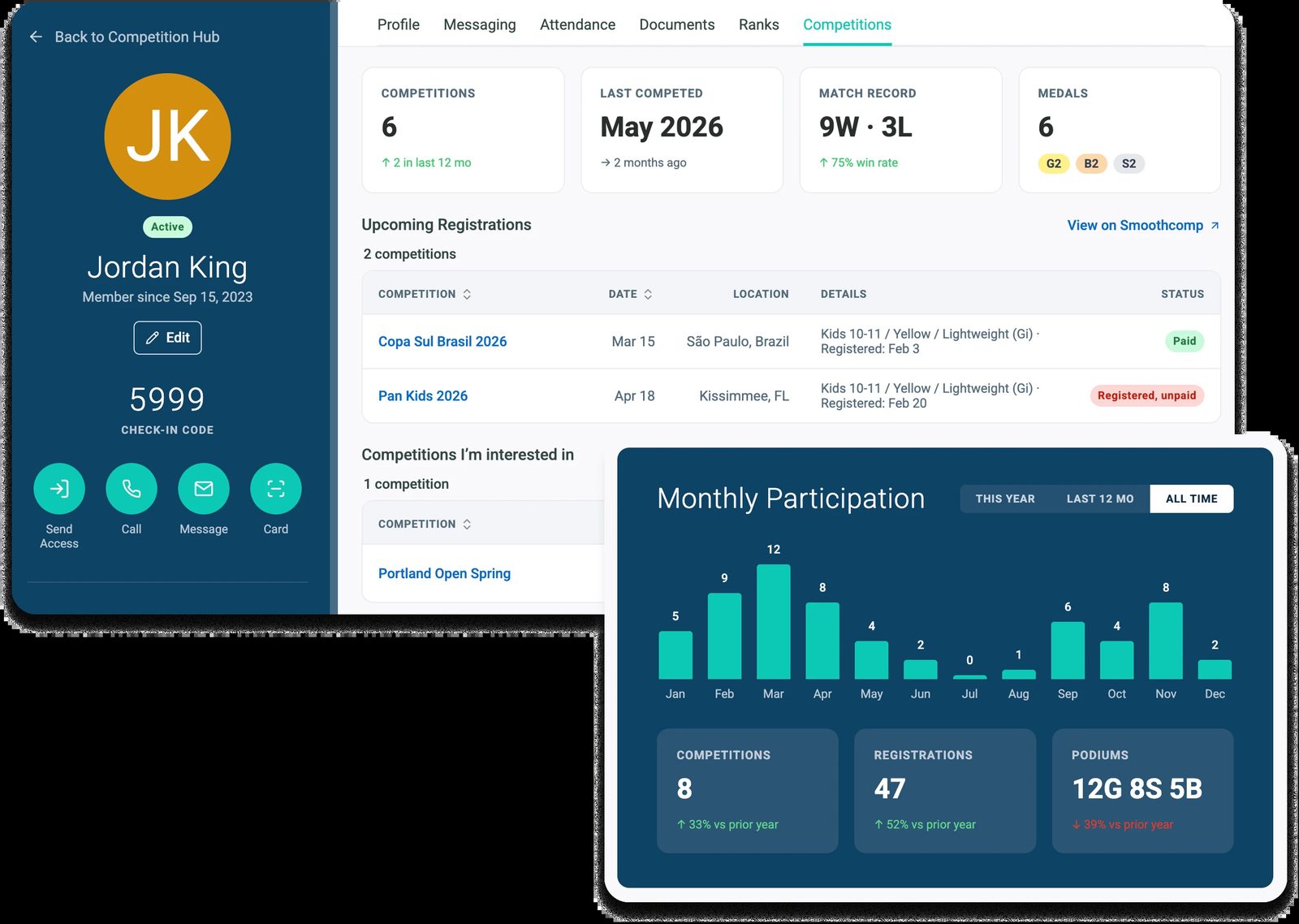
Source: gymdesk.com/smoothcomp-connect, October 2026.
If your students haven't competed yet, an interclub tournament is the gentlest place to start.
How This Comparison Was Built
A tool made the list if it publishes martial arts features you can check, plus a price or a plain statement that it doesn't publish one. I read every price off the vendor's own page on October 19, 2026.
Each tool was judged on the needs above, and Gymdesk got the same treatment, gaps included. It took its falls like everyone else.
The parent comparison, martial arts management software, covers every belt-based art. This one is for dojo management software that has to work specifically for judo.
A few tools that show up on other judo lists aren't here.
Wild Apricot, Join It, and Acuity Scheduling are association, dues, and booking tools with no grading. Member Solutions is a managed billing service (it sells an "AI Billing Team"), and TeamSnap is built for team sports and doesn't publish a club price.
The Best Judo Software in 2026
The right tool depends on your club's size, how many of your members are kids, and how much your club competes.
These aren't ranked.
Gymdesk comes first because this is Gymdesk's blog (you'd have guessed). The rest are grouped by the kind of club they suit.
At a glance:
Tool | Best for | Starting price | Judo grade terms | Grading tools |
Gymdesk | Clubs with kids' classes and a competition team | $75/mo ($100 with your own processor) | Judo belt style, custom ranks | Promotion criteria, ready-to-promote report, grading events |
MatGoat | Small clubs that want judo grade language cheaply | $40/mo (up to 50 students) | Kyu, dan, and mon by federation | Exam records, time in grade |
MartialArts.io | Federation-heavy clubs | $47/mo (up to 50 students) | Kyu, dan, federation affiliations | Grading events, technique requirements by rank |
Kicksite | Tiny clubs that want a long-running vendor | $49/mo (up to 25 students) | Not listed | Belt testing, eligible-to-promote list |
Spark Membership | Marketing-led schools | $199/mo | Not listed | Requirements per rank |
Zen Planner | Large multi-program schools | From $99/mo | Not listed | Belt and skill tracking |
Martialytics | Clubs that want grading at the center | $69/mo (up to 50 students) | Not listed | Grading on every plan |
Clubworx | Australian and New Zealand clubs | Free (up to 20 members) | Not listed | Grading events (+AUD $10, top two plans) |
Dojo Expert | Small European clubs | €14/mo (up to 100 members) | Not listed | Grade records |
Prices from each vendor's own pricing page, October 19, 2026. "Not listed" means the vendor's pages don't say. The feature may still exist, so ask.
Gymdesk

Source: gymdesk.com homepage, October 19, 2026.
Gymdesk is martial arts school software built for independent gyms, and judo is one of its rank styles.
It runs your kyu and dan grades as a custom ladder with promotion criteria, grading events, and the grading fee billed at promotion. It also handles scheduled freezes, family accounts, and judo and BJJ ranks on one member.
Gymdesk uses active-member pricing, and it costs less if you process through Gymdesk Payments, though you can bring your own processor.
- Micro (up to 50 active members): $75/mo with Gymdesk Payments, $100 with your own processor
- Small (51–100): $100 / $125
- Medium (101–150): $150 / $175
- Large (151–250): $200 / $240
- Enterprise (251+): quoted
Prices are in US dollars. The lower rate applies with Gymdesk Payments in the US and Canada, or with an approved processing partner elsewhere.
Visitors, frozen and cancelled members, and prospects don't count toward the active total.
There's a 30-day free trial with no credit card and no contract.
The honest limitations. Under 50 members, it isn't the cheapest tool here.
There's no dedicated field for federation licenses (the workaround is below). And a branded app in the app stores is $100/mo extra (the standard member app is included).
Ask them: What will my bill be at the member count I expect a year from now? How do I set up our federation's grades and time-in-grade rules?
Best for: a judo club with a kids' program and a competition team, or a BJJ school running judo as a second program.
MatGoat

Source: matgoat.com homepage, October 19, 2026.
MatGoat started in a BJJ academy, and it has the most judo-specific landing page of any tool here.
Its judo page describes kyu, dan, and mon grades set by federation, attendance by class, technique videos organized by grade, and linked parent profiles. It also tracks grade exams with dates, time in grade for each judoka, and full grading history.
Price: Basic is $40/mo for up to 50 students, and Professional is $60/mo with no student limit.
Taxes are extra, and it bills in your country's currency.
Limitation: collecting student payments needs Professional, so most clubs are really looking at $60.
Ask them: Can a minimum time in grade block a promotion, or is it only displayed? Which payment features need Professional?
Best for: a small club that wants judo grade language out of the box at a low price.
MartialArts.io

Source: martialarts.io homepage, October 19, 2026.
MartialArts.io has the deepest judo vocabulary of any vendor I read.
Its judo page covers IJF, USJA, USJF, and USA Judo affiliation tracking, nage-waza and katame-waza requirements by rank, kata for dan grades, and grading days. That's more throw vocabulary than I have.
It even mentions nonprofit clubs training in shared spaces. That's more of the judo world than most vendors bother to describe.
Price: Basic is $47/mo for up to 50 students, Deluxe is $97 for up to 150, and Premium is $147 for up to 1,000.
There's a 14-day trial, and it's month to month.
Limitation: the lower tiers cap your students, and the judo page shows very little proof from real clubs. Basic includes two logins (you plus one staff), Deluxe three, and Premium five, which is tight for a club whose chair, secretary, and treasurer all need access.
Ask them: Where do I record each member's federation and license expiry? Can I talk to a judo club using it?
Best for: a federation-heavy club that wants affiliation tracking built in.
Kicksite

Source: kicksite.com homepage, October 19, 2026.
Kicksite is martial arts school software.
It has belt testing, an eligible-to-promote list, and every feature on every tier.
Price, by student count: 0–25 students $49/mo, 26–50 $99, 51–100 $149, and 101+ $199.
Limitation: the price doubles at the 26th student, and nothing on its pricing or feature pages speaks judo.
Ask them: Can I build a kyu ladder with a minimum time-in-grade? Do frozen students count toward my band?
Best for: a tiny club that wants a long-running martial arts vendor.
Spark Membership

Source: sparkmembership.com homepage, October 19, 2026.
Spark Membership is a martial arts CRM built for marketing-led schools.
It has belt history tied to attendance, curriculum requirements per rank, family accounts, and free migration.
There's one plan: an eight-week free trial, then $199 a month.
Limitation: there's no smaller tier for a 40-member club, and its judo page says "belt" but never kyu or dan.
Ask them: Is there a lower price for a club under 50 members? Can I set different grade ladders by federation?
Best for: a growth-focused school that wants its software vendor helping with enrollment marketing.
Zen Planner

Source: zenplanner.com homepage, October 19, 2026.
Zen Planner is an established multi-program platform with belt and skill tracking.
Packages start at $99/mo for Studio, with Essentials from $198 and Ultimate from $348.
Website and Engage are extra.
Limitation: every price on the page says "starting at," so you'll need a demo to get your real number.
Ask them: What's the price at my member count? Do frozen members count as active?
Best for: a large multi-program school that wants modules and a demo-led setup.
Martialytics

Source: martialytics.com homepage, October 19, 2026.
Martialytics puts grading at the center, and every feature comes on every plan.
Price, by student count: 0–50 students $69/mo, 51–100 $99, 101–200 $129, and 200+ $199.
There's a 30-day trial.
Limitation: nothing on its pricing or feature pages is judo-specific.
Ask them: Can I add mon grades for juniors? Can a grading fee go on a household's bill?
Best for: a club that wants low per-student pricing with grading at the center.
Clubworx

Source: clubworx.com homepage, October 19, 2026.
Clubworx is Australian club software with style and belt tracking, priced in Australian dollars.
It's free for up to 20 members. Growing is AUD $109/mo for up to 100 members, Accelerating is AUD $149 for up to 250, and Established is AUD $169 with no limit.
Limitation: grading events are a $10/mo add-on, and only on the two top plans.
A club that wants them pays at least AUD $159.
Ask them: Can a Growing-plan club run gradings without the add-on? Do frozen members count toward my cap?
Best for: a club in Australia or New Zealand.
Dojo Expert

Source: dojoexpert.com homepage, October 19, 2026.
Dojo Expert is a European grade-tracking tool, priced in euros.
Basic is €14/mo for up to 100 members, Pro is €24 for up to 1,000, and Ultimate is €33 with no limit.
Paying yearly takes 20% off.
Limitation: Basic is manual attendance only. QR check-in, class booking, and the student app start at Pro, PayPal starts at Pro, and card and direct-debit payments (Stripe and GoCardless) need Ultimate.
Ask them: What does a club need on Ultimate that it doesn't get on Pro? Is there a price in my currency?
Best for: a small European club that wants grade records cheaply.
Also worth knowing: House of Grapplers ($79/mo, or $39 for its first 100 founding gyms) and SportEasy (priced per member, in euros) cover general club admin, and Spond advertises free membership management.
What Judo Club Software Actually Costs
Nobody gets thrown in this section, but your treasurer will read it twice.
The pricing model changes your bill more than the headline price does. And the tier to price is the one that runs your gradings.
This is what each tool costs a month for a 50-member club and a 120-member club, on the plan that includes grading, before card processing. Each vendor's own definition of an active member applies.
Tool | Pricing model | 50 members | 120 members | Watch for |
Gymdesk | By active members, all features | $75 with Gymdesk Payments / $100 own processor | $150 / $175 | Frozen members don't count |
MatGoat | Flat (payments need Professional) | $60 | $60 | Taxes extra |
MartialArts.io | By student cap | $47 | $97 | Student caps |
Kicksite | By student band | $99 | $199 | Price doubles at 26 |
Martialytics | By student band | $69 | $129 | Inactive students free |
Spark Membership | One flat plan | $199 | $199 | Eight-week trial |
Zen Planner | Modules | From $99 | Not published | Active members only; demo needed |
Clubworx | By member cap, AUD | AUD $159 with grading events | AUD $159 with grading events | Grading is an add-on |
Dojo Expert | By member cap, EUR | €24 for booking and the app (€33 for card payments) | €24 (€33 for card payments) | Card payments need Ultimate |
Prices from each vendor's own pricing page, October 19, 2026.
Two things the table doesn't show.
On base price, Gymdesk is mid-pack. MatGoat, MartialArts.io, Martialytics, and Dojo Expert all publish lower numbers at 50 members.
The case for Gymdesk is what comes included: freezes, family accounts, and grading events on every plan.
It also puts results from Smoothcomp events on the member profile, through Smoothcomp Connect.
Two free apps cover tournament day itself.
Coach Companion, built by the Smoothcomp and Gymdesk teams, lets you pick the event, build your coaching crew, and assign a coach to every athlete or match. It pings you when a match has nobody in the corner, takes notes per match, and the competition-day results land on the member's Gymdesk record.

Source: gymdesk.com/smoothcomp-connect, October 2026.
Smoothrecorder is Smoothcomp's app for filming a match. The video carries the live score and clock, and it tags who's on the mat, so a parent in the stands films a match that's already labeled.
And the frozen-members rule matters more in judo than in most arts, because seasonal pauses are normal. Gymdesk doesn't count frozen members toward your tier.
Ask every vendor the same question, because a summer full of paused members shouldn't push you up a band. "Inactive" and "frozen" may not mean the same thing to every vendor, so ask about both.
To run your own numbers, try the gym software cost calculator.
For the wider picture, see gym management software cost.
We'll keep you in the loop with fresh content, podcasts, how-to guides, tool reviews, and product exclusives.
Which Judo Software Fits Your Club
Start with the kind of club you run, because that decides most of what you need from judo club management software.
A small volunteer judo club
Under 50 members, a committee, and a rented room.
On price, start with MatGoat or MartialArts.io. If you run a big kids' program and want freezes handled for you, Gymdesk Micro is worth the difference.
If you're hoping for free judo software, Clubworx is free up to 20 members, Spond advertises free membership management, and most of the rest offer a free trial.
Dojo software for a full-time judo club
Sasaki Judo in Orlando is the model here: a judo-only dojo aiming for about 150 members, run by a sensei teaching judo full time.
Start with Gymdesk, MartialArts.io if federation tracking matters most, or Zen Planner if you want modules.
Judo inside a BJJ school
This is the most common shape we see: judo as a second program in a grappling school.
Members hold separate BJJ and judo ranks, and you want both on one record.
At Combat Sports Academy in Orlando, Lakea Vargas coaches judo and BJJ, and the rank view is one of the parts he likes:
"It's easy to see the numbers. It's easy to see the ranks."
Start with Gymdesk, or MatGoat if budget comes first. For the BJJ side of the decision, see BJJ gym software.
A club with a competition team
Start with Gymdesk and Smoothcomp Connect, so results from Smoothcomp events land on the same profile as each grade. Registration and brackets stay on Smoothcomp or JudoManager.
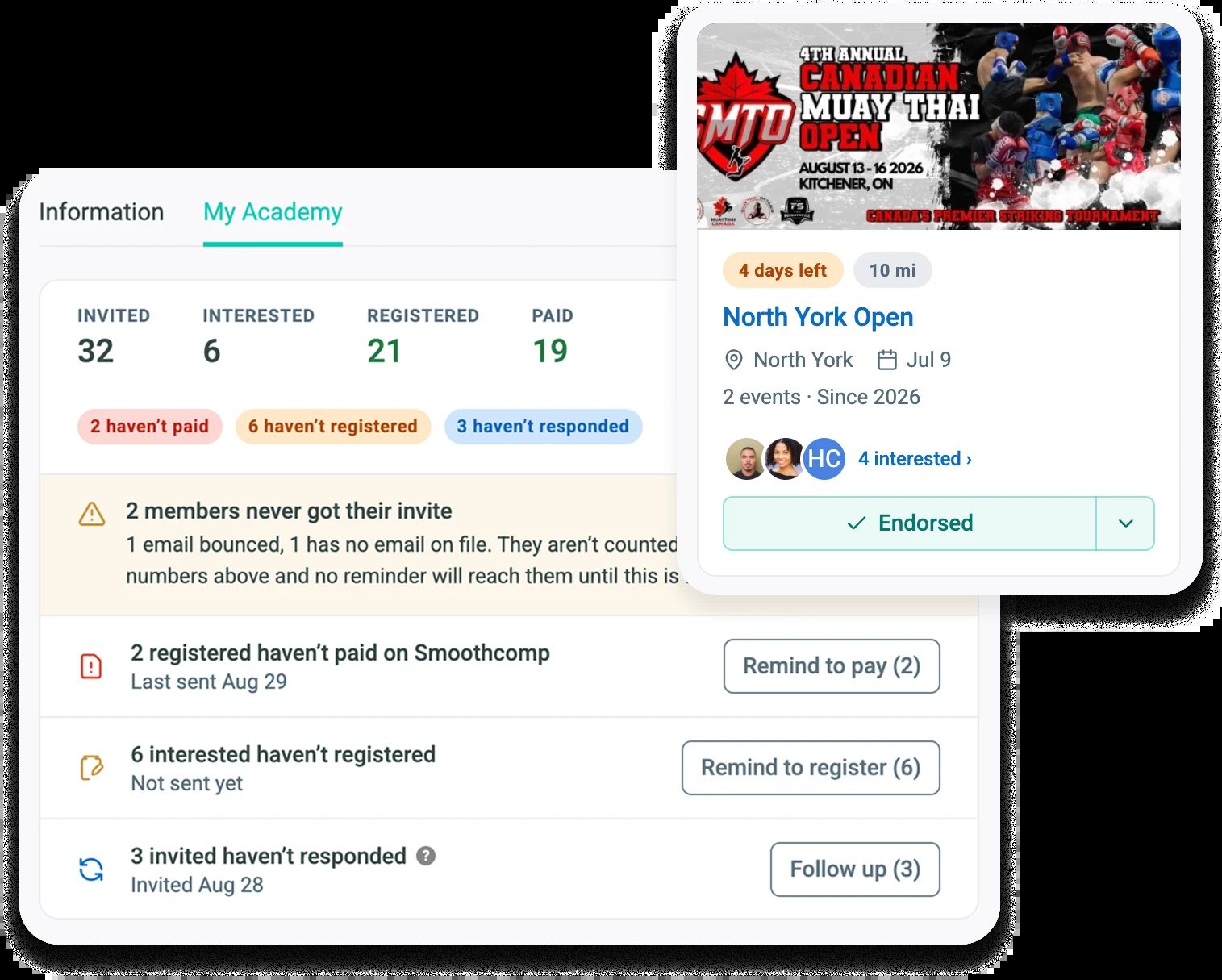
Source: gymdesk.com/smoothcomp-connect, October 2026.
Results from JudoManager-run events don't come in automatically.
Each club type, with a typical size and where to start:
Club type | Typical size | Start with | Why |
Small volunteer club | Under 50 | MatGoat, MartialArts.io, or Gymdesk Micro | Lowest prices, or freezes and kids' billing handled |
Full-time judo dojo | 100–150 | Gymdesk or MartialArts.io | Grading, kids' programs, and federation tracking |
Judo inside a BJJ school | Varies | Gymdesk | Both programs and ranks on one member |
Club with a competition team | Any | Gymdesk with Smoothcomp Connect | Results next to rank |
Running a Judo Club on Gymdesk
If Gymdesk is on your shortlist, this is the practical part. Each need from earlier has a home, and one of them takes a workaround.
This is how the needs from the top of this post map onto Gymdesk:
- Grading night. Set up your kyu ladder with the judo belt style, add time in grade and a minimum age to each rank, and pull the promotion report to see who's ready. Run the grading as an event, and the fee goes on the bill at promotion. Member profiles and ranks and attendance tracking cover the details.
- Pauses. Schedule a freeze with billing paused and a return date, or freeze a group at once.
- Kids and parents. Family accounts put siblings on one payer, the family head manages each child's account from one login, and members can see their ranks in the member app.
- Judo and BJJ side by side. Separate programs and ranks on one member, and a judo-only membership can't check in to BJJ classes.
- Waivers. The member list filters by document signing status, so you can see who hasn't signed.
- Committees. Every plan includes unlimited staff accounts with their own permissions, so a treasurer handover is a new login.
- Competition. Smoothcomp Connect puts results from Smoothcomp events on the member profile.
Federation licenses take one workaround.
There's no built-in license field, so add a dropdown custom field for the federation and one for the renewal year (or a tag like "USJF 2027"). Then save a filter on it to pull everyone due before a grading.
Eric Mieles coaches at Sasaki Judo. He remembers what came before Gymdesk:
"We struggled with software… We would use this product, that product. It was not easy prior to finding Gymdesk."
Shinjiro Sasaki runs the dojo, and he'd much rather be on the mat. He put it this way:
The rest of their story is in the Sasaki Judo case study.
Pick the Software That Runs Your Grading Night
Price the tier that actually runs your gradings, and make sure the rank ladder fits your federation.
Then ask every vendor how it counts a frozen member, because in judo, the summer always comes.
If the answer is one system for grading, kids' billing, and competition, start a free 30-day trial of Gymdesk's martial arts software. No card, no contract, and nothing to un-pause if it doesn't fit.
FOR JUDO CLUBS
Kyu ladders, grading fees at promotion, family accounts, freezes, and results from Smoothcomp events, all on one member profile. Try it free for 30 days. No card, no contract.
Start Free TrialGym management software that frees up your time and helps you grow.
Simplified billing, enrollment, student management, and marketing features that help you grow your gym or martial arts school.


FAQ
Judo Software FAQs
Short answers to the questions club owners ask most.

Sean has spent the last decade creating content that helps businesses—small and not so small—grow smarter to allow operators to do more of what they love. You know, the fun stuff.
From shipping and international logistics to web development and marketing, he's done the work (not just the words) to scale retail and service businesses efficiently.
You can find his work at Sendle, Shogun, The Retail Exec, Gymdesk, and more.