
How Much Do BJJ Instructors Make? Salary Data, Career Path & Income Breakdown

BJJ instructors could make between $15k and $100k+. That range is all over the place—are salary sites spitting out empty numbers?
If you’re using salary data, you’ll find that the “experts” aren’t always as accurate as we’d like them to be. They often share misleading data that swings between pessimism and unreasonable optimism.
Is the truth somewhere in between?
If you’ve done the research for yourself, you’ve probably noticed that the numbers are all over the board.
Which number is closer to the truth? Today, we break things down. First, we’ll answer why the numbers vary. Then we’ll provide a realistic income estimate based on your experience, location, and other sources of income.
Let’s dive in.
Why BJJ Instructor Salary Data Is All Over the Map
As we have already seen, instructor salary data isn’t exactly accurate.
Why is that? Well, for starters, salary estimates typically lump gym owners, W-2 instructors, 1099 instructors, and part-timers into a single group.
Okay, pretty misleading.
But is it really all that different? Yeah, it’s not a great estimate. The earning potential for each of these groups is significantly different. Well, what exactly are salary aggregators like ZipRecruiter, Glassdoor, or RDX Sports measuring?
What the salary sites actually measure
Salary aggregators create estimates from two sources: they use job listings, and they rely (pretty heavily) on limited self-reported data from academies.
They take job titles with varying meanings (e.g., Brazilian jiu jitsu coach, head instructor, and jiu jitsu instructor) and lump them together, creating averages for their estimates.
Not a great plan.
When you look at the data, salary ranges can differ by $31,000 or more. Algorithms drive these estimates; they’re not based on structured compensation surveys or real-world data, and that’s a problem.
Let me show you what I mean.
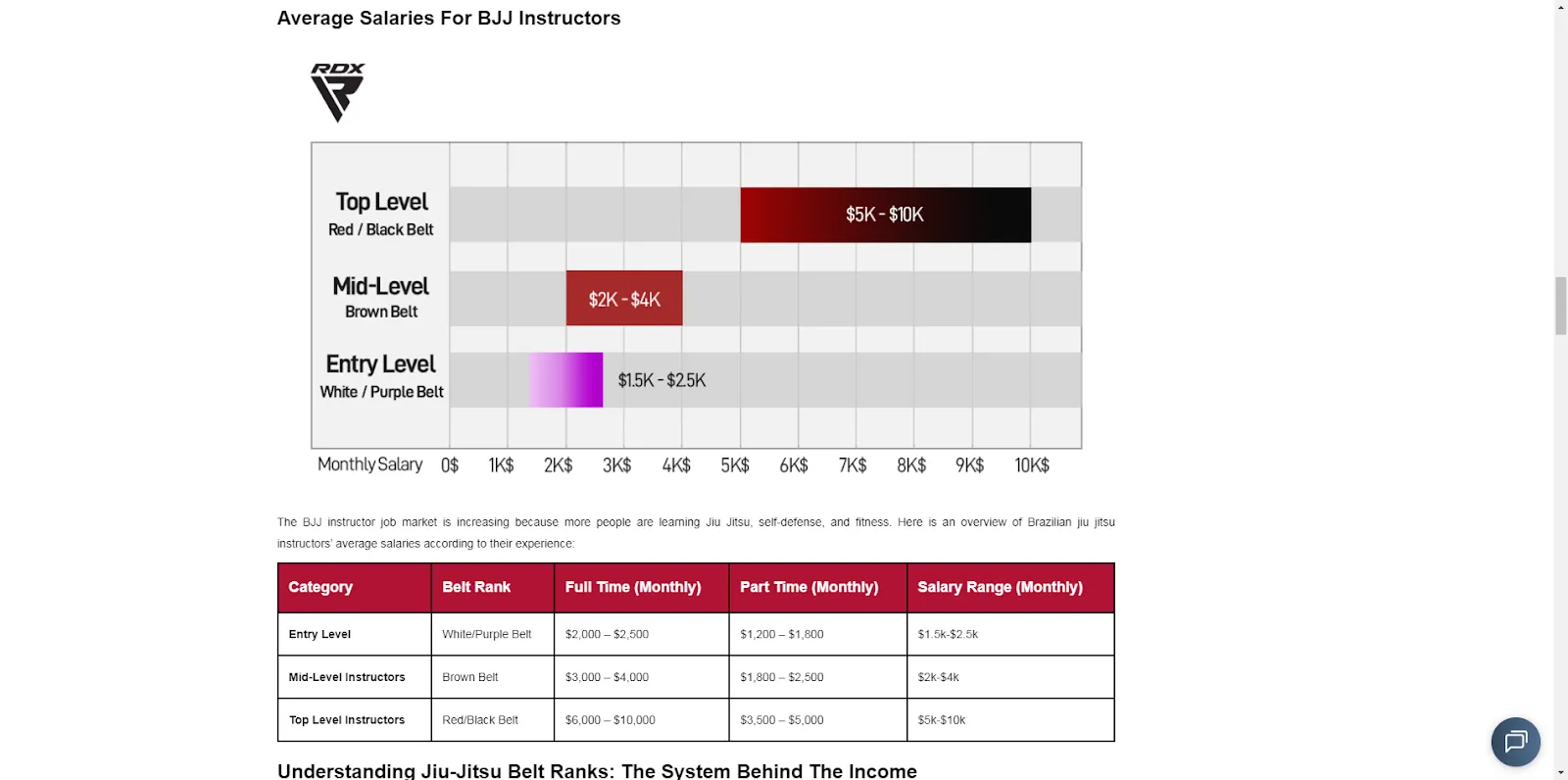
RDXSports salary range: $24K – $100K/yr
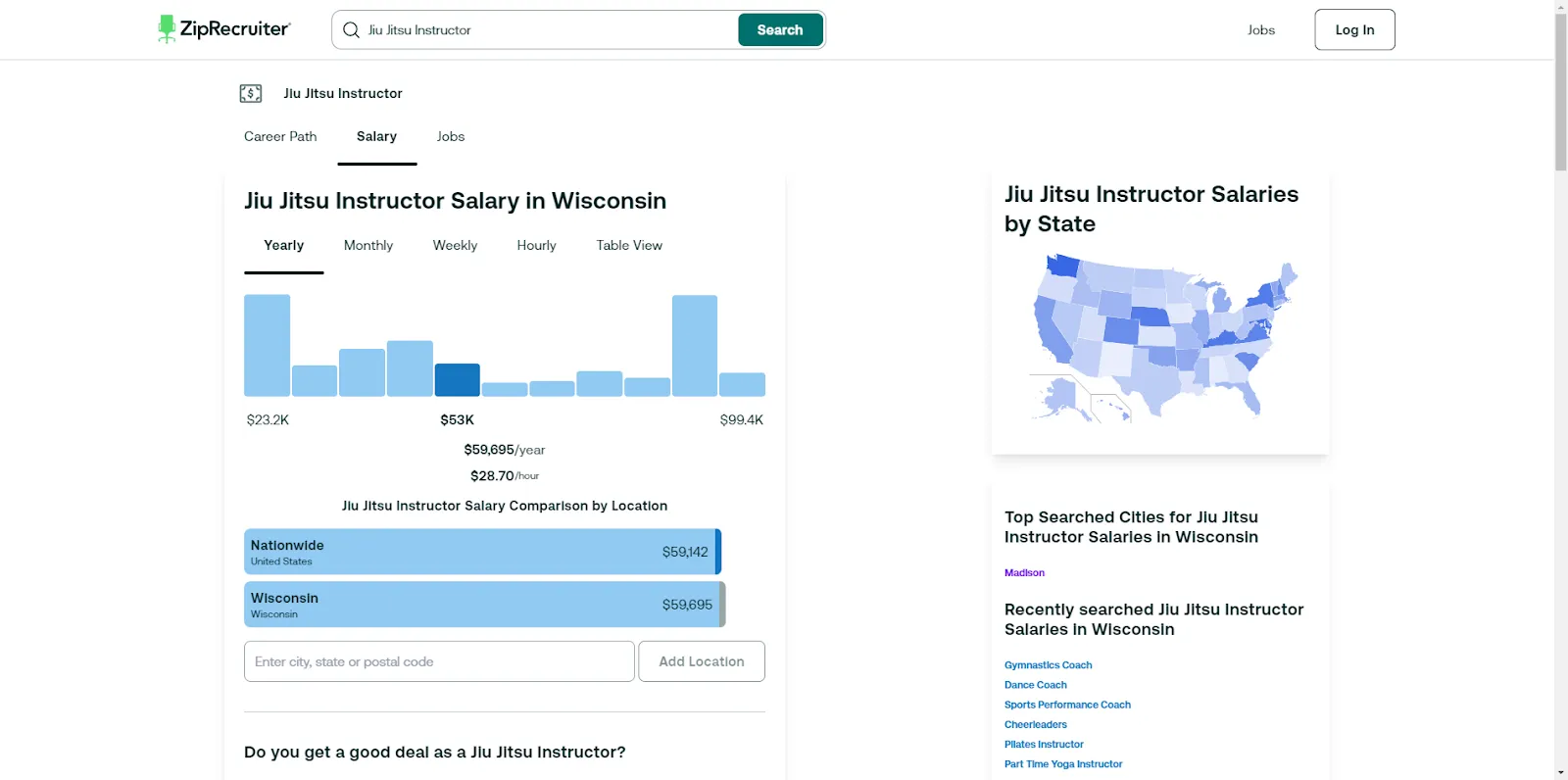
ZipRecruiter salary range: $55K – $99K/yr
Glassdoor salary range: $58K - $95K/yr
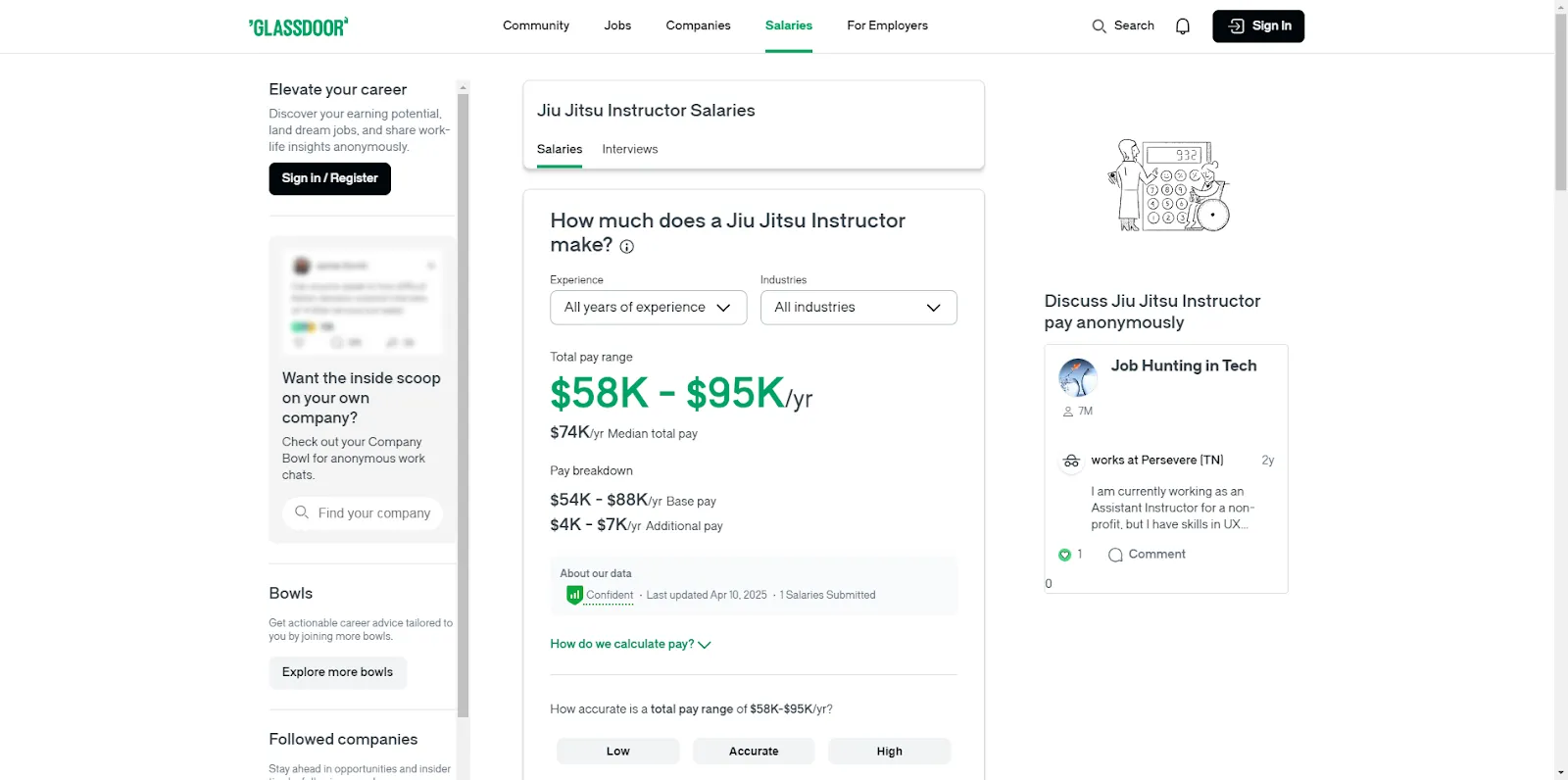
See what I mean? These salary ranges are all over the place.
Whose data is the most accurate? How do we know we’re working with an accurate salary range? The answer to this question begins with an understanding of the employee/owner problem.
The employed instructor vs gym owner problem
Remember how I said salary sites lump everyone together? The biggest distortion is the employee/owner problem.
There’s no distinction between jiu jitsu instructors who are teaching and gym owners who are paying themselves a salary from their cash flow.
Why would that matter? Well, for starters, both of these roles have very different income ceilings and risk profiles.
- Employee instructors: These are W2 or 1099 instructors who are paid to teach at a gym they don’t own. These employees can be full-time or part-time, with various compensation models for their role. If you’re researching compensation and payroll, here’s a primer on managing instructor payroll.
- Gym owners: These are academy owners who receive a salary or an owner draw as compensation. They’re focused on managing the business, creating a curriculum, teaching classes, and handling any issues that crop up. Here’s a breakdown showing you how much gym owners make, and what martial arts school owners actually take home once every wage is paid.
If you’re looking at salary ranges, you’ll need to identify your role.
Are you an owner-operator or an employee-instructor? If you’re an owner-operator, you’re in the driver’s seat. You choose the salary you can afford.
What if you’re an instructor negotiating for a position at a local gym?
While salary websites aren’t as accurate, their ranges are a very useful starting point for testing. Here’s a simple, real-world process you can use to gather the intel you need to negotiate compensation:
- Use a salary aggregator (i.e., ZipRecruiter) to identify the instructor salary range for your area. You’ll want to identify the salary website that best fits with your area.
- Choose the compensation style for your target academy. Gym owners can choose to lead, match, or lag the market.
- Market leaders pay instructors more than other academies.
- Matchers pay what’s in line with industry standards and established gyms.
- Laggards are usually accidental (e.g., instructor candidates tell you your pay is too low, or you pay less because you can’t afford to spend more on salaries).
- Start at the bottom of the salary range listed in your area. You’ll want to identify the salary range that aligns with your data-backed estimates. If you’re joining a smaller gym or they’re working with a shoestring budget, they’re probably a laggard; if they’re an established gym with a decent budget, you can choose.
- Put out feelers. You can approach gym owners for the role you’re looking to fill. Start on the low end of the salary range and work up from there. Look for ways to add value to your offer (e.g., covering multiple classes, increased availability, etc.). If you’re looking to maximize your earnings but you know instructors aren’t able to support this, suggest a bonus structure to your compensation plans (e.g., $30 per session + $20 bonus for each new student you bring in/sign up).
Make sense? When negotiating, you’ll want to identify where you fall on the spectrum.
If you’re a new or inexperienced teacher, be prepared to do more to sweeten the deal. If you’re experienced, show how that experience will bring more value to the gym.
BJJ Instructor Salary by Experience Level
The experience you have determines how much you can earn. Here’s a brief breakdown of the differences between entry-level and experienced instructors.
Before we get into the details about each experience level, here’s your cheat sheet:
Now for the details on each.
Entry-level and assistant instructors
There’s a lot of debate on this. Many people in the jiu-jitsu community feel blue and purple belts have no business teaching.
Meanwhile, there are blue, purple, and brown belts running their own gyms. If you’re interested in hiring entry-level (blue- and purple-belt) instructors, you’ll need to address this question.
When John Danaher started teaching at Renzo Gracie’s in New York, he was a purple-belt.
He actually refused to take a salary. Instead, he took a small stipend to cover rent and made most of his money teaching privates.
As an instructor, you’ll need to identify the compensation schemes you’re most comfortable with. Instructors can be paid via :
- An hourly rate
- A flat rate
- A flat rate + bonus
- Salary
In the beginning, most entry-level instructors teach part-time. Here’s a table showing what annual compensation looks like (in the $10–$30/hr range) for blue and purple belts. Find your rate and weekly class counts to see where you’d land.
Experienced instructors (brown and black belts)
Full-time instructors are a different story.
If you’re a full-time instructor, you’re typically a brown or black-belt instructor who teaches at a large gym in a bigger city. Full-time instructors earn $25–$45 per hour, which translates to $35K–$55K annually (depending on the salary aggregator you use).
This full-time tier usually involves teaching 10 to 25 classes each week.
As a full-time instructor, you’ll also be expected to assist with developing or implementing the curriculum and doing what it takes to support student retention.
Here’s the thing about this: Your academy’s pricing model significantly affects your ability to carry a full-time instructor.
If you’re looking to hire full-time staff members, the way your academy structures tuition will help to support your full-time instructors and support staff.
Head instructors and program directors
What about larger gyms?
If you’re running a larger academy in the metro area and you’re an established black belt, you can expect to earn $50K to $100K/yr.
These are gyms with large headcounts. As a head instructor, your responsibilities go beyond teaching and include staff mentorship, curriculum ownership, and student performance tracking.
Understand that salaries on the higher end of this range are outliers.
Elite and celebrity instructors
If you’re an athlete in the top 1–2%, your income can easily exceed six figures.
Instructors in this tier earn income from multiple streams—academy salaries, seminar fees, private lessons, sponsorships, and instructional sales.
For example, Gordon Ryan charges $1,200 per hour.

If you’re a celebrity athlete competing at a high level, you can command (much) higher rates. That sounds great until you realize your rate is determined by a factor stronger than celebrity or status.
That’s right, it’s geography.
How Geography Affects BJJ Instructor Pay
Geography has a significant impact on instructor salaries.
Here’s why that’s so important: Most instructors are limited by geography.
Market demand and the cost of living significantly affect the prices students are willing to pay. This, in turn, impacts instructor salary expectations.
Looking at salary aggregators, we see compensation in the following ranges.
According to RDX Sport, the top paying cities in the US include:
No surprise here, right? If you’re in a bigger city, you can earn more.
The downside is that higher salaries often come with higher living expenses—a $55K salary in a major metro like New York City offers less purchasing power than $40K in a smaller city like Indianapolis.
This is why salary aggregators, while inaccurate, are still useful. It’s a starting point.
You can use these salary ranges, along with anecdotal data (e.g., talking to other gym owners, asking around), to identify a starting point.
There’s no uniform data source for the jiu-jitsu community—it’s something you’ll have to test and analyze for yourself, depending on your compensation style.
This is how instructors build a stable, reliable income.
Beyond Your Paycheck: How BJJ Instructors Actually Build Income
New instructors often enter teaching with fuzzy, implicit, or unreasonable expectations. They generally settle into one of three camps.
- To teach for free: Some students are just happy to get the status boost from teaching—but they’ll continue to pay full tuition at their academy. This is great at first, but it often leads to bitterness, resentment, and decreased morale in the gym.
- To be paid a full-time salary (as a new instructor): On the other end of the spectrum, some new instructors believe they’re better and more knowledgeable than they are. These students expect to be paid a full-time salary and often ask for additional incentives (e.g., free membership, free rash guards).
- To make a full-time income from only teaching classes: These instructors are talented, but they’re often disengaged. They want to teach their classes, do what’s expected, and go home. They’re often unwilling to teach private sessions, conduct seminars, or work on content.
While this can work, it’s generally unreasonable.
Successful instructors generally focus on building multiple streams of income via privates, seminars, guest instruction, and online content.
Private lessons
Private coaching is one of the easiest ways to increase instructor income.
Rates typically vary by geography, accolades, and track record—ranging from $25–$100 per hour for most instructors to $500 or more per hour for elite, high-level instructors.
Teaching five private sessions each week at $50 (or $100) per session can generate an additional $12,500–$25,000/yr.
Scheduling tools like Gymdesk can simplify the process, allowing instructors to manage privates online instead of playing phone tag.
Seminars and guest instruction
Seminar income, while seasonal, is accolade and reputation-driven.
Up-and-coming instructors can earn $1,000–$5,000 per seminar, while elite-level instructors can earn much more, depending on competitive success and the reach of their networks.
Online content and instructionals
Platforms like Skool and Patreon make it easy to build a digital content and subscription coaching business.
By partnering with third-party platforms like YouTube and instructional platforms, instructors can earn substantial recurring revenue.
Most treat online content and instructionals as side hustles or alternative income, which is a shame. This income stream can easily become the main thing, as many athletes have shown.
Okay, how do we build multiple income streams?
The Realistic Career Timeline (And What You’ll Earn Along the Way)
If you’re taking a realistic look at your career timeline, you’ll want to focus on the specific steps you’ll need to take to build stable earnings.
Let’s take a look at the various phases in your career.
The ownership decision
At some point, many instructors may find that they’ve hit an income ceiling.
If they’re willing to take the risk and they’ve built a stable following, they may consider starting their own BJJ academy. If they see that their former boss is doing well, they may be more motivated to push forward or take over the school from their head instructor.
The Hard Truths About BJJ Instructor Pay
If you love teaching, training, and jiu-jitsu in general, the idea of making a full-time income may sound incredible, and it is. But there are some caveats you’ll want to pay attention to.
Benefits are rare
Most instructors don’t have health insurance; they don’t receive retirement contributions, paid time off, or stock options.
Promotions and pay raises are few and far between, and an independent contractor classification is the norm.
Fix it by: Purchasing health insurance plans and investment products to plan for retirement. You can purchase health insurance coverage for as little as $30 per month. You can use investment products like annuities or life insurance to plan for retirement.
Burnout is real
It’s common for teachers who are training, coaching, and running a gym to struggle with burnout.
If you’re teaching 15 to 20+ classes per week, while also training daily, it’s a significant amount of physical strain.
Here, Chewy shares some details on dealing with burnout:
Fix it by: Carving out downtime each week. Set aside time off and plan for vacations. Do what you can to create a clear separation between teaching, training, and your personal life.
Income fluctuates seasonally
It’s common for attendance to spike in January and September, then drop a bit during the summer months.
Students travel, enjoy their summer breaks, spend time with family—this is where retention strategies, like the ones we’ve outlined in our guide, have a direct impact on instructor job stability:
Teaching, like any activity, comes with its share of downsides.
Fix it by: Building a full-time income that’s based on rock-solid, reliable income streams. If you’re looking to increase your income as an instructor, follow a plan.
For example, you can create training then share it on platforms like Patreon, Skool, or BJJ Fanatics. You can build up a roster of sponsors who support you as you compete year-round. Do what you can to create resources that don’t require you to directly trade time for money.
How to Increase Your Earning Potential as a BJJ Instructor
If you’re looking to boost your earning potential quickly, here are some simple steps you can follow.
- Earn your black belt. The biggest pay boost comes after you hit this milestone.
- Compete regularly. Become a known competitor in local, regional, national, or international tournaments. Doing this increases your credibility and perceived authority.
- Track retention metrics. If you can show consistent student engagement, you have a stronger bargaining position during negotiations.
- Build a private-lesson client base. This gives students income stability that extends beyond class.
- Develop a specialty. Are you a phenomenal kids’ coach? Do you build world champions, or are you focused on self-defense tactics?
- Build an online presence. Consistent marketing produces long-term student growth and reliable cash flow.
Become the instructor your students want.
Build a consistent, reliable base—focus on the metrics students pursue. With consistent work, you’ll find you’re able to command higher fees, boosting your earning potential over time.
Is Teaching BJJ a Viable Career?
The answer is yes.
If you’ve done the research for yourself, you’ve probably noticed that the numbers are all over the board. As we’ve seen, that’s not a barrier. With the right process, you can increase your earning power.
The process is the same whether you’re an owner-operator or an employee-instructor.
So, how much do jiu jitsu instructors make in the real world? The answer depends on your belt rank, market size, employment structure, and income streams.
Instructors who diversify income streams and eventually transition to ownership achieve stable, long-term earnings. Whether you’re negotiating instructor pay or preparing to open your own academy, having the right systems in place makes business easier.
Follow the plan we’ve laid out, and you’ll find it’s easy to increase your earning potential, no free labor necessary.
And, whether you are running a gym or teaching at a gym, having the right software is key to keeping your head near the mat instead of the computer. Gymdesk was made for it. Try free for 30 days if you don't believe us!
Gym management software that frees up your time and helps you grow.
Simplified billing, enrollment, student management, and marketing features that help you grow your gym or martial arts school.


FAQ
BJJ Instructor Pay FAQs
.webp)
Andrew McDermott is a gym owner, Brazilian Jiu Jitsu brown belt, and digital marketer. He’s on a mission to build premier, high-stakes grappling tournaments, world-class academies, and a championship team of high-level athletes.