
The Best Boxing Gym Software in 2026, With Real Prices

Imagine it's a Tuesday, it's 6pm, it's already a bit humid in the room.
A fitness-boxing class is warming up on the bags, and nobody in it plans to get punched in the face, ever.
Three amateurs are on the team bag, getting ready for a USA Boxing card next month. A walk-in at the desk wants to know what a day pass costs. And a parent is signing a nine-year-old up for Saturday mornings.
Your boxing gym software has to sell and track all four of those people.
Most gym software was built for a member who buys one plan and books one class, so it handles the first person fine and fumbles the rest.
THE SHORT VERSION:
For most independent boxing gyms, Gymdesk is the best fit, because it sells memberships, day passes, class packs, private sessions, and gloves from one system. A boutique fitness-boxing studio should look hard at TeamUp or WellnessLiving, and a brand-new gym with no budget can start on PushPress Free after doing the processing math.
What Boxing Gyms Need From Gym Software
A boxing gym makes money in more ways than a typical membership gym, and good boxing gym software has to keep up with all of them. It also carries a liability problem most gyms never think about: sparring.
So the criteria start there.
Drop-ins, day passes, and class packs
Walk-ins and 10-class cards are a real revenue line at a boxing gym.
Your boxing membership system should sell them at the desk and online, count them down, and expire them. If you sell open bag time, add a capacity limit and a waitlist, or your heavy bags get booked like a Black Friday sale.
Ask each vendor whether a day-pass visitor counts as an active member, because the answer changes your bill.
Private pad sessions
Private sessions are usually booked by text message, which is how a Thursday 7am session turns into two people standing in an empty gym.
Look for privates on their own calendar, tied to the coach, and paid when they're booked.
The sparring gate
Fitness members and fighters share a room, so before anyone does contact work, you need a signed liability waiver on file and a way for a coach to see who's cleared.
Contact comes in grades, too.
Lisa Titan, who owns St Johns Boxing in Portland and is a USA Boxing certified coach, said her coaches ease new boxers in by dialing the sparring down:
"We might say something like jab round only, or keep it below 20% power."
If you run an amateur club, you'll also want expiring medicals and coaching accreditations on one list, so fight week brings no surprises.
Retail at the desk
Someone forgets their wraps at least once a week (it's a law of physics). A point of sale that puts wraps, gloves, and mouthguards on the member's card beats a cash box and an IOU.
For what to stock, see this list of boxing gym equipment.
A kids' class
A parent signs the waiver, and siblings share one bill. Without family accounts, a boxing for kids program becomes a stack of separate invoices.
Leads and trials
Someone books a trial, comes once, and you never see them again.
Look for trial booking, automatic follow-up, and a "came once" list so a coach can call them.
Getting people in the door is its own job, covered in boxing gym marketing.
Simple enough for a coach who'd rather be coaching
Many boxing gym owners are coaches first. Lisa said:
"I'm not a very technically minded person."
A long feature list is worthless if nobody at the gym opens it.
Here's the checklist in one place:
Need | What good looks like | Red flag |
Drop-ins, packs, bag time | A $20 day pass sold at the desk or online in a couple of taps, counted down and expired, with capacity limits on open gym | Walk-ins entered as members and billed monthly by mistake |
Private sessions | Privates on their own calendar, tied to a coach, paid at booking | Booked by text and paid in cash, maybe |
Sparring gate | Waiver signed at sign-up, plus a visible "cleared for contact" marker | Waivers in a filing cabinet, clearance in the coach's head |
Retail | Gear rung up on the member's card, with sizes tracked | A cash box and a sticky note |
Kids' class | Family accounts, guardian details, one bill per family | One invoice per kid |
Leads and trials | Trial booking, automatic follow-up, a "came once" list | Trial names on paper behind the desk |
Simplicity | Staff can run a check-in on day one | Only the owner knows the password |
How This Comparison Was Built
I read every price off the vendor's own pricing page on October 15, 2026.
A boxing gym software tool made the list if it shows up where boxing gym owners compare software and publishes features you can check.
Every tool was judged against the boxing gym management software needs above, Gymdesk included, gaps and all.
Smaller boxing-specific vendors like Mat Track, MatGoat, and ClubHelix aren't here, because I couldn't find a public pricing page for them.
If your gym also runs belt programs, martial arts management software gets its own comparison, judged on rank tracking.
One thing you notice reading ten gym software homepages back to back: a surprising number of them promise less admin. Ours says "Less Admin. More Members. Zero Guesswork." We've decided to take the rest as a compliment.
The Best Boxing Gym Software in 2026
No single tool is best for every boxing gym, and the pricing model matters as much as the price.
These aren't ranked.
Gymdesk comes first because this is Gymdesk's blog (you'd have guessed) and it's built for exactly this kind of gym. The rest are grouped by the kind of gym they suit.
At a glance:
Tool | Best for | Published starting price | Drop-ins and packs | Private session booking |
Gymdesk | Independent boxing gyms | $75/mo ($100 with your own processor) | Yes | Yes |
PushPress | New gyms starting at $0 | $0 (Free plan) | Yes | Yes |
Zen Planner | Larger gyms buying modules | From $99/mo | Not listed | Not listed |
ABC Glofox | Multi-site fitness brands | Not published | Not listed | Not listed |
Mindbody | City studios that want marketplace traffic | From $79/mo | Not listed | Not listed |
Kicksite | A boxing class inside a belt-based school | $49/mo (0–25 students) | Not listed | Not listed |
TeamUp | Pack-heavy fitness-boxing studios | $119/mo (0–100) | Packs, yes; drop-ins not listed | Yes |
Wodify | Gyms with serious S&C programming | $199/mo ($99 with a demo by Oct 31) | Yes (appointments) | Yes |
WellnessLiving | Gyms that want hard waiver enforcement | $69/mo (one staff member) | Yes (passes) | Yes |
Spark Membership | Kids-heavy martial arts schools | $199/mo | Not listed | Not listed |
Prices from each vendor's own pricing page, October 15, 2026. "Not listed" means the vendor's pricing page doesn't say, not that the feature is missing.
Gymdesk

Gymdesk is built for independent combat-sports gyms.
Every plan includes every feature Gymdesk builds, unlimited staff accounts, and a gym website.
For a boxing gym, that covers drop-ins, class packs, privates with online booking, waivers, gear sales, a member app, and attendance that shows who's gone quiet.
Gymdesk uses active-member pricing, and it costs less if you process through Gymdesk Payments, though you can bring your own processor.
- Micro (up to 50 active members): $75/mo with Gymdesk Payments, $100 with your own processor
- Small (51–100): $100 / $125
- Medium (101–150): $150 / $175
- Large (151–250): $200 / $240
- Enterprise (251+): quoted
Visitors, frozen and cancelled members, and prospects don't count toward the active total. There's a 30-day free trial with no credit card and no contract.
The honest limitations. The price climbs as you grow, and a 20-student program pays more on Gymdesk's Micro tier than on Kicksite's $49 band.
A branded app in the app stores is $100/mo (the standard member app is included), and door access is an optional $100/mo beta add-on.
And there's a lot in it. A coach who only wants a schedule and a card reader will leave some of it switched off.
Ask them: What will my bill be at the member count I expect a year from now? Which add-ons would my gym actually need?
Best for: an independent boxing gym that sells memberships, packs, privates, and retail and wants one system for all of it.
PushPress
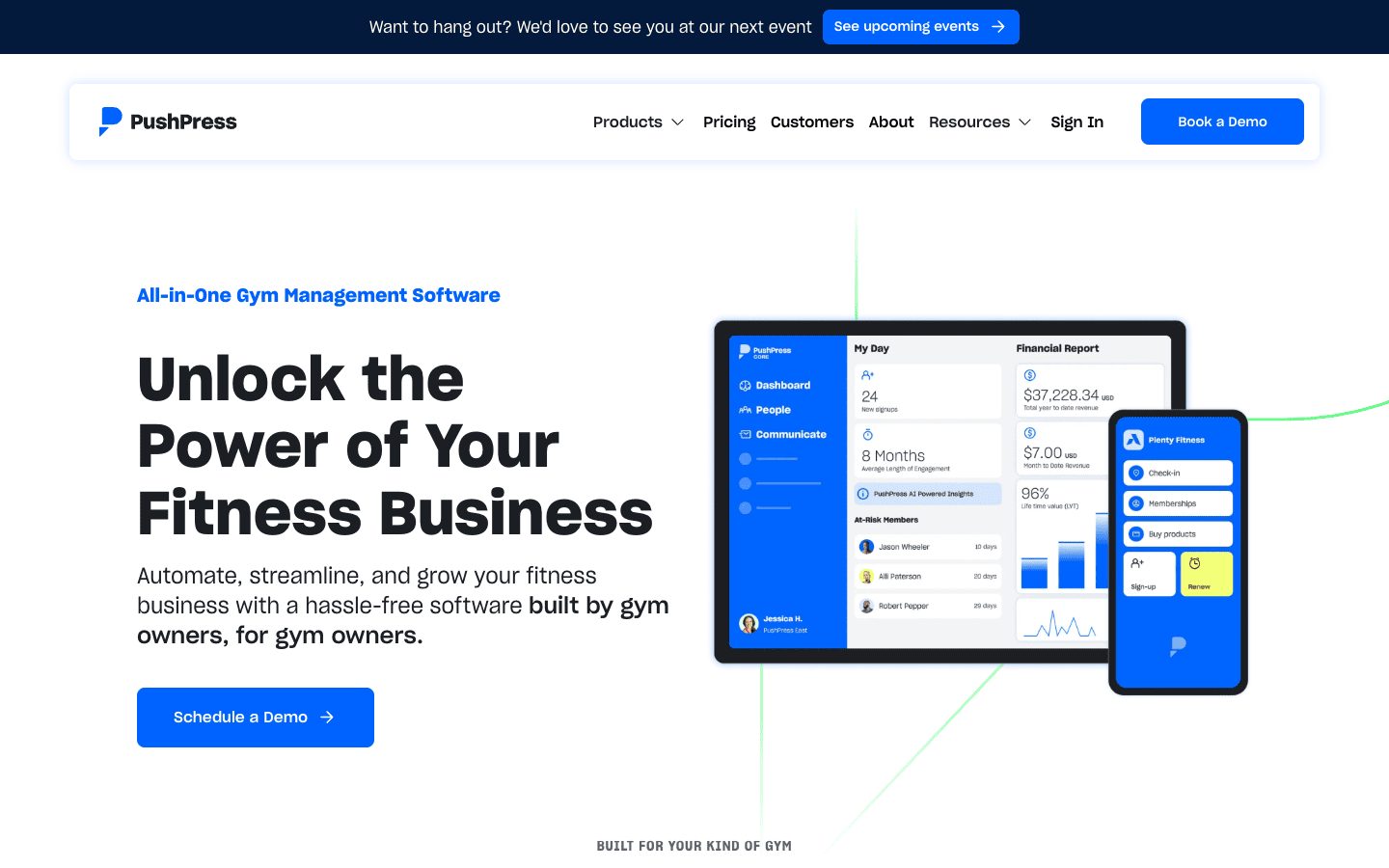
PushPress started in CrossFit, and it's the only tool here with a $0 plan.
Its pricing page lists personal training appointments, drop-ins, class packs, digital waivers, and events with registration. Plan purchase limits stop someone from buying your free trial five times.
Price: Free is $0 a month, with card processing at 4.99% + $0.30. Pro is $159/mo and Max is $229/mo, both with lower processing rates.
Limitation: the free plan carries the highest processing rate on the page, and the marketing tools cost extra.
Ask them: At my monthly card volume, what would I pay in processing on Free compared with Pro? Which of the features I need sit in Grow or Train?
Best for: a brand-new gym that wants to start at $0 and has done the processing math.
Zen Planner
Zen Planner is established studio software, sold in packages. You pay by active member, and pay-per-session attendees aren't counted, so a true pay-per-visit drop-in doesn't move your bill.
Ask how a class pack counts, since anyone with a membership or event attendance in the past month does.
Packages start at $99/mo for Studio, with Essentials at $198, Ultimate at $348, and a New Business Bundle at $199. A branded app is $39/mo extra.
Limitation: every price on the page says "starting at," and the per-member bands aren't published. You'll need a demo to get your real number.
Ask them: What's the per-member price at my size? Does someone on a class pack count as an active member?
Best for: a larger gym that wants to buy modules à la carte.
ABC Glofox

ABC Glofox is a boutique-fitness platform owned by ABC Fitness.
The pricing page is a quote form that asks for your business type and number of locations. That's the whole price list.
Limitation: you can't see a number without handing over your details.
Ask them: What's the monthly price for one location? Is there a minimum contract term?
Best for: a multi-site fitness-boxing brand with an operations team.
Mindbody

Mindbody is the big consumer marketplace. Room and resource management and Client Pick-a-Spot (so members can pick a spot) are Accelerate-tier features, and Accelerate is quote-only.
Neither comes with the $79 entry plan.
The entry price is "Starting at $79 USD/month per location," with every tier card above that reading "Let's talk."
When the Mindbody app sends you a new client, Mindbody takes 20% of their first purchase, capped at $30. Existing clients, tracked referrals, and people who find you another way don't trigger it.
It's a finder's fee, charged once.
Limitation: only the entry price is public, and the spot-booking features a bag-heavy gym would want sit on a quote-only tier.
Ask them: What does Accelerate cost for one location? How do you decide whether a new client came from the app?
Best for: a boutique fitness-boxing studio in a big city that lives on discovery.
Kicksite
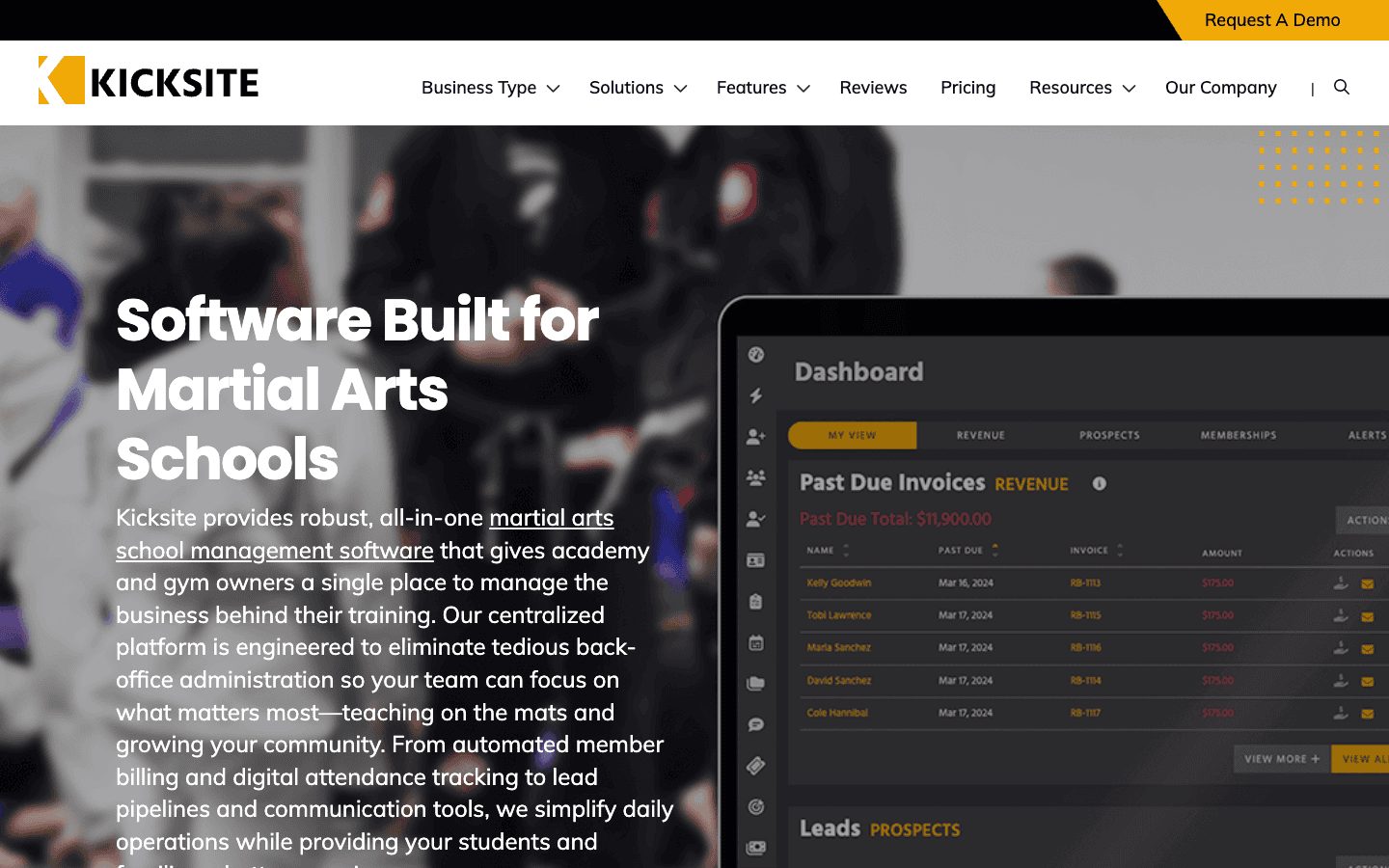
Kicksite is martial arts school software with the simplest published bands on this list. It flags failed payments, captures leads with forms and landing pages, and includes free one-way texting and attendance.
Price, by student count: 0–25 students $49/mo, 26–50 $99, 51–100 $149, and 101+ $199. Every tier gets all features, and your first 30 days are free.
Limitation: the whole product is pitched at belt-based schools, and the pricing page doesn't mention drop-ins, class packs, or private sessions.
Ask them: Can I sell a day pass and a 10-class card? Can members book a private session with a coach?
Best for: a small boxing program inside a traditional martial arts school.
TeamUp

TeamUp is fitness-studio booking software built around packs and appointments.
It sells memberships and packs, books appointments against instructor availability, and handles waivers and forms, a point of sale, a penalty system, and family accounts.
TeamUp bills by active customer: 0–100 $119/mo, 101–200 $189, 201–300 $219, 301–400 $249, 401–500 $289, and 501+ $379. It prices in pounds too (from £99), which suits a UK club, and it's month to month.
Limitation: anyone who booked or bought something last month counts, so a busy walk-in month can push you up a band.
Ask them: How many drop-ins would push me into the next band? Does a one-time visitor count the same as a member?
Best for: a fitness-boxing studio that runs on packs and penalties.
Wodify

Wodify started in CrossFit and is strong on performance tracking, and its pricing page lists drop-in and package sales plus appointment scheduling.
Digital waivers and contracts come on the base Essentials plan, and Accelerate adds lead management and family groups with shared payments for a kids' class.
Price: Essentials lists at $199/mo, Accelerate at $299, and Ultimate at $499. Wodify offers $100 off every month, for life, if you book a demo by October 31, which makes them $99, $199, and $399. No long-term contracts.
Limitation: the headline price is a promotion with a deadline, and the workout tracking suits a strength-and-conditioning gym more than a boxing gym.
Ask them: Is the $100-off price written into my agreement? What would I pay if I signed up after October 31?
Best for: a boxing gym that programs serious S&C alongside its classes.
WellnessLiving

WellnessLiving is an all-in-one studio platform.
Book-a-Spot and asset reservations handle ring or bag time, its digital waivers can block access until they're signed, and it has family booking, waitlists, and a self check-in kiosk.
On monthly billing, Starter is $69/mo for one staff member, Business is $199/mo, BusinessPro is $349/mo, and Enterprise is "Call us." Paying annually saves 10%.
Limitation: Starter covers one staff member, so a gym with a second coach is really looking at $199.
Ask them: What does Business cost after the two promo months? Can a second coach run check-in on Starter?
Best for: a gym that wants hard waiver enforcement and bag booking, with the budget for Business.
Spark Membership

Spark Membership is a martial arts CRM built for marketing-led schools.
It has student profiles with belt history, family accounts, attendance trends, and free data migration.
There's one plan: an eight-week free trial, then $199 a month.
Limitation: it's built around belt-based schools and kids' programs. Its software menu lists kickboxing, not boxing, and there's no smaller tier for a 40-member gym.
Ask them: Is there a lower price for a gym under 50 members? Can I sell drop-ins and book private sessions?
Best for: a kids-heavy martial arts school that added a boxing class.
What Boxing Gym Software Actually Costs
The pricing model decides your bill more than the headline price does.
This is what boxing gym software costs a month on the base plan, before card processing, for a 45-member club and a 140-member gym. Each vendor's own definition of an active member applies.
Tool | Pricing model | 45 members | 140 members | Not included |
Gymdesk | By active members, full platform included | $75 with Gymdesk Payments / $100 own processor | $150 / $175 | Optional: branded app +$100, door access +$100 (beta) |
Kicksite | Student bands, everything included | $99 | $199 | Nothing listed |
TeamUp | Active customers (recent drop-ins count) | $119 | $189 | Branded app +$99 |
PushPress | Flat tiers plus add-ons | $0 Free (4.99% + $0.30 per card payment) or $159 Pro | Same | CRM +$329, branded app +$97 |
Zen Planner | Active members, modules extra | From $99 | Band not published | Website from +$99, Engage from +$249 |
WellnessLiving | Flat tiers by staff | $69 Starter (one staff) or $199 Business | Same | Promo pricing for the first two months |
Spark Membership | One flat plan | $199 | $199 | Nothing listed |
Wodify | Flat tiers | $199 Essentials ($99 with the Oct 31 demo promo) | Same | Higher tiers $299–$499 |
Mindbody | Per location | From $79 | From $79, higher tiers quoted | 20% fee on marketplace first purchases |
ABC Glofox | Quote | Not published | Not published | Not published |
Prices from each vendor's own pricing page, October 15, 2026.
To run your own numbers, try the gym software cost calculator.
Two things the table hides. A free plan isn't free if every payment runs through it at 4.99% + $0.30. On PushPress's own numbers, Free beats Pro until card volume passes roughly $7,600 a month, where the 2.1-point gap in card rates overtakes Pro's $159.
And a tool that counts drop-ins as customers can bump a busy walk-in gym up a band in its best month. Gymdesk leaves visitors and prospects out of its count, while TeamUp counts anyone who booked or bought something in the previous month. Ask every vendor: does a day pass count?
For the wider picture, see gym management software cost.
Software is a small line next to rent and coaches, and what boxing gym owners make shows where it sits in the margin.
We'll keep you in the loop with fresh content, podcasts, how-to guides, tool reviews, and product exclusives.
Which Boxing Gym Software Fits Your Gym
Start with the kind of gym you run. The table at the end sums it up.
An independent boxing gym with a competitive team
Memberships, packs, privates, gear, a kids' class, and a few fighters.
Start with Gymdesk, or Kicksite if you run a small program inside a belt school and want the lowest small-band price.
If you host fight nights, that's a different tool: martial arts tournament software.
A boutique fitness-boxing studio
No sparring, lots of classes, and heavy pack and intro-offer sales, so boxing studio software looks more like a yoga studio's, with louder music.
TeamUp fits a studio that runs on packs and penalties, and WellnessLiving is close behind if you want spot booking and waivers that block booking until they're signed.
Mindbody makes sense if discovery is worth a marketplace fee of 20% of a new client's first purchase, capped at $30.
An amateur or volunteer-run boxing club
Volunteer coaches, subs, a register, and medicals with expiry dates.
For boxing club software, start with Gymdesk (unlimited staff accounts, so volunteers don't cost a seat) or TeamUp if you want to be billed in pounds.
One Gymdesk gap: it doesn't track expiry dates on medicals or coaching accreditations. A tag like "medical due" plus a saved filter you pull before fight week does the job, but you'll keep it current by hand.
A brand-new gym on a tight budget
Start with PushPress Free or Gymdesk Micro, and run the processing math before you choose.
For the rest of the startup budget, see what it costs to open a boxing gym.
Boxing plus kickboxing, Muay Thai, or MMA
If boxing is one program inside a striking or MMA gym, start with Gymdesk anyway.
It keeps boxing, kickboxing, Muay Thai, and BJJ on one system, with one member list and one bill per member. For the full multi-discipline comparison, see MMA gym software.
Gym type | Typical size | Start with | Why |
Independent gym with a team | 40–150 members | Gymdesk | Memberships, packs, privates, and gear in one system |
Boutique fitness-boxing studio | 100+ active customers | TeamUp or WellnessLiving | Built around packs, penalties, and spot booking |
Amateur or volunteer club | 30–100 members | Gymdesk or TeamUp | Unlimited staff seats, or pricing in pounds |
Brand-new gym | Under 50 | PushPress Free or Gymdesk Micro | Lowest starting cost, once processing is counted |
Boxing inside an MMA or striking gym | Varies | Gymdesk | Every program on one system; the MMA guide compares the rest |
Running a Boxing Gym on Gymdesk
This is how the needs from the top of this post map onto Gymdesk:
- Drop-ins and packs. Any class can carry a non-member drop-in price, and class packs count down at check-in. Walk-ins who never join don't count toward your tier, so a busy month of day passes doesn't move your bill.
- Gear. Gloves go on the member's card at the point of sale, with sizes as product variants and stock that counts down as you sell. The cash box can finally retire.
- Kids and member accounts. Family accounts carry guardian details, one bill, and the waiver. Members and parents log into their own accounts, and you decide what they can change there.
- The ones who came once. Trial bookings get automatic follow-up, and attendance shows who's new and who's stopped coming. Members check in from the member app.
The sparring gate takes one workaround. Waivers get signed in the sign-up or booking form, and you can block check-in until they are.
There's no button labeled "cleared to spar."
Make one with a custom checkbox field or a tag, then a saved filter that pulls the list before sparring night.
The came-once list is what Lisa Titan's gym manager pointed to:
"You can see which ones are new and if they're active or not, and everything's all in one place."
Lisa picked Gymdesk in her first year at St Johns Boxing. She said:
She hasn't used all of Gymdesk's tools, and she's had her frustrations with it. Sometimes she hands it off to someone else, and it comes back to her.
The member accounts are a part she likes:
"I like it that they can log into their own account and I can decide what they can and can't do from their account."
Pick the Software That Fits the Gym You Actually Run
Count your revenue lines first: memberships, packs, privates, gear, and the kids' class.
Then ask every vendor how it counts a member, and price the real month, add-ons and card processing included.
If the answer is one system for an independent boxing gym, start a free 30-day trial of Gymdesk's martial arts software. No card, no contract, and no exit fee (or awkward phone call) if it doesn't fit.
FOR INDEPENDENT BOXING GYMS
Drop-ins, class packs, private sessions, waivers, and the gloves at the desk, all on one account per member. Try it free for 30 days. No card, no contract.
Start Free TrialGym management software that frees up your time and helps you grow.
Simplified billing, enrollment, student management, and marketing features that help you grow your gym or martial arts school.


FAQ
Boxing Gym Software FAQs
Prices in these answers come from each vendor's pricing page on October 15, 2026.

Seanは過去10年にわたり、規模を問わずさまざまな企業が賢く成長できるよう、コンテンツを制作してきました。経営者が本当に好きなこと、つまり楽しい仕事にもっと時間を使えるようにするためです。
配送や国際物流からウェブ開発、マーケティングまで、言葉だけでなく実務を通じて、小売業やサービス業の効率的な事業拡大に携わってきました。
これまでの執筆先には、Sendle、Shogun、The 小売 Exec、Gymdeskなどがあります。