

Here's something nobody tells you when you're gym shopping: every chain claims to have everything you need.
Great equipment. Friendly staff. A judgment-free zone (trademark pending).
Most of them are telling the truth, more or less. The problem is that "everything" means something different depending on who you are.
A competitive powerlifter has exactly zero use for a barre studio. A working parent who can squeeze in 45 minutes at 6 PM doesn't need a 24/7 key-fob gym in an inconvenient part of town.
The best gyms in the US are the ones that match your actual life. Amenities lists rarely tell you which one that is.
This guide breaks down 12 major gym chains in America—what they're genuinely good at, what they're not, and who they're really built for. No hype, no franchise marketing copy.
The 12 Best Gym Chains in the US at a Glance
Pricing and US location counts compiled from chain corporate sites and 2025 SEC filings (Planet Fitness, Xponential, Life Time); ranges reflect base-to-premium tiers across markets. Most chains offer base/premium tiers and corporate or family discounts.
How I Ranked These
At Gymdesk, we work with thousands of gym owners across the country. That gives us a useful vantage point on what members actually pay and why they leave. It also shows which chains punch above their weight on retention.
This list reflects that view, not a Google-results regurgitation.
For each chain, I looked at:
- Price vs what you get. Not just the sticker number—what's actually included at each tier.
- Accessibility. Location count, hours, and how reliably you'll be able to use it.
- Who it serves well. Every chain has a clear ideal member. The ones who pretend not to are usually the ones to avoid.
- What it's not. As important as what it is.
No gym is best for everyone. A $10/month Planet Fitness is life-changing for one person and completely wrong for another. The question is fit, not popularity.
(For a broader look at the categories these chains fall into, see our breakdown of gym types.)
1. Planet Fitness
Monthly cost: $10–25. Locations: 2,600+ in the US.
Planet Fitness is the most accessible gym in America by almost every definition. Ten dollars a month for the Classic plan. Over 2,600 locations.
The equipment covers the basics without intimidating anyone who's new to working out. The "Judgment Free Zone" is real, at least in terms of vibe—these gyms skew toward beginners and casual members.
What you will find is a clean, functional space with lots of cardio and a circuit training area, plus staff who won't make you feel like you wandered into the wrong place.
The Black Card tier (~$25/month) adds tanning, massage chairs, guest privileges, and access to any Planet Fitness location nationwide.
That last part matters more than people realize—if you travel even occasionally, the Black Card pays for itself in not having to find a hotel gym.
Who it's for: People just starting out, people on a tight budget, and anyone who needs a low-pressure environment to build the habit.
Who should look elsewhere: Intermediate to advanced lifters who need heavy free weights, bumper plates, or specialty strength equipment. Planet Fitness is famously not set up for serious barbell work, and that's by design.
2. Anytime Fitness
Monthly cost: $35–50. Locations: 2,400+ in the US (5,000+ worldwide).
Anytime Fitness works for a simple reason: it's open when other gyms aren't. If your schedule is unpredictable, if you travel for work, or if you're the type who genuinely will go at 11 PM—this is the chain for you.
The facilities are small by design. You get cardio, free weights, strength machines, and functional training space. No pool. No racquetball court. No spa. Just the equipment most people use, staffed during business hours and key-fob accessible around the clock.
Memberships typically include access to other locations after 30 days of membership. That matters if you work in one part of town and live in another—or if you travel.
Founded in 2002 in Cambridge, Minnesota, the chain grew fast because it solved a problem the big-box gyms ignored: people wanted a gym they could actually get to.
You'll find Anytime Fitness in strip malls, small towns, and urban neighborhoods that larger chains skip entirely.
Who it's for: Anyone with an irregular schedule—nurses, first responders, shift workers, parents who train at 5 AM, frequent travelers.
Who should look elsewhere: People who want group classes, pools, or a high-energy atmosphere with lots of social programming.
3. LA Fitness

Monthly cost: $30–50. Locations: 700+ in the US.
LA Fitness is a solid, full-service gym at a mid-range price.
The facilities typically include indoor pools, basketball and racquetball courts, group fitness studios, a full cardio deck, and both free weights and machines. Signature Club locations add spa amenities and upgraded locker rooms.
Founded in 1984 in Southern California, LA Fitness expanded by acquiring established swim and racquet clubs—which is why pool access is unusually strong at this price point.
The experience varies by location more than most chains. A newer LA Fitness in a busy market will feel meaningfully different from an older location in a quieter one. Tour the actual club you'd use before signing.
Who it's for: People who want full amenities—especially pools and courts—at a price below what Life Time charges.
Who should look elsewhere: Anyone who prioritizes brand-new equipment or a consistent experience across locations.
4. 24 Hour Fitness

Monthly cost: $25–50. Locations: ~125 in the US.
Despite the name, 24 Hour Fitness is now more selective about which clubs stay open around the clock—check the specific location before you sign.
What it does offer consistently is size. These are large clubs with cardio decks, free weights, functional training areas, pools at many locations, group fitness studios, and personal training.
The tiered pricing structure roughly corresponds to how many clubs you can access and which amenities are included.
The chain went through bankruptcy restructuring in 2020 and closed a significant number of clubs, but the remaining footprint has stabilized—primarily concentrated in California, Texas, Colorado, and Washington.
It's a full-service gym at a price point that competes with budget chains in the higher tiers. That pitch mostly holds up if there's a location near you.
If you're weighing whether always-open access is worth the premium, here are the 24-hour gym pros and cons.
Who it's for: West Coast residents and people who want a traditional full-service gym with extended (often 24-hour) access.
Who should look elsewhere: Anyone in a smaller city or East Coast market where the footprint is thin—the value proposition collapses without a nearby club.
5. Crunch Fitness
Monthly cost: $10–30. Locations: 450+ in the US.
Crunch Fitness opened its first location in New York City's East Village in 1989 with a specific goal: make the gym more fun. That DNA is still visible. These are high-energy spaces with diverse class schedules, colorful branding, and a less serious vibe than most competitors.
The class variety is the genuine differentiator—aerial yoga, kickboxing, dance-based formats, HIIT, cycling. If you're someone who gets bored doing the same thing every session, Crunch gives you options that budget competitors don't.
Pricing competes directly with Planet Fitness at the base tier but adds personality at the higher tiers. Peak Results memberships unlock guest privileges, HydroMassage, tanning, and access to any Crunch location nationwide.
Who it's for: People who want variety and a less corporate atmosphere without paying boutique prices. Good for members who want group classes but can't justify $150/month for them.
Who should look elsewhere: Serious lifters looking for specialty equipment or anyone who wants a quiet, focused environment.
6. Gold's Gym

Monthly cost: $25–40. Locations: 600+ in the US.
Gold's Gym has been around since 1965, when Joe Gold opened the original location in Venice Beach, California—the gym where Arnold Schwarzenegger trained, where Pumping Iron was filmed in 1977, and the reason "Mecca of Bodybuilding" entered the lexicon.
The chain has diversified significantly since then—group classes, Les Mills programming, cardio decks, functional fitness zones, personal training.
But its identity is still rooted in strength. If you walk into a Gold's looking for a serious free-weight section, you're going to find one.
Pricing varies by location more than most chains since many are franchised. Call the specific club you're considering—online pricing is often a starting point, not the actual offer.
Who it's for: People who want to lift heavy and train in a gym with history. Intermediate and advanced lifters who want serious equipment without paying premium prices.
Who should look elsewhere: People who want a low-pressure beginner environment. Gold's can feel intimidating in a way Planet Fitness explicitly is not.
7. YMCA
Monthly cost: $30–75 (varies widely by location and household). Locations: 2,700+ in the US.
The YMCA is the oldest and most community-oriented gym network in the country. Calling it a "gym" undersells what it does.
These are full community centers—swim lessons, after-school programs, summer camps, senior fitness, chronic disease prevention, and sliding-scale pricing for families who'd otherwise be priced out of fitness entirely.
Memberships typically range from $30–75/month depending on location and household size, with most branches offering financial assistance.
The facilities vary widely. Some YMCAs have modern fitness floors and pools, others show their age.
The mission is consistent across all of them: strengthen community through youth development, healthy living, and social responsibility.
If your priority is a place your entire family can use together—toddlers to grandparents, swim lessons to chair yoga—the YMCA is hard to beat.
The US YMCA has operated since 1851, and that 175-year history is the structural reason these facilities exist as broadly as they do.
Who it's for: Families with kids, seniors, and anyone who values community programs alongside their workouts.
Who should look elsewhere: People who want the polished aesthetic of a commercial gym, or specific premium amenities (a heavy-duty free-weight area, modern group fitness studios) consistently across locations.
8. Life Time

Monthly cost: $100–250. Locations: 175+ in the US.
Life Time is in a different category from most chains on this list.
These are large-format clubs—often 100,000+ square feet—with swimming pools, basketball and pickleball courts, racquetball, group fitness studios, childcare, cafes, coworking, spa services, and personal training under one roof.
The pricing reflects all of that. Life Time is built to be your only option—a place you go for the workout, and also for the family, the recovery, the downtime, and sometimes the work-from-cafe afternoon.
It's a premium product with real premium execution. The facilities are well-maintained, and the staff-to-member ratio is higher than most chains. The classes are legitimately good.
Many members use the club as their primary social hub.
Who it's for: Families who'll actually use the full range of amenities, and members who want their gym to double as a community.
Who should look elsewhere: Anyone who just wants to lift weights and leave. You'll be paying for a lot of amenities you'll never touch.
9. Equinox

Monthly cost: $200–350. Locations: 110+ in the US.
Equinox is the most expensive widely available gym chain in the country, and the pricing is the point.
For $200–350/month, you get meticulously designed spaces, eucalyptus-scented towels, top-tier equipment, spa services, and group fitness classes taught by instructors who are genuinely elite.
The footprint is concentrated in major metros—New York, LA, San Francisco, Miami, Chicago, DC. Equinox competes on experience, not accessibility.
Polished locker rooms, curated playlists, a member base that expects perfection. The brand also operates Equinox Hotels and owns SoulCycle, signaling a clear strategy: own the premium wellness vertical.
Equinox delivers a different product than every other chain on this list. The very top tier—E by Equinox flagships in major metros—pushes past $500/month.
Who it's for: Urban professionals who view their gym as an extension of their lifestyle and are willing to pay for it.
Who should look elsewhere: Pretty much anyone for whom price is a real factor. The economics only work if you're using it three-plus times a week and the experience itself is part of the value.
10. Orangetheory Fitness
Monthly cost: $59–169 depending on class frequency. Locations: 1,500+ in the US.
Orangetheory is the most structured workout on this list. The structure is the whole point.
Every class is 60 minutes, coach-led, and built around heart-rate zones. You wear a monitor, your stats display on screens, and the whole session is designed to get you into and out of specific effort levels (the goal: at least 12 minutes in the "Orange Zone").
The workout combines treadmills, rowing machines, and floor strength work in intervals. The programming changes daily. You don't design your own session; you show up and follow the plan.
Pricing depends on how many classes you book per month. Basic packages are around $59 for 4 classes; unlimited memberships in major markets run $159–169.
It's more expensive than a traditional gym, but you're paying for coaching, community, and accountability. People who consistently use Orangetheory tend to be serious about it.
Who it's for: People who need structure and accountability to stay consistent. Members who've tried self-directed gym routines and found themselves staring at the ceiling wondering what to do.
Who should look elsewhere: People who want to lift heavy, train on their own schedule, or can't commit to a class format.
11. F45 Training

Monthly cost: $60–200 depending on market and frequency. Locations: ~500 in the US (1,500+ worldwide).
F45 stands for "Functional 45"—every workout is 45 minutes of functional, circuit-based training.
The programming rotates through thousands of exercises, so boredom isn't really a thing. Classes are coach-led, high-energy, and designed to work for everyone from beginner to advanced through modifications.
Studios stay small (usually 20–30 people per class), which creates a tighter community feel than most big-box gyms manage.
F45 was founded in 2012 in Sydney and is now a global franchise. After going public in 2021, the company hit a rough patch and shut down a lot of underperforming studios. The remaining locations are generally the stronger operators.
Pricing varies a lot by market. Some studios sell class packs starting around $60; unlimited memberships in major US markets can run $180–200/month.
Who it's for: Social exercisers who want variety, coaching, and a team atmosphere without committing to a single training modality.
Who should look elsewhere: Anyone who wants to train solo, lift heavy weights, or move at their own pace.
12. Pure Barre
Monthly cost: $99–199. Locations: 650+ in the US.
Pure Barre is the most specialized chain on this list. The workout is ballet barre-based: small, isometric movements targeting specific muscle groups, often performed at or near an actual ballet barre. It's low-impact, technically demanding, and has a devoted following.
If barre training is what you want, Pure Barre is the gold standard for this format in the US—precise instruction delivered through small, tight-knit studios by design.
Pricing is firmly in the boutique tier. You're not getting a general fitness membership—you're paying for access to one training style, delivered consistently across 650+ studios.
Pure Barre is owned by Xponential Fitness (acquired in 2018), which also operates Club Pilates, CycleBar, and several other boutique brands.
Who it's for: People who specifically want barre training, recovering from injuries, or looking for a mind-body connection in a low-impact format.
Who should look elsewhere: Anyone who wants variety, a lower price point, or access to cardio and strength equipment alongside their classes.
How to Pick the Right Gym for You
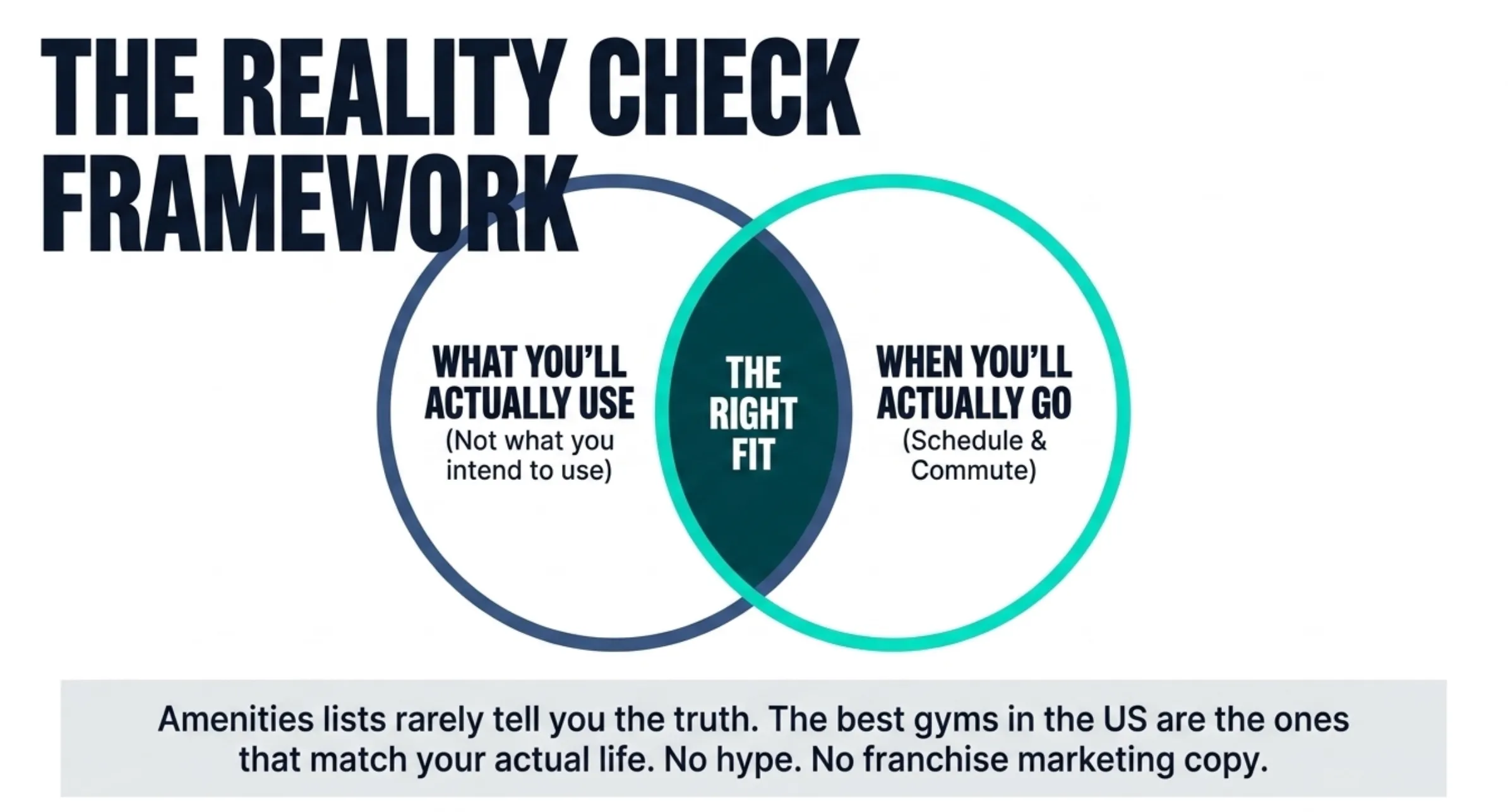
Most people pick a gym based on proximity and price, which is a fine starting point. But two other things matter a lot more than people think.
What you'll actually use. Not what you intend to use. Not what sounds good in theory. If you've never taken a group fitness class in your life, don't pick a gym based on its class schedule. If you've never used a pool, the aquatics at LA Fitness don't help you.
When you'll go. The best gym in America is useless if it's closed when you're free, or if you'll skip it because parking is a nightmare. The gym that fits your schedule and your commute will outperform the one with the most impressive Instagram every time.
Two things to do before you sign anything:
- Try it first, at the time you'd actually train. Almost every chain offers a free pass or guest visit. A 2 PM Saturday tour tells you nothing about your 6 PM Tuesday workout.
- Visit at peak hour. A gym at 6 PM on a Tuesday is the gym you're actually buying. Mid-morning weekday tours are sales theater.
What You'll Actually Pay: Gym Pricing in the US
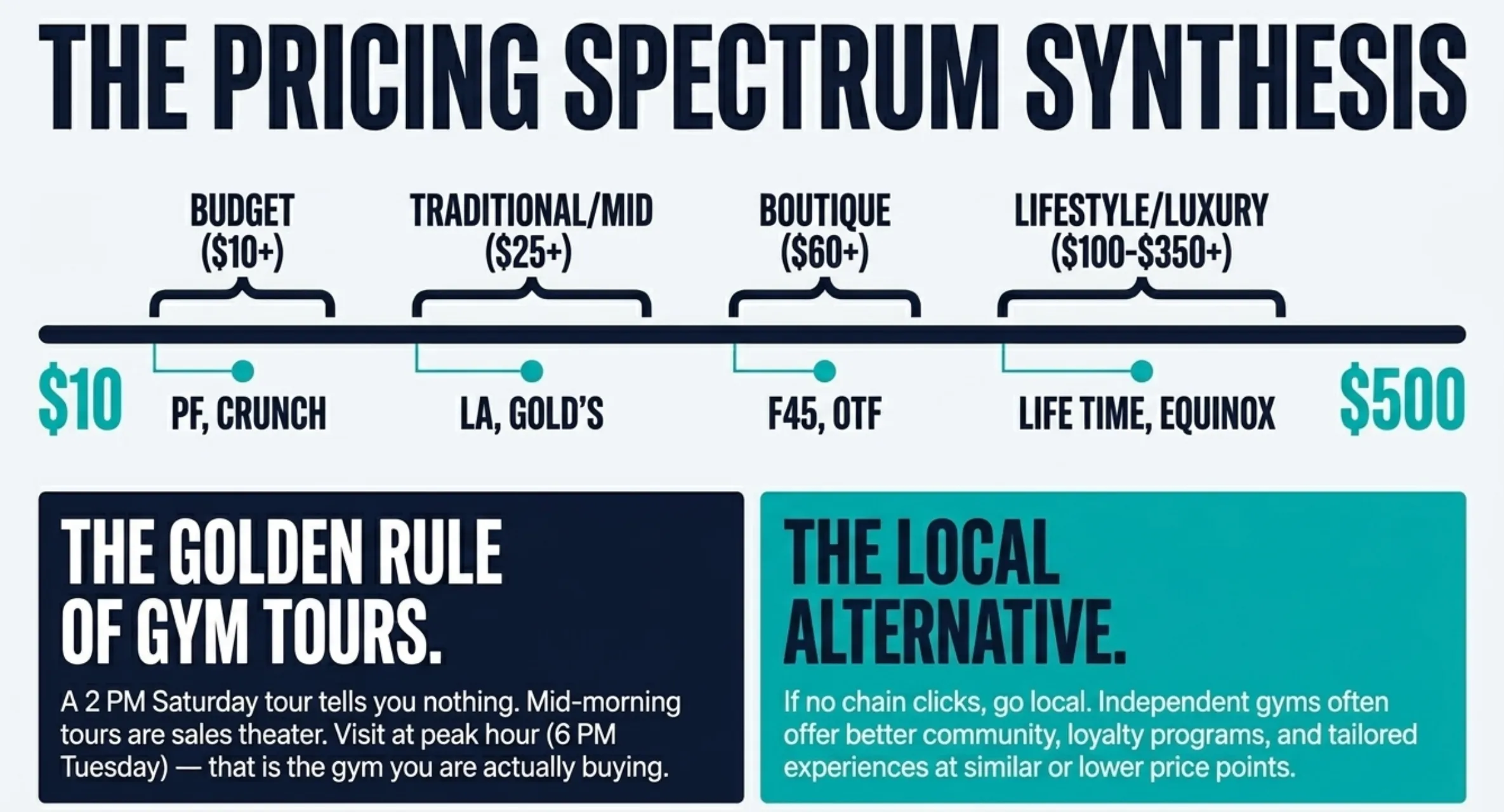
Budget chains like Planet Fitness and Crunch start around $10/month for base tiers. Mid-range full-service gyms like LA Fitness, Gold's, Anytime Fitness, and 24 Hour Fitness run $25–55. Community options like the YMCA range $30–75 depending on household and sliding-scale eligibility.
Boutique studios price differently. Orangetheory, F45, and Pure Barre typically run $60–200/month, often structured as class packs or unlimited tiers. The boutique premium buys coaching, accountability, and small class sizes rather than equipment access.
At the top end, Life Time runs $100–250 and Equinox runs $200–350. Equinox's flagship E by Equinox locations in major metros push past $500/month.
For more on how this lines up with actual gym usage, the gym membership statistics data is worth a look—including how often members actually show up, which is the number every gym would rather not talk about.
(Retention is the other half of that story; see the gym retention strategies the chains on this list actually use.)
Picking Your Best Gym in the US
The best gym in the US for you is the one you'll actually use at a price you won't resent. Location matters too—if it requires a detour, you'll find reasons not to go.
None of them is objectively best. The question is which is best for you—and that requires knowing what you actually need before you sign anything.
If you've read this far and none of these chains is clicking, that's your answer: visit a few independent gyms in your neighborhood.
The chains above spend a lot of money on first impressions. Your local gym's advantage is the gym loyalty program and community the national chains can't replicate.
And often, the membership costs less anyway.
Gym management software that frees up your time and helps you grow.
Simplified billing, enrollment, student management, and marketing features that help you grow your gym or martial arts school.


FAQ
Best Gyms in the US FAQs

Sean has spent the last decade creating content that helps businesses—small and not so small—grow smarter to allow operators to do more of what they love. You know, the fun stuff.
From shipping and international logistics to web development and marketing, he's done the work (not just the words) to scale retail and service businesses efficiently.
You can find his work at Sendle, Shogun, The Retail Exec, Gymdesk, and more.