
The best PushPress alternatives for gym owners are Gymdesk, Zen Planner, Perfect Gym, GymMaster, and Rhinofit. Each one fits a different type of gym, from martial arts schools to 24/7 access facilities. The right pick depends on your size, budget, and how you run your day-to-day.
PushPress works for a lot of gyms. The free plan stops being free somewhere around $7,600 a month in card payments.
If you're weighing whether PushPress still fits, here are five alternatives worth a look.
KEY TAKEAWAYS:
The top five PushPress alternatives are Gymdesk, Zen Planner, Perfect Gym, GymMaster, and Rhinofit, each built for a different type of gym.
Gymdesk has the highest rating (4.8 on Capterra), pricing from $75/month with Gymdesk Payments, a free gym website, and purpose-built martial arts features.
Rhinofit is the most affordable, with a free tier for very small gyms and paid plans from $57/month.
Perfect Gym sits at the other end: packages start at €179 per club per month, built for larger multi-location operations.
Zen Planner starts from $99/month and fits boutique studios, gyms, and martial arts schools. Automated member outreach needs the Ultimate plan (from $348/month) or the Engage add-on.
Why Gym Owners Look for PushPress Alternatives
The usual triggers are cost and tier jumps. Card fees on the free plan, belt tracking locked to paid tiers, and add-ons stack up as your gym grows.
You picked a free plan because it made sense at the start. Then your membership grew, and so did the fees.
What the PushPress free plan really costs
PushPress Free is $0 a month, but each card payment costs 4.99% + $0.30. Pro is $159/month at 2.89% + $0.30, and Max is $229/month at 2.75% + $0.30.
At 4.99% vs Pro's 2.89%, Free costs more than Pro once you process about $7,600/month in card payments. (The $0.30 fee is the same on both plans, so the break-even is $159 divided by the 2.1-point rate gap.)
Take a 100-member gym running $15,000/month in card payments across 100 charges:
PushPress Plan | Monthly Fee | Card Rate | Software + Card Fees |
Free | $0 | 4.99% + $0.30 | ≈ $778.50 |
Pro | $159 | 2.89% + $0.30 | ≈ $622.50 |
Max | $229 | 2.75% + $0.30 | ≈ $671.50 |
These use PushPress's published rates as of October 2026, excluding add-ons and taxes. At that volume, Free costs about $156/month more than Pro.
Where PushPress tier jumps add up
Belt tracking only comes with Pro ($159/month) and Max ($229/month). For a martial arts school, that's not optional.
Add-ons cost extra, per PushPress's pricing page: Train is $79/month, Grow is $329/month, and the Branded App is $97/month. Door access runs through third-party integrations like Kisi and HybridAF, which bill you separately.
We'll keep you in the loop with fresh content, podcasts, how-to guides, tool reviews, and product exclusives.
PushPress Alternatives: Comparison Table
Prices and Capterra ratings are as of October 2026. For a line-by-line look at the top two, see Gymdesk vs PushPress.
Software | Starting Price | Best For | Capterra Rating (Reviews) |
PushPress | Free (4.99% + $0.30 cards); Pro $159/month | CrossFit/functional gyms | 4.7 (186) |
Gymdesk | $75/month with Gymdesk Payments | Martial arts schools, small–mid gyms | 4.8 (148) |
Zen Planner | From $99/month | Boutique studios, gyms, martial arts schools | 4.3 (270) |
Perfect Gym | From €179 per club per month | Large multi-location facilities | 3.9 (33) |
GymMaster | $89/month | 24/7 access gyms, larger facilities | 4.7 (172) |
Rhinofit | Free for 20 or fewer active users; paid from $57/month | Budget gyms, CrossFit boxes | 4.0 (269) |
The 5 Best PushPress Alternatives, Reviewed
Each profile covers features, pros and cons, pricing, and Capterra reviews, so you can compare like for like.
1. Gymdesk

Gymdesk fits martial arts schools and small-to-mid gyms that are tired of paying for a higher tier to get the basics. Belt tracking, automated billing, and a free gym website come on every plan, starting with Micro.
It was founded in 2016 by a Brazilian Jiu-Jitsu black belt, and it's rated 4.8 on Capterra across 148 reviews. The interface is simple, and the support team answers when you need help.
Overview of features
Gymdesk covers the essentials:
- Member management. Find records, attendance, and training progress in seconds.
- Automated billing. Stop spending Sundays chasing who paid.
- Attendance tracking. See who's showing up and who's dropping off.
- Point-of-sale system. Sell gear at the front desk.
- Marketing features. Reach members and prospects from inside Gymdesk.
- Reporting tools. Check how your gym is doing from built-in reports.
- Member mobile app. Members book classes and manage accounts from their phone, so fewer texts land on yours.
- Rank progression tracking. Spot who's ready to test at a glance.
- Free gym website. A working site included at no extra cost.
- Integrations. Connect Stripe, Square, Zapier, ActiveCampaign, and Zoom.
Setup can be done in a day, with no training required.
Pros and cons
Pros:
- Simple and intuitive interface
- Fast and easy setup
- Automation features that save you time on billing, attendance, and outreach
- Free gym website
- Every feature on every plan; optional extras priced separately
Cons:
- Door access is still in beta
Pricing
- Micro Gym (up to 50 active members): $75/month
- Small Gym (51–100 active members): $100/month
- Medium Gym (101–150 active members): $150/month
- Large Gym (151–250 active members): $200/month
- 251+ active members: talk to us for a price
Those are the Gymdesk pricing rates with Gymdesk Payments. Use your own payment processor instead and it's $25 a month more ($40 on Large).
Every plan includes every feature. The only extras are the optional add-ons below.
Optional extras are priced separately:
- Door access (beta): $100/month for up to three doors, then $29 per extra door; hardware is a separate one-time cost
- Branded member app: $100/month, first month free (billing starts once the app is live)
- Additional location: $50/month with Gymdesk Payments ($100 with your own processor)
You can compare PushPress and Gymdesk costs with the PushPress vs Gymdesk cost calculator.
PRO TIP:
Running a BJJ or karate school? On PushPress, belt tracking starts at $159/month. On Gymdesk, it's on the $75 Micro plan with Gymdesk Payments ($100 on your own processor). The martial arts comparison goes deeper.
Reviews
Capterra: 4.8 (148 reviews)
2. Zen Planner

Zen Planner serves boutique studios, gyms, and martial arts schools where class scheduling and member communication matter most. The Zen Planner review goes deeper.
Billing and scheduling run on automation. Automated outreach comes with the Ultimate plan or the Engage add-on.
Overview of features
Payments run through Zen Planner's preferred processors, including its in-house Daxko Payments. Billing, scheduling, attendance, reporting, and a mobile app on iOS and Android are all standard.
Where it stands out:
- Digital belt tracking. Track student progress so instructors always know where someone is in the curriculum.
- Automated member outreach. Workflows and email campaigns come with Ultimate (from $348/month) or the Engage add-on.
- Custom reporting. See what's working and what's not across attendance, revenue, and retention.
Pros and cons
Pros:
- Easy member check-in and check-out
- Plugs into tools you're probably already using
- Automated billing and scheduling save admin time
Cons:
- Some Capterra reviewers mention a steep learning curve
Pricing
Zen Planner starts from $99/month, according to Capterra. Pricing rises from there, so check their site for current tiers.
Some modules cost extra, so check current add-on pricing.
Reviews
Capterra: 4.3 (270 reviews)
3. Perfect Gym
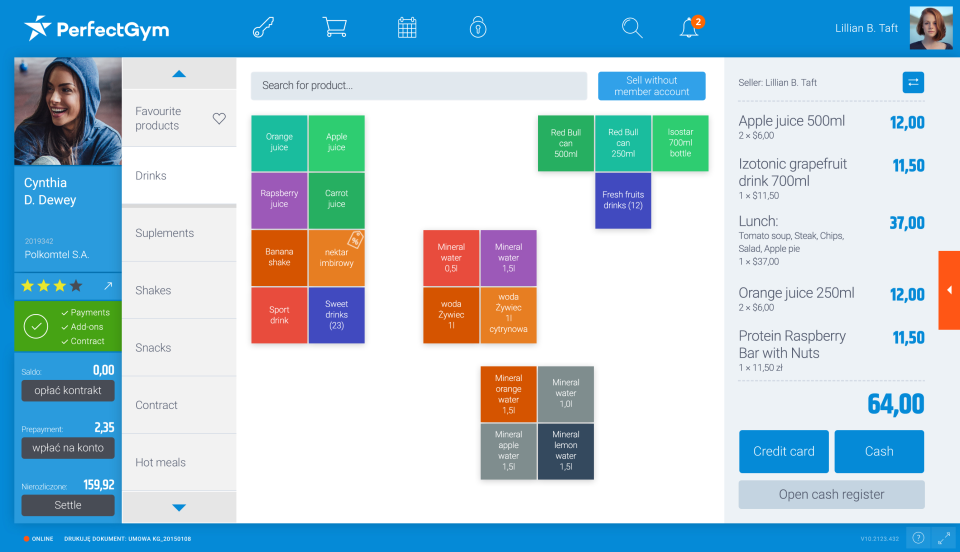
Perfect Gym is built for multi-location fitness centers and health clubs, the kind that book squash courts and spa rooms alongside classes. If it's on your shortlist, this Perfect Gym alternatives roundup is worth a read.
The tradeoff? It's pricier: packages start at €179 per club per month.
Overview of features
Court and room booking is what sets Perfect Gym apart on this list. Scheduling, billing, reporting, and a mobile app on iOS and Android round it out.
Where it stands out:
- Facility booking.Book squash, basketball, and tennis courts plus spa rooms online.
- Self-service kiosk. Perfect Gym promotes a self-service kiosk for check-ins and payments.
- Retention reporting. Perfect Gym markets reports to spot members at risk of leaving.
- CRM module. Track leads from first inquiry through signup.
Pros and cons
Pros:
- Built for multi-location gyms
- CRM that tracks leads through the full sales pipeline
- Court, spa, and class booking in one system
Cons:
- Highest starting price on this list, priced per club
- Some Capterra reviewers mention a steep learning curve
Pricing
Perfect Gym sells three packages, priced per club:
- Studio: from €179/month
- Club: from €349/month
- Enterprise: from €575/month
Each tier is quote-based above the starting price, so ask for a full quote.
Reviews
Capterra: 3.9 (33 reviews)
4. GymMaster
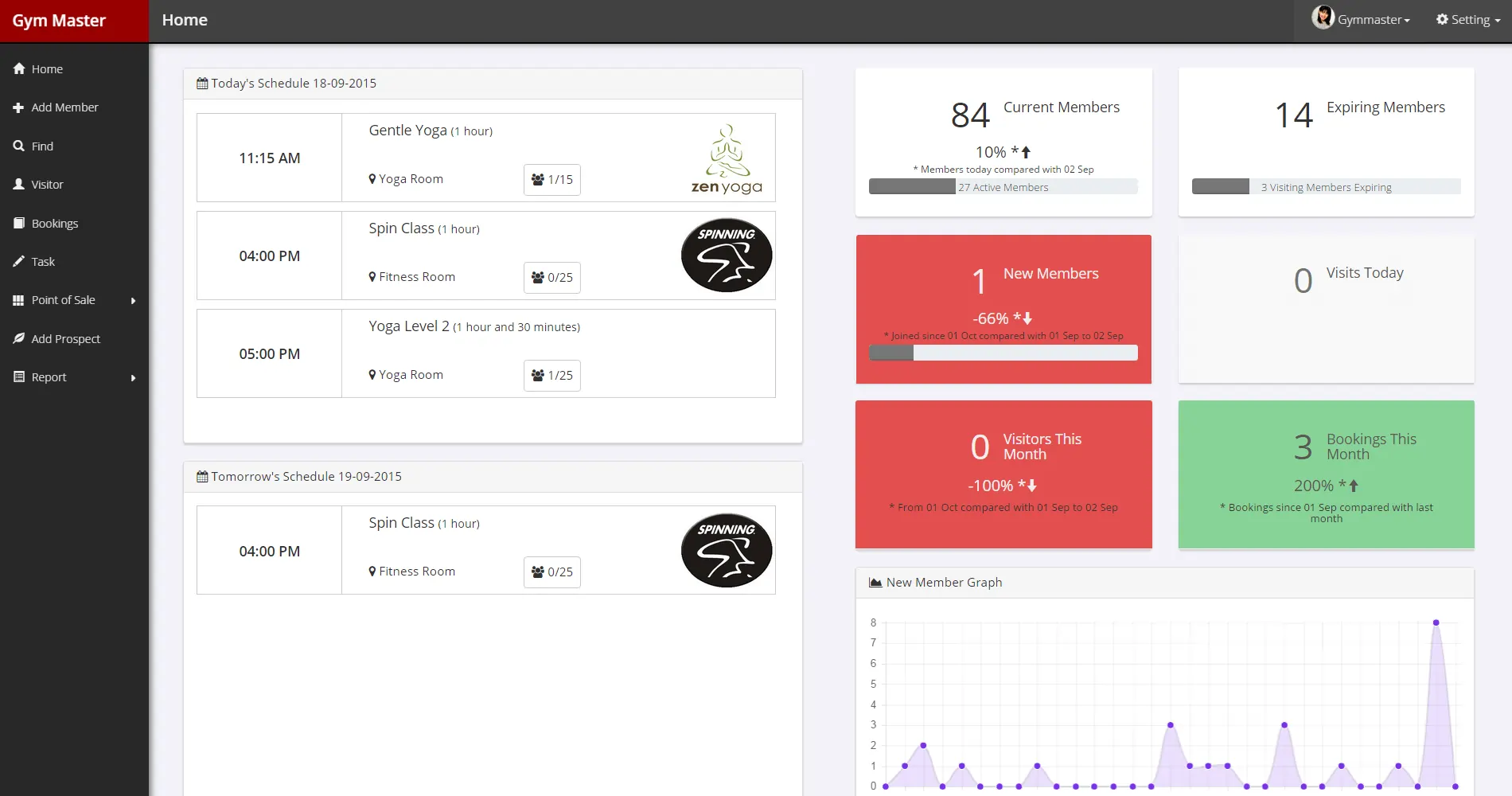
GymMaster is strongest on access control: key cards and door management for 24-hour entry across staffed and unstaffed hours. This GymMaster alternatives guide compares it with other options.
Overview of features
Door hardware is GymMaster's headline. It also handles member communication through email, SMS, and push notifications, alongside billing, scheduling, attendance, staff management, reporting, and a mobile app on iOS and Android. GymMaster lists integrations including Zapier, Mailchimp, Zoom, and an open API.
Where it stands out:
- Access control. Key cards and door management for staffed and unstaffed hours.
- Member self-service. Members manage their own billing, bookings, and personal info without calling the front desk.
Pros and cons
Pros:
- Members can handle their own billing and bookings
- Clean mobile experience
- Flexible enough to match your gym's workflow
Cons:
- Some Capterra reviewers say it takes time to learn
- Gets expensive at higher tiers
Pricing
- Foundation at $89/month (up to 100 members)
- Advanced at $129/month (up to 400 members)
- Professional at $209/month (up to 1,300 members)
- Enterprise with custom pricing
Versions with 24/7 door access run $129, $169, and $249 a month. GymMaster also offers a 60-day money-back guarantee.
Reviews
Capterra: 4.7 (172 reviews)
5. Rhinofit
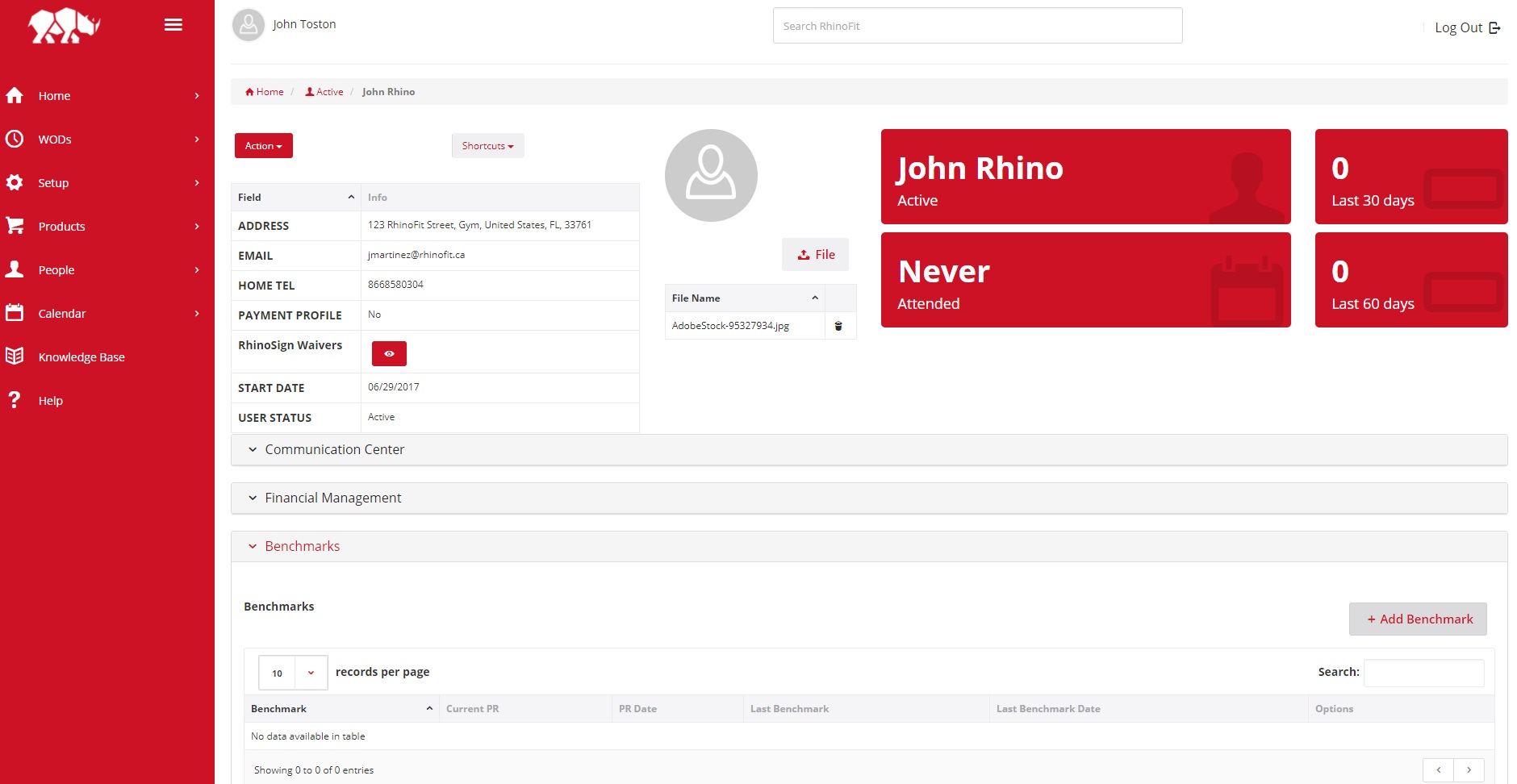
Rhinofit serves gyms, fitness studios, CrossFit boxes, and martial arts schools. It's one of the most affordable options on this list.
Paid plans start at $57/month, and very small gyms can run free. The Rhinofit alternatives post covers where it falls short.
It also covers 24/7 access. Members can get in with barcodes and key fobs, or a barcode in the mobile app, even when staff isn't on-site. If you're running unstaffed hours, Rhinofit handles the door.
Overview of features
The free Start-Up tier is the draw for very small gyms. Billing, scheduling, attendance, reporting, staff management, and a mobile app on iOS and Android come standard.
Where it stands out:
- 24/7 gym access. Members enter via barcodes, key fobs, or the app anytime.
- Digital waivers. Members sign online through the built-in RhinoSign system.
- Lead capture forms. Embed signup forms on your website to collect prospects automatically.
Pros and cons
Pros:
- Easy to use
- Free plan for gyms with 20 or fewer active users and $2,500 or less in monthly payments
- Handles unmanned gym access well
Cons:
- Missing some advanced features you'd find in pricier platforms
Pricing
- Start-Up: $0/month for 20 or fewer active users and $2,500 or less in monthly payments
- Standard at $57/month
- 24/7 access at $99/month for the software, or $149/month packaged with door hardware
Rhinofit was running the 24/7 plan as a limited-time deal in October 2026, so confirm the price before you sign.
Reviews
Capterra: 4.0 (269 reviews)
How to Choose the Right PushPress Alternative
The best alternative depends on what your gym needs. Here's a quick decision guide:
- Martial arts school or BJJ academy? Gymdesk. Built by a BJJ black belt with martial arts rank tracking baked in.
- Large multi-location operation? Perfect Gym. Court and spa booking, per-club pricing, plus reporting Perfect Gym markets for spotting members at risk of leaving.
- 24/7 unmanned access? GymMaster or Rhinofit. Both handle access control for staffed and unstaffed hours.
- Budget is tight? Rhinofit's free plan (20 or fewer active users and $2,500 or less in monthly payments) or Gymdesk's Micro Gym plan at $75/month with Gymdesk Payments.
- Boutique studio? Zen Planner. Solid automation for scheduling and outreach, though it costs more as you grow.
GYM OWNER TIP:
Test the software with your real workflow. Most platforms offer free trials or demos. Run your class schedule, add a few test members, and see how billing works before committing.
How to Switch From PushPress Without Losing Members
Fitness facilities keep about two-thirds of their members in a normal year, according to the Health & Fitness Association's 2025 benchmarking report. A botched switch (failed payments, missing records, confused members) eats into that.
Move your data by CSV, move saved cards processor-to-processor, and run both systems until billing checks out. Here's the order that keeps members from noticing.
- Export your data from PushPress. Pull member, membership, attendance, and payment records as CSV files.
- Start the card migration early. Saved cards don't travel in your member CSV. Your new platform opens a Stripe migration request, and Stripe replies within three business days.
- In Gymdesk, Payment Method Sync then matches stored cards from Stripe, Square, Authorize.net, GoCardless, or Ezypay to your members, so nobody re-enters a card (Gymdesk Payments takes them by CSV).
- Some processors won't release cards at all, and transfers can take weeks, so ask before you set a switch date.
- Import into your new platform. In Gymdesk, that's the Migration Center, which takes CSVs for members, memberships, attendance, payments, products, and leads.
- Run both systems in parallel. Keep PushPress live until your first billing run in the new system checks out.
- Tell your members. Let them know what's changing, when, and whether they need a new app.
Get Your Evenings Back
Gymdesk automates billing and tracks attendance for you, so the admin stops spilling into your evenings.
If Gymdesk sounds like the right fit, try it free for 30 days. No credit card, no contract.
FOR GYMS LEAVING PUSHPRESS
No paying for a higher tier to get the basics. Gymdesk starts at $75/month with Gymdesk Payments, every feature on every plan, and a free gym website. Try it free for 30 days. No credit card, no contract.
Start a 30-Day Free Trial