柔術サブミッション:全レベル対応、50以上のテクニックガイド
Every submission you'll ever hit comes down to one moment: your opponent decides that tapping beats the alternative.
That's the whole game. Not strength, not speed—the ability to put someone in a position where their only good option is to quit.
A white belt drilling their first armbar and a black belt hunting heel hook entries are chasing the same thing from opposite ends of the spectrum.
This guide walks through more than 50 submissions, from the chokes every beginner should own to the techniques that take years to apply safely.
Along the way, we'll look at what the competition data actually says about which submissions finish—because the answer is rarely the flashy ones—and how to drill them so they hold up under a resisting opponent.
If you train Brazilian Jiu-Jitsu (BJJ), think of this as a map.
You won't master all 50. You'll build a game around a handful and learn to recognize the rest.
What Are Jiu-Jitsu Submissions?
A submission is any technique that forces your opponent to tap out—or accept an injury if they don't.
Striking arts win by doing damage. Jiu-jitsu wins by exploiting the structural limits of the human body: joints that only bend so far, a brain that needs a constant blood supply.
Submissions break down into three families, each attacking a different vulnerability.
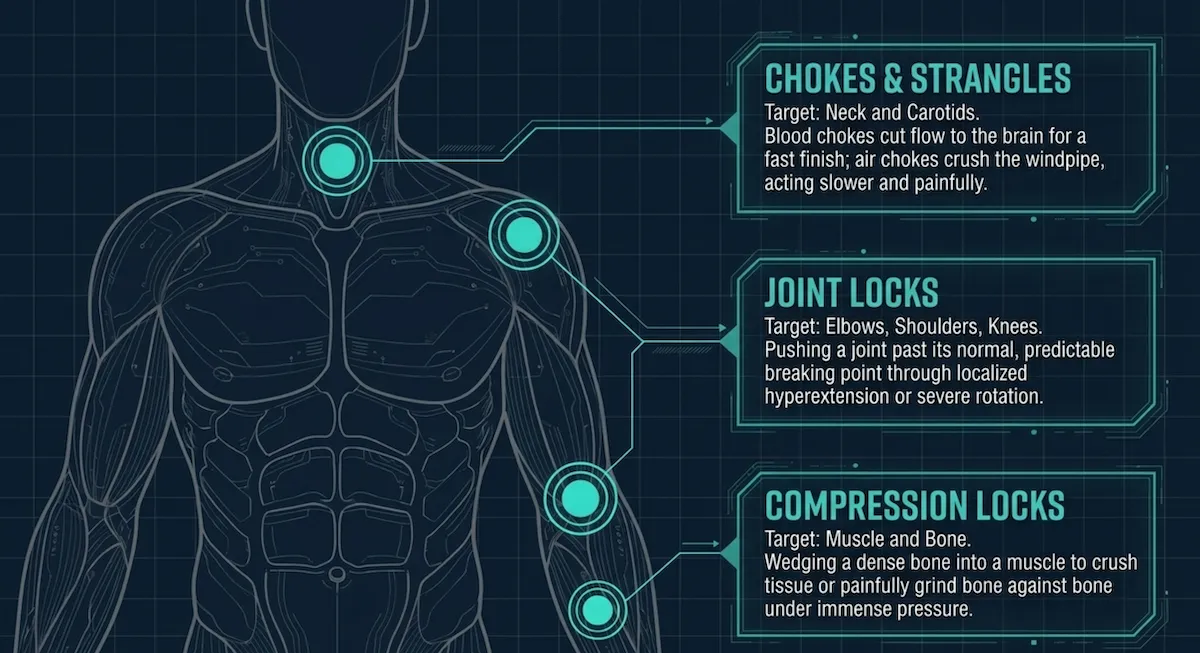
- Chokes and strangles target the neck. Blood chokes like the rear naked choke compress the carotid arteries and cut blood flow to the brain, which is why they put people to sleep in seconds. Air chokes like the guillotine crush the windpipe instead—slower, more uncomfortable, and generally less efficient, but available from positions a blood choke isn't.
- Joint locks push a joint past its normal range. The armbar isolates and hyperextends the elbow. The kimura rotates the shoulder behind the back. These work because human joints have predictable breaking points, and a trained grappler knows exactly where they are.
- Compression locks crush muscle or grind bone against bone. The bicep slicer wedges a forearm into the crook of the arm; the calf crusher digs a shin into the calf. The pain usually arrives well before the damage, which is what makes them tappable—if applied with control.
Legal vs illegal submissions in competition
What you're allowed to do depends entirely on the rule set and your belt, and getting this wrong can mean a disqualification or a hurt training partner.
The IBJJF ties submission access to belt level.
White belts start with the fundamentals: armbars, triangles, rear naked chokes, americanas, kimuras, and the straight ankle lock.
Blue and purple belts add wrist locks.
Brown and black belts unlock the dangerous end of the catalog—bicep and calf slicers, toe holds, kneebars, and, in no-gi only, heel hooks.
ADCC and most submission-only events play by looser rules, allowing heel hooks and advanced leg attacks for every adult competitor regardless of experience.
That single difference splits the modern grappling world into two strategic camps, and it's why a no-gi specialist and a gi competitor can feel like they train different sports.
The Most Effective Jiu-Jitsu Submissions, According to the Data
Reputation and reality don't always line up on the mats.
Public analyses of competition data from IBJJF and ADCC events—cross-referenced with UFC submission records—give us a clearer picture of which techniques actually finish when skilled people fight back.
A note on the numbers below: treat them as well-supported estimates, not gospel.
Finish rates shift with rule set, division, and how a given dataset counts an "attempt." But the patterns are consistent enough across sources to trust the broad strokes.
Top performers by finish rate
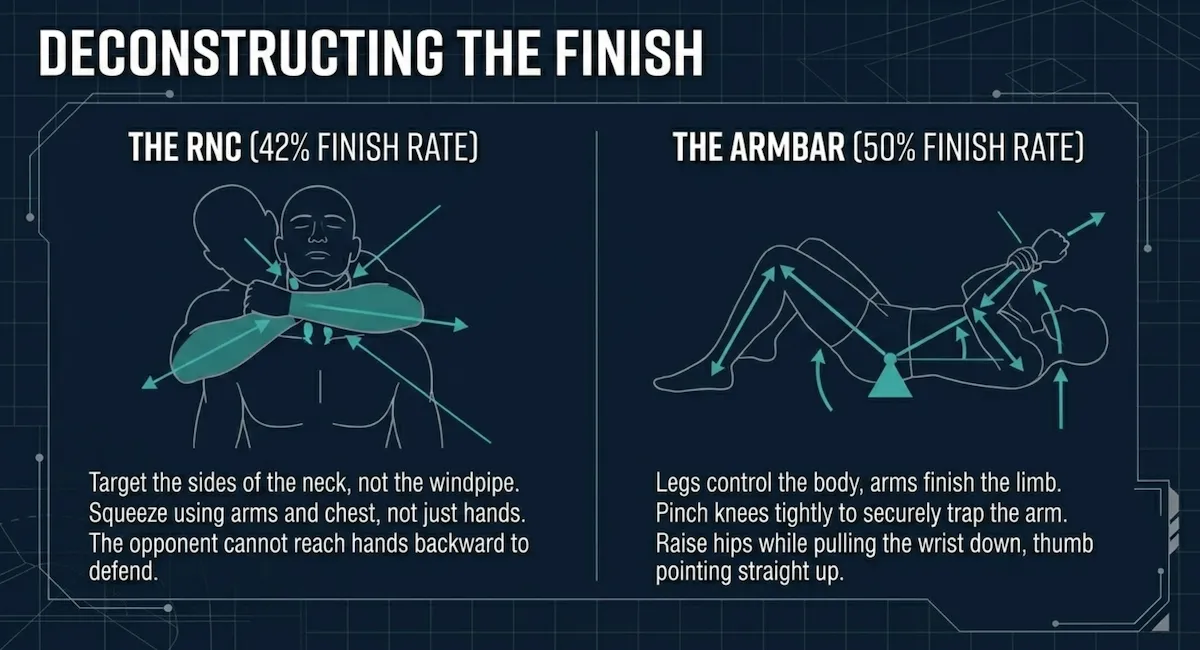
Rear naked choke: around 42%.
The RNC dominates both gi and no-gi, and it's one of the highest-volume finishes in any large dataset. Attacking from back control, you compress both carotids at once while your opponent can't reach your hands to defend.
There's almost no escape once it's locked—which is exactly why elite competitors spend so much time fighting to not give up their back.
Bow and arrow choke: roughly 89%.
The highest-percentage gi choke there is. At the 2019 IBJJF Worlds it reportedly finished 17 of 19 attempts. You use the collar as a rope and the leg as an anchor, creating pressure from two directions that's nearly impossible to relieve.
The catch: getting into position is hard, which keeps the attempt count low.
Armbar: around 50%.
The most-attempted submission in the sport, and one beginners learn in week one, yet it never stops working.
It threatens from mount, guard, side control, and scrambles. The mechanics are dead simple—isolate the elbow, hyperextend the arm—which is precisely why it scales from white belt to black belt.
Cross collar choke: about 75%.
Turn your opponent's own collar into a weapon and you get tremendous leverage with very little athleticism required. It's a fundamental that stays lethal at every level.
Triangle choke: around 38%.
From closed guard, you trap the head and one arm and finish with your legs.
Lower percentage than the chokes above because the setup is technical and the defenses are well-known, but devastating when the angle is right.
What the numbers should tell your training
A few patterns here should reshape how you spend your mat time.
The flashy stuff underperforms its hype. Heel hooks finish around 20% of the time in no-gi—real, but well below the reputation that's made them the internet's favorite submission.
The data argues for drilling rear naked chokes and armbars far more than exotic entries.
Context changes everything. The guillotine finishes under 10% in sport BJJ, yet accounts for roughly 17% of UFC submission wins.
Same technique, completely different value—because what works against a striker shooting a sloppy takedown isn't what works against a black belt in a gi.
Essential Submissions for Beginners
Before anything exotic, build a foundation of high-percentage techniques you can hit from common positions. These six are the core curriculum. Drill them until they're boring, then keep drilling them.
Rear naked choke from back control
The gold standard. From back control, slide one arm under the chin until your bicep is against one side of the neck and your hand reaches your opposite shoulder or bicep. Your free hand goes behind their head, and you squeeze the gap shut.
Key technical points:
- Target the sides of the neck, not the windpipe—you want a blood choke, not a painful air choke they can tough out
- Squeeze with your arms and chest, not your hands
- Drive their head forward with your free arm to close the space
- Keep your legs hooked or your body glued to their back the entire time
It works because you're attacking the carotids from the one position where they genuinely can't defend with their hands. Win the back, and the finish is often a formality.
Armbar from guard
The armbar from closed guard teaches mechanics you'll reuse for the rest of your career. Break their posture, isolate one arm, and pivot your hips perpendicular to attack the elbow.
Step-by-step execution:
- Break your opponent's posture down in closed guard
- Control one arm at the wrist and tricep
- Swing your leg over their head while keeping arm control
- Pivot your hips perpendicular to their body
- Pinch your knees and trap the arm against your chest
- Finish by raising your hips while pulling the wrist down, thumb pointing up
The lesson here is universal: legs control, arms finish. You'll see that same division of labor in half the submissions in this guide.
Triangle choke from closed guard
The triangle rewards patience and flexibility, but the stopping power is enormous once you lock it.
Technical sequence:
- Control one wrist and secure an underhook or angle on the same side
- Climb one leg high onto their shoulder and back
- Throw the other leg over their neck while keeping wrist control
- 足首を反対側の膝の裏に引っ掛け、三角絞めをロックします。
- 角度をつける:相手に対して体が垂直になるようにピボットします。
- 両膝を締め、相手の頭を引き下げて極めます。
この絞め技は、相手の肩を巻き込むことで首の片側を圧迫し、もう片側を自分の脚で締め上げる仕組みです。
角度が正しければ数秒で極まりますが、間違えると力任せに絞るだけでスタミナを消耗してしまいます。
サイドコントロールからのアメリカーナ
通常、初心者が最初に習う肩固めの一種であり、コントロールしながらじわじわと極めるサブミッションの入門として最適です。
実行のポイント:
- 相手の胸に自分の胸を密着させ、重圧をかけたサイドコントロールを確立します。
- 相手の手首を頭の近くのマットに押し付けます。
- もう一方の腕を相手の肘の下に通し、自分の手首を掴みます。
- 手首を固定したまま肘を持ち上げ、相手の頭の方へ腕を「描く」ように動かします。
- 相手がタップするまで、ゆっくりと圧力を高めていきます。
固定した手首が支点となり、腕の力で肩を限界まで回転させるテコの原理を利用します。
肩は前触れなく痛めるため、ゆっくりと適用してください。練習相手を怪我させることに名誉はありません。
マウントからのクロスカラーチョーク
優位なポジションから襟を利用して攻撃する、柔術の基本的なテクニックです。
グリップと実行方法:
- 相手の胸に体重を乗せ、マウントポジションを確立します。
- 片手を襟の奥深くまで差し込み、親指を内側に入れます。
- もう片方の手を反対側の襟に入れ、指を4本深く差し込みます
- 肘を脇腹に引き寄せ、胸を張ります
- 体重を前下方へかけ、絞めを極めます
マウントポジションは相手の逃げ道を制限し、襟を掴むことで正確に圧力をかけることができます。マウントを維持する技術を習得すれば、ポジションとサブミッションの両面で大きな成果が得られます。
ストレートフットロック
レッグロックの入り口となる技であり、ほとんどのルールで全ての帯色において使用が認められています。下半身攻めを構築する上で、最も安全な出発点と言えるでしょう。
技術的な適用:
- 相手の足を胸に抱え込み、前腕の骨の部分をアキレス腱に当てます
- 両膝を締めて相手の足を固定し、回転して逃げられないようにします
- 後ろに倒れ込み、腰を突き出して足首に圧力をかけます
- 無理に捻るのではなく、体を伸ばすようにして圧力をかけます
- 相手が回転して逃げられないよう、足をしっかりと固定し続けます
ヒールフックのような重大な怪我のリスクを抑えつつ、レッグロックのコントロールを学べます。準備が整えば、より高度なレッグロックの世界への扉を開くことにもつながります。
中級から上級向けのサブミッション
プレッシャーのかかる状況下でポジションを維持し、基本技を極められるようになったら、よりタイミングや柔軟性、セットアップを要する技術を取り入れていきましょう。これらは習得のために反復練習が不可欠です。
キムラ:万能なショルダーロック
キムラは柔術において最も汎用性の高いサブミッションの一つであり、あらゆる局面から狙うことができます。アメリカーナとは異なり、腕を逆方向に回転させるため、攻防の角度が大きく変わります。
多角的な応用:
- サイドコントロールから:腕を90度に曲げた状態で行う基本形
- ガードポジションから:相手がマットに手をついた際に有効なカウンター
- ハーフガードからの強力なスイープ&サブミッションのコンビネーション
- タートルポジションから:相手の支えとなる腕を攻める
競技において約23%の確率で極まる技ですが、その数字以上に価値があります。キムラグリップは、たとえ極めるつもりがなくても、この競技において最も優れたコントロールポジションの一つだからです。トップレベルの選手の多くが、このグリップを軸にゲームを組み立てています。
ダースチョーク:ノーギのスペシャリスト
ダースチョークは、ハーフガードやサイドコントロールから狙えるため、ノーギにおける定番の技となっています。片腕を相手の首の下から反対側へ通し、両手を組んで締め上げます。
ハーフガードからのセットアップ:
- 相手がハーフガードにいる状態でアンダーフックを取る
- 腕を深く相手の首の下に通し、反対側から出す
- ゲーブルグリップで両手を組む
- チョークをタイトに保ったまま、反対側へ転がる
- 体重をかけて隙間を埋め、極める
ダースチョークは、ノーギグラップリングが道着の襟を使わず、身体のメカニズムを駆使して独自のサブミッション体系を築き上げたことを象徴しています。掴むべき襟がない分、プレッシャーと角度が極めの鍵となります。
オモプラッタ:無限の選択肢を持つショルダーロック
オモプラッタは、脚を使って肩を攻める技です。単体で極まることは稀ですが、スイープや移行の起点となるため、ガードポジションにおいて最も有用な技の一つです。
テクニカルな手順:
- ガードポジションから、相手の片腕を孤立させる
- 脚をその腕越しに振り上げ、相手の背中に乗せる
- 相手が回転して逃げないよう、反対側をコントロールする
- 上体を起こして前方に体重をかけ、肩に負荷をかける
- このポジションを利用してスイープを狙うか、相手が防御した際に別の攻撃へと繋げる
これを単なるフィニッシュ技ではなく、起点として捉えてください。たとえオモプラッタを防御されても、そこからスイープやバックテイクに繋げることが可能です。
ギロチンチョークのバリエーション
ギロチンチョークにはいくつかの種類があり、それぞれ異なるポジションや相手の反応に合わせて使い分けます。
ブラジリアン柔術の試合での極め率は10%未満と高くありませんが、テイクダウン失敗からの切り返しとしては非常に速いため、総合格闘技(MMA)では極めて重要な技となります。
ハイエルボー・ギロチン:
- 絞める側の腕を顎の下深くに入れる
- 相手がテイクダウンを狙って頭を下げてきた際に有効
- ハンドファイトと頭の位置取りが成否を分ける
アームイン・ギロチン:
- 相手の片腕を巻き込んで絞める
- 脱出は困難だが、正確なポジショニングが求められる
- ガードプルと組み合わせて極めることが多い
たとえ極めきれなくても、ギロチンは不用意なテイクダウンに対する強力な抑止力となり、ガードポジションへの移行やスイープへの確実なルートとなります。
ニーオンザベリーからのベースボールチョーク
ニーオンザベリーによるコントロールを活かした、道着着用時特有の絞め技です。
手順:
- バランスを保ちながらニーオンザベリーを確立する
- 襟を「野球のバット」を持つように握り、両手を重ねて間隔を空ける
- 下の側の手を相手の首の奥深くまで差し込む
- 膝で圧力をかけて相手の脱出を防ぎながら、絞めを完成させる
- グリップと角度を調整して極めを見つける
このポジションは相手の動きを封じると同時に、チョークを仕掛けるための安定した土台となります。ポジションとサブミッションがいかに互いを補完し合うかを示す好例です。
タートルに対するクロックチョーク
相手が防御のためにタートルポジションをとった際、クロックチョークはその防御姿勢を逆手に取ります。
ステップバイステップの解説:
- タートル状態の相手の横から襟をコントロールする
- 時計の針のように、相手の頭の周りを足で歩く
- 襟を保持したまま、足を使って相手の動きをコントロールする
- 胸を張り、腕を引き寄せて圧力をかける
- 角度を調整して首に負荷をかける
この円運動は攻撃の角度を広げると同時に、タートルからの一般的な脱出方法である回転や立ち上がりを封じます。
上級・特殊サブミッション
これらは安全に適用できるようになるまで何年もかかり、実際の負傷リスクも伴うため、多くのルールセットで上位帯のみに制限されています。基本をしっかりと守る相手を脅かし、自身の技術を完成させるために活用してください。
ヒールフック:議論を呼ぶレッグロック
ヒールフックは 現代のグラップリングのあり方を一変させました。その是非を巡る議論は絶えません。ノーギにおけるフィニッシュ率が約20%という高い有効性を誇る一方で、その危険性が何よりも重要視されています。
仕組み: ヒールフックは、足を固定してかかとを回転させることで膝を攻撃します。そのトルクはACL(前十字靭帯)、MCL(内側側副靭帯)、半月板に同時に負荷をかけます。痛みを感じる前にダメージが蓄積する他の多くのサブミッションとは異なり、ヒールフックは予兆なく膝を破壊する可能性があるため、非常に厳格なエチケットが求められます。
安全プロトコル:
- 痛みではなく、位置を意識してタップを。足がコントロールされている時点で、すでに手遅れです。
- フィニッシュの回転を加える前に、まずはエントリーとコントロールを徹底的に練習してください。
- 経験や快適さについて、パートナーとオープンに話し合いましょう。
- YouTube動画ではなく、必ず有資格のインストラクターから直接学んでください。
ヒールフックの利点は、相手の身体で最も弱い構造的ポイントを攻めつつ、下半身全体をコントロールできる点にあります。現代のレッグロックシステムは、この脅威を中心に構築されています。
ゴゴプラッタ:柔軟性が鍵となる絞め技
柔術で最も奇妙なサブミッションの一つ。ガードポジションから足の甲を相手の喉元に当てて絞め上げます。
技術的要件:
- 足首を相手の首まで引き寄せるための十分な股関節の柔軟性
- ポジションを維持するための体幹の強さ
- 喉元への正確な足の配置
- 終始相手の姿勢をコントロールする能力
高い柔軟性と特殊なセットアップが必要なため試合で見かけることは稀ですが、サブミッションがいかに創造的になり得るかを如実に物語る技です。
ツイスター:エディ・ブラボーの脊椎ロック
ツイスターはエディ・ブラボーの「10th Planet」システムから生まれた技で、単一の関節ではなく脊椎全体を攻撃します。
ポジションとメカニズム: 足を固定した状態で上半身を逆方向に回転させ、脊椎とその周辺の筋肉に負荷をかけます。通常、トラックやその他のバックアタックのポジションから展開されます。
負傷のリスクについて: 脊椎へのサブミッションは本質的に危険であり、椎間板、神経、筋肉の損傷を伴う可能性があります。ほとんどのルールで脊椎ロックが禁止されているのには正当な理由があります。狙う前に必ず大会のルールを確認してください。
バナナ・スプリット:股関節と鼠径部への攻撃
バナナ・スプリットは、両脚を広げて股関節と鼠径部を極限までストレッチし、攻める技です。
セットアップとコントロール:
- タートルポジションやそれに準ずる体勢から、相手の両脚をコントロールします。
- 相手の柔軟性の限界まで両脚を広げます。
- 自身の体重を乗せて、ストレッチを深めます。
- 相手がタップするまで、一定の圧力をかけ続けます。
この技は柔軟性が低い相手には非常に有効ですが、体が柔らかい相手にはほとんど効果がありません。個人の身体的特徴によって、どのサブミッションを狙うべきかが変わるという好例です。
カーフクラッシャー:コンプレッションロックのメカニズム
カーフクラッシャーは、自身のすねを相手のふくらはぎやアキレス腱に押し当てて圧迫する技です。多くの柔術ルールでは、茶帯以上で認められています。
適用方法:
- 相手の脚を自身の両脚で挟み込み、ふくらはぎを固定します。
- 自身のすねをくさびのようにして、相手のふくらはぎの筋肉に当てます。
- 相手の足を引くと同時に、自身の両脚を締め上げます。
- 相手がタップするまで、徐々に圧力を強めていきます。
コンプレッションロックは、関節技とは異なる種類の損傷を引き起こします。靭帯の断裂ではなく、筋肉の断裂や骨の打撲を伴うものです。痛みは徐々に増していくため、良識ある相手であればタップする猶予があります。
ペルビアン・ネクタイ:ギロチンチョークの進化系
ペルビアン・ネクタイは、フロントヘッドロックに自身の脚を組み合わせることで、通常のギロチンチョークで起こりうる脱出を防ぐ技です。
実行のフレームワーク:
- ギロチンチョークのセットアップと同様に、フロントヘッドロックの体勢を確立します。
- 相手の頭部をコントロールしながら、片側の腕を自身の体で封じ込めます。
- 相手の背中に足をかけ、下方向へ圧力を加えます
- 足を使い、締め上げている間の回転(ロールアウト)を防ぎます
- 圧力と角度を調整して極めます
これは、グラップラーがいかに古い技術を改良し続けているかを示す好例です。不完全なサブミッションに手足を追加して隙を埋める、という考え方です。
柔術衣あり vs なし:サブミッションはどう変わるか
柔術衣 の有無は、有効なサブミッションの種類、極まる頻度、そして試合全体の組み立て方に影響を与えます。この違いを理解することで、異なるルールや練習環境にも適応できるようになります。
柔術衣で有効なサブミッション
ボウ&アローチョーク(約89%) 襟を掴むことで強固なグリップが得られ、さらに足で逃げ道を塞ぐことができます。下になった相手はこれら2つの圧力ポイントを解消できず、一度極まればほぼ防ぐことは不可能です。
ベースボールチョーク クロスカラーグリップによるテコの原理は、衣がなければ成立しません。そのため、ノーギ(衣なし)ではほとんど見られない技です。
ループチョーク 襟を使った巧妙な罠であり、防御的に前へ圧力をかけてくる相手を、自らの姿勢によって窮地に追い込みます。
エゼキエルチョーク 袖をコントロールすることで、ガードの中やマウントポジションからでも絞め技を仕掛けられます。衣の摩擦がこの技を成立させる鍵となります。
ノーギで有効なテクニック
ヒールフック(約20%) レッグロックのシステムは、衣がない環境でこそ真価を発揮します。足の絡みつきを邪魔するものや、グリップに頼った防御が存在しないためです。
ダースチョーク 相手が道着を掴んでフレームを作り、脱出することができないため、ノーギではより一層効果的です。
アナコンダチョーク ダースチョークの親戚にあたる技で、同じフロントヘッドロックの体勢から異なる角度で攻めます。
ギロチンチョークのバリエーション 襟を掴むグリップがないことで防御の選択肢が減るため、ノーギの方が一般的に極まる確率が高くなります。
道着の有無を問わないサブミッション
道着を着ているかどうかをほとんど気にせず使えるテクニックがいくつかあり、これらはあらゆる戦術の基盤となります。
- リアネイキッドチョーク: 道着の有無に関わらずメカニズムは同一
- 三角絞め: グリップの微調整のみで、極め方は同じ
- 腕ひしぎ十字固め: セットアップは異なるが、極めるメカニズムは同一
- キムラロック: 純粋な腕のポジションと肩へのプレッシャーで極めるため、道着は不要
グリップがすべてを左右する理由
最大の違いは、何をつかめるかという点です。道着ありの場合、襟、袖、パンツなど、どこでも掴むことができ、そのグリップは強力で外すのが困難です。これによって襟絞めが可能になる一方、防御側にも追加の選択肢が生まれます。
ノーギでは、アンダーフック、オーバーフック、リストコントロール、そして肌と肌のグリップしか使えません。固定力は劣りますが、より速くダイナミックな展開になります。このトレードオフが、その後のすべてを決定づけます。
危険なサブミッションと安全性
練習中にあなたやパートナーが怪我をしてしまっては、このガイドの内容も意味をなしません。
試合を素早く終わらせるサブミッションは、同時に選手生命を終わらせるリスクも孕んでいます。その違いは、ほぼ間違いなくコントロールとコミュニケーションにあります。全体像を把握するために、私たちの 怪我の予防と管理 に関するガイドをぜひご一読ください。
ハイリスクなサブミッションと怪我のメカニズム
ヒールフックと膝の靭帯 現代のグラップリングにおいて最も怪我のリスクが高い技です。固定された足に回転圧がかかると、ACL(前十字靭帯)、MCL(内側側副靭帯)、半月板が同時に損傷し、多くの場合、予兆なくダメージを負います。
予防策: 初心者は「キャッチ&リリース」を徹底し、足がコントロールされた瞬間にタップすること。フィニッシュの練習よりもエントリーの反復を優先し、必ず指導者の監督下で行ってください。
ネッククランクと脊椎ロック これらは回転や過伸展によって頸椎を攻撃します。椎間板ヘルニア、神経損傷、脊椎損傷を引き起こす可能性があります。
予防策: 最低でも数秒かけてゆっくりと極め、パートナーと常に声を掛け合うこと。痛みを感じる前に脊椎への圧力を感じた時点で早めにタップし、上級者同士の練習に限定してください。
コンプレッションロック バイセップスライサーやカーフクラッシャーは、組織を圧迫し骨を擦り合わせます。爆発的に極めると、骨折や断裂を招く恐れがあります。
予防策: 最小限の圧力から始め、パートナーの様子を見ながらゆっくりと強度を上げること。フィニッシュを競うのではなく、コントロールとポジションの練習として取り組んでください。
年齢と経験による制限
ほとんどの団体が技術の解禁をスキルレベルに応じて制限していますが、その理由は単純です。危険な技を扱うには、それ相応の判断力が伴わなければならないからです。
ユースおよびティーン部門: basic chokes and joint locks only—no heel hooks, neck cranks, or compression locks, with extra supervision throughout.
Adult white and blue belts: straight ankle locks but no other leg locks, basic arm and shoulder submissions, no spinal or compression locks, no heel hooks in most gi organizations.
Advanced belts: brown and black belts gain heel hooks in no-gi IBJJF competition (a 2021 rule change), plus bicep and calf slicers, toe holds, and kneebars at brown belt. Spinal locks like neck cranks and the twister stay banned in IBJJF at every level.
Communication beats toughness
Most training injuries are preventable with a thirty-second conversation. Set expectations before you roll, talk during, and debrief after.
Before training: share experience levels and comfort with specific submissions, agree on pressure and tapping norms, flag old injuries, and set techniques either of you wants to skip.
During training: give verbal feedback on pressure, keep a "tap early when unsure" mindset, stop the moment either partner is uncomfortable, and check in during long drilling rounds.
After training: talk through what felt unsafe, adjust your protocols, and address minor tweaks before they become real injuries.
The goal isn't zero risk—that would mean zero training. It's intelligent risk: explore the full range of the art while keeping everyone healthy enough to train again tomorrow.
Building Your Submission Game
A real submission game isn't 50 techniques—it's a handful you trust completely, connected by transitions, organized around the positions you actually reach. Here's how to build one.
Prioritize high-percentage techniques
The data is clear about where your early reps belong. Build the bottom of the pyramid first.
Foundation layer (high finish rates):
- Rear naked choke (~42%, from the strongest position in the sport)
- Armbar (~50%, available almost everywhere)
- Bow and arrow choke (~89% in the gi)
- Cross collar choke (~75% in the gi)
Secondary layer (solid, situational):
- Triangle choke (~38%, a guard player's bread and butter)
- Kimura (~23% finish, but elite as control)
- D'arce choke (a no-gi workhorse)
- Guillotine variations (fast off scrambles and takedowns)
Advanced layer (lower percentage, high ceiling):
- Heel hooks (~20%, game-changing where legal)
- Omoplata (low finish rate, huge transitional value)
- Exotic chokes and compression locks (situational, but they complete a game)
Finish consistently with the foundation before you spend mat time on techniques that only work under specific conditions.
Chains, not single attacks
Elite grapplers almost never hunt one submission in isolation. They build chains, where a defended attack feeds the next one and the opponent never gets to rest.
Armbar to triangle: Attack the armbar from guard; when they clasp their hands to defend, switch to the triangle.
Kimura to back take: Secure the kimura grip; when they roll to escape, ride the roll into back control and the rear naked choke.
Triangle to omoplata: Set the triangle; when they post the arm to defend, swing into the omoplata on that same arm.
Chains keep constant pressure on, drain your opponent's defensive reserves, and make each individual submission more likely by removing their time to recover.
Position-specific systems
Organize your attacks by where you are, so you always have a primary, a backup, and an exit.
Mount: cross collar choke first, armbar when they defend the collar, arm triangle as a third option, with a back take if mount gets shaky.
Closed guard: triangle off the guard break, armbar when the triangle stalls, omoplata on an overcommitted defending arm, sweeps when nothing's there.
Back control: rear naked choke as the priority, bow and arrow when you have the gi, armbar from the back when chokes are defended—all while fighting to keep the position.
Side control: kimura on the far arm, americana when the angle's wrong for the kimura, arm triangle from head-and-arm control, with mount or knee-on-belly as upgrades.
Drill with purpose
Random reps produce random results. Progress the intensity deliberately.
- Weeks 1-2, isolation: 50-100 reps per session, no resistance, perfect technique, both sides
- Weeks 3-4, progressive resistance: add about 25% resistance and work through common defenses
- Weeks 5-6, situational sparring: start in the position, go live, reset after each attempt
- Weeks 7-8, integration: hunt the submission inside normal rolling and build the chains
Pair smartly, too—similar experience for safe progression, varied body types to test your technique, and a teaching mindset over a winning one during drills.
For gym owners: this progression maps almost directly onto a belt curriculum. If you're structuring classes, building each belt level around its legal, high-percentage submissions—and tracking who's drilled what—turns a vague "we teach jiu-jitsu" into a real syllabus. Our guide to BJJ lesson planning and curriculum walks through how to do it.
Attack both ends of the body
Complete games threaten the upper body (chokes, arm locks) and the lower body (leg locks), so opponents can't specialize their defense.
Upper-body attacks finish more often, carry more margin for error, and demand strong positional control. Lower-body attacks open up positions where upper-body submissions aren't available, add threat diversity, and surprise opponents who only train upper-body defense.
A sane split for most people: roughly 70% of your submission time on high-percentage upper-body techniques, 30% on leg locks appropriate to your belt—while staying competent at defending both.
Competition Strategy by Format
Different rule sets reward different games. Knowing the format you're competing in should shape which submissions you sharpen and when you hunt them.
IBJJF and points-based gi
IBJJF rewards position and control, which favors high-percentage, conservative finishing.
Lean on collar-based attacks—the bow and arrow's finish rate makes it essential off the back. Prioritize mount and back control, which score well and set up your best submissions.
And resist the urge to chase exotic finishes when the clock and the points favor a rear naked choke or an armbar from a dominant spot.
Tactically: establish position before you hunt, use submission threats to advance position even when they don't finish, and know the referee restart rules so you don't surrender a good position for nothing.
ADCC and submission-only
Without points to protect and with longer matches, the risk-reward math flips toward aggressive hunting.
Leg locks become essential—heel hooks are legal for all adult competitors, and even a 20% finish rate creates the scrambles that lead to other finishes.
Long matches reward conditioning and let you take submission risks a points match wouldn't. And a submission-only mindset means committing fully, which opens the door to creative techniques that are too risky elsewhere.
Build multiple finishes from each major position, drill your escapes hard enough to survive, and condition for genuinely long battles.
Body type and weight class
Your attributes should steer your selection.
Bigger grapplers get more out of pressure-based finishes—arm triangles, crushing chokes, compression locks—and can ride dominant positions while they break a defense down.
Smaller, faster grapplers should lean on guard attacks—triangles and omoplatas—and use speed and angles to create openings in scrambles.
When sizes are even, preparation decides it: study tendencies, build chains, and out-execute under pressure.
Reading the clock
Manage the match in thirds.
Early, establish dominant position, use submission threats to advance rather than force, and gather information on how they defend.
In the middle, hunt more aggressively based on the positions you've won and the chains you've drilled. Late, commit to finishes when good positions appear, accept some positional risk for a real chance, and target the specific defensive gaps the match has revealed.
Position First, Submission Second
The most important thing the data teaches isn't which submission to learn—it's why the best ones win.
リアネイキッドチョークが圧倒的な強さを誇るのは、巧妙なメカニズムゆえではなく、それが要求するポジションの優位性によるものです。ボウアンドアローチョークの極め率の高さは、技そのものの威力もさることながら、それを仕掛けるために必要なスキルの高さを物語っています。
サブミッションとは、ポジション、タイミング、コントロールという一連のプロセスを経て完結する文章のようなものです。
技だけを単体で追い求めても、極めきれないテクニックが増えるだけです。強固なポジションの上に技を積み重ねることで、それらは自然と身体に染み付いていくはずです。
まずは基本から始めましょう。
リアネイキッドチョーク、アームバー、三角絞めを、反射的に出せるようになるまで反復練習してください。コントロールと判断力が養われるにつれて、対応できる範囲を広げていきましょう。
早めのタップを心がけ、賢くトレーニングし、スパーリングパートナーを大切にしましょう。来週も一緒に練習したいと思える相手でいることが重要です。今日あなたが苦戦している白帯のアメリカーナこそが、誰をも極められる強固なゲームを築くための第一歩なのです。
道場を運営しており、成長を支えるシステム(カリキュラム、出席管理、請求、会員維持など)をお探しなら、Gymdeskの格闘技向けソフトウェア がまさにそのために作られました。まだ道場運営を始めたばかりであれば、こちらのガイド ブラジリアン柔術道場の始め方 が次のステップとして役立つはずです。
Gym management software that frees up your time and helps you grow.
Simplified billing, enrollment, student management, and marketing features that help you grow your gym or martial arts school.

FAQ
ブラジリアン柔術のサブミッションに関するよくある質問
Josh is a martial arts educator and coach who bridges live training on the mats with evidence-based teaching. A 4th degree Taekwondo black belt and dedicated Brazilian Jiu-Jitsu practitioner, he’s spent years running classes, mentoring students, and helping instructors move beyond rote drills to training that actually works under pressure.
He holds a Master of Education in Teaching & Learning from Liberty University and runs Combat Learning, where he breaks down ecological dynamics, constraints-led coaching, and games-based training for combat sports. Through his writing and podcast work with Gymdesk, Josh turns coaching science and gym-owner stories into practical ideas you can use to run better classes and build a stronger martial arts school.