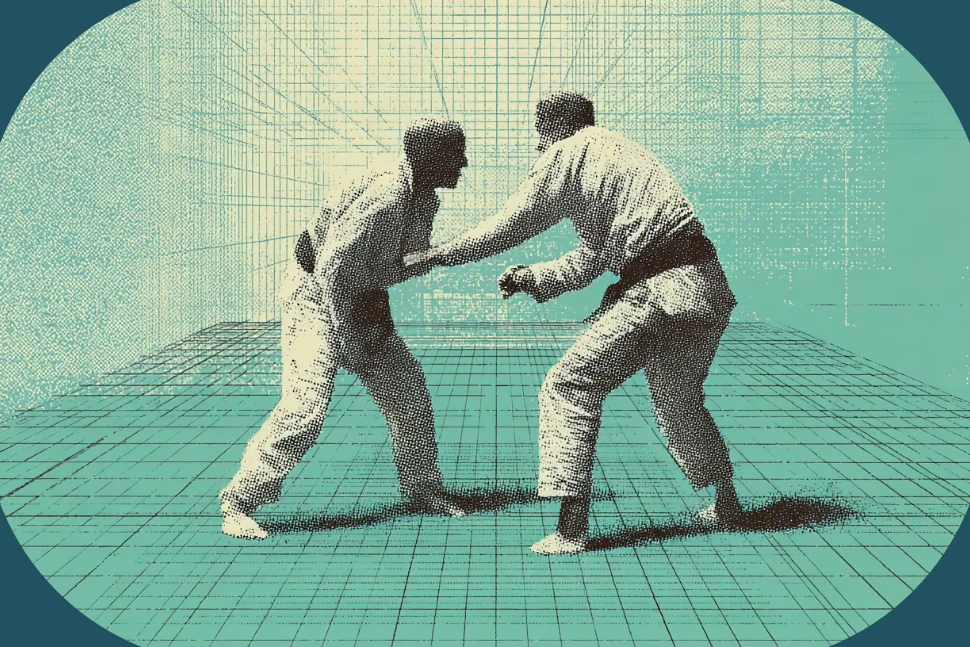
If you've spent any time on grappling YouTube in the last five years, you've heard the phrase. American jiu-jitsu. Some say it like a slogan, some like a punchline.
The term traces to a Keenan Cornelius rebrand. In late 2019, he reopened his San Diego academy as Legion American Jiu Jitsu, and started arguing on his Dojo Storm podcast that Americans shouldn't be calling it "Brazilian" anything—the phrase had appeared in US newspapers as early as 1914.
That argument matters less than what came with it. A loose, no-gi-leaning, wrestling-integrated, leg-lock-fluent way of training that had been building for a decade finally had a label.
American jiu-jitsu isn't a federation or a system.
It's the version of Brazilian jiu-jitsu that grew up around Keenan, John Danaher's New York basement, Eddie Bravo's tournaments, and a generation of wrestlers who decided the mat was more interesting than the cage.
If you run a school, this is the movement reshaping what your members want to train. Here's what it actually is—and what it isn't.
KEY TAKEAWAY:
American jiu-jitsu isn't a federation, a system, or a separate art. It's a cultural movement inside BJJ defined by four training preferences: wrestling-first standing game, leg locks taught from white belt, no-gi as the default expression, and a faster innovation cadence than traditional academies.
If you teach jiu-jitsu in the US in 2026, you're already inside it, whether you call it that or not.
What "American Jiu-Jitsu" Actually Means
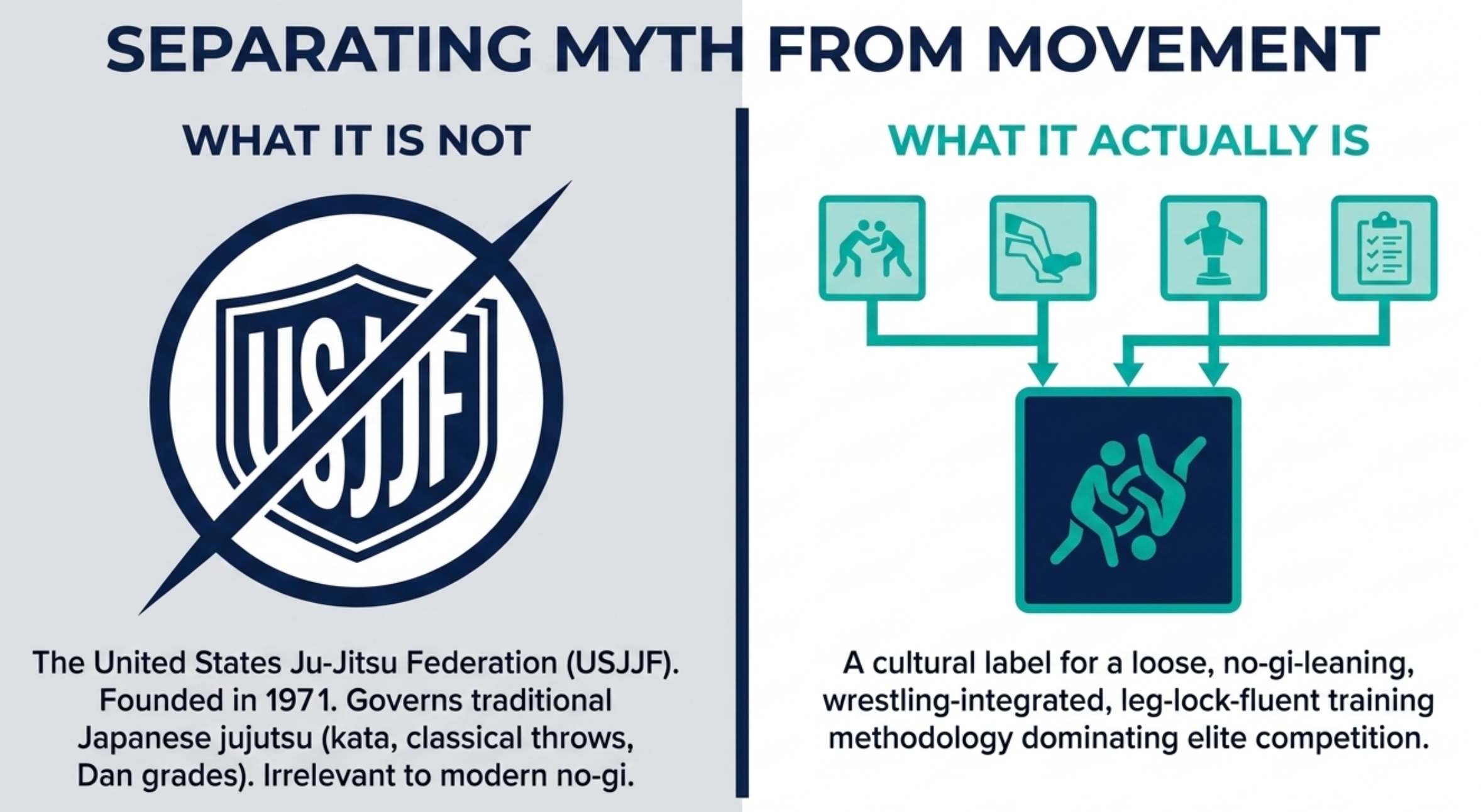
Start with what it's not. It's not the United States Ju-Jitsu Federation (USJJF).
That organization, founded in 1971, governs traditional Japanese jujutsu—kata, classical throws, Dan grades. It has roughly nothing to do with the cultural movement Cornelius named.
If you're searching for "American jiu-jitsu" and landing on USJJF rank manuals, you're in the wrong neighborhood.
The movement is something else entirely. It's a label for a set of training preferences that have come to dominate elite no-gi competition over the last decade:
- Wrestling is the standing game, not a footnote. Practitioners default to takedowns and top control, not pulling guard.
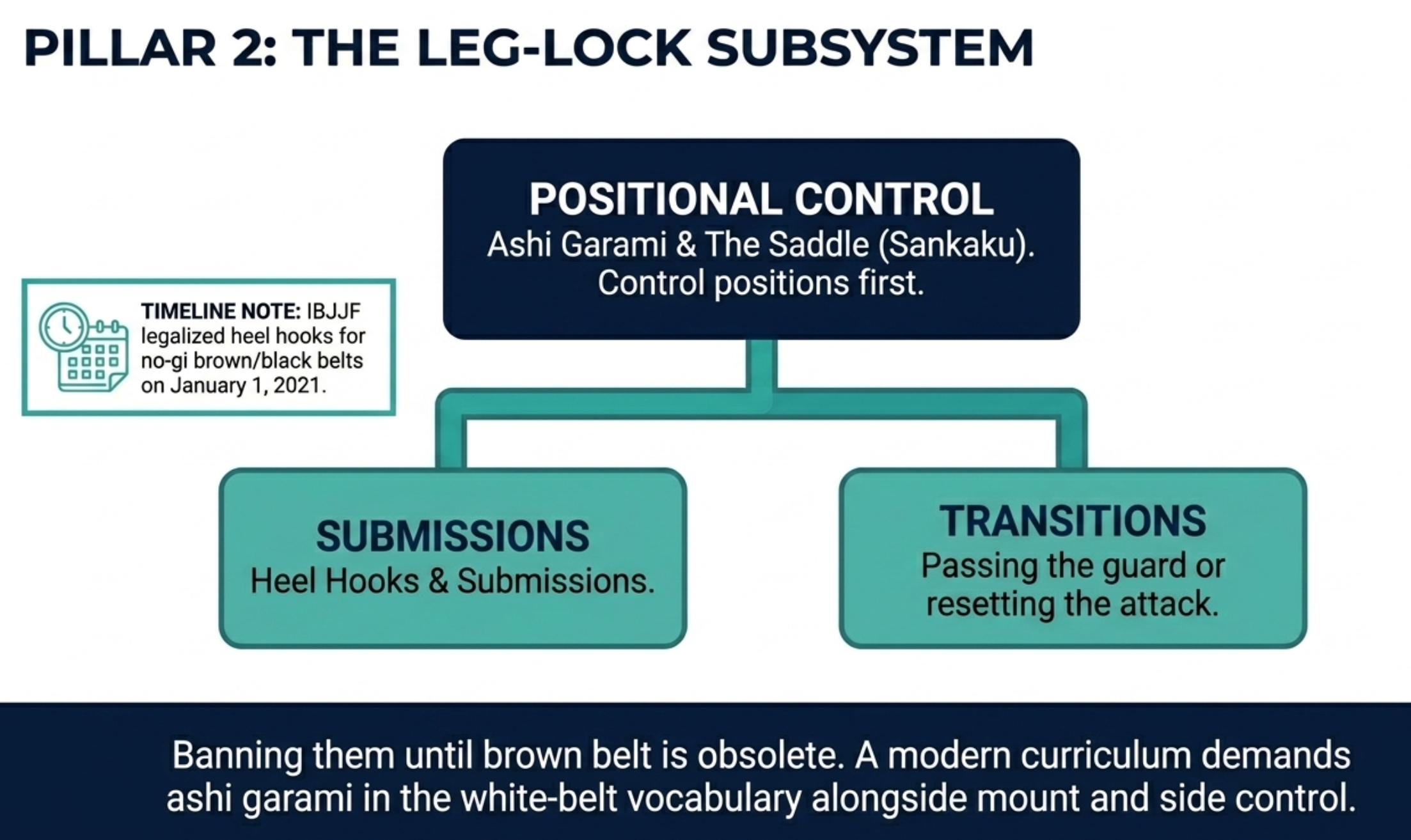
- Leg locks are curriculum, not contraband. Heel hooks, ashi garami, and saddle entries get drilled from white belt, not banned until brown.
- No-gi is the default expression. Think ADCC, ONE Championship, and EBI rather than gi-only IBJJF brackets.
- Innovation beats lineage. A new guard system from a 24-year-old in San Diego gets adopted faster than it would have in a traditional Gracie academy.
None of these traits are uniquely American. Brazilian, Japanese, and Russian grapplers all contribute.
But the cultural center of gravity—the academies, podcasts, and prize money—has been in the US for most of a decade.
That's the working definition.
Where the Term Came From
American newspapers used "American jiu-jitsu" as a phrase as far back as 1914 and 1926.
Mitsuyo Maeda was demonstrating jiu-jitsu in the US around 1904. Theodore Roosevelt was training it at the White House the same era—years before Maeda ever taught Carlos Gracie in Brazil.
Cornelius leans on this history in his argument: the Americans didn't get jiu-jitsu from Brazil, they got it from the same source Brazil did.
The modern story is shorter. Cornelius rebranded Legion in late 2019 and started using "American jiu-jitsu" as his school's identity.
He has publicly argued that the rebrand strengthened his academy commercially.
Other coaches followed. The label stuck not because of a federation or a movement document, but because it captured a vibe people already felt.
The etymology argument is secondary. A generation of US-based grapplers needed a way to describe what they were already doing.
The Cultural Pillars of American Jiu-Jitsu
Strip the rebrand and the historical argument away, and what's left is a set of training choices.
Wrestling as the foundation
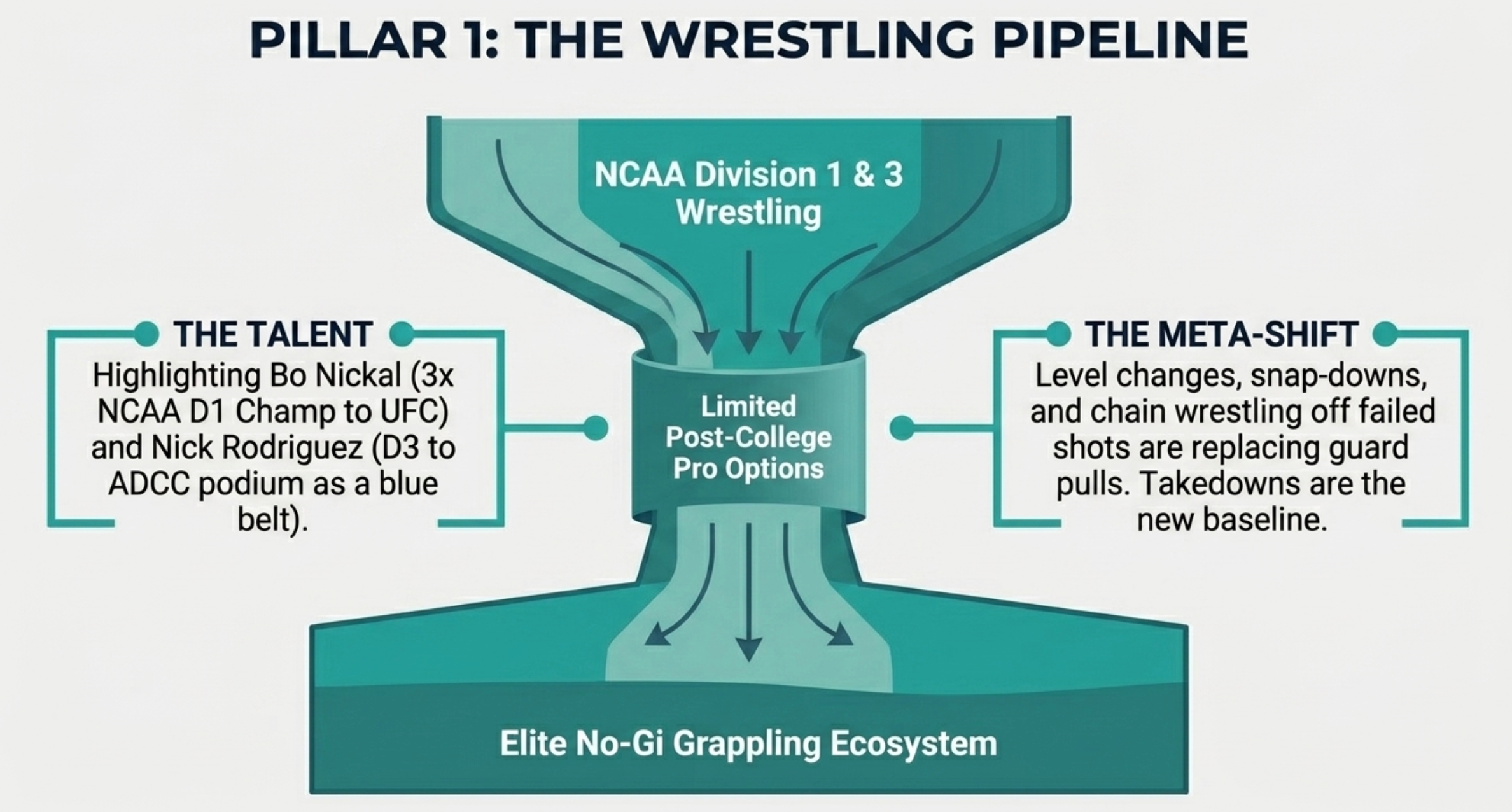
A large share of elite American grapplers under 30 have wrestling backgrounds, either from high school mats or from training alongside someone who did.
The takedown game in modern no-gi is shaped by collegiate wrestling—level changes, snap-downs, and the chain wrestling off the failed shot.
You can see it in the crossover careers.
Nick Rodriguez is the cleanest case. He wrestled D3 at Ferrum College, started training jiu-jitsu in June 2018, and made the ADCC podium as a blue belt the following year. He isn't alone—the wider crossover generation, including former NCAA champions now competing on no-gi mats, is the talent pool reshaping the sport.
Wrestlers find no-gi grappling natural, and grapplers raid wrestling rooms for their standing game.
If your school doesn't have a wrestling component, you're missing the front half of how a real fight starts. Cross-training across grappling disciplines has become a standard expectation for serious students.
Leg locks as core curriculum
For most of jiu-jitsu's history, leg locks lived at the back of the textbook.
The IBJJF banned heel hooks and knee reaping below brown belt until January 1, 2021. They're still illegal in the gi at every level. The safety rationale held up for years because the techniques were poorly taught.
John Danaher changed that.
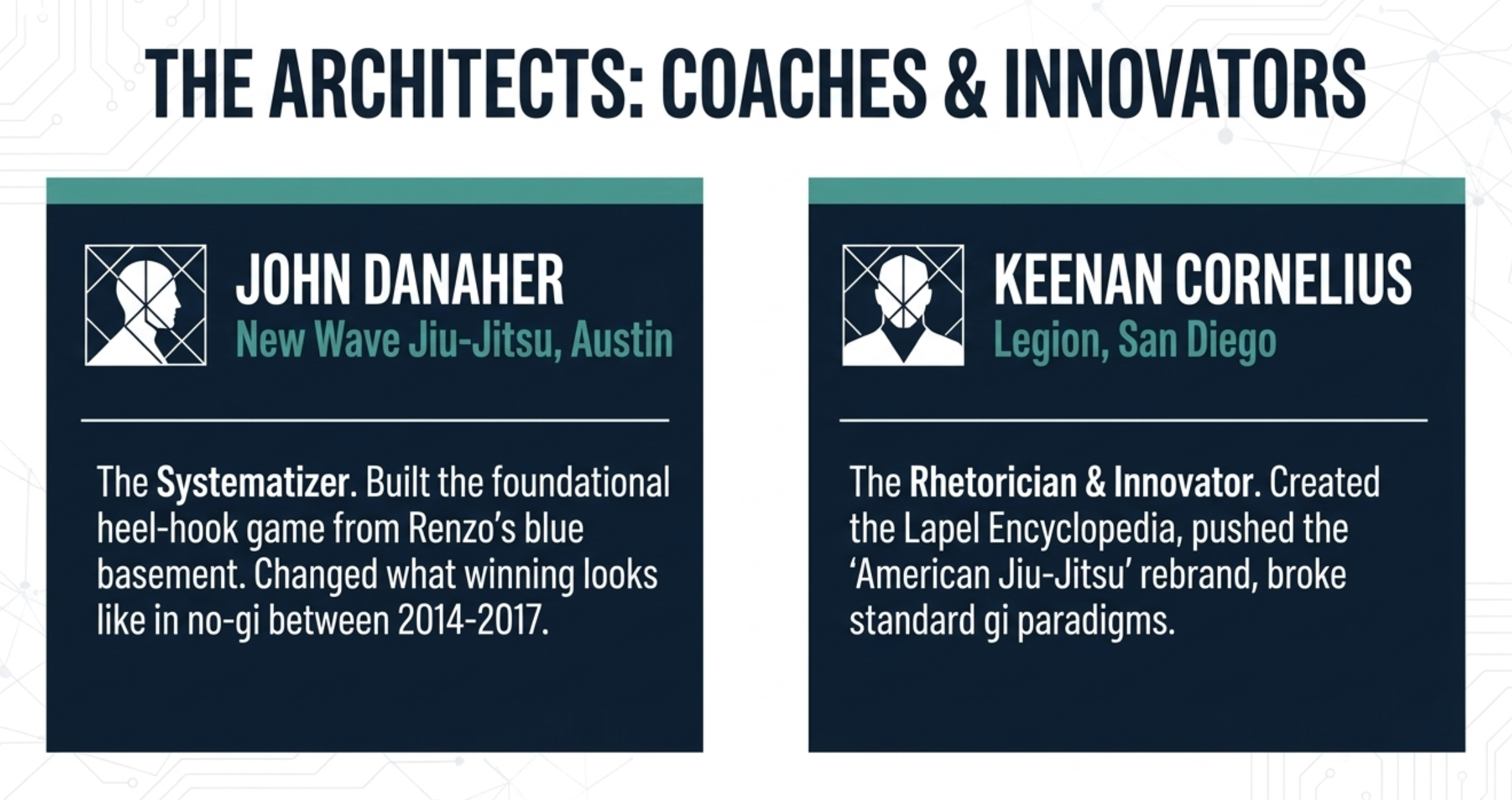
From his "blue basement" at Renzo Gracie's New York academy, Danaher and his students built a systematic heel-hook game around ashi garami and the saddle (sankaku)—control positions first, submissions second.
By the 2017 ADCC World Championships, his students Gordon Ryan, Garry Tonon, and Eddie Cummings were dominating black-belt divisions with leg attacks. Craig Jones, training independently in Australia, made the same point from the other side of the world.
The Danaher Death Squad dissolved in July 2021 over the kind of tensions that come with too much success in one room.
Danaher, Ryan, and Tonon formed New Wave Jiu-Jitsu in Austin. Craig Jones, Nicky Ryan, Nick Rodriguez, and Ethan Crelinsten started B-Team down the road. Both rooms are still producing the most technical no-gi competitors in the world.
If you teach no-gi and treat leg locks as advanced material, you're behind the sport. A structured BJJ curriculum needs ashi garami and the saddle in the white-belt position vocabulary alongside mount and side control.
No-gi as the default
The largest publicly reported purses in the sport now sit in no-gi formats—ADCC, ONE Championship Submission Grappling, and EBI's overtime format that Eddie Bravo introduced in 2014.
Mikey Musumeci, the first American to win multiple IBJJF world championships, is also the first-ever ONE Submission Grappling world champion.
He holds the most wins (7) and most title defenses (3) in the promotion's history as of late 2025.
The gi still teaches grip-fighting patience and slow positional pressure better than no-gi can.
But if you're building a competition team and trying to attract talent, no-gi is where the eyeballs and the purses are.
The People Building It
A few names anchor the movement.
Keenan Cornelius
Trained originally under Lloyd Irvin, then Andre Galvao at Atos. Promoted to black belt by Galvao on September 14, 2013.
Founded Legion in San Diego in 2019, where he started the Dojo Storm podcast that pushed the rhetorical case for dropping "Brazilian" from the name.
He's also the most influential American innovator in the gi.
Worm guard, squid guard, reverse de la worm, and gubber guard are all lapel-guard systems he's credited with developing at Atos, built around the thesis that the opponent's own lapel is a control mechanism waiting to be used.
He released The Lapel Encyclopedia digital instructional and built a whole curriculum around the idea.
John Danaher
New Zealander, moved to New York in 1991 for a Columbia philosophy PhD and never finished it—found a basement instead.
His sole instructor was Renzo Gracie, who promoted him to black belt on April 2, 2002.
Danaher built the most influential coaching system in modern no-gi and now operates out of Austin with New Wave.
Gordon Ryan, Garry Tonon, Craig Jones
The competitive face of the leg-lock era. Ryan and Tonon train at New Wave; Jones runs B-Team a few miles away.
All three have shaped what an "American jiu-jitsu" black belt looks like in 2026—fluent in wrestling and deadly at leg entanglements, with no allegiance to either side of the gi line.
Mikey Musumeci
Born in Marlboro, NJ, in 1996. Lineage runs through Andre Pederneiras and Gilbert Burns.
First American with multiple IBJJF world titles, current ONE Submission Grappling champion, and has a submission named after him (the "Mikey lock," a modified heel hook).
Living proof that the movement isn't only about size and wrestling—Musumeci is a flyweight technician.
The wrestling crossover generation
Nick Rodriguez, Bo Nickal, and a steady pipeline of NCAA wrestlers who find no-gi grappling pays better than amateur wrestling's post-college options.
This pipeline is the single biggest factor reshaping the sport's talent pool.
How American Jiu-Jitsu Differs from Traditional BJJ
Dimension | Traditional BJJ | American Jiu-Jitsu Movement |
Standing game | Often skipped; pull guard is fine | Wrestling-first; takedowns and top control |
Leg locks | Restricted until brown belt | Taught from white belt |
Format priority | Gi competition (IBJJF) | No-gi (ADCC, ONE, EBI) |
Innovation cadence | Slow, lineage-respecting | Fast, system-flexible |
Curriculum source | Academy's parent lineage | Mix of instructionals, seminars, social media |
Most schools sit somewhere in the middle of these two lanes, and both produce excellent grapplers.
The question is which lane your students are pulling you toward, so your curriculum can keep up.
What This Means for Gym Owners and Instructors
Your no-gi class is more important than it used to be.
Five years ago, no-gi was a once-a-week thing at most gi-first academies. Today, plenty of young members come in asking for no-gi first.
If your schedule still treats no-gi as the optional bolt-on, members will quietly drift to the gym down the street that runs no-gi three nights a week.
A leg-lock framework needs to live alongside mount and side control from white belt. Drilling heel hooks once a quarter doesn't teach the position.
The control positions—ashi, the saddle, 50/50—need to function as fundamental positions you teach from day one.
The traditional BJJ belt progression was built around a different curriculum. Updating yours doesn't mean abandoning the belt system; it means letting the syllabus reflect what the sport actually rewards now.
Wrestling-curious members need a route in.
Even if you're not hiring a wrestling coach, structured takedown technique inside the warm-up—single legs, snap-downs, sprawls—keeps you in the conversation when a former wrestler walks in looking for somewhere to roll.
Attendance and progression need real tracking now. A leg-lock curriculum has too many moving pieces to teach by memory.
You need to know who's drilled the saddle entry and who's cleared to roll with leg attacks on. That's a record-keeping problem.
Martial arts management software is how the bigger academies stay organized as the syllabus gets denser.
Built-in attendance and curriculum tracking keeps the position-by-position record without piling more admin onto your instructors.
Members will compare your program to what they see online. The Mikey Musumeci match they watched last weekend, the Danaher instructional they bought, the B-Team podcast they listened to on the drive in—those shape what they expect from your mat.
You have to know it exists and have a coherent answer for why your room makes the choices it does.
Where the Movement Goes Next
The trajectory is mostly a continuation of the last five years.
No-gi prize money keeps growing. ONE Championship's submission-grappling division pays some of the largest publicly disclosed purses in submission grappling.
ADCC trial seasons are expanding, and the financial gravity is pulling more talent toward no-gi specialization earlier in careers.
IBJJF rule sets keep loosening as the federation chases the audience that grew up on EBI and ADCC.
The wrestling pipeline is structural. This crossover appears durable as long as US amateur wrestling outpaces its professional outlets.
That talent will keep flowing into grappling for the foreseeable future.
Academy curricula get denser. The body of technique a serious purple belt is expected to know now would have been black-belt material in 2010.
Schools that adapt their teaching infrastructure—lesson planning, member progression tracking, video review—will keep producing the next wave. The ones that don't will keep producing capable hobbyists.
American innovations get adopted in Brazil and Europe; international competitors come to Austin and San Diego to train.
The "American" in "American jiu-jitsu" is a center of gravity, not a closed system.
Why the Label Stuck
Strip away the rebrands and the regional pride and the etymology arguments, and the American jiu-jitsu movement is about a refusal to accept that the sport has already been figured out.
Traditional BJJ has lineage, beauty, and a deep technical heritage that earned its respect.
The American movement adds something the traditional system didn't always reward—a license to experiment, to question, and to lose a few matches in service of a better idea.
If you teach jiu-jitsu in the US in 2026, you are already inside this movement whether you call it that or not. The real question is whether your program is keeping up.
If part of keeping up means tightening how you track curriculum, attendance, and member progress as the syllabus gets denser, Gymdesk is built for the way modern grappling academies actually run.
Gym management software that frees up your time and helps you grow.
Simplified billing, enrollment, student management, and marketing features that help you grow your gym or martial arts school.


FAQ
American Jiu-Jitsu FAQs

Joshは、マット上の実践的なトレーニングとエビデンスに基づく指導をつなぐ、格闘技の教育者・コーチです。テコンドー四段の黒帯で、ブラジリアン柔術にも打ち込んでいます。長年にわたりクラスを指導し、生徒を育ててきました。インストラクターが型どおりの反復練習から抜け出し、プレッシャーの中でも通用するトレーニングを行えるよう支援しています。
Liberty Universityで教育学修士号(Teaching & Learning)を取得し、Combat Learningを運営しています。Combat Learningでは、格闘技におけるエコロジカル・ダイナミクス、制約主導型コーチング、ゲーム形式のトレーニングを解説しています。Gymdeskでの執筆やポッドキャストを通じて、コーチングの科学とジムオーナーの体験談を、クラスの質を高め、より強い格闘技スクールを築くための実践的なアイデアに変えています。