

The first time Ricard Carneborn tried to build tournament software, it crashed almost as soon as the event started. He's Smoothcomp's CSO and co-founder now, and he still calls it the low point.
"And that's my worst experience ever."
He'd tried it with a guy who knew software. The guy tried hard, and Ricard gives him credit for it. It was just way too early.
It got so bad that Ricard had to get out of the building.
"I had to walk out of the venue, I had to leave the venue because I was so stressed."
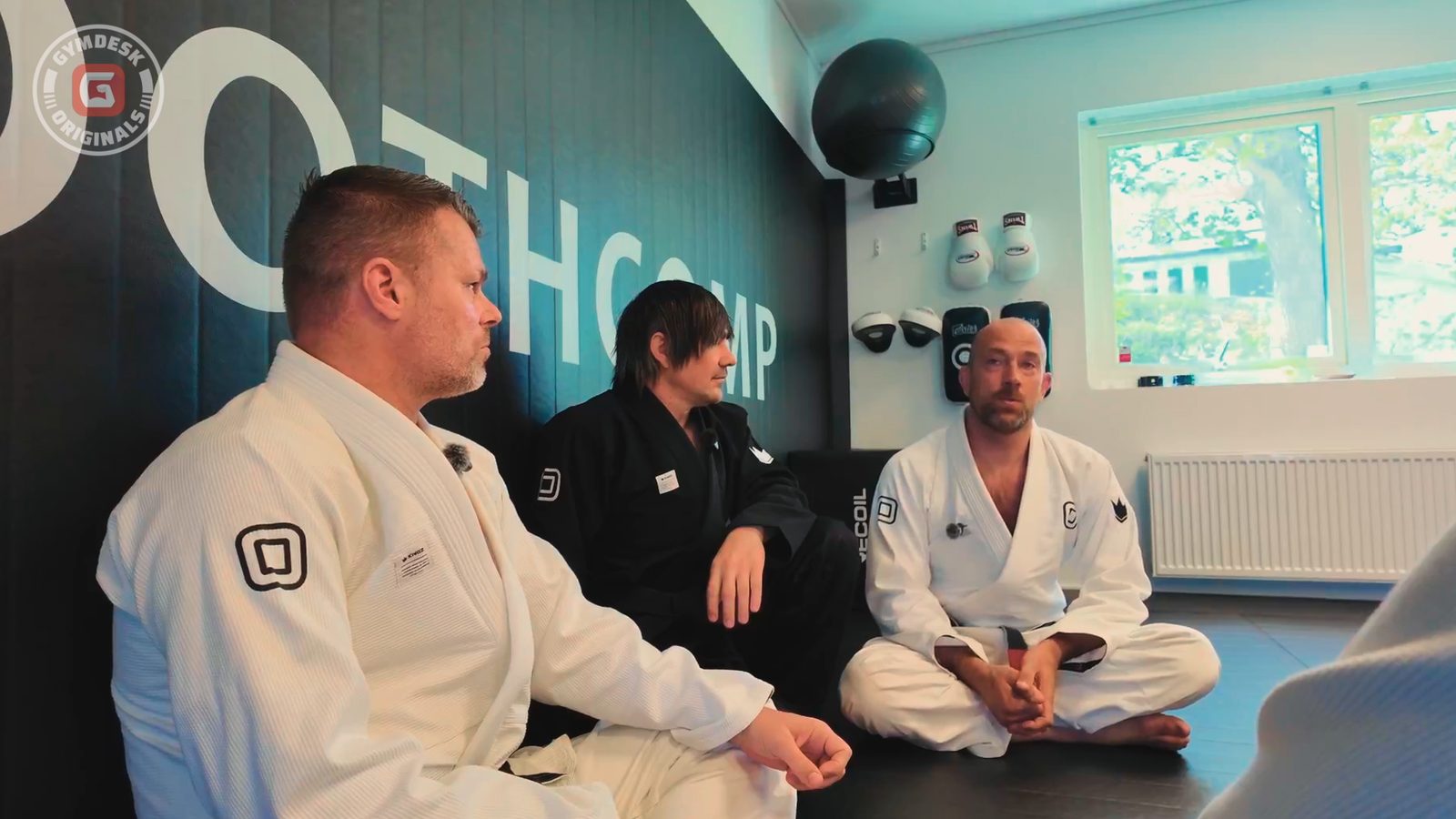
Alex Cuevas, Gymdesk's CEO, went to Sweden to hear the rest of it for Gymdesk Originals. The story starts on the west coast, in Stenungsund, a small town close to the ocean.

The two Martins' academy there sits in an old gymnastics hall with a shelter in the basement, past a skate park, under a crocodile logo.

Smoothcomp's office, where the roundtable was filmed, has kicking pads and gloves on one side of the room.
The local academy trains there three times a week.
Two Tournaments and a Big TV
Martin Janson, Smoothcomp's CEO and co-founder, started his tournament in Stenungsund in 2006. He and his wife were both competitors, and they didn't love the events they'd been competing in.
"We thought they were not athlete centric. They were more centered about the business model of the tournament, or they were more centered about something else, you know? And sometimes it felt like the referees was the main character at the event."
So every decision went through one question. Would it help the athlete?
"Will this benefits the athletes? Will it give the athlete better time to prepare and know if they can eat?"
The event became the Swedish Open. It drew people from Denmark, Norway, and the rest of Sweden.
Ricard had been at this even longer. He runs Nacka Dojo, a big academy in Stockholm, and he started organizing events back when a spreadsheet was the high-tech option.
"So I started doing my first tournaments in 1999, way before software and then paper, Excel spreadsheets, sending your, like, competition registration by post, I think even."
The two men met at a seminar Ricard was teaching in Gothenburg.
They rolled, and Ricard came away impressed.
"You train and you try to kill each other, but you become friends," he said.
In 2012, Ricard started a Brazilian Jiu-Jitsu event of his own, the Nordic Open.
His earlier events were sport ju-jutsu, a style he helped start that caught on across Scandinavia. You punch and kick, it turns into judo once you grab hold, and it becomes ground grappling when you hit the mat.
That's when the friendly rivalry began. Each organizer went to the other's tournament, and each tried to top the other the next time.
"We started comparing our tournaments, you know, being friends for many years. Like, okay, well, we have this big TV. So yeah, we have this. And we have, like, we started, you know, making fun of each other and always trying to, you know, be better than for next one."
We'll keep you in the loop with fresh content, podcasts, how-to guides, tool reviews, and product exclusives.
The Badminton Software
Behind the show, neither event ran on anything that held up. Ricard still tells this one to the organizers he helps.
That first crash had come years earlier, "before, like, I think, like 2010, maybe." The badminton day came later.
Before Smoothcomp, his own events ran on software built for badminton. For two years it actually did a decent job of the parts that happen before the tournament.
"You could accept online registrations. You can create brackets. That's fine."
What it couldn't do was run the matches.
There was no live scoring, so once the first match started, the event moved off the screen and onto flip boards and paper.
"But then as soon as the tournament started and you were back to pen and paper..."
Every finished match meant a handwritten result sheet. Someone carried it over to Ricard and a colleague at the computer, and they typed it in.
The first sheet came in and they typed it up. Then the next one came in, and the one after that.
Anyone who has run brackets by hand knows the next part.

Ricard puts it at about 1,000 matches across the day. (In all fairness to the badminton software, nobody had asked it to handle armbars.)
"So like half through the tournament, we have to, to abandon it..."
They'd promised the crowd live updates, so that went down with it. The two men at the computer started laughing, the way you laugh when the airline says your bag is "probably" in Frankfurt.
Alex asked how that felt.
Ricard walked away from that tournament with one idea.
"And then I was like, well, we need to build something that solves the entire system."
Registrations by Email
Over in Stenungsund, the Swedish Open had its own admin problem. That's where the third founder, Martin Varghult, comes in.
(Yes, two Martins. Stay with me.)
Varghult had started a web agency called Pixelstore in 2005. Then he started training with Martin Janson and got pulled into helping run the Swedish Open.
For a while, the event took its registrations by email.
Varghult built a fix: an online registration and payment module, just for the Swedish Open. It wasn't Smoothcomp yet. It did make the admin a lot lighter.
Ricard was already looking for something that solved the whole thing. He saw it and wanted in.
Four Days in Stenungsund
The three of them planned to meet in Stenungsund to talk it through. Ricard was supposed to stay one day.
He ended up staying three or four extra days. At home, the subject didn't change either.
"My wife was so tired of me because like, there's only thing I could talk about."
The plan started small.
Build something for the Swedish Open and the Nordic Open. Then they looked around to see what else existed.
They found tools that each did one piece of the job. Some lived on a single PC. Ricard remembers what was missing.
"There's nothing online. You could maybe publish a schedule, but there's no real time updates."
The cloud question didn't take long.
The choice was a local network inside each venue, with cables strung between the scoring computers, or software that ran online. Varghult, the one with the tech background, said the local setup would cause more trouble.
"You get more problems running cables and the IP addresses and trying to build like an ethernet network than just using the cloud."
The harder part was agreeing. Two organizers, each sure his way was right, had to settle on one way, as Janson tells it.
"I made tournaments my way, he made tournaments his way."
So they argued it out, issue by issue.
"So I would change my mind on a core issue and I valued because his argument was better and vice versa. Then we find the middle way and we say, okay, this is the best practice of a tournament."
They also had one test for every product decision.
Janson explains it:
"We just wanted to be proud of the software. And that is still here today. If we have a meeting discussing a product, we have the same compass direction. It's like, are we proud of this?"
They built the system around that best practice.
Martin Janson had brought the athlete-first rule from the Swedish Open, and it came along too.
"The core principles since the start has been to elevate the athletes experience at the tournament. So by focusing on that, we help the organizers as a part of that, because it's their customers."
Programming in the Car
They built the first version over the summer of 2015. The first event ran on Smoothcomp on 25 October 2015.
It was Ricard's own tournament.
He'd done the brackets and was ready, and he remembers the others still coding on the drive up.
The software hadn't learned to lock brackets yet.
Then someone at the event started touching the schedule on an iPad, and the brackets moved with it.
"I have this minus 77 men bracket in my hand because we didn't have a feature that locked the brackets and on an iPad. So he was touching the schedule. And so now suddenly you're moving my brackets around, like, where should it be? And I'm like, I don't know. It was terrible, but yeah, I think we solved it, but that was like the first version of it."
A few weeks later the Swedish Open ran on an improved version. "It was good for me, but it was way better three weeks later."
One Email to Abu Dhabi
A few months in, they wondered if anyone else would want it.
In early 2016 they contacted everyone they knew in martial arts, and plenty of people they didn't.
That summer, Ricard's family was visiting Martin Janson's house. Just before they all left for a day of sightseeing, Janson remembered an old email thread he had with the UAEJJF.

The UAEJJF is now the AJP.
About a month later, one of them was in Abu Dhabi. A few months after that, they were traveling with the UAEJJF to its Grand Slam events.
"We were in Tokyo, London, Rio de Janeiro."
Keeping the Day Jobs
For years, none of this paid the bills.
The Smoothcomp founders kept their day jobs, put all the revenue back into development, and built Smoothcomp in their spare time.
Martin Varghult had a number in mind for when that could change.
They hit it. Varghult had a good job at Pixelstore, and he still calls the switch "truly the dream to like concentrate 100% only on Smoothcomp."
That was years of nights and weekends, and Ricard says he never felt burned out.
"It's a positive stress. It makes me go faster and do better."
I Got My Life Back
Alex asked how many countries Smoothcomp is in now.
"All of them," came Ricard's deadpan answer. Then, a little more seriously: "No, we've been global."
SMOOTHCOMP BY THE NUMBERS
Smoothcomp's own count over the past 12 months. These are averages and a peak for events run on Smoothcomp, not figures for the whole tournament market.
~150
Events on an average weekend
200+
Events on the busiest weekend
~27,000
Athletes competing on an average weekend
Source: Smoothcomp platform data, past 12 months, as reported by the founders. Platform activity only, not an industry benchmark.
By Smoothcomp's own count over the past 12 months, about 150 events run on it on an average weekend, and more than 200 at the peak.
About 27,000 athletes compete on an average weekend.
That many events on one weekend means there's no quiet time to fix things. When the founders travel to events, they see a thousand people in one venue scrolling the app to check their match times.
Organizers depend on it, and Ricard says the team knows it.

Newbreed runs jiu-jitsu tournaments, and when Smoothcomp first reached out, Dave Heller's team had no software at all.
Ricard still thinks about that conversation.

Dave prepped from Wednesday afternoon through Friday, traveled Friday, and ran the event Saturday.
Then came the cleanup, and Ricard still remembers how Dave described it.
"After the tournament, I spent Sunday, Monday, and maybe half of Tuesday, like, you know, results, refunds, all the after work of a tournament. I don't have any spare time pretty much."
Newbreed moved to Smoothcomp. A couple of months later, they talked again, and Dave told Ricard this.
Where Gymdesk Comes In
Gymdesk has its own origin story: a jiu-jitsu black belt who thought he could build better gym software. It's built for the gym owner, and the mission is less admin, more members, zero guesswork.
Alex knows the admin side from before Gymdesk.
He used to own restaurants in Miami, small ones, running on paper order tickets. Then one Mother's Day the line went out the door.
"When we weren't used to that volume, all of a sudden my little ticket system with the piece of paper just exploded."
He called it "the most demoralizing, soul-crushing experience."
Plenty of gyms run competition the same way. It happens outside every system the gym pays for.
The event is a poster on the wall. Somebody registers under the wrong academy, and you find out at the venue.
The proof of what your gym builds lives in group chats and camera rolls.
Gymdesk already tracks belt progression, attendance, and skills. "We're missing that part," Alex said, meaning competition.
Gymdesk and Smoothcomp are now one company. That's where Smoothcomp Connect comes from.
Ricard put the problem this way.
There's now a Competitions tab in Gymdesk.
Coaches find the Smoothcomp tournaments worth the team's time and put them in front of members. Members register under the right academy from a form that's already filled in.
When it's over, the results land on each member's record. That's the competition record, and it's included in your plan.
Attendance, belt rank, skills, and how they did when it counted. One record. That's the proof of what your gym builds.
Smoothcomp Connect
The wrong-academy mistake can't happen, and registration stops being “handholding.” Getting more people to compete stops being a second job.
See Smoothcomp ConnectGym management software that frees up your time and helps you grow.
Simplified billing, enrollment, student management, and marketing features that help you grow your gym or martial arts school.


FAQ

Seanは過去10年にわたり、規模を問わずさまざまな企業が賢く成長できるよう、コンテンツを制作してきました。経営者が本当に好きなこと、つまり楽しい仕事にもっと時間を使えるようにするためです。
配送や国際物流からウェブ開発、マーケティングまで、言葉だけでなく実務を通じて、小売業やサービス業の効率的な事業拡大に携わってきました。
これまでの執筆先には、Sendle、Shogun、The 小売 Exec、Gymdeskなどがあります。