Build a BJJ Family, Not a Fight Team: A Community-First Blueprint
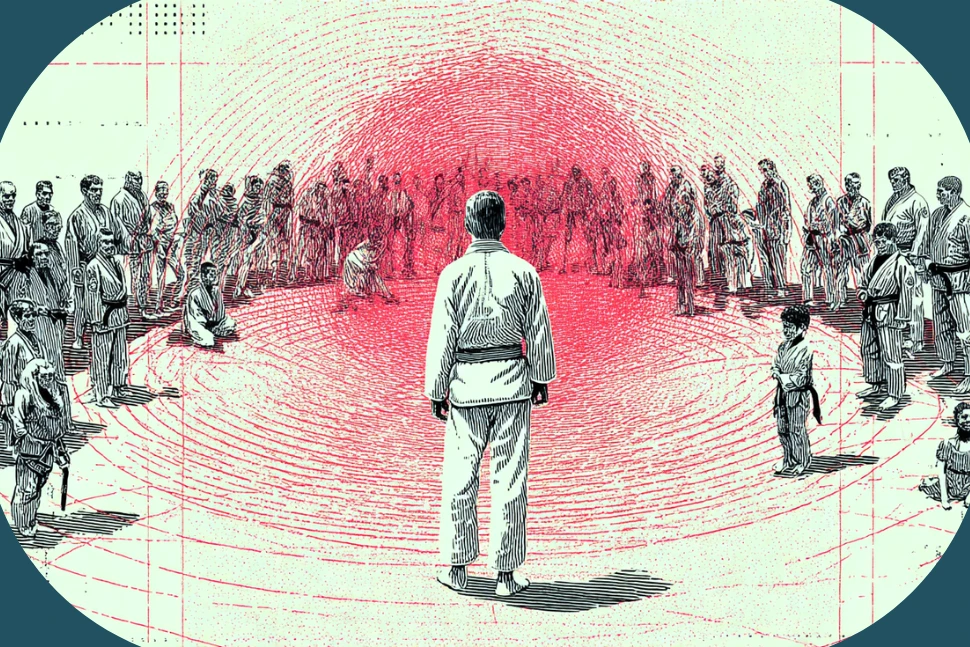
Peak January in St. Catharines, Ontario. A blue belt is moving houses. He posts in his gym's WhatsApp group two weeks out—hey guys, I'm moving, can you help?—and when the day comes, seventeen or eighteen people from his BJJ school show up to help.
Nobody was assigned. Nobody was guilted into it. They just came.
A year later, the gym's owner moves, and twenty-plus show up for him.
That scene is the reason Alex drove out to Renzo Gracie Niagara to sit down with Professor Fernando Brazileiro. Most gyms say they're a community. Very few could produce eighteen members on a Saturday in January to carry somebody's couch.
Fernando's can. If you want to know how to build community at a martial arts gym, this is the clearest working model we've seen.
I have no plan to build a professional MMA fighter here. I want to build a community. I want to build a family, a BJJ family. That's the goal.
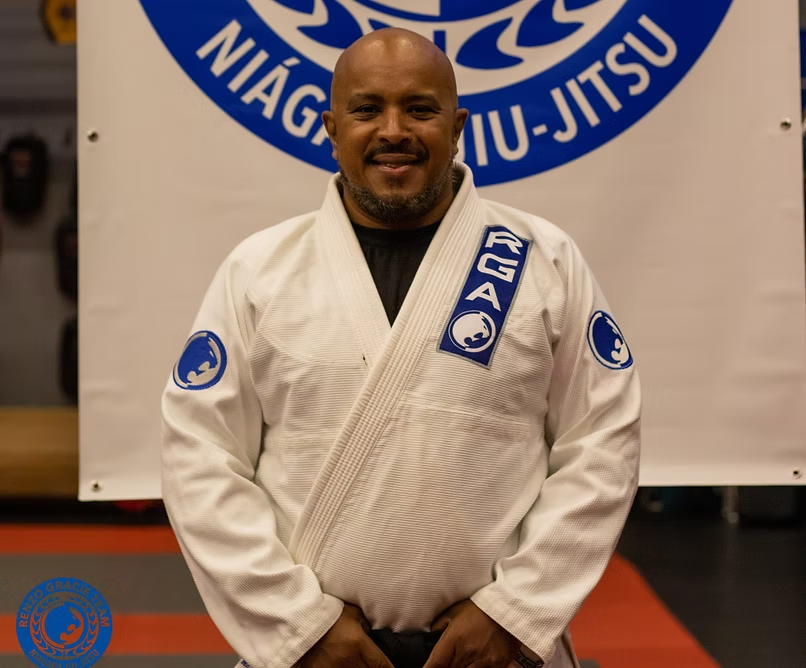
This post is what we took away from that conversation: a blueprint for building a martial arts gym community that feels like a family, not because you put it on the About page, but because your members behave like one when it counts.
You can watch the whole episode here:
What a Community-First Gym Actually Means
Most owners treat "community" as a mood. It shows up on the website, in the welcome email, on the hoodie. It means roughly the same thing as "we're nice here."
That's not what Fernando's running, and it's not what this post is about.
There are three archetypes a martial arts school can grow into:
None of these are wrong. But you have to choose, because a gym that tries to be all three is mediocre at all three.
Fernando made his choice out loud in the first ten minutes of our conversation. Once you hear an owner say it that plainly, you notice how rare it is.
What follows isn't a general guide to positive culture. It's a specific operational blueprint for the community-first path, built from how Fernando runs Renzo Gracie Niagara.
The Move-Crew Test (How to Know if You Have Real Community)
Before the blueprint, a diagnostic. Every owner thinks they already have culture.
Here's the test. Tomorrow morning, post in your members' group chat: hey, a teammate needs help moving this weekend. Who's in? Not for money. Just because.
How many show up?
That number is your community score. It's the count of adults who'd take a Saturday off, drive across town, and carry furniture up a flight of stairs for somebody whose last name they maybe don't know yet.
Fernando's answer is on record. "When someone will move, okay, we have a WhatsApp group," he said.
"So, hey, guys, I'm going to move in two weeks. Can you guys help me? And when that happened, like, show up 15, 20 guys."
Seventeen or eighteen for the blue belt in January. Twenty-plus for Fernando. A dead car battery in the parking lot gets jumped by somebody from the group.
You could call it the Move-Crew Test because it's falsifiable.
Post the ask. Count the trucks. If they don't show, you have a customer base that shows up to a building three times a week.
The good news is that the behavior is buildable. Fernando didn't mandate it. He didn't write it into the onboarding email.
He built the conditions that let it emerge, and the five decisions below are what those conditions look like in practice.
The Five Decisions That Build a BJJ Family
Everything at Renzo Gracie Niagara rolls downstream from one identity choice Fernando made early and repeats often. Here's how that choice plays out on the ground.
Decide what your gym is not
This is the hardest one, and it's the one most owners skip.
Tell prospects up front: if you want to fight professionally, this isn't your place. Fernando does exactly that, and he'll send them to a fight team across town. Saying what he isn't is how prospects figure out what he is.
You cannot be a fight team and a family and a retention-optimized commodity gym at the same time.
The tactics diverge at pricing, at how you handle an ego on the mat, at whether you run a kids class at all. A gym that tries to serve every persona ends up with a room full of people who don't quite fit anywhere.
Pick what you're not. Say it out loud to every prospect. Every other decision gets easier.
Stop running the welcome loop yourself
When asked what his onboarding process looks like, Fernando laughed.
Every time that we have someone new here, I don't need to ask, "Hey, Alex, can you help him?" My students get, take the act. "Hey, are you new? I'm going to help you." I don't even need to ask anymore.
That's the goal state: culture so ingrained that the owner has stepped out of the welcome loop entirely.
It's the payoff for a year or two of doing it yourself, explicitly, every single time, until the behavior became the room's default.
There's another path: codify it.
Two Bridges Muay Thai runs the Three Friend Rule, where every new person meets three people (front desk, coach, training partner) before the warm-up. Run it until members start doing it without the checklist. Then stop running it.
What doesn't work is assuming your members will welcome new people because you're nice. They won't unless you've shown them how.
Use language to shape the room before the rolling starts
This one surprised me. Fernando talks out loud in class about how much courage it takes to step on a BJJ mat as a white belt, and then he names the asymmetry directly to his existing students.
"To step on the mats on the first day requires a lot of courage because you have no friends here," he said.
"You don't know how that's going to happen. You don't know how that's going to work. You don't know what to expect. So that requires a lot of courage, even for big, strong guys. Imagine for girls, for women."
He frames it in advance, in front of the men, so the culture of accommodation is already there before any woman walks in.
"They deserve to have a place on the mat," he said. "It's not a favor that we are doing."
He runs a mixed room where the men have already been taught how to think about it. No separate women's-only program required.
This is a language-first inclusion tactic, and it costs nothing.
Forte Jiu-Jitsu's community takes a different path by keeping women visibly training at every session. Both work. Both start with the owner deciding the room is going to be welcoming before the first new person walks in.
If you're running women's BJJ classes and watching retention improve, the class itself isn't the whole lever. It's the signal you're sending the rest of the room.
Put your community in a WhatsApp group
Most "build community" advice defaults to events. Host a barbecue. Run an in-house tournament. Plan a seminar.
Fernando runs fewer events than you'd expect for a gym that produces move-crews.
What he has is a member WhatsApp group used for actual logistics: moves, car batteries, gear questions, "does anyone have a ride to the tournament Saturday." The group is the infrastructure.
Start the group yourself. Use it for real logistics, not reminders, not promotions. Offer help before you ask for it, and respond publicly when someone posts a need so the pattern is visible.
After a month, members are modeling the behavior on their own, and the group becomes what Fernando's is: a place where "in Rio, the BJJ gym is a space that you go, even if you don't want to train, you go to hang out with your friends, to have a conversation."
That's the model he grew up in, and the part he deliberately imported into a small town in Canada. The channel replaces the building when people can't physically be there.
Use your kids program to set the adult room's tone
Fernando runs two kids tiers: Little Ninjas (ages 3–5, about 30 students split across multiple classes because demand exceeds a single slot) and a bigger-kids program at around 40.
On Saturdays, he runs a "no-gi family class" where adults and kids share warm-ups, sometimes drill together, then split the mat for technique and rolling. Parents and kids are in the same session, not in parallel rooms.
That shared warm-up changes what the adult room feels like.
It's a family gym, literally, because your training partner might be somebody's dad and your next partner might be that kid's older brother. The room doesn't have to pretend.
Fernando teaches break falls as winter safety ("if they fall on the ice, they will not hit the back of the head"), and he disciplines through silence.
"More they make noise, lower I talk," he said. "I just cross my arm, make a bad face and look at them without any word."
The kids learn respect without being yelled at. That's what their parents notice when they stay on for the adult class.
Your kids program sets the temperature of your adult room. That's the real ROI on it.
The Thing That Happens When You Stop Chasing Medals
Here's the counterintuitive part.
Fernando isn't running a competition team. He says so repeatedly, on camera, to his own members. And yet, about two weeks before this episode, his gym sent 13 athletes to a tournament and came home with 12 medals.
"For us, it was a good result, but that's not our focus," he said. "It was about the culture, the lifestyle."
We've talked to enough BJJ owners to know how rare that ratio is. Most competition-first programs don't hit it.
When a gym is built on belonging instead of ambition, members train more, because the room is where their friends are.
The blue-belt plateau doesn't break their commitment when the commitment is to people instead of a trophy cabinet. And when they do compete, they compete to represent the room, which is a more durable motivation than "I have to prove I'm good."
In Fernando's case, the community-first gym outperformed a lot of competition-first programs on raw medal ratio. One data point isn't a law. But it should at least complicate how you think about the trade-off.
Fernando put it this way, after telling me about a student whose life changed through training:
Medals, trophy, they're going to get old. But confidence in life is forever.
That's the quote that goes on the wall. It's also the reason white belts at his gym don't quit, which is the crisis every BJJ academy owner is quietly losing to.
Most of the gym retention strategies that actually work in BJJ follow from a culture decision, not a policy one.
If you want to see this pattern in other gyms, Nova Jiu-Jitsu's community is the closest sibling story to Fernando's.
What This Costs You (The Honest Trade-Off)
I don't want to pretend this is free, because it isn't.
The community-first gym owner shows up emotionally in ways the commodity owner doesn't. You'll know your members' spouses' names. You'll notice when a blue belt stops coming and send a text before the cancellation email. You'll help somebody move.
That's the emotional cost. There's also a scale cost.
You probably can't build a 1,200-member, five-location BJJ operation this way without losing the thing that makes it work.
If scale is your goal, you need to know that going in. A few gyms have threaded that needle, but most who try it lose the culture by the third or fourth location.
Pick the model that matches the life you want.
Fernando moved his family from Rio to a small Canadian city and chose to teach BJJ full-time. That's not replicable for most readers. But the choice underneath it—to run a gym where the room matters more than the trophy—is.
The Blueprint
One last thing. The right tools—Gymdesk, in Fernando's case—don't build your community for you, but they can get the admin out of the way so you can show up for people: noticing when attendance drops, catching the white belt who's drifting, freeing you up to have the conversation that keeps somebody training.
That's the part of the job that only you can do. Everything else is supposed to take care of itself so you can get to it.
Gym management software that frees up your time and helps you grow.
Simplified billing, enrollment, student management, and marketing features that help you grow your gym or martial arts school.


FAQ

Sean has spent the last decade creating content that helps businesses—small and not so small—grow smarter to allow operators to do more of what they love. You know, the fun stuff.
From shipping and international logistics to web development and marketing, he's done the work (not just the words) to scale retail and service businesses efficiently.
You can find his work at Sendle, Shogun, The Retail Exec, Gymdesk, and more.