Day One at Ralph Gracie's Academy: A 220-Pound Beginner, a 150-Pound Black Belt, and the Armbar That Changed Everything

In 1998, Misho Ceko was flipping through a copy of Maxim when he landed on an article about Ralph "the Pit Bull" Gracie.
The way Misho remembers it, the piece made Ralph sound like something out of a myth: a guy who "choked out pit bulls." At the end, it mentioned he had an academy in Mountain View, California, about a block from where Misho lived.
So he walked in.
What he saw on day one was not a welcome class.
"There was probably five or six people training and two of the guys got into a fist fight on the mat during practice," he says. "And 30 years later, I don't know if I've seen another fight like that in a gym."
A real fist fight. In a class. On his first visit.
He didn't run out the door. He got hooked. And the way that room trained shaped everything Misho believed about martial arts for nearly thirty years. Including, eventually, the parts he decided to throw away.
Watch the whole episode here:
They Throw You Into the Fire
There was a philosophy behind the chaos. It just wasn't a gentle one.
That was the model. You showed up, you got a few minutes of instruction, and then you were live against people who knew what they were doing. Sink or swim.
The people who could take it stayed and got dangerous. The people who couldn't, didn't come back.
That same first day, after about thirty minutes of being shown how to pass guard and finish an Americana, the class broke into what amounted to a ten-on-ten battle royale.
Misho was a big guy—220 pounds, a lifter, someone who was used to being the strongest person in most rooms.
Then he locked up with Dan Camarillo.
A hundred and fifty pounds beat two hundred and twenty in about a second. For a guy whose whole physical identity was built on strength, that was a revelation delivered at full speed.
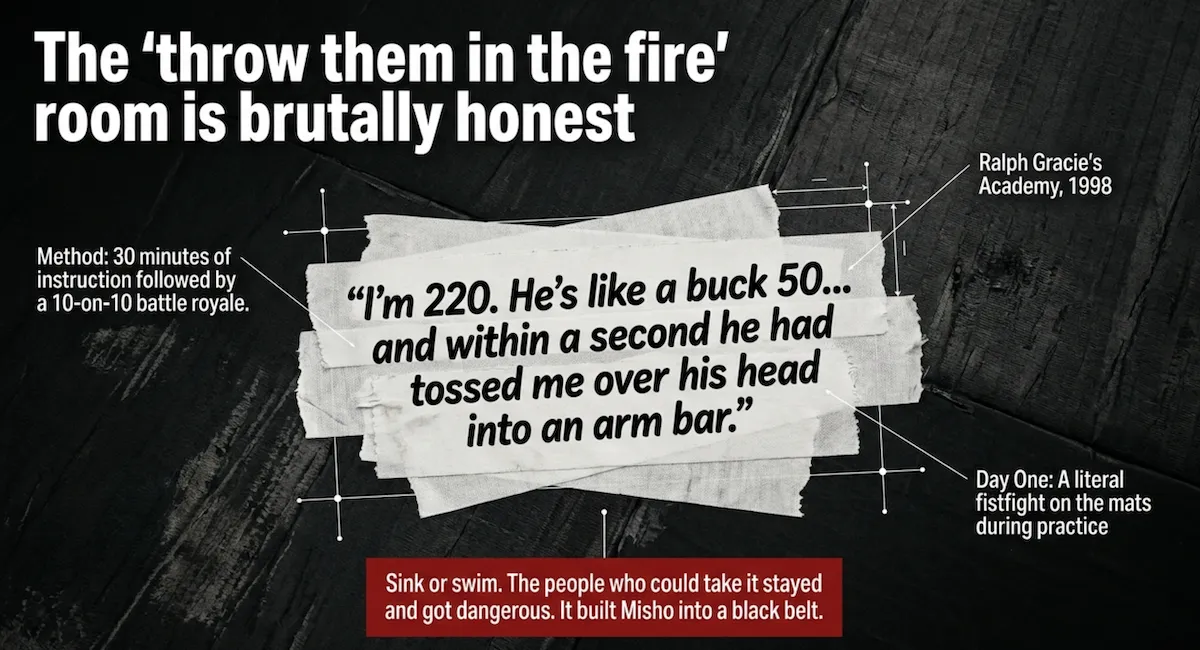
"I stopped going to the gym and lifting," he says. "I was like, I need to figure out the technique."
That's the gift of the throw-them-in-the-fire room. It is brutally honest. There is no hiding from what works and what doesn't, because you find out the moment you step on the mat.
It built Misho into a black belt. He clearly loves it. You can hear it in how he tells the story thirty years later.
And he refuses to run his own gym that way.
Build Killers, or Build a Community
The training that forged you is not the training that fills your school.
Misho says it plainly:
Sit with that for a second. The throw-them-in-the-fire model is exceptional at producing elite competitors. That's exactly what it's built to do, and a room like Ralph's did it about as well as anyone ever has.
It just isn't built to fill a community school with hundreds of beginners.
A room that intense is designed to forge a few dozen serious competitors. By design, it will never hold three or four hundred members, because most of the people who walk through your door are not trying to become killers.
They're trying to get in shape, learn something hard, and belong somewhere.
Run a roomful of nervous first-timers through that same sink-or-swim gauntlet, and you lose almost all of them in the first month.
This is the part that a lot of competition-pedigree owners get wrong. They confuse "standards" with "hostility." They think slowing down for beginners is going soft.
So they run a beginner's first class like a tryout, and then they wonder why their member retention is poor, and their mats are empty on Tuesday nights.
Misho came out of the most intense room imaginable and drew the opposite conclusion. The fire made him. It won't build his gym.
So the way new people experience Chicago MMA is deliberately not the way he experienced jiu-jitsu, and the clearest example of that is what happens in the kids' room.
The Kid Who Started Standing Taller
The person running the kids program at Chicago MMA, Coach Kevin Manko, understands something it took the sport decades to admit out loud.
You teach beginners by meeting them where they are. Especially the young ones.
That sounds obvious. It is the exact opposite of throw-them-in-the-fire.
There is no version of a fun-first, game-based kids class that resembles the ten-on-ten battle royale Misho walked into in 1998. That isn't going soft. For a brand-new kid, the only standard that matters is coming back next week.
The payoff is the kind of thing that doesn't show up on a competition record.
Kevin tells the story of one student who came in carrying something heavy.
"He was experiencing a lot of bullying," Kevin says. "It really tanked his confidence."
The kid didn't get thrown into the fire. He got eased in: privates, then kids' classes, surrounded by a room built to make him feel safe instead of tested. And it worked.
That's a member who stays for years. That's a parent who tells other parents. It's the difference between a gym that produces a handful of monsters and a gym that changes a few hundred ordinary lives, and stays open long enough to keep doing it.
What This Means If You Run a Gym
The lesson isn't "be soft." Misho is not soft, and neither is his gym.
The lesson is that the room that makes a champion and the room that builds a business are two different rooms, and you have to decide on purpose which one you're running.
Most owners never make that decision consciously. They just default to recreating the intensity of wherever they trained, and then they're confused when ordinary people don't stick.
The fix is to design the first thirty days around the beginner's experience, not the black belt's.
How you onboard a new student, whether they feel tested or welcomed in their first week, predicts whether they're still around in their first year far more than how technical your curriculum is.
The schools that grow are the ones that make the on-ramp gentle and keep the standards high once people are on it.
You can absolutely build a serious culture without making week one feel like a fist fight.
Misho got the best of the old way. He earned a black belt in a room built to forge fighters, where staying was on you, and he's the first to credit it for the practitioner he became.
He just had the wisdom to see that a room built for future champions and a room built for a few hundred everyday members are two different rooms, and to build the second one without losing the standards of the first.
About Gymdesk Originals: Real gym owners. Real stories. We visit gyms across the country to learn how they built their communities from the ground up.
Gym management software that frees up your time and helps you grow.
Simplified billing, enrollment, student management, and marketing features that help you grow your gym or martial arts school.


FAQ

Sean has spent the last decade creating content that helps businesses—small and not so small—grow smarter to allow operators to do more of what they love. You know, the fun stuff.
From shipping and international logistics to web development and marketing, he's done the work (not just the words) to scale retail and service businesses efficiently.
You can find his work at Sendle, Shogun, The Retail Exec, Gymdesk, and more.