A Somewhat Complete History of Boxing in the USA

American boxing keeps getting written off and refusing to die.
The sport hit its first commercial peak in the 1920s, lost a generation of fans to MMA in the early 2000s, and then a 58-year-old Mike Tyson and a YouTuber pulled in 60 million households on Netflix one Friday night in November 2024.
Whatever boxing is right now, it isn't dead.
What follows is the history of boxing in the United States—the fights, the rule changes, the mob, the women who had to sue their way into the ring, and the streamers funding most of what's left.
If you run a boxing gym, or you're thinking about it, the long view matters. The sport has cycled through golden ages, scandals, and reinventions every couple of decades. Knowing which part of the cycle you're in is most of the job.
The Pre-1920 Origins
Boxing came to America with Irish immigrants and stayed in the shadows for half a century.
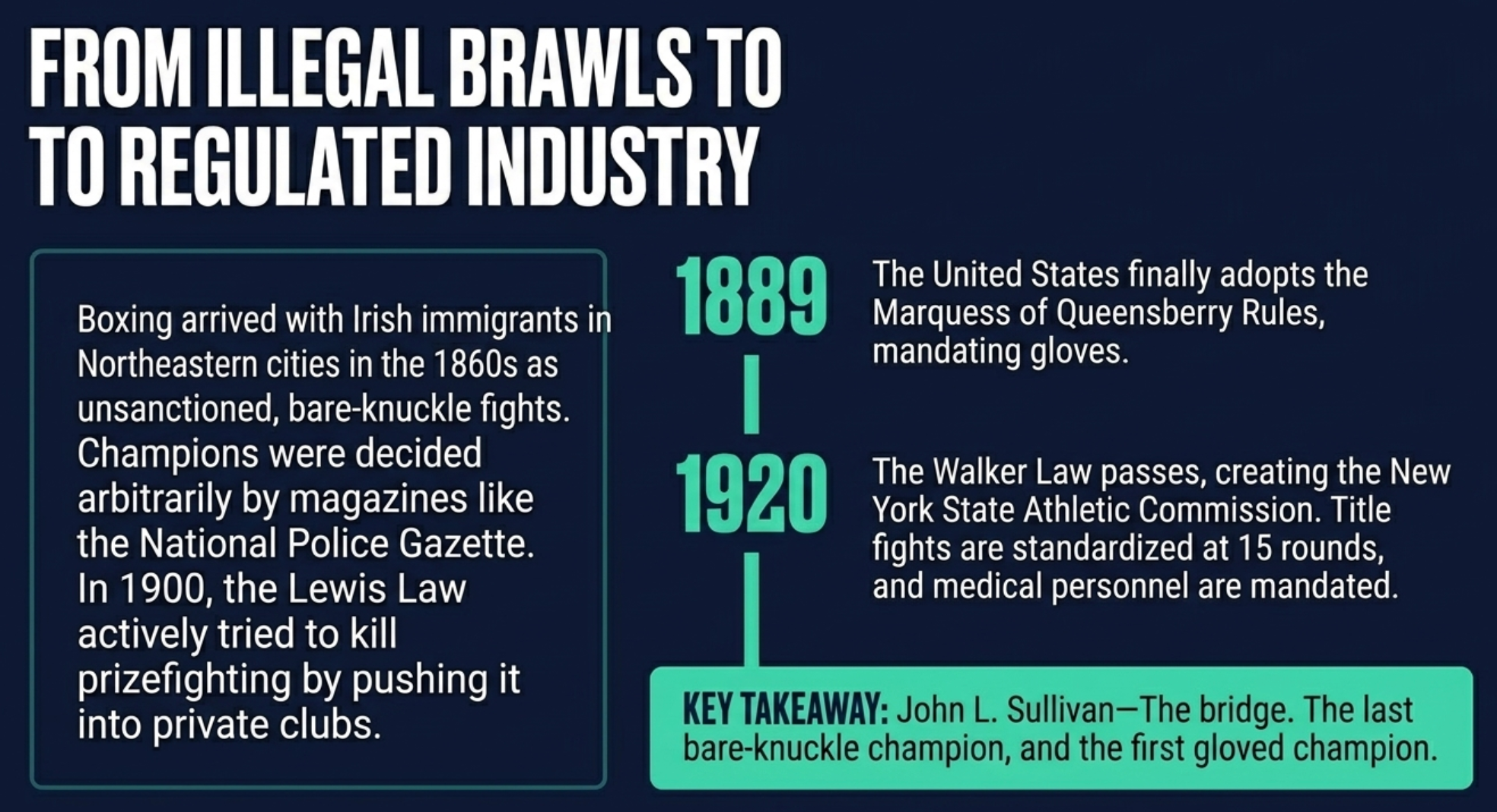
Throughout the 1860s and 1870s, Irish arrivals in Boston, New York, and other Northeastern cities brought bare-knuckle fighting with them. The bouts were unsanctioned.
There was no central governing body and no state oversight.
Champions were declared by the popular men's lifestyle magazine National Police Gazette, and a fighter's record meant whatever the Gazette said it meant.
In 1867, the Marquess of Queensberry Rules were codified in London—the first formal ruleset to mandate gloves. The United States didn't adopt them until 1889.
Sullivan straddled both eras.
He was the last bare-knuckle heavyweight champ and the first gloved one. Corbett took the gloved title off him in 1892, and Corbett's footwork is why historians call him the father of modern boxing.
The Amateur Athletic Union was established on January 21, 1888, and held its first event that April overseeing boxing, fencing, and wrestling.
In 1900, New York passed the Lewis Law. It was framed as a safety measure but actually aimed to kill the sport—it banned prizefighting unless the fighters belonged to an exclusive private athletic club and the bout was held privately.
Western states were more lenient, which is the only reason boxing survived the next twenty years in the United States.
Boxing in the 1920s
The 1920s are when American boxing became American culture.
In 1920, the Lewis Law was repealed and replaced by the Walker Law, which created the New York State Athletic Commission and dragged the sport into something resembling regulated entertainment.
Title fights were standardized to 15 rounds, medical personnel had to be present, and certain moves, such as head-butting, were banned outright.
The following year, the National Boxing Association was established as a 13-state body. It was later renamed the World Boxing Association in 1962 and is still one of the four major sanctioning organizations today.
Radio did the rest. Once stations started broadcasting fights, attendance and interest exploded. Major events drew crowds in the tens of thousands.
Jack Dempsey, heavyweight champion from 1919 to 1926, became one of the Big Five in American sports—alongside Babe Ruth, Bill Tilden, Bobby Jones, and Red Grange.
Boxing wasn't a niche curiosity anymore. It was Sunday-paper material.
In 1923, Chicago Tribune sports editor Arch Ward founded the Golden Gloves of America to host competitions between amateur fighters from Chicago and New York.
It was renamed the National Golden Gloves in 1962 and remains the pinnacle of boxing competition for amateurs in the country.
Boxing in the 1930s
Tens of millions of Americans tuned in to Joe Louis fight Max Schmeling in 1938. The Depression should have killed boxing—the heavyweight division saved it.
When the stock market collapsed in 1929, professional fighters took a brutal pay cut along with everyone else. What kept the sport alive was a string of compelling heavyweights: Max Schmeling, Max Baer, and Joe Louis.
Louis became champion in 1937 and held the title until his retirement in 1949—a twelve-year reign that's still the longest in any weight class.
He's the only boxer in any division to hold a world title for the entirety of a single decade.
Louis was also the first Black athlete to be celebrated by mainstream white America without qualification, which mattered more than the records.
His 1938 rematch against Schmeling—a German fighter the Nazi regime had tried to claim as an Aryan symbol—drew tens of millions of radio listeners. Louis won by knockout in the first round.
The cultural weight of that fight is hard to overstate.
If you're running a gym in 2026 and wondering how Louis stayed champion for twelve straight years through a depression and a world war, the answer is the same one operators give now.
He kept showing up, kept fighting credible challengers, and didn't disappear when the economy did.
Boxing in the 1940s
World War II suspended most title fights but accelerated boxing's move onto television.
The country shifted to the war effort after Pearl Harbor, and most major bouts paused for three years. Many fighters, including Louis, joined the military.
Television saved it.
Stations were broke, and fight broadcasts were cheap, so even with most title fights paused, 10-round bouts kept the sport on the air and grew its TV footprint.
Sugar Ray Robinson, Rocky Graziano, Archie Moore, and Jake LaMotta all emerged in this decade.
LaMotta and Robinson built a rivalry that stretched across five fights in three years—most boxing historians still consider it one of the defining rivalries in the sport's history.
Murderer's Row
Throughout much of the 1940s, eight African-American boxers—Charles Burley, Eddie Booker, Jack Chase, Cocoa Kid, Bert Lytell, Lloyd Marshall, Aaron Wade, and Holman Williams—were avoided by most of the era's prominent fighters, including Sugar Ray Robinson (who avoided Burley specifically).
Six of them never received title shots.
The reasons were corrupt management, racial discrimination, and in some cases both. They were forced to fight each other to stay active.
Lloyd Marshall, Cocoa Kid, Eddie Booker, and Charles Burley were eventually inducted into the International Boxing Hall of Fame.
The only title-holders out of the group were Jack Chase, who held the California state heavyweight and middleweight belts, and Eddie Booker, who lost his middleweight title to Chase.
The rest got plaques much later than they deserved them.
Boxing in the 1950s
The 1950s were boxing's first true Golden Age—and also the decade the mob ran the sport openly.
After the war, people had money again. Veterans came back wanting bigger paydays.
Televised fights were now a reliable revenue stream, and big-name boxers got Hollywood roles, endorsement deals, and the kind of celebrity that hadn't existed for fighters before.
LaMotta and Robinson met for the last time in 1951, but both kept fighting other opponents through the decade. Rocky Marciano retired in 1955 with a 49-0 record and 43 knockouts—still the only undefeated heavyweight champion in history.
By the late 1950s, every weight class had a recognizable star.
What the public didn't fully see—but suspected—was how much of the sport was being decided in private. The mafia-controlled International Boxing Club ran boxing in New York, Chicago, and Detroit through most of the decade.
Boxing in the 1960s
Two things defined the 1960s: the WBC's founding, and one Louisville teenager who would change the meaning of the word champion.
In 1962, the NBA renamed itself the WBA. The following year, members from the WBA and 11 boxing representatives from other countries met in Mexico City on Valentine's Day and founded the World Boxing Council.
Two sanctioning bodies, two belts. The era of fragmented-belt boxing fans still complain about started here.
As boxing tried to clean up its public image after the IBC scandals, a young heavyweight named Cassius Clay started making noise both inside and outside the ring.
At 22—a few months before announcing his conversion to Islam and changing his name to Muhammad Ali—he beat Sonny Liston in February 1964 to capture the WBA, WBC, NYSAC, and Ring Magazine heavyweight world titles.
Three years later, Ali was arrested for refusing conscription into the US Army during the Vietnam War. He was convicted in 21 minutes, stripped of his titles, and had his boxing license suspended in every commission in the country.
He was 25 years old, the most famous athlete on the planet, and locked out of his sport for what would turn out to be three and a half years.
The conviction was eventually overturned by the Supreme Court in 1971.
Boxing in the 1970s
The 1970s were the greatest heavyweight decade in boxing history. Probably the greatest any weight class will ever see.
Ali was reinstated in 1970 and won the North American Boxing Federation heavyweight title that December.
The following year, in his attempt to regain the three other titles stripped from him in 1967, he suffered the first loss of his career—to Joe Frazier in what was billed as the Fight of the Century.
Ali got his titles back from George Foreman in 1974's "Rumble in the Jungle" (note: the third Ali-Frazier fight in 1975 was the "Thrilla in Manila").
He lost them to Leon Spinks in February 1978, then beat Spinks back to win back the WBA title seven months later. He fought twice more before retiring in 1981—losing both bouts.
Around Ali, the heavyweight division was stacked: Joe Frazier, Larry Holmes, George Foreman, Floyd Patterson, Ken Norton, Leon Spinks, and Chuck Wepner all had real moments.
Wepner's 15-round fight against Ali in 1975—where the journeyman heavyweight was knocked out only in the final round—inspired Rocky, released in 1976.
Foreman first retired in 1977 at age 28 after losing to Jimmy Young, and wouldn't compete again for ten years.
Boxing in the 1980s

Mike Tyson stared a hole through Trevor Berbick at the November 1986 weigh-in, and then they fought.
After Ali's retirement, the heavyweight division rotated titleholders without much excitement until an undefeated knockout artist, Mike Tyson, defeated champion Berbick in November 1986.
Berbick looked scared during the staredown.
Tyson came in 27-0 with 25 knockouts. He didn't make Berbick wait long.
He didn't make it out of round 2. The official time was 2:35—Tyson dropped him with a left hook, and Berbick fell down twice trying to stand back up. The boxing world had a new king.
Outside the heavyweight ranks, the 1980s also produced Sugar Ray Leonard, Marvin Hagler, Roberto Duran, and Thomas Hearns—the "Four Kings" whose middleweight and welterweight bouts against each other are still studied for their tactical depth.
Boxing in the 1990s
Tyson's collapse defined the decade as much as his rise had defined the previous one.
The 1990s opened with one of the biggest upsets in sports history when Buster Douglas knocked Tyson out in February 1990, taking his WBA, WBC, and IBF heavyweight titles.
Two years later, Tyson was sentenced to six years in prison for rape. He served less than three.
He returned in 1995 with new tattoos of Mao Zedong, Che Guevara, and tennis player Arthur Ashe. Nobody knew what to make of him. Most people, including Tyson, gave up trying.
He won the WBC heavyweight title in March 1996 but lost it to Evander Holyfield in November.
Their June 1997 rematch ended when Tyson bit off a chunk of Holyfield's ear and was disqualified. He fought once more for a title—June 2002 against Lennox Lewis—and lost by knockout in the eighth round.
The decade's other story was a three-way heavyweight rivalry between Riddick Bowe, Holyfield, and Lennox Lewis.
All three held the championship at some point. Lewis unified the WBA, WBC, and IBF heavyweight titles in November 1999, just before the new millennium.
Boxing in the 2000s
Boxing started losing the cultural center to MMA, and never quite got it back. With the new millennium underway, a generation of fans drifted away.
Fights had become more exclusive—pushed onto Pay-Per-View or premium channels like HBO and Showtime—at exactly the moment a younger demographic was finding mixed martial arts on basic cable.
Spike TV's The Ultimate Fighter premiered in 2005 and pulled millions of new viewers into UFC orbit.
MMA passed boxing in participation and casual popularity within the decade, and the broader category of combat-sports training shifted in MMA's direction at the gym level too.
After Lewis retired in 2003, a few stars carried the torch—Roy Jones Jr., Bernard Hopkins, Floyd Mayweather Jr.—but most casual sports fans couldn't have named more than one of them. The talent was there.
The access wasn't. If your title fight cost $69.99 on PPV and your interview was buried behind a cable subscription, you weren't building new fans.
Boxing in the 2010s
4.6 million Americans paid to watch Mayweather and Pacquiao do nothing for twelve rounds in 2015. That's the decade in one number.
The two superfights
In May 2015, Floyd Mayweather Jr. and Manny Pacquiao finally met after five years of failed negotiations.
The fight sold 4.6 million PPV buys in the United States, the most in history. The fight itself was tactical, careful, and largely unsatisfying. It didn't convert the next generation.
Two years later, in August 2017, Mayweather faced UFC star Conor McGregor in an actual sanctioned boxing match.
McGregor had no professional boxing experience. The fight sold 4.3 million PPV buys in the US anyway. The crossover sold itself.
Canelo and the Olympic drought
The decade also produced Andre Ward, Sergey Kovalev, Gennady Golovkin, and a young Saul "Canelo" Alvarez—the Mexican fighter who would dominate the next decade.
The first Canelo-GGG fight in September 2017 was scored a controversial draw. Their rematch a year later went to Canelo by majority decision.
Both fights are still argued over.
USA Boxing's Olympic decline became impossible to ignore. The US men hadn't won a boxing gold medal at the Summer Games since Andre Ward in 2004—a drought that would extend through the next decade.
Boxing in the 2020s
The 2020s rewrote the economics of boxing in two events: a streaming deal and a 58-year-old.
Undisputed era returns
Oleksandr Usyk became the first four-belt undisputed heavyweight champion in history when he beat Tyson Fury in May 2024—and removed any ambiguity in the December rematch with a clearer unanimous decision.
Saul "Canelo" Alvarez kept his unified super-middleweight crown over Edgar Berlanga, then lost it to Terence Crawford in their September 2025 Netflix superfight, making Crawford the first male boxer of the four-belt era to win undisputed status in three different weight classes.
The Netflix moment
The bigger story is the platform. On November 15, 2024, Netflix streamed Jake Paul vs. Mike Tyson live and free to subscribers from AT&T Stadium in Arlington, Texas.
The card drew 72,300 in-person attendees, 60 million households on Netflix watching live, and a peak of 65 million concurrent streams.
Netflix called it the most-streamed sporting event ever. Variety later reported 108 million live global viewers across the full card.
Two things to notice. First, the gate revenue alone exceeded $18 million—one of the biggest non-Vegas boxing gates in US history.
Second, the actual main event was 58-year-old Tyson getting outboxed by a 27-year-old YouTuber. Boxing purists hated it. The financial model didn't care.
Influencer boxing's circuit
Influencer boxing isn't a joke anymore. The Pauls have a real promotion company—Most Valuable Promotions, now one of the highest-profile promoters in the sport. KSI has his own UK circuit, Misfits Boxing.
Whether you like it or not, that's where the money is.
Bare-Knuckle Boxing's Comeback
Sanctioned bare-knuckle fighting returned in 2018, almost 130 years after the Queensberry Rules ended it.
Boxing gloves themselves are a relatively recent invention. Early gloves were used in training but were essentially glorified ranching gloves—two ounces, no real padding, half the size of modern MMA gloves.
Cotton and horsehair stuffing came later. The gloves got too puffy and cumbersome by the 1950s, when foam padding replaced both.
Even after Queensberry Rules adoption in 1889, plenty of fighters scoffed at training in gloves. Some openly mocked those who did.
The 1920 Walker Law in New York mandated gloves and effectively eliminated legal bare-knuckle competition in the United States.
Then in 2018, the Bare Knuckle Fighting Championship held its first sanctioned event in Wyoming. BKFC has continued operating, signed several former UFC fighters, and proven there's a real audience for combat sports stripped back to their pre-1889 form.
Bare-knuckle is small, but it's not going away. There's an audience for combat sports at their pre-1889 settings.
The Mafia Era

A California promoter got beaten with a lead pipe outside his home in 1959. That attack ended the mob's run on American boxing.
Beginning in the late 1930s, organized crime ran the sport for the better part of two decades.
Carbo and Palermo take over
New York hitman Frankie Carbo—later nicknamed the Czar of Boxing—started managing fighters in the lighter weight classes purely to exploit them.
Throughout the 1940s, Carbo and fellow gangster Frank "Blinky" Palermo (who had legally obtained a license to manage and promote despite his criminal record) used mob connections to intimidate fighters into taking smaller cuts of their purses and throwing fights for betting coups.
The LaMotta-Fox dive
The most infamous incident came in 1947, when middleweight contender Jake "Raging Bull" LaMotta lost by technical knockout to Billy Fox—a fighter whose stellar record was almost entirely manufactured by Palermo.
LaMotta took the dive in exchange for a future title shot, plus $20,000 (closer to $290,000 in today's dollars). He admitted to it years after retirement.
NYSAC suspended his license at the time and withheld both fighters' winnings, but couldn't prove the fix.
LaMotta got his title two years later by knocking out Marcel Cerdan in the 10th. Fox lost eight of his next fourteen fights.
The IBC as a front
In 1949, the International Boxing Club was founded as a corporation that promoted fights in New York, Chicago, and Detroit.
By 1960, court hearings had revealed the IBC was a front for Carbo and Palermo.
Carbo's wife was on the IBC payroll at $45,000 a year—money laundered straight back to him.
Throughout the 1950s, the two ran the sport. They decided who fought whom, who got title shots, and sometimes who won. Judges occasionally called fights for the wrong fighter, as in Tony DeMarco's win over Carmen Basilio for the welterweight world title.
Basilio got a rematch and knocked DeMarco out, but most fighters didn't get that chance.
How the run ended
The end came when Californian promoter Jackie Leonard reneged on a deal with Carbo and was beaten with a lead pipe outside his home.
The attack pushed the California State Athletic Commission to bring in state and federal investigators.
Carbo, Palermo, and others were eventually convicted of extortion and conspiracy. Carbo got 25 years. Palermo got 15. Carmen Basilio's testimony was central to both convictions.
If you've ever wondered why fans still don't trust judges' scorecards, this era is part of the answer. The sport never fully shook the suspicion.
Women's Boxing in the United States

Women fought their way into American boxing through the courts.
The first recorded women's match in the US took place in 1888 between Hattie Leslie and Alice Leary. Women's boxing was a display event at the 1904 St. Louis Olympics and didn't gain traction.
For most of the 20th century, the sport had a niche following—mostly framed as self-defense—in major cities.
Suing for the right to fight
In 1977, Cathy Davis successfully sued NYSAC after being denied a license because she was a woman.
She was the first woman to appear on the cover of Ring Magazine in August 1978 and remained the only one until Ronda Rousey in 2016.
Davis had an exciting style and a popular following, though some of her fights were later alleged to have been fixed.
In 1983, Darlina Valdez and Holly McDaniel became the first female boxers to headline a fight card. Valdez won by decision in a 15-round bout.
A decade later, in 1993, 15-year-old Dallas Malloy successfully sued USA Boxing under Washington state's anti-discrimination law after being denied an amateur license.
The judge issued a preliminary injunction that allowed her to compete. She defeated Heather Poyner by decision the following year—the first sanctioned amateur female boxing match in US history.
Building momentum in the 2000s
Women's boxing built momentum through the late 1990s and 2000s, alongside a broader rise in combat-sports training for women.
Laila Ali (Muhammad's daughter) opened her career with a 31-second knockout of April Fowler. Ann Wolfe and Christy Martin became drawing cards in their own right. All three are in the International Women's Boxing Hall of Fame.
Women's boxing became an Olympic sport in 2012, fully 108 years after that 1904 St. Louis exhibition.
The Taylor-Serrano breakthrough
The sport's biggest single moment came on November 15, 2024, when Katie Taylor and Amanda Serrano headlined the co-main of the Tyson-Paul Netflix card.
Their rematch drew 50 million households globally and became the most-watched professional women's sporting event in US history. Taylor's $6 million purse for that fight was reportedly the largest in women's boxing history.
They fought a third time in 2025. Taylor won that one too, sweeping the trilogy 3-0.
Where Boxing Stands Now
The sport that keeps getting eulogized is currently in one of its most economically interesting decades since the 1920s.
The fitness industry numbers
Per IBISWorld, the US boxing gym industry is on track to hit $1.6 billion in 2025, growing at roughly 6.9% per year.
Globally, the boxing gym market sits around $10.2 billion and is expected to nearly double by 2033.
Boutique boxing studios are everywhere. Apps sell on-demand bag workouts. People are punching things to feel better, and the numbers say it works.
Industry estimates put consumer interest in boxing fitness up roughly 84% over the past few years.
Where the elite sport is weak
That doesn't mean the sport's elite is healthy in every dimension. American Olympic results have been thin since 2004.
Mainstream US heavyweight stars are scarce. The sanctioning body alphabet soup keeps splintering belts faster than fans can follow.
Plenty of legitimate critics will tell you boxing is fragmented, captured by influencer money, and a long way from its 1980s peak.
What this means for gym operators
None of that matters much for the gym down the street. Boxing fitness, kids' programs, and amateur clubs are doing fine.
If you're running a boxing gym, expanding into a kickboxing program, or adding boxing inside a martial arts school, the macro tailwinds are real.
Operators who've been through cycles say it plainly. Program the fundamentals well. The "is boxing back" debate doesn't pay your rent—Keith Keppner makes the same point in his GDO interview.
Every decade in this story does the same thing. Something—radio, TV, PPV, MMA, streaming—was supposed to kill boxing.
The Long View
Every decade in this story does the same thing. Something—radio, TV, PPV, MMA, streaming—was supposed to kill boxing. None of it has.
The sport that came over with Irish immigrants, survived the Lewis Law, ran through the mob, made and broke Mike Tyson, and now lives partly on Netflix is more durable than its critics keep predicting.
It has its golden ages and its scandals and its quiet stretches. What it doesn't do is disappear.
If you're a gym owner, the question worth sitting with isn't "is boxing back." The question is which part of the cycle you're operating in—and what the operators before you did when the cultural attention fell off.
Mostly they kept showing up. So did the sport.
Pull up next month's card. There'll be one worth watching.
Gym management software that frees up your time and helps you grow.
Simplified billing, enrollment, student management, and marketing features that help you grow your gym or martial arts school.


FAQ
Boxing History FAQs

Sean has spent the last decade creating content that helps businesses—small and not so small—grow smarter to allow operators to do more of what they love. You know, the fun stuff.
From shipping and international logistics to web development and marketing, he's done the work (not just the words) to scale retail and service businesses efficiently.
You can find his work at Sendle, Shogun, The Retail Exec, Gymdesk, and more.