
A Deal Fell Through 2,000 Miles Away. Then He Found the Perfect Spot on Google Maps.
Marty Herrick had the whole thing figured out.
A university president in Kansas City had recruited him as VP of enrollment—and sweetened the deal with the one thing Marty actually wanted. "He said, 'Hey, if you come out here, I'll let you run your own jiu-jitsu program on the campus.'"
Free use of the wrestling room. Every incoming freshman funneled through a self-defense course to seed the program. A built-in audience in a city where rent didn't make your eyes water.
For a guy who'd been training BJJ since 2009 and dreaming about opening a school in one of the most expensive markets in the country, this was the shortcut. He and his wife Ellen converted their San Diego house into an Airbnb, and Marty flew east to build it.
Then it fell apart.
"Unfortunately, that massively imploded on me." Marty doesn't go into details. The short version: the opportunity collapsed, and it wasn't something he could fix.
I had my tail tucked between my legs and kind of felt like the universe had given me a good hard check—like, 'You're not ready for this.'
He went back to his fintech job. Told himself to stay in his lane. The school dream went on the shelf.
It stayed there for a few months.
Watch Marty Herrick's full story at Adayama Jiu Jitsu—from the deal that fell apart in Kansas City to building a thriving BJJ community in El Cajon, San Diego.
The Phone Call That Changed Everything
Marty's instructor at Outliers Jiu Jitsu called. "Hey, do you still wanna open a school? 'Cause I found a location that you might be interested in."
They drove down to look at it. Marty and Ellen weren't sold—not on that particular spot. But the seed was replanted. That night, at 9:00 PM, Marty sat at his desk and did something that would change everything.
He googled "jiu jitsu in San Diego."
I looked at all the pins dropped for all the schools. And I found this pocket, and I was like, 'What? Why is there nothing there?'
San Diego is one of the meccas of jiu-jitsu in the United States. Alliance, Legion, and dozens of other schools dot Miramar Road alone. The idea that there was an underserved area seemed impossible.
But there it was. A gap on the map in El Cajon—specifically the Rancho San Diego area, about 25 minutes inland from the coast.
Finding the Space Nobody Else Saw
Marty's next search: retail space for lease in that pocket.
"I found this spot. The advertisement was terrible for it." The listing didn't exactly sell the dream. But Marty messaged the landlord anyway, mostly out of curiosity. He wanted to understand what leasing a commercial space actually involved.
The reply came back: "Yeah, it used to be a karate school. Why don't you come down and take a look?"
That stopped him. A space that had been a martial arts school—three different times, apparently, based on what local students later told him. Taekwondo, karate, repeat. Nobody had made it stick.
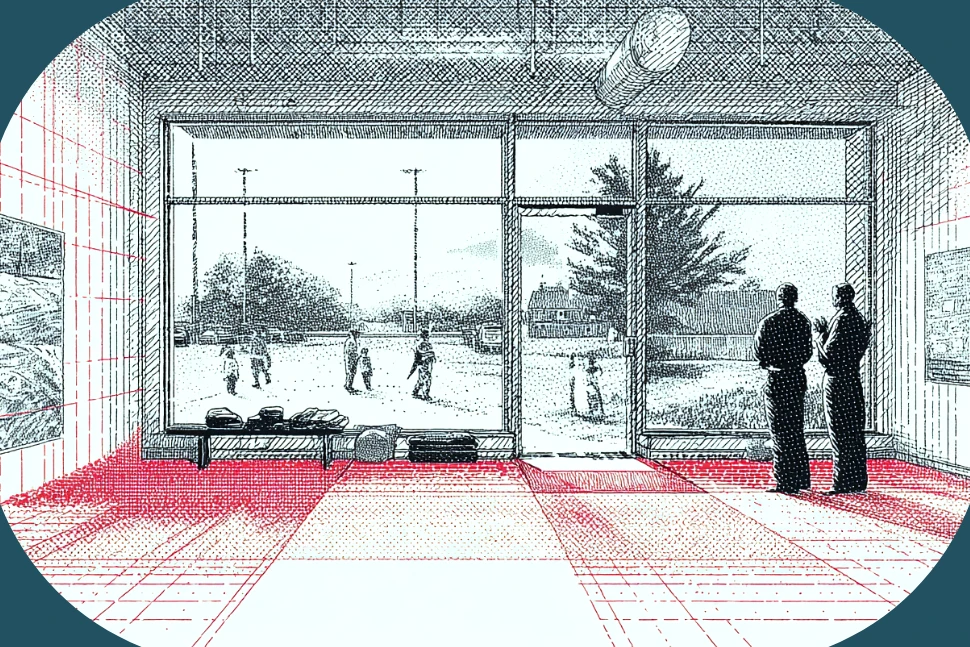
He drove down with Ellen. Walked in. Concrete floors. Missing drywall. Yellow paint. Five years vacant.
"I asked the guy, 'How long has this place been vacant?' He said, 'Almost five years.' And I thought, 'No way.'"
That night, he brought Ellen back. They peered through the windows after hours, already imagining what it could be.
"She's like, 'Oh my gosh, this could be it.'"
What sold them wasn't the space itself—it was the location. Dairy Queen next door. Baseball fields across the way. A popular nail salon pulling in moms from the neighborhood.
"There's constantly kids walking by. People are constantly looking in the windows when we're running classes."
They signed the lease. Personal guarantee. Five years. Everything on the line.
"When you sign those leases, they're like, 'We're gonna take your house if you don't make good on this five-year lease.'"
Marty had a nightmare before they opened. He fell asleep on the couch and woke up screaming, "What have I done?"
Building From Nothing (Well, Almost Nothing)
The buildout meant leveling uneven concrete, floating a new floor, and installing over 1,000 square feet of Fuji Mats. Marty designed the gym's color scheme from an unexpected source—Gymdesk's website templates.
"I went onto Gymdesk and was looking at your website templates, and it's like five color templates. I picked this, went to Fuji Mats, and designed all of this based off of one of the color templates."
Before the doors opened, Marty got scrappy. He and Ellen put flyers on cars. He set up the gym on Google Maps and Apple Maps and Yelp as early as possible—a move that paid off almost immediately.
"Phone calls will start coming in. Someone said, 'Hey, we're interested in joining your school,' and I thought, 'Me? What?' 'We saw you on Google Maps.' 'Oh my gosh.'"
He ran an Instagram promotion: find one of our flyers, sign up, get your first month free. The people who found those flyers became his foundation.
"Those guys that found us are like my foundational guys. Everybody loves them. They love this place. They have their families in here."
AJ and Josh. The first believers.
A Full-Time Job and a Full-Time Gym
Marty is still working a full-time job in fintech. Adayama isn't a side project—Tuesday night adult classes regularly hit 35 to 40 people—but Marty isn't behind a desk at the gym all day, either.
That's where automation makes the difference.
"I have a full-time job, so throughout the day I'm working on other stuff. When leads come in, the system automatically starts pumping out stuff to them to get the customer engaged."
Speed to lead matters. When someone fills out a form at 2:00 PM on a Tuesday and Marty's in a meeting at his day job, Gymdesk's automated follow-up handles the first touch. By the time Marty checks in that evening, the conversation is already started.
The retention side works the same way. When students miss a week, check-in emails go out automatically. Birthday messages. Milestone congratulations for 30 classes, 90 classes.
"There's always a time where I'll see an email come in from a member where they're like, 'Oh, hey, thanks for reaching out. We just got sick, but we're gonna be back.' And I'm like, 'What are they talking about? Oh, they responded to an email that went out from the system.'"
Members think Marty is personally keeping tabs on them. He is—just not manually.
The referral program runs the same way. Fifty percent off for the referrer, 50% off for the new member. All handled through Gymdesk.
"All they have to do is put in, 'Hey, Marty referred me.' It goes into the system, automatically sets it on the next billing period, takes care of all that stuff for you."
Running a gym while holding down another career isn't the traditional path. But Marty is proof you don't have to quit your day job to build something real—you just need the right systems in place.
The Name Behind the Mats
Every gym name tells a story. Most don't tell one this personal.
"We didn't just want one of those fight-type-of-name schools."
Marty grew up on a street called Mount Ada in San Diego. His father—an Irish-American Navy man—was often deployed for six to nine months at a time. His mother, who is Asian, worked to support the family. The neighborhood stepped in.
"We had all these great neighbors that I could walk over to their house, and they would let me in and fix a plate of food for me and take care of us."
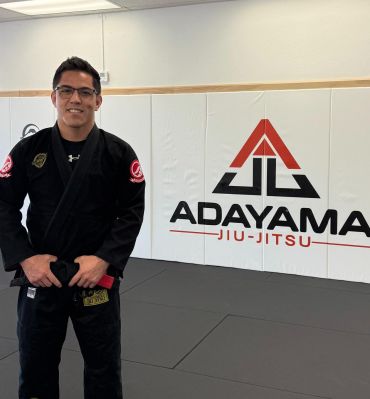
When it came time to name the school, Marty wanted something that honored both his San Diego roots and his Asian heritage—his and Ellen's. He asked ChatGPT how to say "Mount Ada" in Japanese.
The answer: Adayama. Yama means mountain.
"It harkens back to growing up and this little apartment complex that we lived in and this great community that we had."
He walked into Ellen's craft room and pitched it. She liked it immediately. The name captured what they wanted the school to be—a place where people take care of each other. Just like the neighborhood that raised Marty when his parents couldn't always be there.
"The most important person in the room is your partner. You gotta take care of each other."
"Like Brazil, the Same Energy"
Ten months in, the culture Marty built from those first few members has taken on a life of its own.
Maria Alencar—known to everyone as Little Mary—is a black belt from Ceara in northeastern Brazil who teaches three adult classes and one kids class at Adayama. She'd been training for 10 years but had never taught at a gym before this one.
"Adayama is my first gym doing the classes teaching. I love here, the energy, the people."
She came to the US knowing her English wasn't perfect. She was afraid. But the community at Adayama reminded her of home.
"It's here, it's like Brazil, the same energy. In the other place, I can't feel this."
What Marty Learned in Year One
When asked what advice he'd give to someone thinking about opening a school, Marty didn't hesitate.
MARTY'S YEAR ONE ADVICE:
"Don't punish yourself for the mistakes that you're gonna make. You're gonna make them." It's like being a white belt—getting submitted 30 times a night. You'll fall on your face. The key is not to torture yourself over it.
"If you're gonna bring people in, be sure about those people that you bring. Don't do it out of desperation." Culture is fragile in the early days. Every person you let through the door shapes it. If what they bring in isn't healthy, you'll be digging out of that hole for a long time.
The Universe Wasn't Saying No
Looking back, Marty doesn't see Kansas City as a failure. He sees it as a detour.
The opportunity that collapsed 2,000 miles away led him to a late-night Google Maps session that revealed a blind spot in one of the most saturated BJJ markets in the country. A former karate school sitting vacant for five years. A strip mall next to a Dairy Queen and baseball fields with kids walking by all day.
If Kansas City had worked out, Adayama wouldn't exist.
Ten months in, Marty is running a gym that pulls 35 to 40 adults on a Tuesday night—while working full-time in fintech. His founding members became his cultural anchors. A Brazilian black belt teaches there because it feels like home. And the whole thing started because one guy refused to let a setback become a verdict.
It has been everything we had hoped it would be.
Marty manages Adayama's operations—from website and lead tracking to automated retention and referral programs—using Gymdesk. Start your free trial to see how it works.
Gym management software that frees up your time and helps you grow.
Simplified billing, enrollment, student management, and marketing features that help you grow your gym or martial arts school.


FAQ

Sean has spent the last decade creating content that helps businesses—small and not so small—grow smarter to allow operators to do more of what they love. You know, the fun stuff.
From shipping and international logistics to web development and marketing, he's done the work (not just the words) to scale retail and service businesses efficiently.
You can find his work at Sendle, Shogun, The Retail Exec, Gymdesk, and more.