

In a Newmarket, Ontario studio, two things are happening at once. Ella Moghaddam is leading a small group on the Reformer floor, rotating between five clients with five different programs.
Across the room, Milad Moghaddam is running a joint-by-joint assessment on a new member's shoulder, drawing a strength curve on a notepad to explain why the middle of the range is the part that almost never gets people hurt.
Same methodology. Two rooms. Two co-authors.
That's the part most "founder methodology" stories miss. ActiveRange Method's training framework—the Internal Strength Model—was co-built.
Both Moghaddams built it. Milad articulates it. Ella embodies it on the floor.
Take either one out and the brand collapses.
If you're a methodology-driven owner—pilates, strength, even martial arts—you've probably wondered whether your point of view is good enough to brand. The real question is whether you have a co-author who can carry the half of the framework you can't.
ActiveRange Method's training framework—the Internal Strength Model—was co-built. Both Moghaddams built it. Milad articulates it. Ella embodies it on the floor. Take either one out and the brand collapses.
How Two Co-Authors Built One Methodology
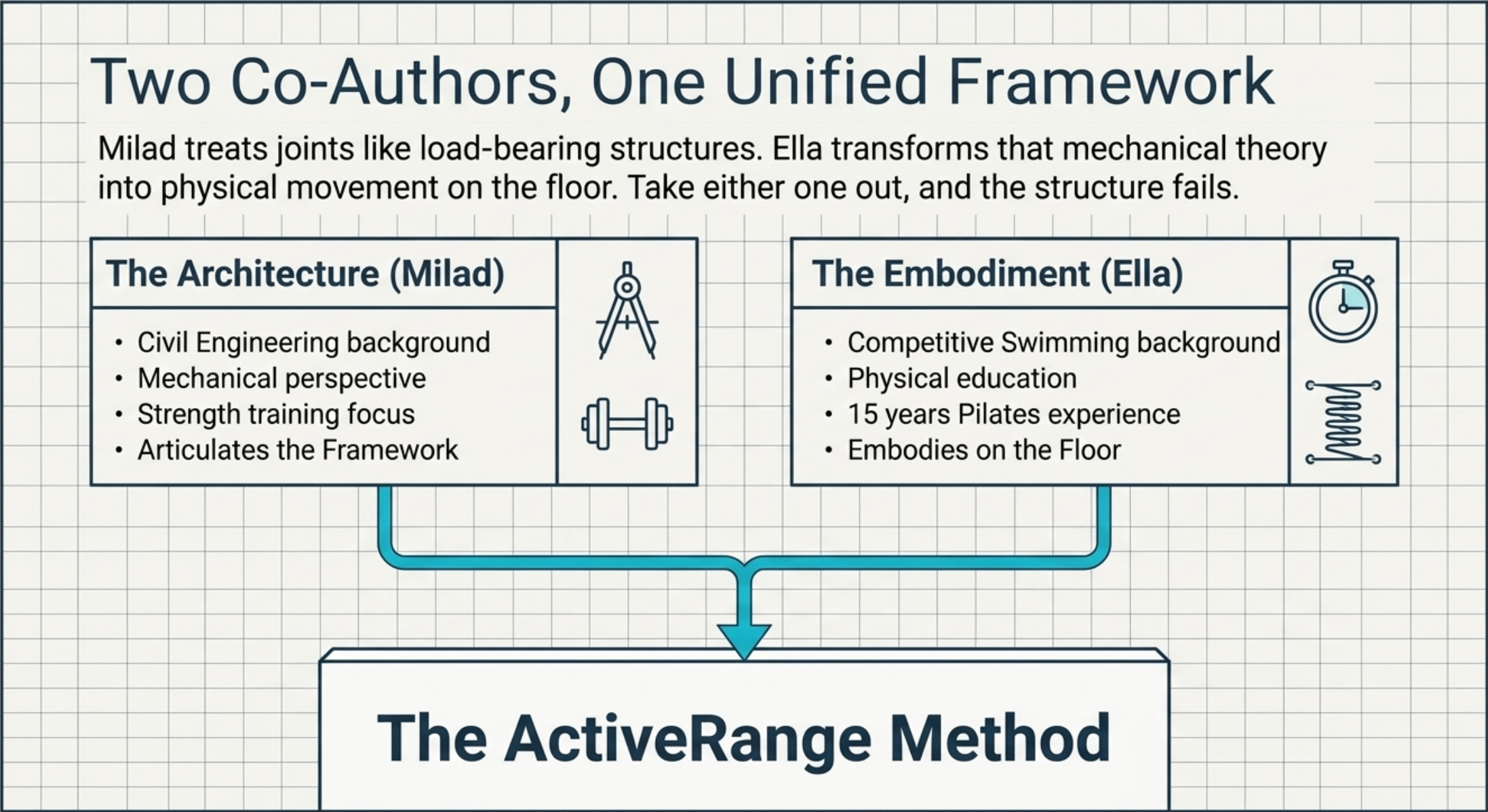
Milad isn't fitness-first. He's a civil engineer who followed his father into construction—roads, buildings, dams—before pivoting to coaching. The mechanical perspective stuck.
I'm a civil engineer. I just followed my father's path… But that civil engineer and studying in the mechanical has served me a lot—because I always have that mechanical perspective. I look at the human body as a moving thing.

That mechanical eye runs through everything else he says. He treats joints like load-bearing structures and compensation patterns like cracks in a foundation.
The Internal Strength Model is what happens when an engineer with a competitive bodybuilding past decides bodybuilding is, in his words, "probably one of the worst when it comes to joint preservation."
Ella came in from the other side—a former competitive swimmer with a physical education background and about 15 years teaching mat and Reformer Pilates.
She's the head instructor and the daily face of the methodology on the floor. She's also the reason the brand exists.
I was thinking, why we choose one? Why not? Like we can have strength and coordination and control and flexibility—like everything that it can mix together. So we built this place.

That's the founding insight. Strength training and Pilates aren't a menu where the client picks one—they're complementary surfaces for the same principles.
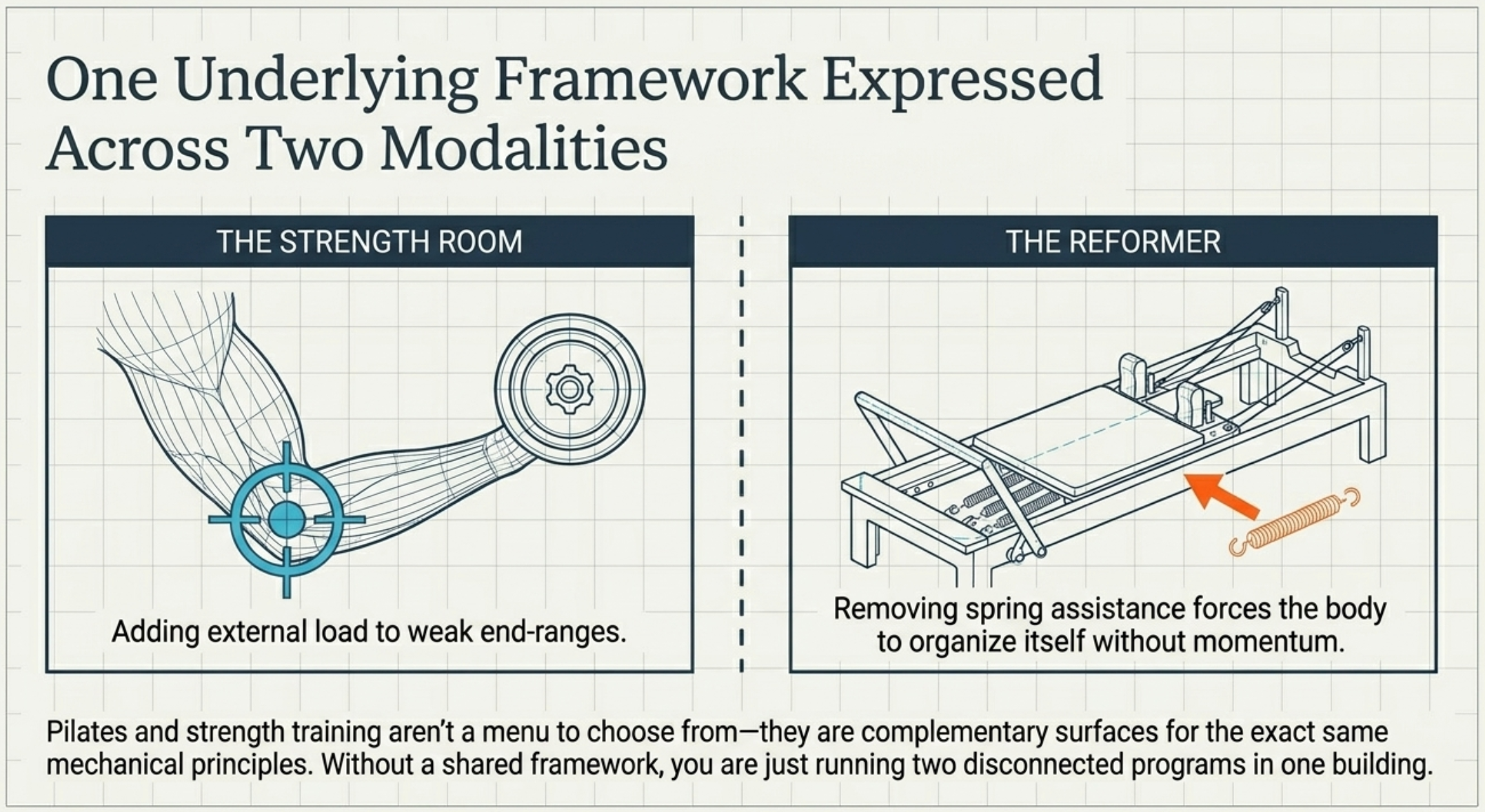
Milad teaches end-range biceps loading. Ella runs the spring selection on the Reformer that loads the same tissue under different conditions. The framework lives in both modalities, or it doesn't live at all.
Most vendors will hand you a pilates studio software shootout. Almost nobody covers studios where the Pilates instructor and the strength coach run the same Internal Strength Model from two angles. That's what's hard to copy.
What the Internal Strength Model Actually Means
In the Internal Strength Model, three principles do most of the work—and one of them is doing more lifting than the rest.
Dimension | Traditional strength training | Traditional Pilates | Internal Strength Model |
Loading priority | External load first; range secondary | Control and flexibility first; load secondary | End-range strength before external load |
Tissue hierarchy | Muscle as primary target | Muscle and stabilizers, joint-aware | Connective tissue first, muscle second |
Progress measurement | Weight on the bar; subjective feel | Form cues; subjective feel | Styku scans, video, range-of-motion data on file |
Modality integration | One room, one tool | Reformer floor only | Strength room and Reformer running the same model |
Group structure | 1:1 PT or open-floor classes | Group class on a shared plan | Small group, individually programmed, ~5 clients per instructor |
Failure mode | Injury at end-range under load | Plateau without progressive overload | Requires assessment infrastructure to scale |
End-range strength before external load
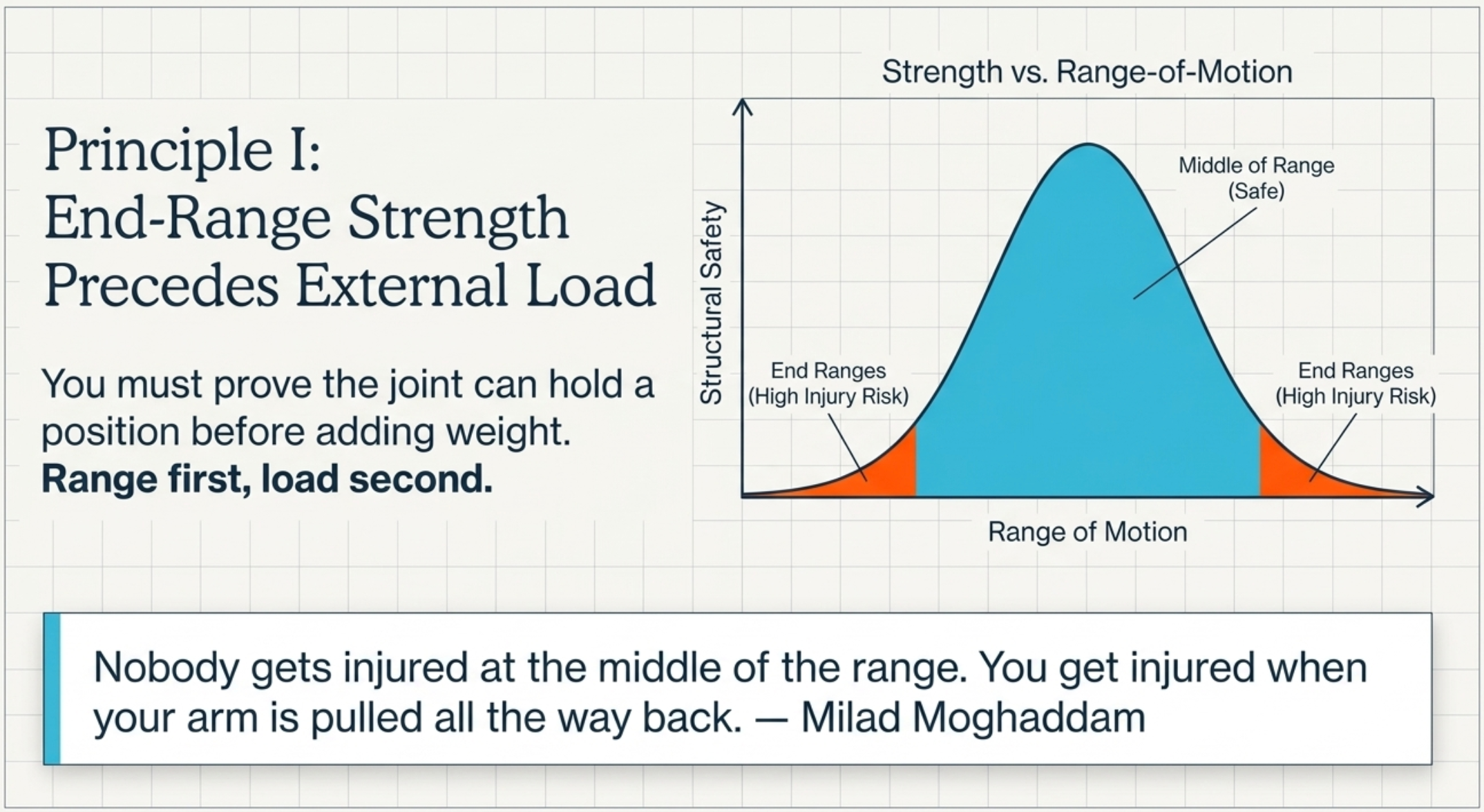
This is the principle most readers haven't heard before. Most lifters train themselves into injury territory because they only load the middle of their range, where they're already strong. The end ranges—where they're weak—are also where injuries happen.
Performance without having the prerequisite equals injury. It's just a matter of time. Problem unsolved equals problem multiplied by time.
Pair that with the strength-curve point: "Nobody gets injured at the middle of the range. You get injured when your arm is pulled all the way back."
The operational version, if you're applying this in your own programming: before you add weight, prove the joint can hold the position. Range first, load second.
Joint integrity over muscular capacity
The second principle is a hierarchy.
In the Internal Strength Model, what Milad calls the "white stuff"—fascia, ligamentous tissue, joint capsule—comes before muscle in the loading order.
"This is legit Internal Strength Model. So now we make this idea of training, adding the muscular capacity, but way second or third or fourth to your nervous system, to your white stuff, which is fascia, which is your ligamentous tissues, which is the joint capsule itself," Milad says.
That's a programming order, not a clinical claim. Connective tissue gets prepared first. Muscle gets the load second.
Quantified progress
The third principle is where the methodology stops being philosophy and starts being a service.
Every client gets a body-composition scan, a goals interview, and a biomechanical assessment. Photos, video, and range-of-motion measurements get attached to their profile.
"What we do here, we're quantitating things. With either a range, pictures—we're doing a lot of video, taking pictures, and attaching them to your profile," Milad says.
If you're building an assessment-driven program, photos and measurements scattered across three different apps aren't actually attached to the client. You can attach the same kind of evidence to each member's record so progress is provable, not just felt. Measure, then trust.
How the Methodology Lives on Ella's Reformer Floor
The Reformer is a teaching surface for the Internal Strength Model that most strength coaches never learn to read.
Spring selection is the obvious example. Lighter springs are often harder than heavier ones because they remove assistance instead of adding load. The body has to organize itself with no momentum to hide behind.
"It's different springs with different muscles… The machine is really like, it's magic," Ella says.
That sounds like a Pilates instructor talking until you remember she came from strength training and competitive swimming, dismissed Pilates outright the first time Milad brought it up, and only converted because the work humbled her.
"Pilates? Yes. It's like, really? Like you, you tell me to do like Pilates, that one that people do like some stretchy stuff," Ella says about her first reaction.
Then she tried it.
And then I was sweaty. That was humbling. I was like, oh my God, I did for years and I couldn't do that.
A side plank she couldn't hold after years of training that should have built the muscle to hold it. That's what converted her.
What the room actually looks like day-to-day: a small group, individually programmed, one instructor rotating through about five clients with roughly 10-minute check-ins. Each client is doing something slightly different.
She's running five parallel programs at once, all sharing a methodology. If you're picturing a class, drop that picture. That's what makes the member app experience load-bearing. Programs live in the app. Progress shows up where the schedule does.
Milad has a contrarian point about instructor caliber that's worth surfacing.
"Even though the instructors aren't necessarily—like, they don't have 10 years or 20 years of experience in the field—immediately, because of the conditions and circumstances that this only gives them, they're going to become effective. They're going to become problem solvers. They are critical thinkers on the go," Milad says.
Translation: the constraints of the Reformer floor force instructors to develop faster than open-floor coaching does. The methodology trains the trainer.
The Economics That Made the Methodology Viable
A point of view doesn't pay rent. The Internal Strength Model survived contact with a Yonge Street lease because Milad engineered the unit economics before he opened the door.
Personal training in Toronto runs, in his read of the market, "anywhere from $60 to—there's folks that they charge $200 per hour," Milad says.
At those rates, most clients can't afford the frequency they need. They buy a few sessions, plateau, and stop. His fix is the operational thesis of the whole studio.
"What I have always had something in my mind: what if I could train five individuals, like assess them individually, but I could train more people—because you don't need me to stay next to you for that entire hour… The hourly can be shared. It's going to be a fracture of what they pay, which is going to help them to become more frequent, which is going to give them the results, which is going to guarantee my paychecks. So it's a win-win situation," Milad says.
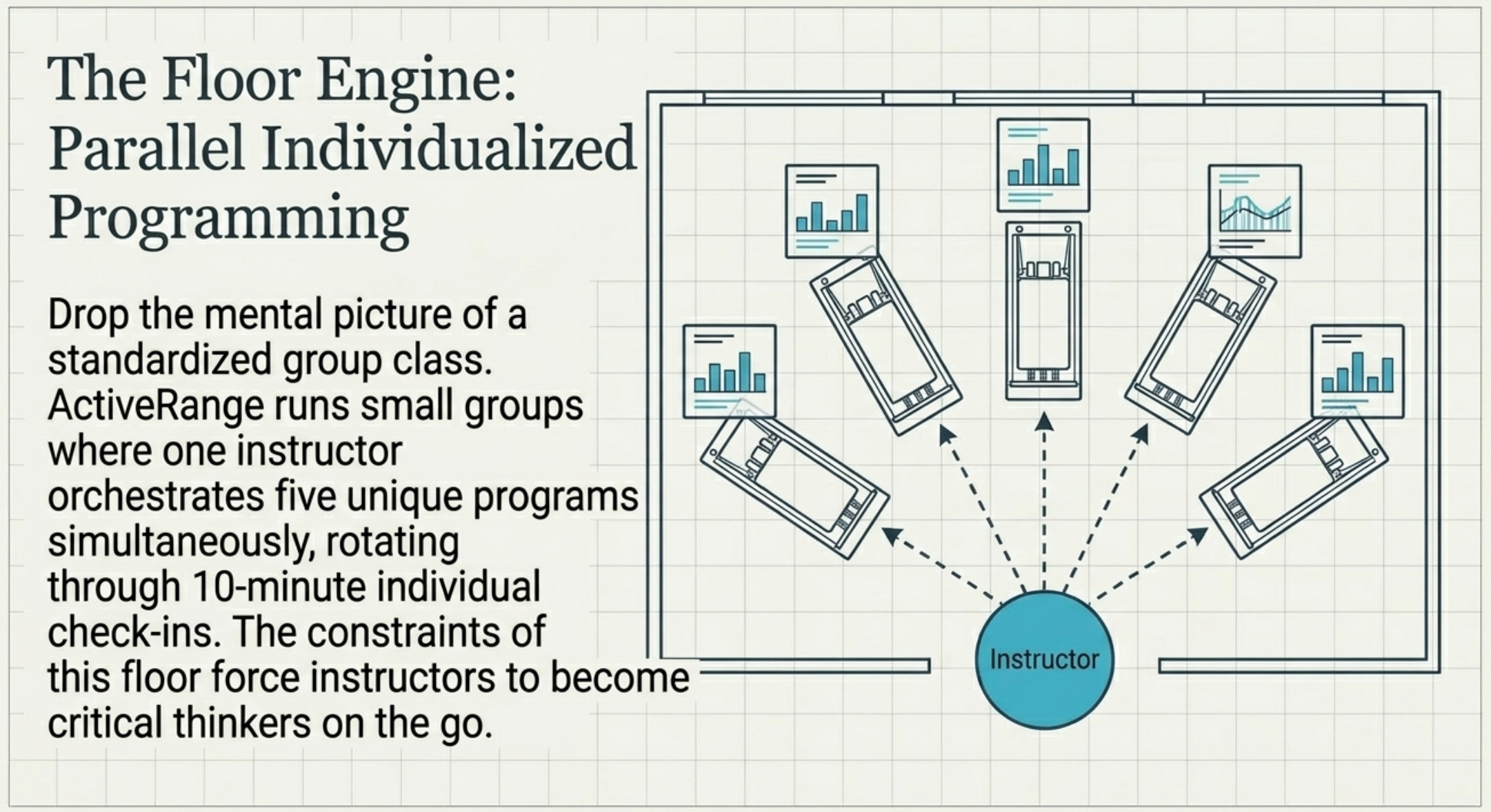
Small-group economics with personal-training programming. The trainer's hour gets shared across five individually-programmed clients.
Lower price, higher frequency, better results—that's the chain that pays for the methodology, if you can hold the line on the assessment work behind it. (Pricing Pilates classes is its own discipline once you're in the door.)
The harder part was earlier. Before Yonge Street, ActiveRange was a Reformer in their basement. Milad was against it.
"I was always against having a basement business. So she pushed and I said, okay, whatever—we're going to have it. But I had no faith," Milad says.
Then he left his last fitness-company job to go independent, and the part most founders don't write about happened.
"I ended up having zero of 35 active clients that I had, which was my main hope," Milad says.
Zero. Of thirty-five. He'd told himself those clients would follow him out the door, and not one did.
That's the kind of math that ends careers. What rebuilt the basement was word of mouth—community clients who came in because someone they knew got a result.
So I started, and word of mouth—found some community clients. They started coming and they saw results. Basement wasn't working economically, but it worked in a result base. It gave me a small sample of: this works. That was enough for me to gamble. I go all in.
The basement was a controlled environment to validate the model in result terms before betting on it in economic terms. Find your basement.
The other piece that mattered before opening day was infrastructure. Milad picked software pre-launch on purpose.
"I knew that the management aspect of managing 200 plus members, it's just going to be impossible if I don't have a good foundation from the get-go… It's very much like accounting. If you don't have the foundation ready, you will have a very hard time closer to the year-end," Milad says.
Take the accounting analogy seriously. Software you bolt on at month nine fits like a renovation. Software you pick before you sign the lease shapes the operation.
The deal-winner was the combination of documentation and scheduling in one platform. Document signing is table stakes for an assessment-driven studio with waivers, intake forms, and per-client program notes. Scheduling has to handle small-group bookings with individual programs underneath. Most platforms had one strength or the other.
If you're picking software for Pilates studios pre-launch instead of patching it together later, the real test is whether the platform can hold documentation and scheduling without making you glue two tools together. Same logic applies if you're switching from paper once a methodology has weight.
Partnership Architecture

Most husband-and-wife founder profiles flatten the partnership into "she runs ops, he runs strategy." That framing misses the point at ActiveRange.
The methodology is co-authored. The decision-making is co-authored too. That's the structural reason the brand survives both founders being on the floor.
"In our culture, we don't have boss. Everybody is a boss. Like even our front desk is a boss. We collaborating. We're communicating. There's no boss," Milad says.
Persian-cultural framing came up explicitly later in the conversation. Flat hierarchy is a working description of how decisions move through the studio. Front desk has authority. Disagreements get scheduled, not avoided. Milad and Ella will literally drive around and get coffee until something gets resolved.
The grind shows up in concrete time stamps.
"If we, like, one of us get tired or complaining, the other one is just pushing—like, no, let's go. We have to go. We were here like 3:00, 4:00 AM and then back at 6:00 AM to work," Ella says.
That's the immigration arc compressed: Iran to Canada, years of working for big chains before going independent, the basement on top of the day jobs, the studio on top of the basement.
And the partnership underneath it all doesn't run on assumptions.
I always say marriage is a contract that has expiry if you don't renew it.
Frame that operationally, and it's the most useful sentence in the conversation. The partnership is maintained, not assumed. Co-authors who don't renew the contract end up with one of them doing two jobs. That's the failure mode for every methodology-driven studio where one founder eventually gets quiet.
The family logistics support it without swallowing it—sister-in-law on staff, his mom helping with childcare. None of that is the architecture. The architecture is two co-equal authors of a framework, renewing the contract.
What This Means If You're Building Your Own Methodology
If you're staring at your own notebook full of training principles, here's what ActiveRange's path actually argues for.
KEY TAKEAWAY:
The framework needs a co-author, not a sidekick. The Internal Strength Model has two co-authors—Milad articulates, Ella embodies—and both names belong on the door. If your methodology only lives in one founder's head, it's a person, not a methodology.
Prove the model in a small room before you sign a big lease. The basement validated ActiveRange in result terms before it made economic sense. Find your basement. (Cost to open a Pilates studio is a useful sanity check before signing.)
Pick the foundation before you need it. Software, documentation, and scheduling are the substrate the methodology runs on once you scale past one room. Same logic shows up in retention strategies that actually work—retention is architecture.
Bottom Line
The methodology is the edge. But what makes it replicable for other operators is the architecture underneath—how it got built, how it gets delivered. Milad articulates the framework while Ella embodies it on the floor. The framework lives in both.
The real question for you isn't whether your point of view is good enough to brand. It's whether you have a co-author who can carry the half you can't, and whether you've picked the substrate to run it on before the lease starts charging rent.
The platform decisions you make pre-launch matter more than the ones you'll make in year three.
Gym management software that frees up your time and helps you grow.
Simplified billing, enrollment, student management, and marketing features that help you grow your gym or martial arts school.


FAQ
ActiveRange FAQs

Sean has spent the last decade creating content that helps businesses—small and not so small—grow smarter to allow operators to do more of what they love. You know, the fun stuff.
From shipping and international logistics to web development and marketing, he's done the work (not just the words) to scale retail and service businesses efficiently.
You can find his work at Sendle, Shogun, The Retail Exec, Gymdesk, and more.