How to Market Your BJJ Gym as a Mental Wellness Destination (Without Being Cheesy)

Sean
Flannigan
March 26, 2026

You already know BJJ changes people's mental health. You don't need a study to tell you that.

The anxious white belt who couldn't make eye contact during their first class? Cracking jokes in the locker room by month two. 

The tech executive who said she "just needed a workout" now tells you training is the only hour she doesn't think about her inbox. 

The divorced dad who showed up looking like he lost a bet brings his kids to the Saturday class and coaches them from the sidelines.

This isn't rare. It's Tuesday.

But most gym owners have no idea how to talk about any of this on their website, their social media, or in a sales conversation—without sounding like they're about to recommend a gratitude journal and some essential oils.

That's expensive. Because a growing wave of people are searching for BJJ mental health benefits—and your gym already delivers them. They just don't know you exist.

The Market Has Changed (and Your Messaging Should Too)

This isn't a feel-good sidebar. It's a business case. Let's talk numbers.

The loneliness epidemic is filling mats across the country

37.4% of U.S. adults experience moderate-to-severe loneliness
1 in 5 Americans reports feeling significant loneliness on any given day
Loneliness increases risk of heart disease by 29% and stroke by 32%

In 2023, the US Surgeon General declared loneliness a public health epidemic

Not a "growing concern." Not a "trend worth monitoring." An epidemic—with health consequences on par with smoking 15 cigarettes a day.

37.4% of U.S. adults experience moderate-to-severe loneliness. One in five Americans reports feeling significant loneliness on any given day. Loneliness increases the risk of heart disease by 29% and stroke by 32%.

So what does that have to do with your gym? A whole lot, actually. 

People are looking for real-world, screen-free, social activities that force them off the couch and into actual human contact. BJJ is basically tailor-made for this—you can't doom-scroll when someone is trying to pass your guard.

The new BJJ student doesn't look like the old one

Five years ago, most people who walked through your door already knew what jiu-jitsu was. They'd watched UFC, trained in something else, or had a friend who kept talking about "the gentle art" at dinner parties.

That person still exists. But they've got company now.

The new wave is stressed professionals, remote workers who haven't spoken to a human in three days, parents who haven't exercised since their youngest was born, people who would absolutely never describe themselves as "fighters." 

They're not Googling "BJJ competition training." They're searching for "stress relief activities near me," "things to do for anxiety," and—this one kills me—"how to meet people in my area."

If your website still leads with comp footage and podium shots, these people don't even see you. 

They scroll right past and sign up for hot yoga. (If you need a broader refresher on reaching new audiences, our martial arts marketing guide covers the full picture.)

The research backs this up—and your competitors don't cite it

OK, here's where you get to be the nerd at the marketing meeting. Peer-reviewed research now backs up what you've watched happen on your mats for years:

87.5% of BJJ practitioners report reduced anxiety
96.9% of BJJ practitioners report improved mood from training
Veterans with PTSD showed effect sizes of 0.80–1.85 after BJJ training

On top of all that, BJJ practitioners develop greater resilience and remain calmer under pressure from the experience of rolling.

Meanwhile, your competitors' websites mumble something about "endorphins" and call it a day. You can cite actual universities. That matters—especially to the anxious Googler who's comparing you to a meditation app.

We broke down the full body of research in our Brazilian Jiu-Jitsu benefits guide if you want the deep cut.

How to Message Mental Wellness (Without Being Cringe)

Great, you've got the BJJ mental health data. 

Now you need to actually say it out loud—on your website, in a DM, in the awkward moment when a prospect asks "so, why should I do this?"—without sounding like you minored in crystal healing.

Lead with identity, not diagnosis

This one rule saves you from 90% of the cringe. Mess it up, and you'll alienate your existing students and the new ones you're chasing.

Don't say: "BJJ cures anxiety." "Train away your depression." "Martial arts therapy."

Do say: "Find your calm." "The best hour of your week." "Where stress goes to die."

See the difference? One sounds like a gym. The other sounds like a pamphlet your doctor hands you as you leave the room.

KEY TAKEAWAY:

You're marketing a place people belong, not a treatment they need. Lead with identity ("Find your calm," "The best hour of your week") rather than diagnosis ("BJJ cures anxiety," "Train away your depression").

Nobody wants to walk into a gym because they've been told they're broken. 

They want to feel like they found their people—and the stress relief is a nice bonus.

GYM OWNER TIP:

Ask your current students: "If you were describing our gym to a stressed-out friend, what would you say?" Their answers will be better marketing copy than anything you could write yourself.

Rewrite the pages that actually matter

You don't need to overhaul your entire website. Focus on the four pages that wellness seekers will actually visit.

1. Homepage hero

If your above-the-fold still reads "Learn self-defense" or "World-class competition training," you're talking to one audience while a bigger one walks right past. 

Something like "Challenging training. Genuine community. A calmer mind." covers both without betraying either.

2. About page

Medals and lineage build credibility. Transformation stories build relatability. You need both—so stop hiding the second one three scrolls below the fold.

3. Programs page

You absolutely do not need to rename your fundamentals class "Mindful BJJ." (I'm begging you.) 

But you can describe it differently: "Our fundamentals program is built for complete beginners. No experience, no fitness level required. Most new students tell us it's the most focused they feel all week."

4. Testimonials page

Highest-value change on this list, and also the easiest. Curate the mental health stories you already have. 

You do have them—you just haven't asked the right questions yet. (More on that in a sec.)

Fix your social media ratio

Pull up your gym's Instagram right now. I'll wait.

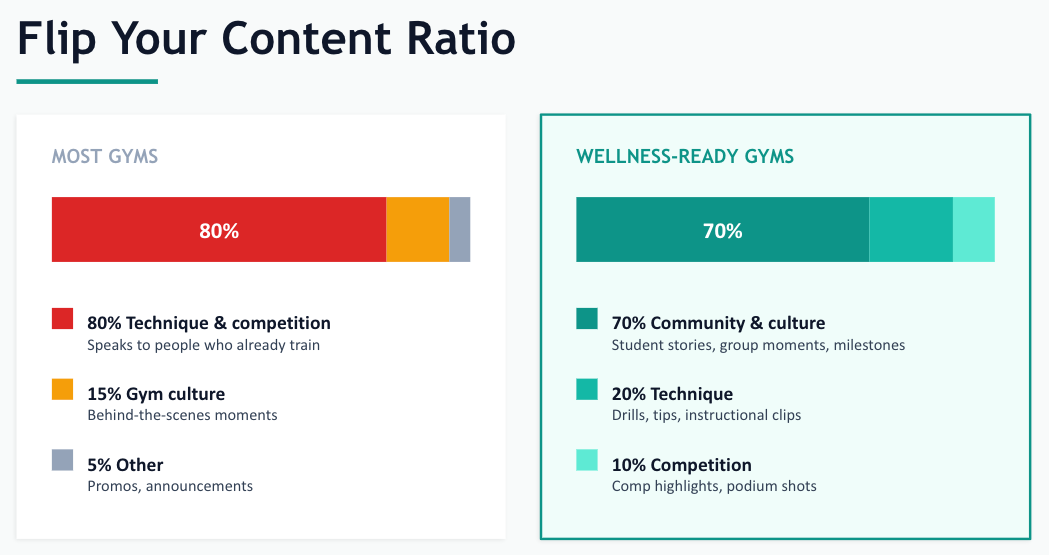
If it's 80% technique clips and competition footage, 15% gym culture, and 5% other—congratulations, you're speaking fluently to people who already train. And you're whispering into the void at everyone else.

Flip it. Aim for 70% community and culture, 20% technique, 10% competition.

You're not abandoning the technique stuff—you're adding the moments that make a stranger stop scrolling. 

Student milestones. Post-class group photos where everyone looks exhausted and happy. Behind-the-scenes footage of your community just being humans together. 

The stressed remote worker scrolling at 10 PM isn't moved by your berimbolo highlight. She's moved by a group of normal-looking adults laughing together after getting choked for an hour.

QUICK WIN:

This week, post one story or reel with this template: a student's name, how long they've been training, and one sentence about how training has changed their life off the mat. Tag them. Watch what happens to your engagement.

Build a testimonial engine that writes your copy for you

You have dozens of mental health transformation stories walking around your gym right now. They're warming up, they're rolling, they're hanging out after class talking about their week. You've just never asked them the right questions.

Try these:

  • "What was going on in your life when you first started training?"
  • "How has training changed how you handle stress outside the gym?"
  • "What would you tell a friend who's nervous about trying BJJ?"
  • "What keeps you coming back?"

Those answers become your website copy, your social captions, and your talking points when a nervous prospect asks "is this for someone like me?" 

And they'll be more persuasive than anything a marketing person could write—because they're true.

Operational Plays: Attract and Retain Wellness Seekers

Words get people in the door. What happens next decides if they stay.

Design an intro experience for the nervous beginner

Let's be honest about something: walking into a BJJ gym for the first time is terrifying. 

More intimidating than CrossFit. More intimidating than a spin class where the instructor yells at you. You're asking a total stranger to let another total stranger pin them to the ground and try to choke them. 

That's a big ask on a Tuesday evening.

For people who are already anxious—which is literally the demographic we're discussing—that barrier is enormous. If your intro experience doesn't lower it, you're losing people before they ever touch the mat.

A few things that help:

  • Dedicated intro sessions separate from regular fundamentals. Thirty minutes, small group or one-on-one, zero sparring. Just enough to make them feel like they learned something and survived.
  • Pre-class communication that addresses the fear directly. "You don't need to be in shape. You don't need experience. You just need to show up." Say it on your website, say it in the confirmation email, say it again when they walk in.
  • Post-class follow-up within 24 hours. Not an automated "how was your class?" email—a personal text or call from you or your front desk. "Hey, great meeting you today. How are you feeling?" That single touchpoint changes everything for converting trial members.

Build bridges to the wellness community

Your gym doesn't exist on an island. (Unless it literally does, in which case—cool location.) 

There's a whole network of wellness professionals in your area—therapists, counselors, yoga studios, corporate HR folks—who are actively looking for activities to recommend. Here are some ideas to get you started:

1. Partner with local therapists and counselors

A lot of mental health professionals are looking for physical activities to recommend—things that combine exercise, community, and presence. BJJ checks every box. 

A quick intro and a handful of guest passes can start a referral pipeline that reaches people you'd never find through Facebook ads. 

(For more outreach tactics beyond wellness partnerships, see our BJJ marketing strategies guide.)

2. Pitch corporate wellness programs

Package a six-week intro BJJ program as team-building and stress management for local companies. 

Remote work has left corporate teams desperate for in-person bonding, and "we did jiu-jitsu together" makes a way better Slack story than "we did a trust fall."

3. Host community events

Open mats explicitly welcoming to non-members. Self-defense workshops pushed through local event channels. Co-branded evenings with yoga studios or mental health nonprofits. 

Every event is a low-stakes introduction to your community—and community is what keeps wellness seekers paying month after month.

Make community your retention superpower

Wellness seekers don't stay for belt promotions. Not at first, anyway. 

They stay because of how your gym makes them feel on a Wednesday night when everything else in their life is loud.

The three-friend rule is your best friend here (pun fully intended). When a new student makes three real connections at your gym, their odds of quitting drop off a cliff. 

For people who showed up partly because they were lonely? Those friendships aren't just good for retention. They're the whole point.

So build this on purpose. 

Social events beyond training. Instructors who ask "how's your week going?" before class—not just "let's drill armbars." A culture that values transformation over trophies, without throwing away the trophies.

The gym owners who nail this—like Nova Jiu-Jitsu—build communities so strong that their members do the recruiting. 

Word-of-mouth from wellness-seeking students is weirdly powerful because they tend to know other stressed, lonely people. One happy, less-anxious member becomes three. It's like a referral program that runs on serotonin.

What NOT to Do

Before you go full "wellness warrior" on your homepage, a few guardrails.

Don't promise therapeutic outcomes

You run a gym, not a clinic. "Our training helps people manage stress" is solid. "BJJ treats anxiety disorders" is a liability waiting to happen.

Frame BJJ as complementary to professional mental health care, never a replacement. 

The studies show it's beneficial. They don't show it's a clinical intervention—and you definitely don't want to be the gym owner explaining that distinction to a lawyer.

Don't alienate your existing students

Your comp team and die-hard grapplers are still your core. This is additive, not a rebrand. You're widening the door, not lowering the ceiling.

The best gyms pull this off by being welcoming and hard. 

The intro is gentle. The training is not. That's actually the whole appeal—people want something real, something that earns the mental health payoff through genuine effort. Don't make your gym softer. Make it easier to walk into.

Don't use therapy-speak you haven't earned

"Somatic regulation." "Nervous system reset." "Trauma-informed training environment."

Cool words. Do you know what they mean? Like, clinically? If the answer is "not exactly," don't put them on your website. 

It's borrowed credibility, and it evaporates the second a therapist or social worker walks through your door.

Plain language works: "Training helps you feel calmer and more confident." Honest, accurate, doesn't require a master's degree to say with a straight face. 

You can still help your members build healthy habits without borrowing clinical vocabulary to describe it.

Don't just say it—show it

If your Instagram is wall-to-wall heel hooks and podium photos but your website says "mental wellness destination," people notice. 

That disconnect doesn't just look sloppy—it kills trust. Take 20 minutes and scroll through your own content like a stranger would. Does it match the story you're trying to tell?

The Bottom Line

This is less a marketing trend, more a market correction.

BJJ has always been good for mental health. The research just caught up, the public just noticed, and now there's a massive group of people actively searching for the thing you already provide. That's about as good as it gets in marketing.

Three moves:

  • Update your messaging. Speak to both your existing students and the wellness-seeking newbies. Lead with identity and community, not diagnosis and treatment.
  • Design your intro for the terrified. That anxious person hovering over the "book a class" button is exactly who you're trying to reach. Make it easy to say yes.
  • Build community like you mean it. Social events, real connections, a culture where people feel like they belong. This is your moat. No app, no algorithm, no AI chatbot can replicate what happens when a group of adults voluntarily choke each other and then go get tacos.

The gym owners who figure this out aren't just tapping into a new segment. They're building more resilient businesses—with members who show up more, refer more, and are far less likely to leave

The tools to track what's working, automate the follow-up, and manage the community side of things? Those exist. The positioning is the part that's up to you.

You manage the positioning, and we can be your tool. Try Gymdesk free to see how easy admin can be, so you can do the matwork.

Table of Contents

Gym management software that frees up your time and helps you grow.

Simplified billing, enrollment, student management, and marketing features that help you grow your gym or martial arts school.


FAQ

BJJ Mental Health Marketing FAQs

How does BJJ help with mental health?
87.5% of BJJ practitioners report reduced anxiety and 96.9% report improved mood (Ruelas et al., European Journal of Sport Sciences, 2025). It combines physical effort, forced mindfulness—hard to ruminate about your inbox when someone is trying to submit you—and genuine community. Veterans with PTSD symptoms showed clinically significant improvement after structured training programs.
How do I market my BJJ gym to non-fighters?
Stop leading with combat. Lead with identity, community, and the transformation your students actually experience. Use testimonials from people who joined for stress relief or fitness, design an intro experience that doesn't require courage, and make sure your website and socials reflect the actual culture of your gym. Most new students in 2026 aren't coming from other martial arts. They're coming from their couch, and they're nervous.
Is it okay to market BJJ as a mental health activity?
Yes—just don't overclaim. "Our training helps people manage stress and build confidence" is great. "BJJ treats anxiety" is not. Frame it as a physical activity with well-documented mental health benefits, complementary to professional care. Stick to plain language. Leave the clinical terms to the clinicians.
What content should I post to attract wellness-seeking students?
Flip your content ratio to roughly 70% community and culture, 20% technique, 10% competition. Post student stories, behind-the-scenes community moments, and short-form content about why training helps with stress. The person you're after isn't impressed by your comp highlights. They're looking at the group photo where everyone's smiling.
How do I attract wellness-seeking students without losing my competition team?
This is additive, not a pivot. Your intro should be welcoming. Your training should still be hard. The best gyms are easy to walk into and difficult to train at—and that contrast is actually the selling point. Nobody gets lasting mental health benefits from something easy.
Sean
Flannigan
Content Marketing Lead @ Gymdesk

Sean has spent the last decade creating content that helps businesses—small and not so small—grow smarter to allow operators to do more of what they love. You know, the fun stuff.

From shipping and international logistics to web development and marketing, he's done the work (not just the words) to scale retail and service businesses efficiently.

You can find his work at Sendle, Shogun, The Retail Exec, Gymdesk, and more.