
Blog Components
Table
Headiskajnfjkasng | Headfasing | Heading | Heading | Heading |
Heading | Heading | Heafasfding | Heading | Heading |
Heading | Heading | Heading | Heading | Heading |
Heading | Heading | Heading | Heafsading | Heading |

Table Element
Planet Fitness has the most memberships worldwide, at 13.5 million.
Globally, there are an estimated 184.59 million gym memberships.
Table Element
The United States has an estimated 64.19 million gym memberships, the most of any country.
From 2000 to 2019, gym memberships nearly doubled in the U.S. (32.8 million to 64.2 million).
Table Element
The United States gym, health and fitness club industry employs an estimated 823,652 people.
Wyoming has the least health and fitness gyms in the U.S. (81).
The United States has a total of 106,132 fitness businesses as of 2022, up from 103,626 in 2021.
California has the most health and fitness gyms in the U.S. (5,123).
Table Element
Germany has an estimated 11.66 million gym memberships, the most of any European country.

The United Kingdom has an estimated 10.39 million gym memberships.
The United States has a total of 106,132 fitness businesses as of 2022, up from 103,626 in 2021.
Italy has an estimated 5.51 million gym memberships.
Spain has an estimated 5.51 million gym memberships.
Table Element
About 24.2% of men engage in sports and physical exercise compared to 22.6% of women.
Gym memberships are split nearly equally between men (49.5%) and women (50.5%).
Young adults ages 18-34 (31%) as well as adults ages 35-54 (31%) make up the biggest populations at the gym.
Women spend an average of 0.3 hours on sports, recreation and exercise daily while men spend an average of 0.44 hours daily.
The next largest population are children ages 6-17 (16%).
Most gym-goers are white and/or non-Hispanic (66.34%). The next largest populations are Hispanic (12.78%) and Black (12.3%).

People between 55 and 64 (10%) and 65+ (12%) are the least likely to be gym members.
Most gym members come from a household making at least $75,000 annually.
Table Element
About 21% of gym members attend almost daily.
The most popular time to go to the gym is in the early morning between 5 a.m. and 9 a.m., which is when 38% of gym members attend.
About 38% of gym members attend multiple times per week.
About 15% of gym members attend once a week.
About 18% of gym members never attend.
About 21% of gym-goers stay in the gym between half an hour and an hour each session.
About 35% of gym-goers stay in the gym between an hour and two hours each session.
About 29% of gym members attend in the late morning between 9 a.m. and noon.
About 25% of gym members attend during lunchtime between noon and 2 p.m.
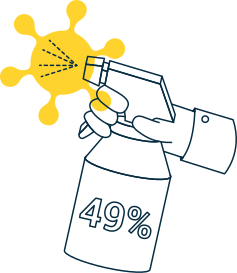
About 49% of people during the COVID-19 pandemic felt very uncomfortable attending a gym.
About 20% of gym members attend in the afternoon between 2 p.m. and 5 p.m.
About 25% of gym members attend in the early evening between 5 p.m. and 8 p.m.
About 16% of gym members attend in the late evening between 8 p.m. and 11 p.m.
Of all new gym memberships, about 12% begin in January
Table Element
About 38% of gym-goers use training and workout equipment (fitness and cardio machines, weights).
About 31% of gym-goers use convenience items (towels, toiletries, drinks, snacks).
About 30% of gym-goers use sports equipment (punching bags, martial arts equipment).
About 29% of gym-goers use a personal trainer.
About 24% of gym-goers use a pool.
About 24% of gym-goers use wellness facilities (sauna, spa).
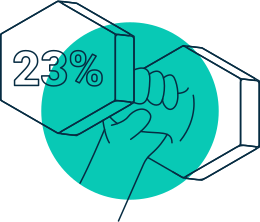
About 21% of gym-goers use coached courses and team training.
About 20% of gym-goers use online courses and workouts.
About 20% of gym-goers use sports facilities (squash courts)
About 14% of gym-goers use outdoor training grounds.
About 14% of gym-goers use EMS training.
Table Element
The average gym membership costs about $51 per month.
About 28% of people pay between $25 and $49 per month for their gym membership.
Despite the averages, nearly half of gym-goers (about 40%) pay below $25 per month.

About 13% of people pay $50-$74 per month for their gym membership.
About 6% of people pay $75-$99 per month for their gym membership.
About 13% of people pay $100+ per month for their gym membership.
Table Element
Most memberships last an average of 4.7 years.
Gyms typically lose about 50% of all new members within the first 6 months.
About 8% of male gym-goers quit their membership after a year.
About 14% of female gym-goers quit their membership after a year.
Table Element
Traditional health clubs average a 71.4% retention rate.
Members who attend group classes are less likely to cancel their memberships than those who do not.

Two interactions per month between staff and members can reduce cancellations up to 33%.

The average fitness studio averages a 71.89% retention rate.
Personal training studios average an 80% retention rate.
The average group exercise studio averages a 73% retention rate.
Table Element
About 44% are members to be fit and in shape.
About 42% are members to maintain a healthy and active life.
About 34% are members to build up muscle.
About 25% are members to have exciting experiences.
About 32% are members to look good.
About 31% are members to have fun.
About 28% are members to meet new people.

About 16% are members to get an adrenaline rush.
Table Element
About 37% of people hold price and contract as one of the most important aspects of a gym.
About 37% of people hold location as one of the most important aspects of a gym.
About 31% of people hold opening hours as one of the most important aspects of a gym.
About 35% of people hold equipment and facilities as one of the most important aspects of a gym.
About 26% of people hold staff as one of the most important aspects of a gym.
About 25% of people hold atmosphere and design as one of the most important aspects of a gym.
About 21% of people hold drinks and snacks as one of the most important aspects of a gym.
About 18% of people hold courses and classes as one of the most important aspects of a gym.
About 20% of people hold sauna, wellness and other additional services offered as one of the most important aspects of a gym.


About 17% of people hold fitting in with other gym members as one of the most important aspects of a gym.
Table Element
As of 2020, the top three most profitable gyms globally were Life Time ($948 million), LA Fitness ($900 million) and 24 Hour Fitness ($607 million).

North American fitness clubs generated $37.98 billion in 2019.
The average cost to start a gym in the U.S. is $50,000, although this will vary by location and facility type.
Equipment costs for a commercial gym can range from $300,000-$500,000.
Smaller gyms may spend around $100,000 on equipment.
In the United States, fitness clubs generated an estimated $35.03 billion in 2019, a number that dipped to $14.63 billion during the COVID-19 pandemic in 2020.
Chief executives at fitness and sports centers average $127,000 in annual wages.
Gym members are worth an average of $517 annually.
Table Element
The global health and fitness market is expected to grow 7.7% annually between 2020 and 2024, with 2024 seeing a projected $96.6 billion in revenue.
From 2009 to 2019, the global health and fitness market saw a 43.9% increase in revenue.
The average gym in the United States recorded $23,771 in expenses in Q3 2020.
Table Element
In 2021 2.34 million people participated in mixed martial arts for fitness in the U.S.
Since 2012, the number of martial arts businesses in the United States has grown at an average rate of 18.7%
In 2021, 1.03 million people participated in mixed martial arts for competition in the U.S.

There were 39,310 martial arts businesses in the United States in 2020, with 50,490 businesses projected by the end of 2022.
Table Element
The martial arts studio market in the United States was worth 8.16 billion in 2020, a number projected to grow to $9.05 billion in 2022.
Out of various gym owners, martial arts gym owners were found to have the highest median salary.
In 2021, there was $578 million in wholesale mixed martial arts equipment sales.
The average martial arts gym in the United States had $35,525 in expenditures in Q3 2020
Table Element
About 50% of martial arts gyms are profitable.
The mixed martial arts industry employed 61,280 employees in 2020, a number projected to grow to 72,810 in 2022
Table Element
England had 160,600 participants in mixed martial arts between November 2020 and November 2021.

South Korea had 13,830 registered martial arts studios in 2020.
In Wales, about 3% of a nationally representative population said they would like to start participating or participate more in martial arts.
In Australia, there are about 256,700 participants in martial arts.
Table Element
Taekwondo and karate, with 33% of respondents reporting participation in both sports.
Boxing, with 25% of respondents reporting participation.
Table Element
Vovinam, with 24% of respondents reporting participation.
Muay Thai, with 21% of respondents reporting participation.
Table Element
Judo, with 26,362 of respondents reporting participation.
Taekwondo ITF, with 10,407 of respondents reporting participation.
Kickboxing, with 9,540 of respondents reporting participation.
Ju-jitsu, with 7,011 of respondents reporting participation.
Table Element
Taekwondo WTF, with 4,249 of respondents reporting participation.
Freestyle wrestling, with 4,187 of respondents reporting participation.
Table Element
About 49% of people ages 18-34 consider themselves a fan of combat sports, with 16% considering themsevles avid fans.
About 51% of people ages 35-44 consider themselves a fan of combat sports, with 17% considering themsevles avid fans.
About 34% of people ages 45-64 consider themselves a fan of combat sports, with 8% considering themsevles avid fans.
About 20% of people ages 65+ consider themselves a fan of combat sports, with 5% considering themsevles avid fans.
Table Element
On average, children participating in mixed martial arts remain active in the sport for 2.6 years
In 2019, U.S. families spent an average of $777 annually for children participating in mixed martial arts. This Includes:
$467 for lessons
$107 for travel
$86 for equipment
$82 for registration fees
$25 for camps
$467 for lessons
$107 for travel
$86 for equipment
$82 for registration fees
$25 for camps
The average child stops participating in mixed martial arts by age 9.


