

You're a good sensei.
Your students respect you, your kata is crisp, and your black belts can teach a class without you in the room. But every evening you look at the open mat space in the back and do the math on how many more kids would fit.
Meanwhile the jiu-jitsu gym across town posts a packed kids' class on Instagram every Tuesday.
Same town. Same parents. Fuller room.
Teaching comes naturally to you. Karate marketing feels like trying to do a kata from a YouTube video with the sound off.
That gap is what causes the feast-and-famine cycle. A good September, a slow February, and an empty belt test in June you didn't see coming.
This guide covers karate school marketing for dojos that teach kids, sell to parents, and compete for the same after-school hours as soccer, dance, and the PlayStation. For the wider picture across every discipline, there's our martial arts marketing playbook.
Short answer
Karate school marketing works best when it speaks to parents first. That means a website that shows programs by age and price, a complete Google Business Profile with steady reviews, one social channel you post to every week, a referral program members use, and fast follow-up on every trial. Track trials, conversions, and lead source so you spend more on what fills classes.
Where Karate Stands With Parents in 2026
Karate is the martial art most parents already know by name, the kind of recognition other arts would trade a black belt for.
It also has a perception problem. Some families see it as old-fashioned next to MMA and jiu-jitsu.
A few numbers worth knowing before you spend a dollar:
That last number matters for budgeting, and we'll come back to it.
The market is big and full of kids. Your challenge is that newer arts have gotten better at telling their story.
The tradition, respect, and discipline that make karate feel "old" to some families are exactly what other parents are looking for. You just need to say it in their language.
Know Your Audience: Marketing to Parents, Not Just Students
If your school has a kids' program (and most do), you're marketing to two people at once.
- The parent. They pay your bill, drive the car, and decide whether to come back next week.
- The student. They take your class, and their excitement (or lack of it) is the first thing the parent notices.
Each one wants something different:
- Parents care about outcomes. They want to see your program build confidence, focus, and discipline, plus help handling a bully and an hour away from a screen.
- Kids want to feel strong and capable. Some want to kick like the fighters they've seen online, some want to protect themselves, and most are just excited to be there for the first month.
It also pays to check who actually lives near you.
NC Budo co-owners Jena Hare and Mike Baez opened in Belmont, North Carolina, expecting to teach competitive martial arts. Then they saw the neighborhood was full of young families with small kids. Jena told us on their Gymdesk Originals episode that within a week she was writing blog posts about the benefits of martial arts for three-to-six-year-olds.
The parents you're trying to reach don't care much about kata names or style lineage, and neither do their kids. That's where most karate marketing goes wrong: it describes the school the way a martial artist would, when the person reading is a parent.
What karate schools say vs what parents want to hear
Here's how the most common dojo lines translate for a parent.
Feature-focused (what most dojos say) | Outcome-focused (what parents are buying) |
|---|---|
"Traditional Shotokan karate, ages 5+" | "A confidence-building program for kids 5–12, taught by black belts" |
"Classes 3x/week, $129/month" | "A structured weekly routine that builds focus and discipline" |
"Certified black belt instructors" | "Safe, professional supervision your child looks forward to" |
"Kata, sparring, and tournaments" | "Self-defense skills and a clear path of progress (white belt → black belt)" |
"Free trial class—sign up online" | "Try a class on us—no contract, no pressure, see if it's a fit" |
Both columns describe the same class.
Go through your website, flyers, and ads, and rewrite each line in outcome terms.
Building Your Karate School Brand
For a karate school, brand has a head start: tradition. Your brand is the gut feeling a parent gets about your school, and tradition is already working in your favor.
That definition comes from Marty Neumeier, author of The Brand Gap, who calls a brand a person's gut feeling about a product, service, or organization. It's your reputation, and your logo is only a small part of it.
Google thinks about it the same way. Back in 2008, then-CEO Eric Schmidt called the internet a cesspool of false information, and told a room of magazine executives how Google planned to sort it out:
Plenty of parents are tired of noise. They want a place built on respect and clear expectations, and they'll judge yours by what they can see because they can't see what happens to their kid's character in week 12.
Here's what parents can see:
- Clean, consistent uniforms
- Organized belt ceremonies
- Instructors who speak to kids with respect
- Clear rules posted where families can read them
- A visible way to track progress, like a stripe chart or belt board
- How you treat parents at the front desk
Lion's Heart Family Martial Arts in Ancaster, Ontario, takes this further than most.
There's no parent seating in the training area at all. Owner Mersina Giampapa streams class to a screen in the hallway, so parents still watch every minute. She explained the deal she offers families on her Gymdesk Originals episode:
“Just trust me and my staff to do the thing in here and you do your parent part at home.”
Your real competition is soccer, basketball, dance, gymnastics, and video games, all asking for the same Tuesday at 5pm.
Your school needs a reason to win that slot, and "we teach martial arts" won't do it. "Your kid will walk into school with their head up" might.
We'll keep you in the loop with fresh content, podcasts, how-to guides, tool reviews, and product exclusives.
Karate School Marketing Strategies That Actually Work
These are the channels that move enrollment for most karate schools. They're affordable, and you don't need an agency to run any of them.
If you also run a taekwondo program, most of this carries over. Our taekwondo marketing guide covers what changes for TKD families.
Website and landing pages
A parent landing on your site wants three answers fast:
- Where am I? A karate school, near them, for kids their child's age.
- What can I do here? Book a trial class.
- Why should I? One specific reason, like "Our kids' program runs four days a week, so it fits around soccer."
Before and after
Before
Says what the school values, not what a parent can do
After
Where am I, what can I do here, and why should I
Riverbend Karate is a made-up school. The price is left blank on purpose: put your real one there.
Assume the parent is on a phone, maybe in a parked car outside some other practice. Make sure your site loads fast and works with a thumb.
The website elements that matter most:
- Programs split by age group (little ninjas, kids, teens, adults)
- Parent-focused benefits in plain language
- Instructor bios with photos
- Testimonials from parents, in their words
- Your prices
- One trial-class button, repeated on every page
Yes, prices. Lindsay Sutton co-owns Community Karate Center in Saint Charles, Missouri, and posted her fees right on her website. She told us why, speaking as a mom who shops for activities herself:
“I want parents and potential students to see right away what they all want to know—the price.”
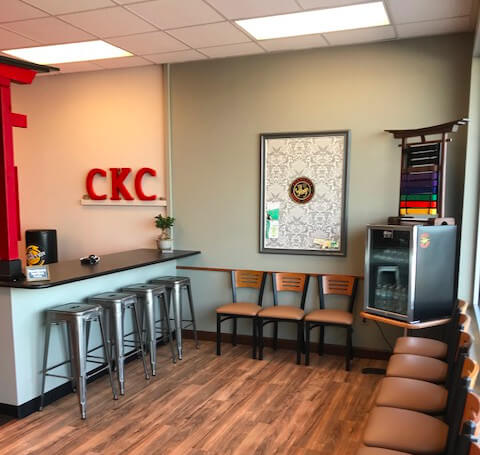
Lindsay Sutton's Community Karate Center in Saint Charles, Missouri. Photo: Community Karate Center.
Some parents who have to email for pricing never get around to it. A parent who sees the price and books anyway has already said yes to the number.
Your website takes trial bookings while you're teaching. If you're building or rebuilding one, here's our guide to building a gym website that turns visitors into trial bookings.
Local SEO and your Google Business Profile
Google favors local businesses with a verified address and reviews from real customers. Your dojo has both. Now you need Google to see them.
Work through these local SEO factors in order:
- Claim and complete your Google Business Profile. Fill in every section: categories, hours, programs, photos. Make your name, address, and phone number match your website exactly.
- Keep it alive. Post belt ceremony photos, class highlights, and schedule changes every week. An active profile shows parents you're open and running.
- Ask for reviews constantly. BrightLocal found 97% of consumers read reviews for local businesses, and parents are no exception.
- Get your on-page basics right. Each program page needs a clear title tag and meta description with your town in it. This on-page SEO checklist covers the rest.
- Build local mentions. Get listed on Apple Business Connect, Bing Places, Yelp, and Facebook. Earn links from local schools, PTAs, and community calendars.
Before and after
Riverbend Karate
4.1(6)
Martial arts school
Hours: not listed
Last review: 2024
Website (goes to the homepage)
Before
No photos, no hours, reviews going stale
Riverbend Karate
4.9(58)
Karate school · Martial arts school
Open today 3:30pm to 8:30pm
Latest review: 3 days ago
Book a free trial class
After
Every section filled in, fresh reviews, a weekly post
Riverbend Karate is a made-up school. The listing is a generic mockup; its ratings, review counts, hours and dates are illustrative.
The best times to ask for a review are after belt tests, at the six-week mark, and whenever a parent says something nice at pickup. Put a QR code by the door, and answer every review, good or bad.
Parents find you with searches like:
- "karate near me"
- "kids karate classes"
- "karate for beginners"
You don't need an agency for this, either. Mersina's local SEO at Lion's Heart is handled by a parent who volunteered. Mersina's reaction, more or less: you're a therapist, how do you know how to do this?
Social media marketing
Maybe you post constantly with no plan, because you use social media every day and assume that makes you good at it. Or maybe you post nothing, or copy the school down the road and hope.
Both get inconsistent results. What works is a simple plan you and your staff can follow.
Set a few house rules first:
- Students are the stars. Instructors appear, but kids and their progress lead.
- Get permission. Have a photo release in your sign-up paperwork, and respect parents who opt out.
- Post like a role model. Same standards online as on the mat. No arguing in the comments.
- Check before you post. Would you stand behind this if a parent forwarded it to the principal?
Go where parents are. That's Facebook, Instagram, TikTok, and YouTube. Then pick one.
Build a routine on that one platform until it runs without you thinking about it. Then add a second. (For more inspiration, here are social media content ideas built for martial arts schools.)
Here's a weekly content calendar to start from. Each day answers a different question a parent has.
Day | Theme | Format | What it signals to parents |
|---|---|---|---|
Mon | Student spotlight | Photo + 1–2 sentence story | "Real kids like mine are growing here" |
Tue | Technique breakdown | 30–60 sec video | "Instructors actually know how to teach" |
Wed | Class in action | Reel / short video | "Classes are active, organized, and fun" |
Thu | Parent testimonial | Quote graphic or 1-min video | "Other parents trust this school" |
Fri | Belt promotion / milestone | Photo + caption | "Kids see real, visible progress" |
Sat | Behind the scenes | Story / reel | "This is a real, welcoming community" |
Sun | Quote / philosophy | Quote graphic | "There's character development here—not just kicks" |
Over a week, a parent sees the kids, the teachers, and the belt promotions.
Paid advertising (Facebook and Google)
Paid ads can grow a school fast. They can also burn a month of your rent if the structure is wrong.
Every ad that works follows the same five steps:
- A bold hook. The first words, image, or second of video that stop a parent mid-scroll. If the hook fails, nothing after it gets seen.
- The problem or promise. Who this is for and why they should care. "Shy kid? Ages five to 12?"
- Value. Proof the program works: a parent quote, a before-and-after, a clip of a real class.
- A strong offer. What they get and why it's worth it. A good offer can carry a mediocre ad, and a weak one sinks a great ad.
- One clear call to action. "Book a free trial class." One button, one next step, and a trial they can claim in two taps.
Target parents who:
- Have children between five and 12
- Live within three to five miles of your dojo
Google search ads work differently. People typing "kids karate near me" are already shopping, so bid on those phrases and send them straight to a trial-booking page.
A few headline styles to test:
- "From 'I Can't' to 'I Will': Watch Your Child Break Their First Board."
- "How We Teach Kids to Walk Away From a Fight, Before They Ever Need a Kick."
- "Trade 60 Minutes of Screen Time for 60 Minutes of Focus, Balance, and 'Yes, Sensei.'"
Start with a small daily budget. Scale only what keeps producing trial bookings, and turn off what doesn't.
Ads are also something you can switch off. Mersina at Lion's Heart said hers did their job for a while:
“We were running ads and stuff for a while and they were working great. But then getting redundant. So we stopped them.”
Run ads while they're producing trials, and pause them when they stop.
Referral programs
If you ask karate school owners where their best families came from, many will tell you another family.
Referrals cost almost nothing and bring in parents who already trust you, because someone they know vouched for you. The catch is that most schools never ask in a structured way.
If you're waiting for word of mouth to happen on its own, you're in good company.
A referral program gives it a push:
- Reward the referring family with something they'll notice, like a discount on next month's tuition or a free private lesson.
- Run "bring a friend" weeks before belt tests, when kids are proudest.
- Give every student a buddy-pass card to hand out at school.
- Thank referrers publicly (with permission) on social media.
Community Karate Center shows how far referrals can carry a school. A couple of years after opening, Lindsay told us word of mouth alone had been enough to keep their classes at maximum capacity. A program is how you keep that from depending on luck.
Gymdesk's referral program tracks who sent whom and can apply a discount or account credit to the referrer's next payment automatically, so no one has to remember.
Community outreach and event marketing
Good community outreach means creating real value for families and local organizations, then letting some of those people find their way to your mat.
Karate schools have one advantage most local businesses would love: you can do a demo almost anywhere. A gym floor, a library, a parking lot at the farmers' market.
Outreach ideas that work for karate schools:
- Free anti-bullying workshops
- School PTA partnerships
- Women's self-defense seminars
- Library story-and-stretch sessions for little kids
- A charity board-break-a-thon
- An open house with a parents-vs-kids pad drill
Some schools build the after-school hours into the program itself. At NC Budo in Belmont, North Carolina, local school buses drop kids at the dojo's after-school program starting around 2:30.
Email marketing and lead nurturing
Your email list is the one marketing channel you own outright.
If Facebook changes its algorithm or your Google ranking slips, your list is still there. That makes it worth building on purpose.
Collect emails where interest is highest:
- Trial sign-ups
- In-person events and demos
- Your website (an inline form or a simple pop-up)
- A sign-up sheet at seminars and belt tests
Offer something useful in return, like a "First Tournament Guide for Parents" or a 30-day home practice plan.
Then write mostly to teach. Parents open emails that help them, like how to practice at home, what happens at a belt test, or how to talk to your kid about a bully.
Segment your list so each group gets the right message:
Segment | Send cadence | Content type | Primary CTA |
|---|---|---|---|
Trial members | 2–3 emails/week | Encouragement, success tips, what to expect next | "Sign up for membership" |
Active members | 1–2 emails/week | Advanced techniques, event reminders | "RSVP" or "Bring a friend" |
Lapsed members | Monthly | Win-back offers + "what's new" updates | "Come try a class on us" |
Prospects | Weekly newsletter | Objection-handling + parent education | "Claim your free trial" |
Trial-to-member converters | 7-day automated sequence | One email per day on next steps | "Become a full member" |
Aim for roughly 80% teaching and 20% selling across everything you send. For more on what to write, see our guide to martial arts email marketing.
The Trial Class Is Where Karate Leads Go Cold
All the lead generation above produces one thing: a parent who books a trial.
What happens next decides whether the work paid off.
A parent fills out your form at 9:40pm. You see it the next afternoon between classes. By the time you call, they've booked at the taekwondo school that texted back that night.
Answer fast. Parents often contact several schools the same night. (Here's more on speed to lead for martial arts schools.)
Before and after
Before
The reply lands the next afternoon, after another school already answered
After
Confirmed in a minute, reminded the day before, called the same day
Riverbend Karate, Dana and Maya are made up. The first two messages can be automated; the last one should come from a real person.
A simple trial system looks like this:
- Reply within the hour, even if it's an automated text confirming the class time.
- Send a reminder the day before with what to wear and where to park.
- Greet the parent by name when they walk into your dojo. Show them where to watch.
- Follow up the same day with one question: "How did they like it?"
- Make the offer within the week, while the kid is still talking about it at dinner.
Why spread it over a week? Expect most parents to take a few days.
They've got three kids, two jobs, and a dishwasher that's been beeping since Thursday. Each touch keeps your school in front of them while they think.
That same-day call goes easier with the words ready. Here's a short sales script your front desk can read to a parent after a trial.
A follow-up call script:
Follow-up call script
Open: Hi, it's [your name] from [school]. How did [child] like class today?
Listen, then ask: What did you notice about them on the mat?
Make the offer: For [age], I'd suggest our [program] on [days]. Want me to save [child] a spot in Thursday's class?
If they need time: No problem. Can I check back with you on Friday?
Swap the bracketed parts for your own details.
Gymdesk's booking forms can create a lead the moment a parent books a trial. Automations send the confirmation and the follow-up, and booking reminders go out before class. The lead pipeline shows where every family stands, from new inquiry to booked, so nobody slips through between classes.
You keep teaching while the follow-up goes out on time, so more of those 9:40pm bookings turn into families in white belts. For more ideas, see our guide to trial program sign-ups.
Retention Marketing: Keeping Students Engaged
Retention is the cheapest marketing your school will ever do.
Keeping a family you already have is usually cheaper than finding a new one. And a student who stays five years is worth more than several who quit after three months.
Common retention strategies for karate schools:
- Celebrate every belt promotion like it matters (to that kid, it does)
- Throw a "homecoming" for students back from a tournament
- Recognize attendance milestones, like a 100th class
- Host in-house tournaments where every kid competes
- Run summer camps that keep kids training through the slow months
All of these work because kids and parents can see progress.
Lion's Heart builds extra steps into the ladder: junior black belts earn teaching roles, and an invite-only weapons program and a demo team with tryouts give students something to reach for after their black belt.
Gymdesk's promotion requirements track attendance toward each student's next rank, so you know who's ready to test. Absence automations reach out when a student hasn't checked in for a set number of days.
Seasonal Marketing Calendar for Karate Schools
Enrollment in a kids' program follows the school calendar. Plan your marketing around it.
12-month karate marketing calendar
Here's a calendar you can adapt for your school, with a prep date for each push.
Month | Theme | Primary tactic | Start prep |
|---|---|---|---|
Jan | New Year enrollment push | Resolution-focused ads + open house | Dec 1 |
Feb | Referrals | "Bring a friend" promo + parent appreciation | Jan 15 |
Mar | Summer camp launch | Early-bird camp registration | Feb 1 |
Apr | Community demos | School assembly + library reading visit | Feb 15 |
May | End-of-school push | Targeted ads + last-day-of-school flyer | Apr 1 |
Jun | Summer program kickoff | Camp launch + free intro week | May 1 |
Jul | Retention events | In-house tournament or family day | Jun 1 |
Aug | Back-to-school | "After-school routine" ads + 2-week trial | Jul 1 |
Sep | Beginner enrollment | Beginner-only intro class | Aug 1 |
Oct | Halloween / community | Trunk-or-treat + Halloween demo | Sep 1 |
Nov | Gift certificates | Holiday gift cert promo | Oct 15 |
Dec | Belt ceremonies / year-end | Final belt test + recap reel | Nov 1 |
Key takeaway
The "Start prep" column is the important one. Give yourself four to six weeks of runway, and you'll never be designing a flyer at midnight the day before the event.
August deserves extra attention. Back-to-school is when parents rebuild the weekly routine, and you want to be in it. Here are more back-to-school martial arts marketing ideas.
Setting a Budget and Measuring What Works
If you don't track your marketing, you're guessing. Guessing gets expensive.
Track five numbers every month:
- Trial sign-ups
- Trial-to-member conversion rate
- Retention rate
- Cost per lead
- Lead source (where each new family heard about you)
Then do the obvious thing. Move money toward channels that produce paying members, and cut what doesn't.
What should you spend? A 2023 IHRSA survey put typical gym marketing budgets at between 2% and 12% of revenue. For a karate school at the 2022 platform average of $105,472, 5% comes to about $5,270 a year, or roughly $440 a month.
Monthly marketing budget
Monthly spend at each share of $105,472, the 2022 average yearly revenue for martial arts schools on Gymdesk. The 2% to 12% range is from a 2023 IHRSA survey, via how much gyms spend on marketing.
That's a reasonable starting budget for one paid channel plus print materials for events.
Lead source is the easy number to skip, and it's the one that tells you where that $440 should go. Track it, and you'll know whether your Facebook ads or the PTA demo brought in more paying families.
Common Mistakes Karate Schools Make with Marketing
Most marketing problems at karate schools are easy to avoid once you spot them.
Here are the most common ones, with a fix for each.
Mistake | Why it costs you students | The fix |
|---|---|---|
Marketing only to the kids | Parents hold the credit card; cool kid imagery doesn't move them | Make every ad, headline, and post parent-first |
Inconsistent posting or outreach | Algorithms punish silence; trust is built by showing up weekly | Batch four to six weeks of content at a time |
Ignoring online reviews | Parents read reviews before they ever visit; silence reads as risk | Set a recurring monthly review-request push (QR sign in lobby + post-class ask) |
Not tracking results | You can't fix what you can't see | Track five numbers: trial signups, conversion rate, retention, CPL, lead source |
Treating marketing as an emergency | Crisis mode = bad decisions, wasted spend, and burnout | Plan from the seasonal calendar so every push starts four to six weeks early |
Karate School Marketing Made Easy
If you're wondering how to grow a karate school, start here: the schools that grow fastest tell their story clearly, every week, in words a parent would use.
You start with real advantages: an art most parents already know, a belt system that makes progress visible, kids who gain confidence by getting good at something, and the structured routine parents are looking for.
You can't tell that story and chase every trial by hand. The follow-up texts, the reminder emails, the "did you like it?" calls all pile up on top of teaching.
Software can handle that part. If you're comparing options, our roundup of the best karate school software breaks down what each one does for a dojo. Gymdesk's martial arts software runs your trial bookings, lead follow-up, and referrals in one place, so you spend your evenings on the mat.
Less admin. More members. Zero guesswork.
FOR KARATE SCHOOLS
Gymdesk's martial arts software runs your trial bookings, lead follow-up, and referrals in one place, so you spend your evenings on the mat.
Gym management software that frees up your time and helps you grow.
Simplified billing, enrollment, student management, and marketing features that help you grow your gym or martial arts school.


FAQ
Karate School Marketing FAQs
Quick answers to the questions karate school owners ask most about marketing.

Andrew McDermott is a gym owner, Brazilian Jiu Jitsu brown belt, and digital marketer. He’s on a mission to build premier, high-stakes grappling tournaments, world-class academies, and a championship team of high-level athletes.